
It’s 1:17 a.m. You’re staring at your ERAS “Education” section for the tenth time, fixated on the dates.
Start date. End date. And your end date is… later. A whole extra semester. Or a whole extra year.
Your brain is stuck on one loop: “They’re going to see this and immediately toss my app, right? I’m done. Finished. Red flag city.”
Let’s walk through how bad this actually looks, who really cares, and what you can do so it doesn’t tank your application.
First: Does Needing Extra Time Automatically Look Like a Huge Red Flag?
Short answer: no.
But context is everything.
Program directors don’t care that you took longer. They care why and what you did with that time.
I’ve seen all of these:
- A student who failed two pre-clinical courses and needed a full extra year. Matched into a solid community IM program.
- Someone who went LOA for a year after their parent died. Came back, did fine, matched EM.
- A student with severe depression who took a year off, got treatment, extended their graduation, wrote a thoughtful explanation. Matched psych, honestly with a stronger story than many “perfect” applicants.
- Someone who had no real reason, poor documentation, vague explanation, continued poor performance. That one did hurt.
So it’s not “extra time = doomed.” It’s more like:
“Extra time + no explanation + continued problems = yeah, that’s bad.”
“Extra time + clear reason + improvement = usually survivable, sometimes even a net positive.”
Let me be blunt: what’s in your MSPE, your transcript, and your Step scores matters more than the raw dates of graduation.
All the Ways Extra Time Can Show Up – And How Programs Perceive Them
Most of us catastrophize by treating all delays as the same. They’re not.
| Scenario | Typical Program Reaction |
|---|---|
| Documented medical/mental health | Neutral → Sympathetic |
| Family crisis / caregiving | Neutral → Sympathetic |
| Research year (planned) | Neutral → Positive |
| Academic struggles, then improved | Cautious → Acceptable |
| Academic struggles, still weak | Concerned → Risky |
1. Medical or Mental Health Issues
If you had:
- Depression, anxiety, burnout
- Surgery, chronic illness, serious injury
- Pregnancy complications
…this is not the death sentence your late-night brain is telling you it is.
Most programs have seen this. A lot of attendings have been through it themselves. What they’re scanning for:
- Did you address the issue?
- Are you now functional and safe to practice?
- Do your later rotations show you can handle clinical work?
If your grades/clinical evals after the delay are strong, the narrative becomes:
“I went through something serious, I got help, I came back, I did well.”
That’s not a red flag. That’s an adult.
2. Family or Personal Crisis
Caregiving for a sick parent. Death in the family. Immigration issues. Financial catastrophe.
Most PDs are human. They get it.
What worries them is not that your life exploded once; it’s whether that’s still dominating your life right now.
If you can show:
- The acute crisis is resolved or is now stable/manageable
- You completed the rest of med school reliably
- You don’t have ongoing attendance/commitment issues
…then this usually lands as: “Tough time, understandable. Move on.”
3. Research or Extra Degree (MPH, MBA, etc.)
This is the funny one. Many anxious applicants lump “extra year for research” into the same panic bucket as “extra year for failing classes.”
Programs… don’t.
If your extra time was:
- A funded research year
- A formal MPH / MS / MBA / MEd
- A dedicated research block for a competitive specialty
Programs often see that as neutral to positive, especially in IM, neuro, rad onc, derm, rads, academic fields.
The only catch:
If your grades and scores are mediocre and you took an extra year for research and you’re applying to a hyper-competitive specialty… then they might think you’re trying to “patch” a weak app. But that’s about competitiveness, not the timing.
4. Pure Academic Struggles
This is the one that keeps people up at night.
You failed a course. Or Step 1. Or a clerkship. Or multiple things. You had to repeat a year or extend multiple semesters.
Programs will absolutely notice. They’re not blind.
What they ask themselves:
- Was it early only (M1/M2) and then you figured it out?
- Or did problems continue into clinical years, Step 2, professionalism?
- Is there a clear inflection point where you improved?
- Does your MSPE sound like: “needed support, responded well” vs “ongoing concerns”?
Extra time with upward trajectory is not fatal. I’ve watched people with rough pre-clinical years match solidly when they crushed clinicals and Step 2.
Extra time with continuing problems – that’s where it truly becomes a big red flag. Not the time; the pattern.
How Ugly Does It Look on ERAS Itself?
You’re probably picturing program directors zooming in on your dates like:
“Hmm, why 2019–2025 instead of 2019–2023? REJECT.”
They don’t have that kind of time.
What they actually see quickly:
- Your grad date
- Whether there’s a leave of absence mentioned
- Any course/rotation repeats or delays in the MSPE
- If you’re more than a few years out from graduation (which is a different problem)
They don’t have an “extended graduation” red flag icon that pops up.
The real “oh?” moments are triggered by:
- LOA entries
- Words like “remediated,” “repeated,” “academic difficulty” in your MSPE
- Gaps in your timeline with no explanation
So no, the mere fact your diploma date is later is not what kills you. It’s silence. Vagueness. Or ongoing weakness.
Do I Need to Explicitly Explain the Extended Time?
Yes. Almost always yes. But don’t write a novel.
You’ve got a few places where this can live:
- ERAS “Education” or “Experience” entries (for research year, degrees)
- ERAS “Additional Comments” section
- Personal statement (only if it ties meaningfully into your story)
- MSPE “Leaves of Absence / Extensions” section (your school writes this)
Here’s the general rule I’d use:
If a reasonable person looking at your timeline would say, “Huh, why did that take longer?”, you should give them a short, direct, non-dramatic answer.
Think:
“I took a medical leave of absence from [Month Year] to [Month Year] for a health condition that has since been successfully treated. I returned to full-time coursework/clinical duties and have had no further interruptions.”
or
“I extended my graduation by one year to complete a dedicated research year in [field] under [mentor], which resulted in [X] presentations/publications.”
You do not need to unpack your entire psychiatric history or family trauma in detail. You just need something clear enough that their brain doesn’t start inventing worse scenarios.
How Different Specialties React to Extended Time
Let’s be honest: some specialties are jumpier about anything that smells like “risk.”
Here’s a rough snapshot, not gospel:
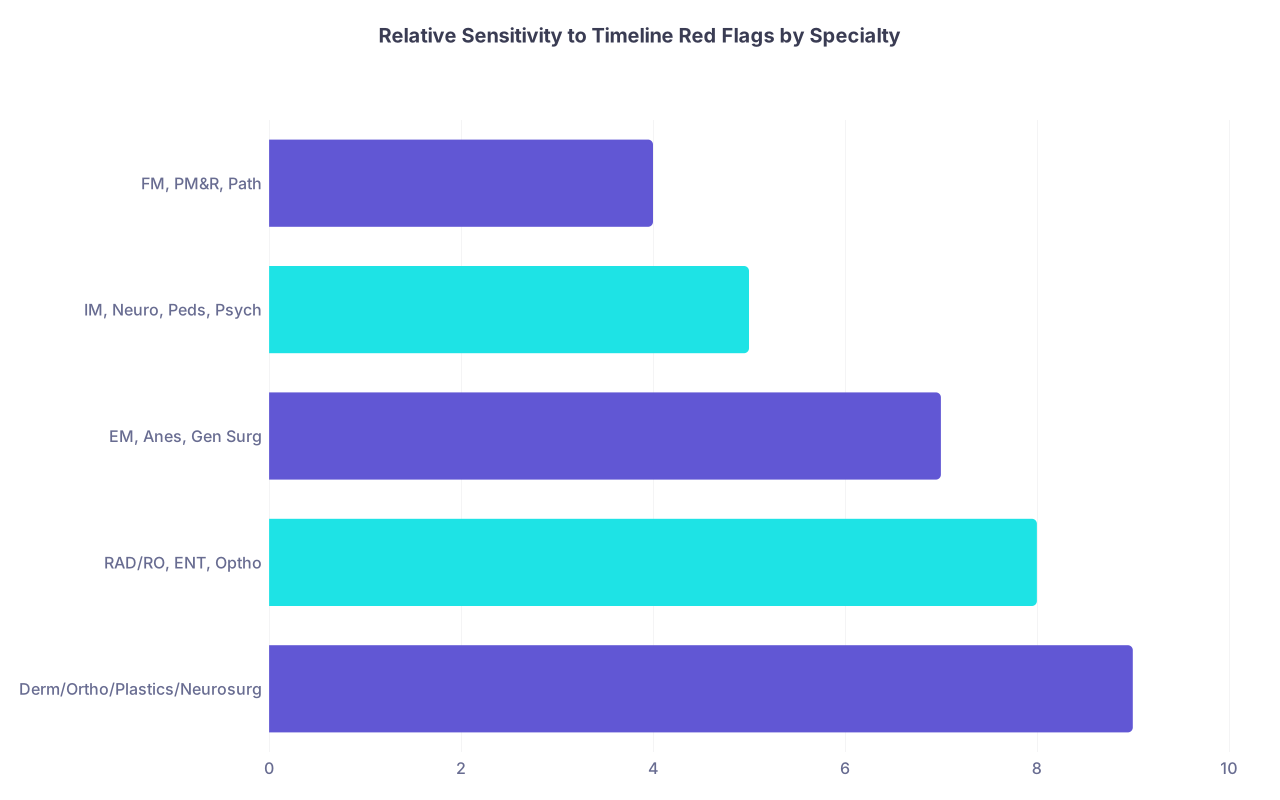
| Category | Value |
|---|---|
| Derm/Ortho/Plastics/Neurosurg | 9 |
| RAD/RO, ENT, Optho | 8 |
| EM, Anes, Gen Surg | 7 |
| IM, Neuro, Peds, Psych | 5 |
| FM, PM&R, Path | 4 |
Ultra-competitive, tiny specialties (derm, plastics, neurosurg, ortho) scrutinize everything. Extended time with academic issues will hurt more there. They’ve got 400 apps for 3 spots. They can be picky.
Primary care, psych, peds, FM, many IM programs? They’ve seen a lot of life happen to a lot of people. A delay with a solid explanation and clear improvement is often fine.
But the pattern doesn’t change: story + trajectory matter more than the raw number of years.
How to Frame This in Your Application Without Sounding Defensive
The worst version is:
“I had some personal issues, but they’re resolved.”
Vague. Defensive. Raises more questions than it answers.
The better version hits four things:
- What happened (at a high level only)
- That you took responsible action
- That the situation is now stable / treated / completed
- Evidence of success afterward
Example for mental health:
During my second year, I took a medical leave of absence to address a mental health condition. I worked closely with my treating team, developed a sustainable treatment plan, and returned to medical school the following academic year. Since then, I’ve successfully completed all remaining coursework and clinical rotations on time and without further interruption.
Example for academic remediation:
I struggled with the volume and pace of the pre-clinical curriculum and ultimately repeated my second year. During that time, I worked with academic support services to overhaul my study strategies and test-taking approach. This led to significant improvement in my performance on clinical rotations and Step 2 CK, and I now feel prepared for the demands of residency.
Notice what’s missing:
Long explanations. Excuses. Blame. Oversharing. Apologies.
You’re not begging them to forgive you. You’re showing you handled a problem, learned, and stabilized.
What If My School’s MSPE Makes It Sound Worse?
Sometimes schools write MSPEs like they’re terrified of being sued, so they dump every tiny thing in there in very stiff language.
I’ve seen lines like:
- “Required to repeat second year due to academic deficiencies.”
- “Progressed with concern regarding time management and test-taking.”
- “Remediated clerkship due to marginal performance.”
And you read that and think: “I’m finished.”
You’re not. But you do need to:
- Read your MSPE (yes, the whole thing) as early as you can.
- Identify the 1–2 statements programs might fixate on.
- Gently address them in your own words in your ERAS/PS, so the program hears your version too.
You can’t rewrite the MSPE. But you can add nuance.
If your MSPE sounds harsher than the reality, your job is to connect the dots: “Yes, that happened; here’s how I responded; here’s where I am now.”
How Bad Is This Compared to Other Red Flags?
Let’s rank your nightmare, because your brain is treating “extended grad” like the world’s worst sin.
| Issue | Typical Impact Level |
|---|---|
| Single LOA for health/family | Low–Moderate |
| Extra time for research/degree | Low |
| One failed course/clerkship | Moderate |
| Step 1 or Step 2 failure | Moderate–High |
| Professionalism/disciplinary | Very High |
Needing extra time by itself is not the top-tier red flag.
Repeated professionalism issues? Multiple exam failures with no improvement? Those hurt much more.
If your “big problem” is a semester/year extension with a clean story and good later performance, you’re in a much better position than you think.
Should I Address This in My Personal Statement?
Maybe. But don’t turn your PS into a 1,000-word justification of your graduation date.
Use the PS if:
- The reason you extended time genuinely ties into why you’re choosing that specialty or how you’ll be as a physician
(e.g., your own illness shaped your view of patient care, or a caregiving role pushed you toward palliative care, etc.)
Don’t use the PS if:
- It’s just “I failed things and then I studied harder.” That belongs in an ERAS blurb, not the emotional core of your story.
Rule of thumb: PS is about who you are as a doctor. ERAS/Additional Comments is about housekeeping and red-flag explanations.
Okay, But What If Programs Just Quietly Screen Me Out?
You’re worried there’s this hidden filter: “extended graduation → auto-trash.”
There isn’t a universal one.
Some ultra-competitive programs might quietly prefer “clean” timelines when they have 1,000+ apps. That’s reality. You can’t control that.
But most places are looking at:
- Step scores / COMLEX
- Clinical grades / honors
- Letters
- School reputation (somewhat)
- Obvious red flags (professionalism, multiple fails)
Extended time with clear explanation falls into the “we’ll see” bucket, not the auto-cut bucket.
Your job is to:
- Apply broadly enough that you don’t depend on only hyper-picky places.
- Make the rest of your application strong enough that they see reasons to say yes.
Simple, Blunt Checklist: How Screwed Am I?
Here’s the harsh little flowchart that’s probably already in your head. Let me just make it explicit.

| Step | Description |
|---|---|
| Step 1 | Extended graduation? |
| Step 2 | Explain briefly in ERAS |
| Step 3 | Mostly OK. Apply broadly. |
| Step 4 | Concern. Strengthen other areas. |
| Step 5 | Major red flag. Consider backup plans. |
| Step 6 | Clear reason? |
| Step 7 | Improved later performance? |
| Step 8 | Ongoing issues? |
If you can honestly say:
- “I have a clear, reasonable reason,”
- “I’m doing better now,” and
- “My clinicals/Step 2 are solid”
then you are not in the “screwed” category. You’re in the “needs explanation but still viable” category.
FAQ (Exactly 5 Questions)
1. Do I have to disclose why I took extra time, especially for mental health?
You don’t need to spell out a diagnosis, but you should briefly indicate that it was a medical or personal issue, you received appropriate care, and you’ve successfully returned. Something like “medical leave” is fine; you don’t need “major depressive disorder, recurrent, moderate.” Keep it respectful but minimal.
2. Will programs judge me for mental health–related leave or think I’m weak?
Some individuals might have biases. That’s reality. But many do not, and a surprising number of attendings and residents have their own mental health histories. Programs primarily care whether you are stable, safe, and reliable now. A treated condition with good performance afterward is a lot less concerning than someone pretending everything is fine while quietly falling apart.
3. I extended for research but didn’t get big-name publications. Does it still help?
It doesn’t magically launch you into derm at UCSF, but it’s generally neutral to mildly positive if you can show real involvement, posters, abstracts, solid letters. It won’t hurt you just because you added time, unless the rest of your app is already very weak and you’re aiming way above your profile.
4. My school forced me to repeat a year. Should I say “forced” or soften it?
Don’t dramatize. Don’t spin. Go with something like: “I repeated my second year due to academic difficulty in [area].” Then quickly pivot to what you changed and how your later performance reflects that. Programs care more about the after than the word “forced.”
5. Can I still match a competitive specialty if I needed extra time to graduate?
Possibly, but the bar is higher. You’ll need: strong Step 2 (if applicable), excellent clinical performance, serious specialty-specific involvement, and honest but tight framing of your delay. Even then, you might need a broader safety net (more programs, more geographic flexibility, maybe a parallel plan). It’s not impossible, but it stops being a “fairy tale” match and becomes a “strategic and realistic” one.
Key points to walk away with:
- Extra time to graduate is not automatically fatal; it’s the reason and your trajectory afterward that matter.
- You need a clear, concise explanation so programs don’t fill in the blanks with something worse.
- Strong Step 2, solid clinical evals, and honest, steady framing can absolutely pull you out of the doom spiral your brain is convinced you’re in.