
Total honesty in residency applications can absolutely backfire if you don’t know what you’re doing.
There. That’s the part nobody wants to say out loud.
You’re being told “just be authentic,” “PDs appreciate vulnerability,” “own your story.” And in the back of your head you’re thinking: okay but… can this actually get me filtered out? Ranked lower? Blacklisted?
You’re not crazy for asking that. You’re smart. Because there’s a line between helpful, controlled honesty and self-sabotage. And no one hands you a map.
Let me guess what’s running through your head at 2 a.m.:
- “If I mention my leave of absence, will they assume I’m unreliable forever?”
- “If I talk about my failed Step attempt, will they toss my app before even reading my personal statement?”
- “If I’m vague, will they think I’m hiding something worse?”
- “If I’m detailed, will I just dig a deeper hole?”
You’re stuck in that awful place where both options feel wrong:
Hide it and feel like a liar. Explain it and feel like you’ve just handed them a reason to reject you.
Let’s untangle this. Not with some fake “everything works out” vibe, but with a real, slightly brutal, but actually useful answer.
The Hard Truth: Programs Don’t “Deserve” Your Whole Life Story
Programs are not your therapist. Or your confessional booth. They’re trying to answer one main question:
“If I bring this person into my program, will they show up, do the work, learn, and not melt down or disappear?”
That’s it. They don’t need to know every detail of the worst week of your life.
So no, you don’t owe them raw, unfiltered, 100% of your internal narrative.
You owe them:
- Enough context so your red flag isn’t confusing or suspicious
- Enough evidence that whatever happened is now low risk of repeating
- Enough maturity to show you’ve processed it and grown
That’s it. Not more.
The mistake anxious applicants make? Over-sharing. Trauma dumping in a personal statement. Trying to prove they’re not hiding anything by describing every symptom, every argument, every meltdown. Then they wonder why it reads like a liability report instead of a residency application.
Honesty is good. Unedited honesty is not.
What Programs Actually See When They Look at Your “Red Flag”
Let’s talk about how your red flag lands on the other side. Because in your head it’s:
“I failed Step 1 because I was depressed, then family issues, then I had to work, then I was exhausted, then—”
On their side? They’re running a quick internal checklist.

Here’s the brutal filter almost everyone uses:
| Red Flag Type | Main Question in PD’s Mind |
|---|---|
| Exam failure / low score | Will this happen again with boards? |
| LOA / extended time | Are they actually able to function full-time now? |
| Course or clerkship failure | Pattern or one-off? Attitude issue? |
| professionalism / conduct note | Are they toxic? Unsafe? Disrespectful? |
| Legal / disciplinary issues | Liability risk? PR nightmare? |
They’re not reading your explanation and deciding if you’re a “good person.” They’re scanning for: risk, pattern, stability.
So your job isn’t:
“Let me tell them everything that ever happened, so they know I’m not a bad person.”
Your job is:
“Let me give them just enough clear, structured info so they can honestly say: okay, they’ve addressed this, it’s unlikely to repeat, and I feel safe ranking them.”
That mental shift—what they actually care about—changes how much you share.
When Full Honesty Helps You (And When It Blows Up Your Application)
Let’s break it into types of red flags, because they’re not all equal.
1. Board Failures / Low Scores
This one haunts people.
- You failed Step 1 or 2
- Or your score is way below the program’s average
- Or you passed on second attempt but still feel like there’s a big scarlet F on your forehead
Here’s where honesty matters, but only if it’s targeted.
Good approach:
- Brief, factual cause (not a saga): “I underestimated the exam and studied inefficiently” or “I struggled with test anxiety that I’ve since formally addressed.”
- Specific corrective actions: new study strategy, tutoring, CBSE/COMSAE scores, stronger Step 2, etc.
- Evidence of improvement: upward trend, better performance, shelf scores, clinical evals.
Bad approach:
- Pages of detail about your childhood, your family’s expectations, your roommate, your ex.
- Graphic descriptions of your mental state that sound uncontrolled or current.
- Language that sounds like you still don’t have a plan: “I just hope it goes better next time.”
Can honesty backfire here? Yes—if you frame yourself as unstable, helpless, or vague about what changed.
But completely ignoring a failure that’s literally on your transcript? That’s worse. Then they have to invent their own story. And their story will be harsher than yours.
Use the MSPE/Dean’s letter + sometimes the personal statement or secondary question. Keep it lean, controlled, and forward-focused.
2. Leaves of Absence / Time Off / Extended Path
This one’s especially slippery, because the anxiety voice says:
“If I even mention mental health, they’ll blacklist me.”
“If I’m vague, they’ll assume I had a breakdown or was in rehab.”
So then you freeze.
Here’s the reality I’ve watched play out: programs react much better to clean, contained explanations than to weird, mysterious gaps.
Reasonable examples that usually land fine when explained briefly:
- Medical LOA for a treated and resolved condition, with clear stability now
- Family crisis requiring temporary time off, now resolved with support systems
- Academic remediation where later performance shows you actually fixed the problem
Risky honesty:
- Detailed recounting of suicidal ideation with no clear treatment or stability now
- Descriptions of ongoing, active symptoms without clear management
- “I took time off for burnout and I’m still working through it.” (That’s what therapy notes are for, not ERAS.)
Programs are not allowed to discriminate against treated mental illness. But they do assess functional risk. You want to sound like someone who hit a speed bump, handled it, and is now reliably on the road.
You don’t need to share:
- Specific diagnoses (unless you choose to)
- Medications
- Every symptom or crisis event
You do need to show:
- It was addressed
- You’re functioning now
- There’s a support/management system in place
Controlled honesty = safe. Detailed, raw, unresolved honesty = can absolutely backfire.
3. Professionalism / Conduct / Disciplinary Stuff
This is where hiding backfires the most.
If there’s a professionalism note, a formal sanction, a Title IX issue, whatever—it’s almost always going to be somewhere in your record. Or at least discoverable when they call your school.
So here, “minimize and pray” is not your friend.
You should:
- Acknowledge it directly and briefly
- Take clear responsibility (no “but my attending was unfair” whining)
- Show specifically what you learned and how your behavior changed
- Show there’s been no pattern since
Where honesty blows up your app:
- You describe a conflict and end up throwing three people under the bus
- You sound defensive, victimized, or like you still think you were right and everyone else was wrong
- You hint at “personality clashes” without taking ownership of your part
Program directors are paranoid about toxic behavior. If your explanation reads like you’re going to be a drama magnet, they’ll quietly move on. Even if the original incident was minor.
So here, honesty has to sound: mature, boring, resolved. Not fiery and still simmering.
Where to Put the Explanation (And How Much to Say)
You’re probably stuck on a very specific question: okay but where do I actually write this, and how many words, and what if I overdo it, and—
Let’s slow that spiral and map it.

| Step | Description |
|---|---|
| Step 1 | Red flag present? |
| Step 2 | Must acknowledge somewhere |
| Step 3 | Optional to disclose |
| Step 4 | Address briefly there |
| Step 5 | Short note in PS or Addendum |
| Step 6 | Ask advisor if strategic to share |
| Step 7 | Visible on transcript/MSPE? |
| Step 8 | ERAS has dedicated question? |
General rule:
- If it’s in your record (transcript, MSPE, dean’s note, course history), you should have a short, controlled explanation somewhere.
- If it’s not visible anywhere and doesn’t currently affect your functioning, then disclosure is optional and strategic, not mandatory honesty.
The personal statement is not where you dump your full red flag essay. It’s where you mention it in 2–4 sentences max, if it’s central to your story and you can pivot quickly to growth and your current strength.
Longer explanations, if needed, go into:
- A specific ERAS question about interruptions or extensions
- An addendum if your school or advisor suggests one
- Rarely, a brief note in the “additional information” section
If you need more than ~150–200 words to explain it? You’re probably over-explaining. Or trying to emotionally justify rather than professionally contextualize.
The Line Between Honest and Self-Sabotaging
You’re afraid of being “fake.” That if you don’t bleed on the page, you’re lying.
You’re not.
You are allowed to keep some things private. You are allowed to containerize your pain and present the summary, not the live feed.
Here’s a sanity check I use:
If you read your explanation and come away thinking:
- “Wow, this person got hit hard, learned from it, and they seem stable now” → Good.
- “Wow, this person is still in the middle of a storm and wants me to rescue them” → Not good.
You want the first reaction.
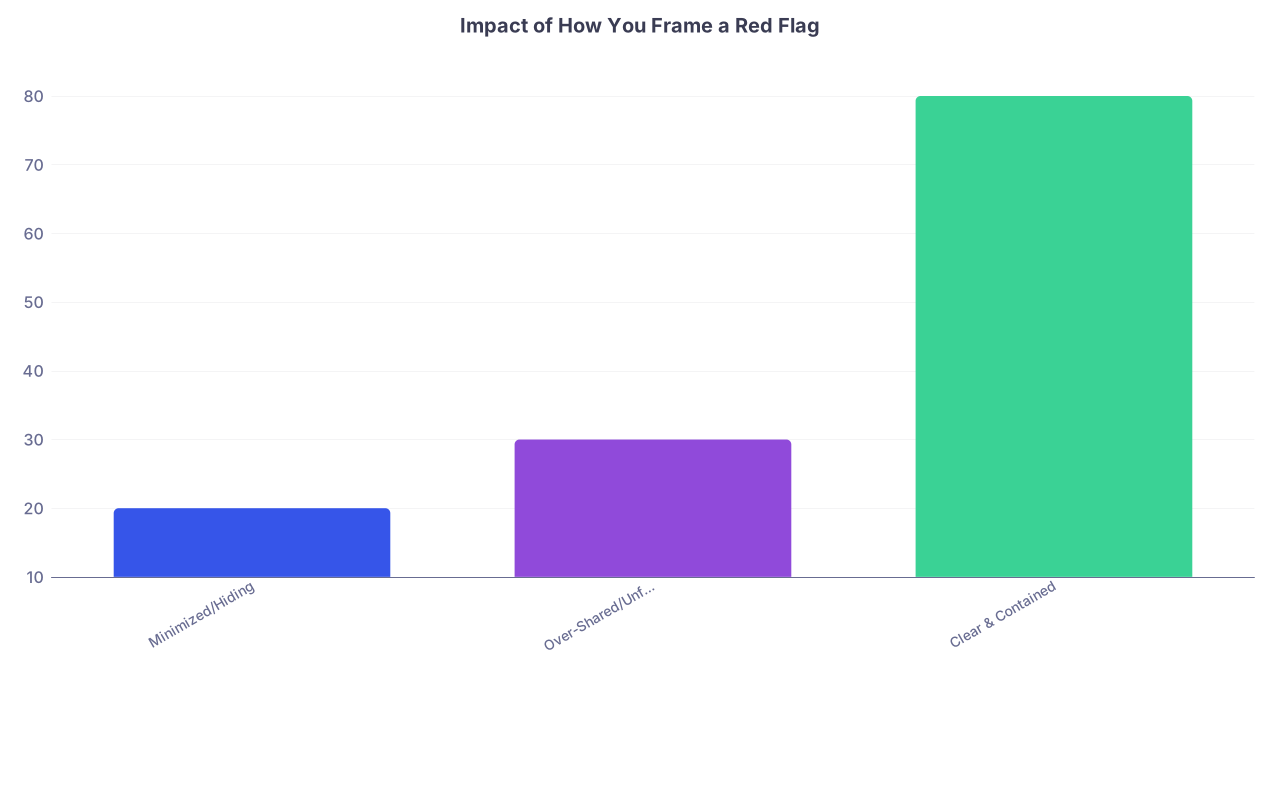
| Category | Value |
|---|---|
| Minimized/Hiding | 20 |
| Over-Shared/Unfiltered | 30 |
| Clear & Contained | 80 |
(The numbers are conceptual, not literal, but you get the idea. Clarity + containment wins.)
So yes, honesty can backfire, but usually not because you admitted the red flag. It backfires because:
- You framed yourself as unstable
- You made them work too hard to find the “stable now” part
- You centered the red flag instead of your recovery/growth
The goal isn’t “tell the whole truth or else you’re a fraud.”
The goal is “tell the relevant, professional, accurate parts of the truth that show you’re safe to train.”
That’s not being fake. That’s being appropriate.
How to Talk About It Without Sounding Like a Walking Risk
Let me give you a structure you can literally plug your story into. You’ll adapt it, obviously, but the skeleton helps.
- One sentence: what happened (objective, no drama).
- One–two sentences: high-level cause (not a full autobiography).
- Two–three sentences: what you did to address it.
- One–two sentences: how your performance since then shows the issue is resolved.
It might look like this:
During my second year, I took a one-semester leave of absence for a treated medical condition. After initially trying to push through worsening symptoms, I ultimately worked with student health to step back and focus on diagnosis and treatment.
Over that semester, I developed a sustainable management plan with my physician and therapist, and I’ve maintained regular follow-up since. Since returning, I’ve completed all remaining coursework and clinical rotations on time with strong evaluations and no further interruptions. This experience forced me to build the support system and boundaries I’ll carry into residency.
Notice what that doesn’t do:
- It doesn’t name the specific diagnosis
- It doesn’t describe the worst nights in detail
- It doesn’t sound unresolved
That’s what you’re aiming for.
You can do the same with a failed exam, professionalism issue, or extended path.
And yes, you will obsess over every word. Yes, you’ll wonder if you should mention more or less. That’s normal. But if you follow that structure, you’re already in the “controlled honesty” lane instead of the “oversharing panic” lane.
You’re Not the Only “Red Flag” in the Pile
One last thing your anxiety brain refuses to believe: you are not the only one.
Every year I see:
- People with multiple failures who still match
- People with leaves of absence who end up chief residents
- People with professionalism notes who pivot hard and become the most reliable team member
Not everyone. Not magically. But enough that it’s not some freak miracle when it happens.
Programs don’t expect perfection. They expect:
- Some dings
- Some rough edges
- Some humans who’ve lived real lives
What freaks them out isn’t that you struggled.
It’s that you might still be in free fall and they’re signing up to catch you.
So your entire goal in how much you share is: show them you’re not in free fall anymore.
That you’ve hit ground, built scaffolding, and can stand on your own feet in July.
FAQ: Red Flags, Honesty, and Not Blowing Up Your Application
1. Should I disclose a mental health diagnosis that isn’t mentioned anywhere in my record?
No, not automatically. If it’s treated, stable, and not currently limiting your ability to function full-time, you’re not “lying” by keeping that private. If the condition directly caused something visible (LOA, failure), focus on explaining the event and your current stability, not on labeling yourself with a diagnosis.
2. What if my school told me not to talk about my red flag but I feel guilty hiding it?
If it’s on your transcript or MSPE, you need some explanation, even if brief. If it’s completely invisible and your advisor says it will only harm you to disclose, that’s not “dishonest”—that’s strategic. You don’t owe programs your full psychiatric or personal history. You owe them functional truth: that you’re safe to train.
3. Can talking about a board failure in my personal statement actually help me?
It can, if you’re concise and you pivot quickly to improvement. A passing Step 2 with a strong score plus a short, clear reflection can actually reassure them. A long, emotional essay centering the failure will hurt you. Two to four sentences is usually enough. Keep the rest of your PS about why that specialty, who you are as a future resident, and what you bring.
4. Do programs blacklist people for having taken a leave of absence?
Some ultra-competitive places silently screen harder, yes. But plenty of solid programs accept LOAs when they look contained and resolved. The killer isn’t the existence of the LOA; it’s a vague, messy, or defensive explanation that makes it look like an ongoing problem. Present it cleanly, and you’ll still be in the running at many places.
5. What if they ask about my red flag in an interview and I panic or overshare?
Practice a 30–60 second version of your explanation out loud. Same structure: what happened, why in high-level terms, what you did, how you’re doing now. Stop talking once you’ve said it. If they want more detail, they’ll ask. You don’t need to fill silence with extra disclosure just because you’re anxious.
6. Is it better to be brutally honest and risk rejection than “hold back” and match somewhere that doesn’t know everything?
This is residency, not a marriage. They need to know relevant, functional truth: can you handle the job, and is the problem likely to repeat? Past that, you’re allowed boundaries. “Brutal honesty” that tanks your chances when you could safely keep something private doesn’t make you noble—it just makes this already awful process harder on you than it has to be.
Key points to carry with you:
- You don’t owe programs your entire life story—only clear, relevant, controlled honesty about what’s already on your record and how you’ve grown.
- Honesty backfires when it’s raw, unresolved, or centered on pain instead of stability and improvement.
- Your goal isn’t to prove you’re perfect; it’s to show you’re no longer in free fall and are safe to trust with a residency spot.