
It’s late. Your classmates are talking about interview invites and rank lists, and you’re staring at one sentence. That one line in your MSPE about “a professionalism concern.” You’ve reread it 40 times. You know the exact wording. You can hear the dean’s voice from that meeting. And now your brain’s on a loop:
“Is this it? Did I just tank my entire career over one stupid thing in M3?”
Let me just say the thing you’re scared to say out loud: you’re not actually asking, “Will this affect my application?”
You’re asking, “Did I just permanently ruin my life?”
Let’s walk through this without sugarcoating it, but also without catastrophizing it into something it’s not.
What That Single Unprofessionalism Note Actually Means (And Doesn’t Mean)
You see “professionalism concern” and your brain reads “do not hire, ever.” Programs don’t read it that way.
Here’s the uncomfortable but honest breakdown.

Programs generally bucket MSPE red flags into rough categories:
| Type of Issue | Typical Program Reaction |
|---|---|
| Pattern of unprofessionalism notes | Major concern / likely screen out |
| Failure/remediation of a clerkship | Significant concern, context needed |
| Single professionalism note, minor | Yellow flag, not automatic reject |
| Single professionalism note, serious | Case-by-case, depends on specialty |
| No professionalism issues | Baseline expectation |
A single unprofessionalism note does not equal a lifetime ban from medicine. It’s more like this:
- It can absolutely hurt you at some programs.
- It can completely sink you at a few hyper-competitive places.
- It will matter less over time as your record fills with other data (evals, LORs, residency performance).
But the idea that every PD is going to read your name and think, “Ah yes, the One With The Incident”… that’s your anxiety talking, not reality.
Residency PDs see a lot of these. You’re not the first person to get written up for something dumb in third year.
How Bad Is Your Note? The Honest Triage
You probably already know the answer in your gut, but let’s formalize it a bit. Programs care about three things:
- What actually happened
- How it’s described in the MSPE
- What you’ve done since
Ask yourself some blunt questions.
1. What actually happened?
Rough spectrum:
- Mild: Late to clinic repeatedly, poor email responsiveness, dress code, one unprofessional comment, minor conflict with staff, incomplete documentation.
- Moderate: Missed critical responsibilities (like call), clear boundary issues with patients/staff, disrespectful behavior, ignoring feedback.
- Severe: Cheating, lying, falsifying data, violating patient confidentiality, harassment, anything involving safety or ethics.
If you’re in the “mild to moderate” zone with no pattern? This is survivable. Annoying, but survivable.
If it’s severe — cheating, lying, anything that makes people question your integrity — it’s absolutely going to be a bigger deal. It’s not career-ending by default, but you’re playing on hard mode.
2. How is it worded in your MSPE?
The wording is almost more important than the event, because PDs don’t get the whole backstory. They get this:
“There was a minor professionalism concern related to punctuality that was addressed and resolved.”
→ Programs read: Not ideal, but whatever.“Student required professionalism remediation after multiple concerns regarding communication and reliability.”
→ Programs read: Pattern. Might be risky.“Student demonstrated a serious lapse in professionalism that raised concerns about judgment and integrity.”
→ Programs read: Big red flag. Needs direct explanation.
Read your line like a stranger who doesn’t know you. If your dean used words like “isolated,” “addressed,” “no further issues,” that actually helps you. If they used “ongoing,” “multiple,” “concerning,” that’s worse.
3. What have your later evaluations and letters said?
This is the part applicants weirdly ignore when they’re spiraling.
If your later clerkships and sub-Is say things like:
- “Reliable and professional.”
- “Excellent team member.”
- “Would happily work with this resident again.”
Those comments actively counterbalance that one note. PDs notice.
If, on the other hand, your evaluations have a theme of “needs to work on punctuality, communication, responsiveness” across multiple rotations, then yeah, that’s no longer a “single” note. That’s a pattern.
How Different Specialties Really React To This
Yes, specialty matters. Some are more forgiving, some pretend they are but aren’t.
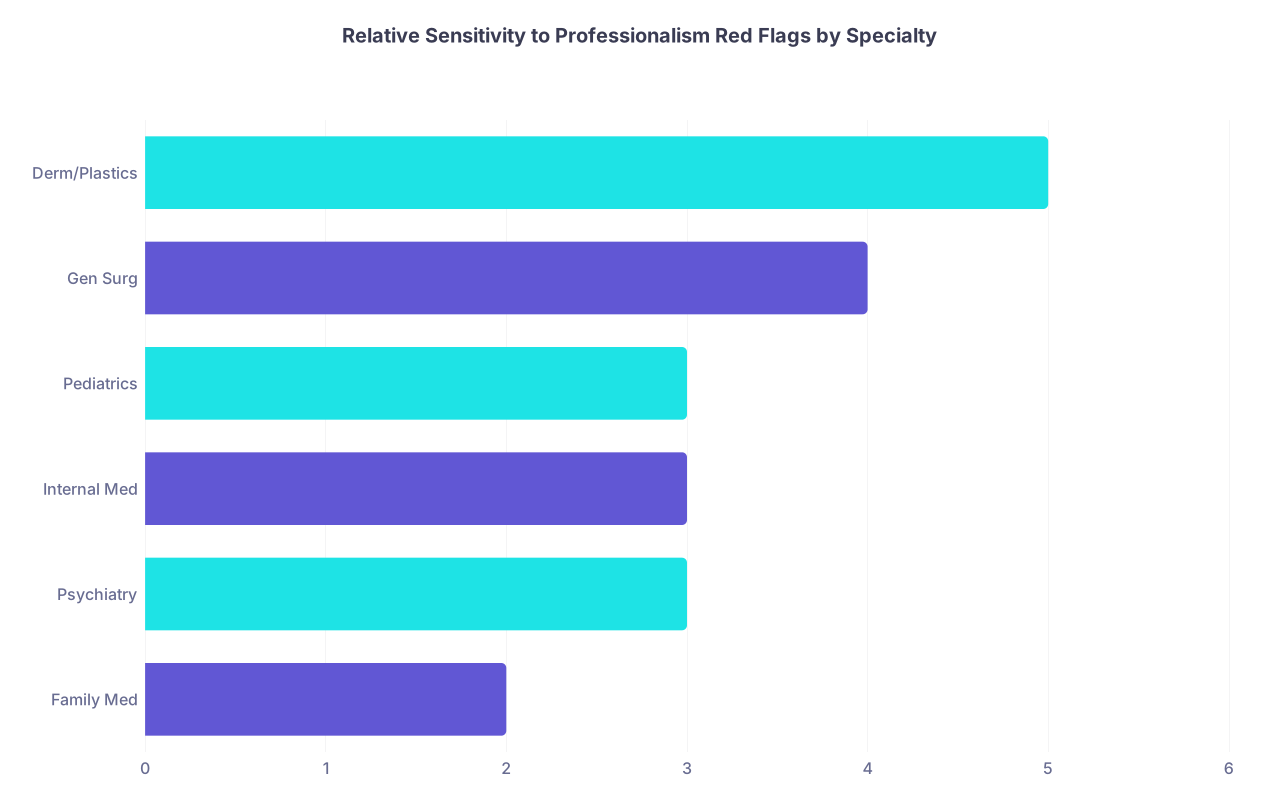
| Category | Value |
|---|---|
| Family Med | 2 |
| Psychiatry | 3 |
| Internal Med | 3 |
| Pediatrics | 3 |
| Gen Surg | 4 |
| Derm/Plastics | 5 |
(1 = least sensitive, 5 = most sensitive; obviously not exact, but directionally true.)
- Family Med / Community IM / Psych / Peds: More likely to read your explanation, look for growth, and weigh your whole application. Not thrilled, but not automatically done with you.
- Competitive fields (Derm, Plastics, Ortho, ENT, Neurosurg): Already screening hard. Any red flag makes a tough situation tougher. Some places will toss the app quickly.
- Gen Surg / Anesthesia / EM: They care a lot about reliability and professionalism in chaotic environments. A single note won’t kill you, but repeated patterns or serious lapses are taken very seriously.
You know what I’ve actually seen? People with a professionalism comment match fine in IM, FM, Peds, Psych, even EM. The ones who got destroyed weren’t the ones with one note. It was the folks with:
- A note + mediocre scores + weak letters + weird interview vibe
or - A major ethics violation.
You are probably lumping yourself with those cases when you don’t belong there.
How Much Will This Really “Follow” You Long-Term?
Here’s the other fear: “Even if I match, is this going to follow me forever? Jobs? Fellowships? Licensing?”
Short answer: this is mostly an early career problem, not a “rest of your life” problem.
Medical school → Residency
Yes, this is where the MSPE matters most. PDs see it. They discuss it. Some may ask you about it outright.
Residency → Fellowship / First Job
The MSPE starts to fade. Programs care way more about:
- Your residency program’s reputation
- Your residency evaluations
- Letters from attendings and PD in residency
- Whether you had any major GME-level issues
Do they occasionally ask for MSPEs at this stage? Sure. Some credentialing processes technically request them. But the weight shifts heavily toward your more recent self.
I’ve seen people with MSPE professionalism hits:
- Match into solid IM programs
- Do well during residency
- Match competitive fellowships because their residency PD said, “This person is outstanding and I’d rehire them.”
No one on a hospital hiring committee is sitting there in 2035 obsessing over a single M3 note about you being late to clinic once.
Licensure and boards
For state licensure and board certification, they care about:
- Criminal records
- Substance use / impairment
- Formal actions against your training license
- Dismissals or forced resignations
- Big, board-reportable stuff
A single unprofessionalism note in your MSPE that never turned into a formal disciplinary action is usually not the hill they die on.
Is it technically “on record” somewhere? Yes. Is it the ghost looming over every credentialing decision for the rest of your career? No.
What You Should Do This Application Cycle
Let’s talk about what you can actually control, instead of lying awake replaying the meeting with your dean.

| Step | Description |
|---|---|
| Step 1 | Read MSPE Carefully |
| Step 2 | Apply Broadly |
| Step 3 | Address in Application |
| Step 4 | Get Advisor + PD Input |
| Step 5 | Strengthen Letters & PS |
| Step 6 | Practice Explanation for Interviews |
| Step 7 | Severity of Note |
1. Get brutally clear on the wording
Print your MSPE. Highlight:
- The exact professionalism sentence
- Any phrases that help: “isolated,” “resolved,” “no recurrence,” “addressed with the student,” “no further concerns”
Knowing the exact wording helps you craft your narrative and also reality-check your anxiety. A lot of people remember it as harsher than it is.
2. Decide if you need to address it directly
Here’s my stance:
- Mild, clearly resolved, no recurrence: You don’t necessarily have to preemptively write a full confessional paragraph. But be ready to explain it cleanly if asked in interviews.
- Moderate or serious, or ambiguous wording: I’d address it briefly somewhere (often in the “adversity” or “anything else we should know” type section) to control the narrative.
Rule: No long, defensive essays. No blaming everyone else. Aim for 3 parts:
- Concise description (no dramatics, just what happened)
- What you learned / how you changed
- Evidence it hasn’t recurred
Something like:
“During my third year, I received feedback regarding a professionalism concern related to missed communication about schedule changes. This was addressed through a meeting with the clerkship director and an action plan focused on improving my responsiveness and reliability. Since then, my subsequent clerkship and sub-internship evaluations have consistently commented on my professionalism and dependability, and I’ve made this an area of active growth.”
That’s it. No 800-word essay about your childhood trauma.
3. Use your letters and later rotations as damage control
Your most powerful counterweight is current evidence that you’re not a walking professionalism disaster.
Things that help a ton:
- Strong sub-I letters explicitly mentioning professionalism, reliability, and teamwork.
- A PD or chair letter that says, in normal human language, “This student is trustworthy and great to work with.”
- Comments on evaluations that directly contradict any implication that you’re still a problem.
If you have a good relationship with an attending, you can (carefully, humbly) say something like, “There was a professionalism concern earlier in med school that’s now noted in my MSPE. I’ve worked hard to grow from that. If you’ve seen improvement in my professionalism on this rotation, I’d be very grateful if you mentioned that in your letter.”
That’s not manipulative. It’s strategic and honest.
4. Apply broad. Broader than your pride wants.
If you’re sitting there with one note and thinking, “I’ll just apply to 25 of the best programs and it’ll be fine” — that’s how people end up in SOAP.
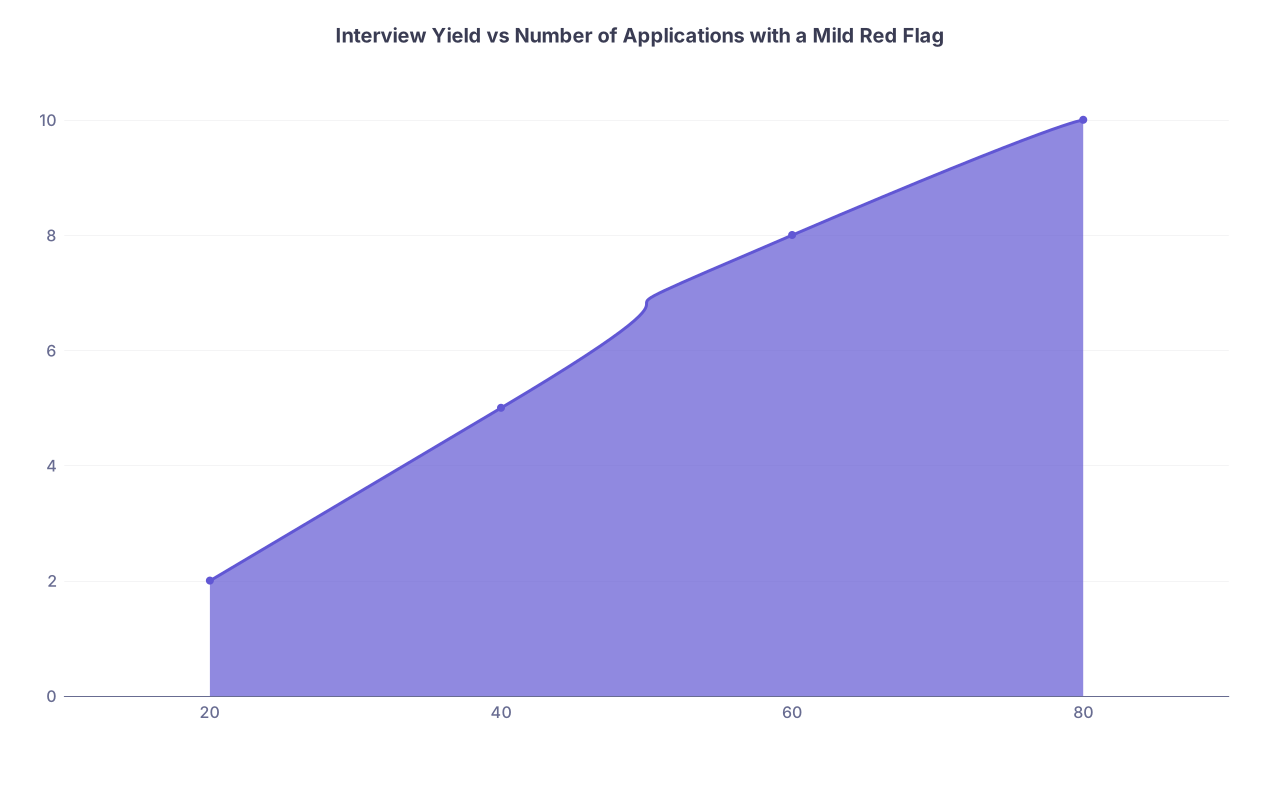
| Category | Value |
|---|---|
| 20 | 2 |
| 40 | 5 |
| 60 | 8 |
| 80 | 10 |
Red flags of any kind (even mild ones) usually mean:
- More applications
- More mid-tier and community programs in the mix
- Fewer “reach” programs, unless the rest of your app is insanely strong
Does that bruise the ego? Yes. Is it better than not matching? Also yes.
How To Talk About It If They Ask You Directly
You’re terrified of this moment: “Tell me about the professionalism concern in your MSPE.”
You can’t babble. You can’t blame. You also can’t give a robotic, lawyered-up answer where you clearly sound like you memorized a script.
Use this basic structure in your head:
Name it clearly.
“On my [rotation], there was a professionalism concern regarding [issue: punctuality, communication, etc.].”Take responsibility without self-immolation.
“I didn’t communicate clearly about X / I underestimated Y / I didn’t recognize how this affected the team.”Describe what you changed.
“Since then I’ve started doing A, B, C to prevent this. For example, on my sub-I, I made sure to…”Point to evidence.
“My later evaluations and letters, especially from [sub-I / attending], reflect that this hasn’t been a recurring issue.”
Short, honest, non-dramatic. No crying. No oversharing.
They’re not testing your ability to be perfect. They’re testing your ability to be accountable and not implode when confronted with uncomfortable feedback.
When It Does Haunt Someone’s Career (The Real Worst Cases)
Let me be painfully blunt. I have seen people’s careers get seriously derailed. But it was never just “a single unprofessionalism note.”
The ones who really get hurt usually have some combo of:
- Multiple concerns documented across rotations
- Dishonesty or cheating involved
- Poor Step scores or failed exams on top of it
- Weak letters (or coded negative letters)
- Then they show up to interviews defensive, evasive, or weird about it
Those are systemic issues. Not “I rolled my eyes at a resident once and it got documented.”
So yeah, there are worst-case scenarios — but they look different than what your 2 a.m. brain is picturing.
FAQ: Your 2 a.m. Questions, Answered
1. Should I ask my dean to change or soften the MSPE comment?
You can ask, but tread lightly. If there’s an actual factual error, absolutely ask for correction. But just “softening” because it makes you anxious? Most schools won’t do that, and pushing hard can backfire.
If the wording is brutal and doesn’t match what actually happened, it’s reasonable to say: “This feels harsher than the feedback I received at the time. Is there any way to clarify that this was an isolated event and has not recurred?” Sometimes they’ll add a clarifying sentence. Sometimes not.
2. Will programs think I’m lying if I don’t bring it up myself?
No. They read dozens of MSPEs a day. They’re capable of seeing a minor note and moving on. You don’t need to preemptively center your entire application around this unless it’s major.
If it’s moderate/serious, then yes, I’d at least briefly acknowledge it somewhere and be ready to discuss. Silence on a big issue looks evasive. Silence on a small issue looks normal.
3. Is it ever smart to delay graduation or take a research year to “distance” myself from the incident?
Usually? No. Time passing doesn’t magically erase a note in a static document like the MSPE. What matters more is the quality of what you do after, not just the passage of time.
A research year makes sense if:
- You’re aiming for a very competitive specialty, and
- You can get stellar letters and productivity that overshadow the concern.
But as a strategy purely to make people forget the note? Not efficient.
4. What’s one concrete thing I can do today to feel less doomed?
Do this right now: print your MSPE (or open it on screen), and:
- Highlight the professionalism sentence.
- Underline any positive phrases in the rest of the document (honors, strong comments, good narratives).
- Then write a 4–5 sentence, plain-language explanation of the incident using the structure I gave you (what happened, your responsibility, what you changed, evidence since).
That becomes your mental script. It turns a vague monster in your head into something specific you can handle.
Then, open one recent evaluation or letter draft and look specifically for any comments that contradict the idea you’re “unprofessional.” That’s your evidence you’re not defined by one line in a dean’s letter.
If you do just those two things today, you’ll be in a much better position than lying there replaying the same nightmare scenario in your head.