
The worst thing about an “Areas for Improvement” section isn’t the words. It’s what they do to your confidence if you let them.
You’re not doomed because your MSPE isn’t glowing. But you are in a different game now. The students with clean, boring MSPEs can afford to be generic. You cannot. You have to be strategic.
Here’s how to turn that section from silent saboteur into a story you control.
Step 1: Decode What Your MSPE Is Really Saying
Before you start “fixing” anything, you need to know exactly what you’re up against. Vague anxiety is useless. Precise understanding is gold.
Pull up your MSPE and read only the “Areas for Improvement” section. Then classify it into one (or more) of these buckets:
| Type | What it Usually Means |
|---|---|
| Professionalism | Reliability, communication, boundaries |
| Knowledge/Performance | Exams, fundamentals, clinical reasoning |
| Work Habits | Time management, documentation, efficiency |
| Communication/Teamwork | Interactions with staff, patients, peers |
| Behavior/Interpersonal | Conflict, attitude, emotional control |
Now, be blunt with yourself. Examples:
“Could improve timeliness of completion of documentation”
Translation: you were slow with notes / late more than once.“Would benefit from further development of fund of knowledge”
Translation: you were below average academically on that rotation or came across unprepared.“Required feedback on professional boundaries and responsiveness to constructive criticism”
Translation: there was a professionalism concern that reached an official level.
Don’t soften it. Don’t catastrophize it. Just name it clearly.
Then ask:
- Is this a one-off (one rotation, one line)?
- Or a pattern (similar phrasing in multiple clerkships or in the summary)?
If it’s a pattern, that’s the story programs will assume unless you give them a better one.
Write down in one sentence:
“Programs will probably think: _______.”
Example: “Programs will probably think: I might be disorganized and unsafe with workflow under pressure.”
Good. That’s the problem you’re actually solving—not the words in the MSPE.
Step 2: Find or Create the Counter-Evidence
You can’t “spin” your way out of this. You need receipts.
Your job now: build a file of concrete things that show growth in the same domain as the criticism.
Match the type of concern with the type of evidence:
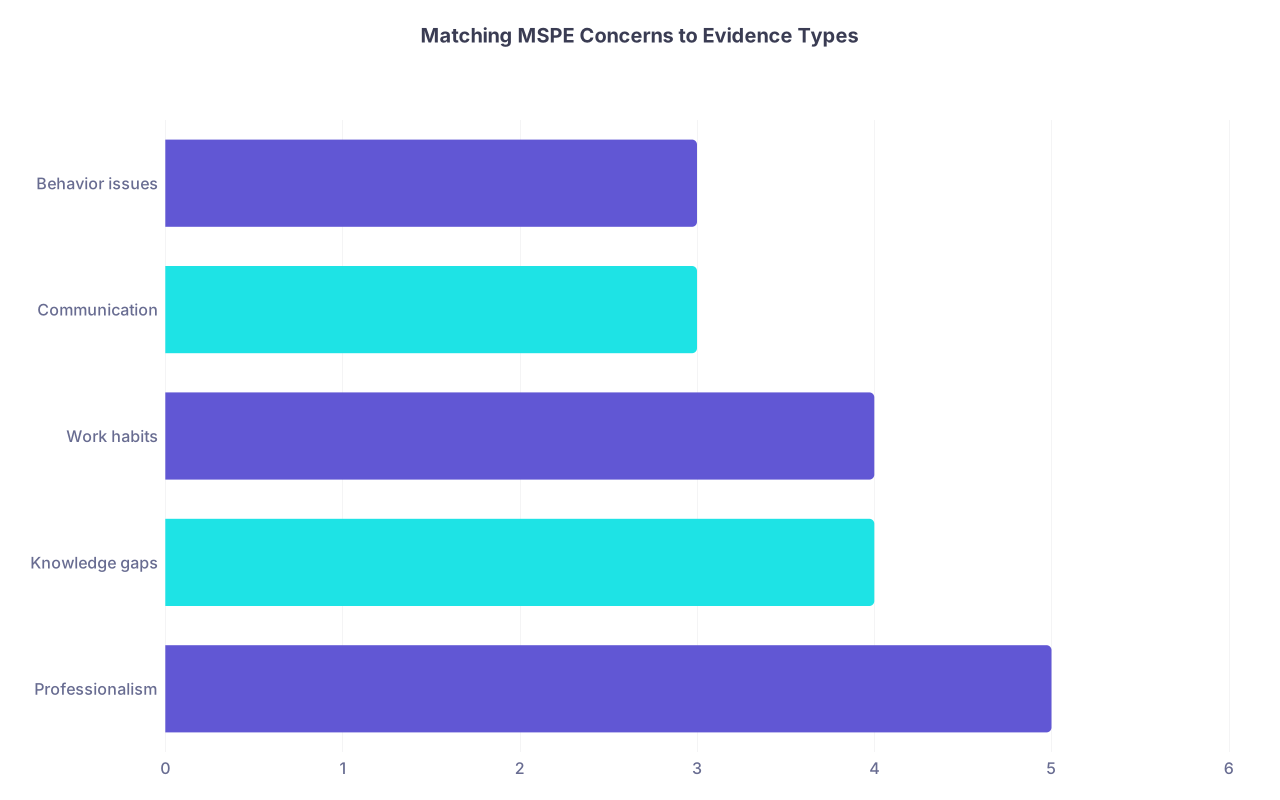
| Category | Value |
|---|---|
| Professionalism | 5 |
| Knowledge gaps | 4 |
| Work habits | 4 |
| Communication | 3 |
| Behavior issues | 3 |
(Scale here is just relative “importance of specific, concrete proof” in each category—professionalism needs the strongest receipts.)
If it’s professionalism
Examples of what helps:
- A later rotation comment like “Always punctual, reliable, and a strong team member.”
- An email or written feedback from a faculty member noting improvement in behavior, reliability, or professionalism.
- Evidence of leadership: chief of a service, course representative, organizer of a clinic or teaching session.
- A professionalism remediation plan you completed successfully, with documentation.
If you had a documented professionalism incident (appearance before professionalism committee, formal write-up), you need two things:
- A clean track record after that point (no repeat).
- Someone senior (clerkship director, site director, advisor) willing to say—informally or in a letter—that you took it seriously and improved.
If it’s knowledge/performance
Useful evidence:
- Upward trend in shelf exams.
- Strong Step 2 CK score relative to earlier performance.
- Later clerkship comments: “Read consistently, excellent fund of knowledge,” “Strong at clinical reasoning.”
- Honors in relevant rotations after weak ones, especially in the same domain (e.g., rough Internal Medicine core but Honors in Sub-I).
If it’s work habits or time management
Evidence:
- Later comments like “efficient,” “handles high patient volume,” “excellent follow-through.”
- Strong performance on sub-internships or busy rotations where work ethic is visible.
- Roles where organization is obvious (research coordinator, clinic flow leader, QI project lead).
If it’s communication/teamwork/behavior
Evidence:
- Comments emphasizing “a pleasure to work with,” “well-liked by staff,” “effective communicator,” “handles feedback well.”
- Participation in teaching or peer-mentoring.
- Feedback from nurses or interprofessional staff (if documented anywhere).
If you’re still in school and reading this early enough, here’s the move: engineer at least one or two rotations where you explicitly tell the attending at the start, “I received feedback about X and I’m working hard on it; please let me know how I’m doing.”
That prompts them to notice your improvement. Which then shows up in their eval.
If you’ve already graduated, you’re stuck with what’s there. That’s fine. You just have to leverage everything that looks even remotely like a counter-point.
Step 3: Decide Where You’ll Address It (and Where You Won’t)
Not every red flag needs a full essay. Over-explaining can make a small problem look huge.
Here’s a simple rule:
Single mild “areas for improvement” line, no pattern, no official incident?
Usually: do NOT write a dedicated paragraph about it. Instead, address it indirectly through your strengths narrative and LORs.Clear pattern or obviously serious concern (professionalism write-up, failed rotation, major conflict)?
You must control that narrative somewhere: personal statement, secondary questions, or advisor/PD letter.
Let’s go channel by channel.
Personal statement: when to bring it up
Bring it up in your personal statement if:
- It’s serious enough that an interviewer will ask you about it.
- It connects directly to why you’re a stronger, more mature applicant now.
- You can frame it as part of your professional growth, not your entire identity.
Do not:
- Open your personal statement with the issue.
- Spend more than ~20–30% of the statement on it.
- Get defensive, blame other people, or litigate the facts.
Good structure:
- Briefly name the issue without drama.
- Own your responsibility.
- Show what you changed (specific actions).
- Show the outcome (feedback, improved evals, roles entrusted to you).
- Pivot to how this shapes the resident you’ll be.
Example skeleton:
During my third-year Internal Medicine rotation, I received feedback that my documentation was often delayed and that I struggled to manage tasks efficiently on busy days. That feedback was accurate. I was trying to do everything myself and hesitated to ask for help, which led to incomplete notes and delayed orders.
I made two concrete changes: I began pre-charting the night before and started using a simple, shared task list with my team so I would not rely on memory. I also asked my senior resident to page me at specific times to check progress. Over the next two rotations, my attendings commented on my improved organization and reliability, and I was trusted with more complex patients during my Sub-I.
Then move on. Don’t wallow.
Interviews: how to handle the question
Assume you will get: “I noticed your MSPE mentions ‘areas for improvement’ in X. Can you tell me about that?”
Your structure:
- One sentence: label the issue.
- One–two sentences: what was going on / what you did wrong. No excuses.
- Two–three sentences: what you changed, how you proved it, what your evaluations say now.
- One sentence: what you took away from it.
Short, controlled, and specific.
Example:
On my Surgery rotation, my MSPE notes that I needed to improve my punctuality and responsiveness. Early in that block, I underestimated pre-rounding time and was late twice, and I was slow to respond to pages when I was tied up with tasks.
I started arriving 30 minutes earlier, prioritized pages over other tasks, and asked my chief to page me directly if anything was urgent. On my later Sub-I, my attending specifically commented that I was always early and very responsive, even on call nights. The experience forced me to over-correct in the right direction, and now I’m very intentional about reliability because I know how it looks when you fall short.
If you feel like you’re talking too long, you are. Stop and let them ask follow-ups if they want more.
Step 4: Use Letters of Recommendation To Quiet the Concern
Your MSPE is a committee document. Letters are personal. Smart programs read them together.
Here’s how you use that.
You want at least one letter that either:
- Indirectly contradicts the concern (without referencing it explicitly), or
- Explicitly states you improved in the exact domain referenced.
Your job is not to script your letter writers. But you can say this:
“Dr. X, my MSPE mentions that earlier in medical school I struggled with [timeliness / documentation / communication]. I’ve worked hard to improve this, and I felt that on your rotation I was able to demonstrate that growth. If that matches your impression, any comments you can make about my reliability/communication on your service would really help residency programs see the full picture.”
If the issue is professionalism or a serious event, the strongest witness is:
- Clerkship director / Sub-I director in the same specialty you’re applying to.
- Or another respected faculty who worked with you after the incident.
You need someone credible to essentially say between the lines: “We trusted this person with responsibility, and it went well.”
Step 5: Adjust Your Application Strategy (Programs, Signals, Backup)
This is where people either get real or stay in denial.
An MSPE with concerning “areas for improvement” doesn’t mean “don’t apply.” It means you have to think like this:
- “Where is my record credible enough that someone will take a shot on me?”
- “Who is more likely to look at the whole file, not just filter on one line?”
Broadly, programs fall into three rough groups:
| Program Type | Flexibility Toward MSPE Issues |
|---|---|
| Big-name academic, highly competitive city | Low |
| Mid-tier academic, regional | Moderate |
| Community / university-affiliated community | Higher |
If you have significant concerns in your MSPE and you apply only to the first category, you’re gambling hard. Most of them have more than enough clean applicants.
So:
- Apply broadly, especially to university-affiliated community programs.
- Use preference signaling (if your specialty has it) on programs where:
- You have a real geographic or personal tie, and
- You can get at least one letter from someone they know or respect.
- Talk to your dean’s office about “behind the scenes” advocacy.
Some schools will quietly reach out to PDs at programs where you’re a good fit and contextualize what’s in your MSPE. That matters more than you think.
If you’re in a match-sensitive specialty (Derm, Plastics, Ortho, ENT, Uro, etc.) and your MSPE has serious issues, you need a backup plan you actually respect. Not as a punishment. As risk management.
Step 6: Clean Up Your Story Everywhere Else
Your entire application has to be consistent with “person who received feedback, changed, and is now reliable.”
Check the following:
ERAS experiences
Don’t list 20 random, one-off, 5-hour volunteer gigs. That screams disorganized and performative.
Instead, show:
- A few sustained commitments (1+ years).
- Roles that show responsibility: leading clinic sessions, coordinating schedules, managing a tutoring group.
If your MSPE says “areas for improvement: reliability,” and your ERAS shows long-term responsibilities held for years, that contrast can actually help you—programs will wonder if the MSPE line was a transient issue that you outgrew.
Gaps and transitions
If you took time off or did an extra year, and that connects to what’s in your MSPE, be ready with a clean, non-dramatic explanation.
Something like:
I took an additional research year after third year. Part of that decision was to have time to address some of the weaknesses I’d encountered clinically and come back better prepared. During that year, I worked closely with [mentor] and returned to rotations with a more structured approach that’s reflected in my later evaluations.
Short. Calm. Controlled.
Social media / online footprint
If your MSPE concern is professionalism or behavior, do a five-minute sanity check on your public online presence. You don’t want a PD Googling you out of curiosity and finding things that match the worst possible interpretation of that line.
Step 7: Decide How You’ll Think About This (Because It Shows)
Here’s the part no one talks about: programs can smell bitterness.
I’ve seen applicants tank interviews not because of what was in the MSPE, but because of how they talked about it. Defensive tone. Long stories about how unfair things were. Too much focus on who “did this” to them.
That’s death.
You want to come across as:
- Self-aware.
- Not crushed by it.
- Focused on the future, not stuck in the past.
So decide now: this MSPE “areas for improvement” is not your identity. It’s a data point you’ve outgrown.
If it helps, adopt a mental script:
“Yeah, my MSPE is not perfect. I learned from that year more than any other. And now I’ve got specific habits and proof that I’m not that version of myself anymore.”
Because if you still believe you’re that version, your body language will sell that more loudly than any crafted sentence.
A Concrete Example: Turning a Bad Line Into a Net Positive
Let me walk you through a common pattern I’ve seen work.
Situation:
- Third-year Surgery: “At times struggled with communication with nursing staff and accepting feedback from senior team members.”
- No other professionalism issues. Later rotations are neutral-to-good.
- Applicant wants General Surgery.
Move set:
Applicant reads this, initially melts down, then recognizes: “Programs will think I’m arrogant / difficult to work with in hierarchy.”
They ask their Sub-I attending in Surgery for a letter, explicitly mentioning they’d like feedback on “teamwork” and “receiving feedback.”
Sub-I eval ends up saying: “Very receptive to feedback, excellent relationships with nursing staff, a pleasure to have on service.”
In personal statement, one tight paragraph:
Early in my third year, I received feedback on my Surgery clerkship that I could be defensive when corrected and that my communication with nurses was not always smooth. It was uncomfortable to hear, but not incorrect. I was afraid of looking incompetent and sometimes argued instead of listening.
On my Sub-I, I made a deliberate effort to change that by asking for real-time feedback, checking in with the charge nurse at the start of each day, and pausing before responding when I felt defensive. My attending later commented on my growth in this area, and I found that when I focused on being teachable, the entire team dynamic improved.In interviews, when asked, they use a two-minute version of that story, same structure.
Result: some PDs actually like them more because they’ve clearly matured, and surgery values people who can take a hit and learn.
Is this guaranteed? Of course not. But it’s infinitely better than hoping no one notices.
When to Get Outside Help (And When Not To)
You should strongly consider getting direct advice (human, not internet) if:
- Your MSPE includes: “professionalism committee,” “formal remediation,” “unprofessional conduct,” or “concerns about integrity.”
- You failed or dropped a core clerkship for non-academic reasons.
- You’re applying to an ultra-competitive specialty with any serious red flag.
Talk to:
- Your dean of student affairs.
- An advisor who sits on your school’s promotions or residency advising committee.
- A mentor in the specialty you’re targeting.
What you want from them:
- How programs in that specialty typically react to a note like yours.
- Whether they think you need to address it directly and where.
- Whether they’re willing to advocate for you off-paper.
What you do not need:
- Ten people editing your personal statement into mush.
- Five conflicting narratives about “how honest you should be.”
Pick 1–2 experienced people. Listen. Decide. Move.
The Bottom Line
Three things to walk away with:
- Your “Areas for Improvement” do not end your career, but they absolutely shape the game you’re playing. Know exactly what they imply and build specific, concrete counter-evidence.
- Control the story in a few key places—personal statement (if needed), letters, and interview answers—without turning your whole application into a confession booth.
- Programs don’t need you to be flawless. They need you to be honest, coachable, and trending up. If your MSPE shows a mistake and your file shows growth, that’s not a red flag; that’s a character reference.