
The residency world is brutal about clinical gaps. But a multi-year gap is survivable—if you treat it like a patient safety issue and not a PR problem.
If you’ve been away from clinical medicine for years, you are not “just another applicant with an explanation.” You’re a re-entry project. Programs are thinking: Can this person safely take care of patients on July 1, under pressure, at 3 a.m.? Your job is to make it very easy for them to say yes.
This is not about spinning a story. It’s about building a documented, believable path back into clinical shape—and then packaging that for ERAS in a way that program directors recognize as serious, not desperate.
Let’s walk through what to do, step-by-step, depending on your situation.
Step 1: Be Honest About the Size of Your Gap
First thing: define your gap the way program directors actually see it.
They don’t care how long it’s been since you were in “healthcare adjacent” work. They care about:
- Last time you had direct, hands-on responsibility for patient care
- Last time you were in a supervised, structured clinical training environment
- Last time you used core clinical skills: H&P, assessment/plan, notes, orders (even if not signed by you)
Rough tiers:
| Time Since Last Clinical Work | How Programs Usually See It |
|---|---|
| < 1 year | Mild concern |
| 1–3 years | Moderate concern |
| 3–5 years | Significant red flag |
| > 5 years | Major re-entry question |
If your gap is 3+ years, you are in “re-entry” territory, not “standard applicant with a blip.”
You need to accept two things up front:
- You must do something structured and clinical before you apply, not just explain.
- The longer the gap, the more you’re going to have to show on paper and in real humans’ testimony.
No way around that.
Step 2: Identify Why You Left – And What That Signals
Programs don’t just care that you left. They care how you left and what risk that creates now.
Be specific with yourself:
- Illness (physical or mental health)
- Family caregiving (kids, parents, spouse)
- Non-clinical work (industry, research, admin, tech, MBA, MPH, etc.)
- Immigration/visa issues
- Failed match / SOAP cycles leading to burnout or discouragement
- Disciplinary or professionalism issues
- Licensing/board exam problems
Each type of gap carries different program director anxieties:
- Illness: Are you stable now? Are there limitations? Recurrence risk?
- Family: Will this happen again? Childcare plan? Support system?
- Industry/research: Are you really coming back or hedging? Rusty skills?
- Failed match: Same weaknesses still present? Has anything actually changed?
- Discipline: Judgment, reliability, professionalism—are they fixed?
- Licensing/exam: Cognitive ability? Test-taking? Risk of dropping out?
You don’t have to confess everything in your personal statement. But you do have to build your re-entry plan around the real concern your story triggers.
Step 3: Choose a Re-Entry Path That Actually Counts
You need recency, supervision, and documentation. Shadowing alone will not cut it for a 3+ year gap.
Here’s the hierarchy of options that programs respect, roughly from strongest to weakest for multi-year gaps:
| Re-Entry Path | Strength for Multi-Year Gap |
|---|---|
| Formal re-entry program / mini-residency | Very strong |
| US-based hands-on externship with documentation | Strong |
| Structured, supervised clinical job (APP-level, scribe+advanced role) | Moderate–strong |
| Research with significant clinical exposure | Moderate |
| Pure shadowing / observerships | Weak alone, okay as supplement |
Now let’s break these down in real terms.
1. Formal Physician Re-Entry or Mini-Residency Programs
If you’re a medical graduate who’s been out for years (especially 5+), this is the gold standard.
These are structured programs—often run by medical schools or big health systems—that provide:
- Direct patient care
- Supervised assessment of your clinical skills
- Feedback and remediation
- A formal letter at the end saying you’re ready for supervised clinical practice
These are not widely advertised and are often expensive. But if you have the means and the gap is huge, they change the conversation immediately.
You’ll see them under names like:
- “Physician Re-Entry Program”
- “Clinician Refresher Program”
- “Mini-Residency”
- “Re-Training for Inactive Physicians”
If you’re in this space, you should:
- Start a spreadsheet of all such programs you can find.
- Email or call and clearly state:
- Your graduation year
- Last clinical work date
- Specialty interest
- Goal: US residency re-entry, not just license refresh
- Ask one direct question: “Do your graduates successfully match to US residency programs, and will your faculty provide detailed assessment letters?”
If they won’t put their name on you in writing, that program is less useful.
Step 4: Build a Concrete 6–12 Month Re-Entry Plan
You can’t “think about re-entry” anymore. You need a timeline with blocks of clinical activity that will show up on ERAS.
Here’s a sample framework:
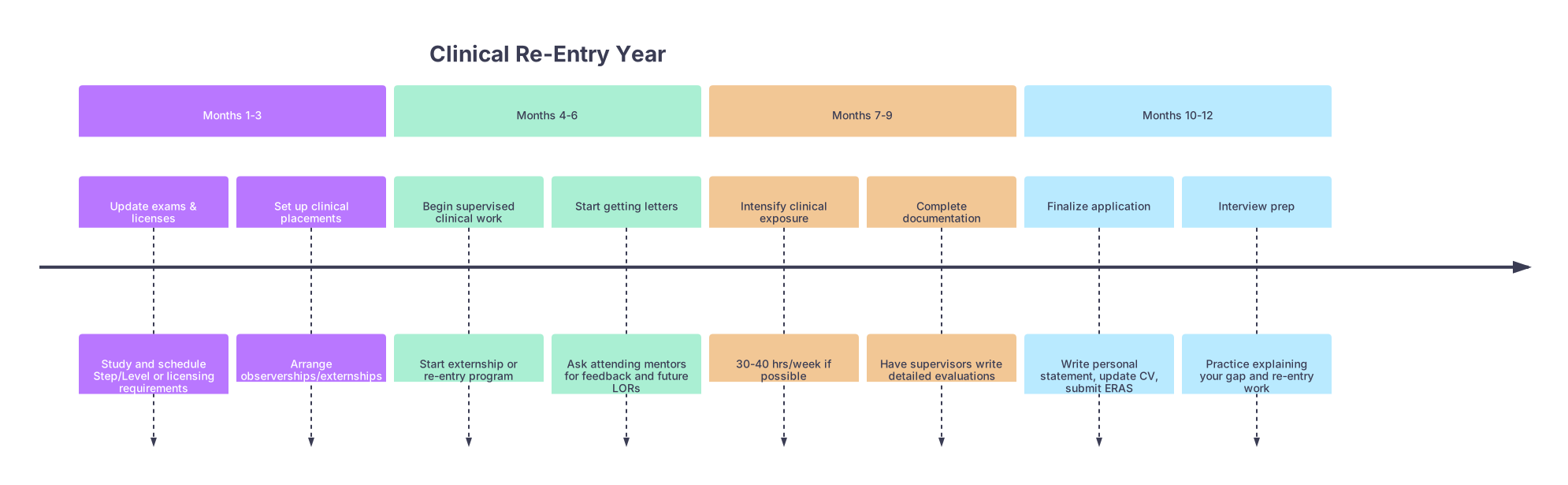
| Period | Event |
|---|---|
| Months 1-3 - Update exams & licenses | Study and schedule Step/Level or licensing requirements |
| Months 1-3 - Set up clinical placements | Arrange observerships/externships |
| Months 4-6 - Begin supervised clinical work | Start externship or re-entry program |
| Months 4-6 - Start getting letters | Ask attending mentors for feedback and future LORs |
| Months 7-9 - Intensify clinical exposure | 30-40 hrs/week if possible |
| Months 7-9 - Complete documentation | Have supervisors write detailed evaluations |
| Months 10-12 - Finalize application | Write personal statement, update CV, submit ERAS |
| Months 10-12 - Interview prep | Practice explaining your gap and re-entry work |
Your goal by ERAS submission day: be able to point to at least 3–6 months of:
- Supervised, structured clinical work
- In the US (if you want US residency)
- With evaluative letters from people who know you now, not ten years ago
Let’s be concrete for different types of gaps.
Scenario A: You Left for Non-Clinical Work (Industry/Research/Admin)
You did clinical work, then pivoted—maybe to pharma, consulting, informatics, or a PhD. Now it’s 3, 5, or 8 years later and you want back in.
Programs worry: “Are they still clinically sharp? Are they going to leave again?”
Your re-entry strategy should look like this:
- Keep your non-clinical work, but carve out serious clinical time for 6–12 months before applying.
- Target: at least 15–20 hours/week of direct clinical exposure, ideally more.
- Make that exposure as hands-on and longitudinal as possible with one team or site.
What to pursue:
- A structured externship with responsibility for H&Ps, notes, and plans (unsupervised signing is not required; supervised participation is)
- A hybrid research/clinical role where you round daily with a team, help manage patients, and are expected to present, write notes, and discuss management
- A formal re-entry or refresher track if your gap is 5+ years
The documentation you need:
- A letter from a supervisor that says things like:
- “Over the past 9 months, Dr. X has been on our inpatient medicine service 3 days per week…”
- “Dr. X routinely presented new admissions, formulated differential diagnoses, and proposed management plans…”
- “In my assessment, Dr. X’s clinical skills are at the level of an incoming PGY-1 and they are ready to enter residency training safely.”
You also want:
- Updated board exam status (Step 3 if possible; fresh Step/Level scores if previous ones are old or borderline)
- A personal statement that cleanly connects your non-clinical work to why you’ll be valuable now as a resident
Skip the “I always knew I would come back” fluff. You left. That’s fine. Own it and show why you’re not leaving again.
Scenario B: You Left for Family or Personal Reasons
You stopped for kids, parental illness, partner’s job, or your own health issues. The fear here is not “skills” first. It’s reliability and bandwidth.
Programs are thinking: “Are they going to disappear mid-year when life gets hard again?”
Your re-entry plan has two pillars:
- Demonstrate stability and support.
- Demonstrate current clinical competence.
What that looks like in practice:
- You can show at least 6 months of recent, consistent clinical engagement:
- Regular days in clinic or hospital
- Not one week here and there
- You can describe—clearly and briefly—how your situation is now stable:
- Childcare plan
- Resolution or controlled status of illness
- Support network
You don’t need to spill your entire medical history. But if you had a major health issue, you should:
- Be able to say you are medically cleared for full-time clinical work.
- Be prepared (if asked privately) to discuss any restrictions.
Documentation that helps:
- A letter from a recent clinical supervisor saying:
- You showed up consistently and reliably
- You handled full clinical days without limitation
- No professionalism or reliability concerns
- If appropriate, a short, neutral note in your ERAS experiences explaining a multi-year “family care” period.
Don’t write a three-paragraph saga about your hardship. One or two clear sentences plus strong recent clinical work says more than any noble narrative.
Scenario C: You Have a Disciplinary or Performance-Related Gap
This is the hardest one. You left a program, were terminated, or had major professionalism issues and then disappeared for a few years.
You cannot story-tell your way out of this. You have to out-work it and out-document it.
Here is the bare minimum you need:
- At least one serious, structured, supervised clinical role where:
- Someone with credibility is willing to say you are reliable, professional, and safe now.
- A clear change story:
- What went wrong (broad strokes, not gossip)
- What you changed (therapy, coaching, boundaries, health treatment, etc.)
- What your behavior looks like now, in actual clinical work
If the problem was professionalism (lateness, confrontational behavior, poor communication), you want your new supervisor to write things like:
- “Dr. X is consistently punctual and dependable.”
- “Dr. X receives feedback appropriately and adjusts behavior.”
- “I would have no hesitation working with Dr. X as a colleague.”
If the problem was competency, you want:
- “Dr. X has demonstrated solid clinical reasoning…”
- “I have directly observed them managing [types of patients] at the level expected of an entering resident.”
And you must accept something: some programs will automatically screen you out. You do not need all of them. You need a few who are willing to carefully read your file and are convinced by your re-entry work.
Step 5: Documentation: What You Actually Need on Paper
Think in three buckets: timeline, competence, stability.
1. Timeline Documentation
You need to be able to show, cleanly:
- What you were doing during each year of your gap
- What you did clinically in the 12–18 months before application
That means in ERAS:
- Every major block of time should be an entry (even if it’s “Family Responsibilities” or “Non-clinical Employment”).
- Multi-year “blank” periods with nothing listed are death. Don’t do that.
For clinical re-entry activities, each ERAS entry should include:
- Hours/week (be honest but not timid; if you’re there two full days plus call, that’s not “4 hours/week”)
- Setting (inpatient, outpatient, specialty)
- Your actual functions (H&Ps, presentations, notes, procedures, teaching, etc.)
2. Competence Documentation
You need letters and evaluations that speak to three things:
- Clinical reasoning
- Work ethic and reliability
- Interpersonal and communication skills
Strong re-entry letters usually:
- Are 1.5–2 pages, not a generic paragraph
- Include the duration and intensity of observation (“I have worked with Dr. X 3 days per week for 9 months…”)
- Compare you to recent residents or medical students (“At the level of our incoming PGY-1s…”)
- Explicitly address your gap (“Despite time away from clinical practice, Dr. X has demonstrated…”)
Do not rely only on ancient letters from training 6 or 8 years ago. They can be supporting evidence, but they cannot be your primary story.
3. Stability Documentation
This is more subtle. You usually don’t upload a “stability certificate.”
But you can demonstrate stability indirectly:
- A continuous, unbroken 6–12 month clinical role on your CV
- A letter that comments on attendance, dependability, and stress handling
- If needed, a short program director email or supplemental letter (not always necessary) clarifying that your previous issues were addressed and are not ongoing
Step 6: Addressing the Gap in Your Personal Statement and Interviews
Your instinct will be to over-explain. Resist that. You’re not writing a memoir. You’re answering three questions:
- Why did you step away?
- Why are you coming back now?
- Why should we believe you’re ready and committed?
In your personal statement:
- One to three sentences on why you stepped away, in plain language.
- “After graduation, I spent several years working in pharmaceutical safety, where I…”
- “For three years, I stepped back from clinical training to care for my two young children while my partner was deployed.”
- A firm pivot to what you did during that time that still makes you a better physician.
- A concrete description of your re-entry work.
- “Over the past year, I have completed [X months] of supervised clinical work at [institution], where I…”
- A forward-looking closing focused on what you want to do in residency and beyond.
In interviews, your tone matters more than your exact words.
Bad: vague, defensive, or blaming.
Better: straightforward, accountable, and anchored in what you’re doing now.
Example script for a 4-year gap due to industry:
“After finishing my initial clinical training abroad, I worked in pharma safety for four years. It was good work, but I realized I missed direct patient care and long-term relationships. Because I’d been away from bedside medicine, I didn’t feel it was safe or fair to just apply back into residency without updating my skills. So in the last year, I’ve been on the inpatient medicine service at [hospital] three days a week—taking admissions, following patients, and working under Dr. [Name]. That experience has confirmed that I want to commit to residency, and my supervisors feel I’m functioning at the level of an incoming intern.”
Short, clear, no drama. Notice the focus is on the last year, not the four in industry.
Step 7: Targeting Programs Strategically
Not all programs will touch multi-year gaps. Some don’t have the bandwidth, some don’t want the perceived risk. Do not waste your time throwing apps randomly.
Where you have a better shot:
- Community programs or smaller university-affiliated programs that have previously taken:
- Older grads
- International grads
- Non-traditional candidates
- Programs that explicitly say they consider “non-traditional paths” or “second career physicians”
- Hospitals where you’ve done your re-entry work (this is huge; they know you now)
You need to be realistic on specialty choice. If your gap is 5+ years and your file is not phenomenal otherwise, gunning for derm or plastics is fantasy. Internal medicine, family medicine, psych, peds—these are more plausible. Some surgical prelim spots can work as bridge years, but they’re high risk if you don’t convert to categorical later.
This is not about “settling.” It’s about getting back into the clinical system first. Once you’re back in, you can build from there.
Step 8: Common Mistakes That Sink Re-Entry Applicants
I’ve watched people with big gaps succeed. I’ve seen more crash and burn. The failures usually do at least one of these:
- Apply without any recent clinical work, relying on old letters and a heartfelt essay.
- Hide the gap with vague CV entries like “consulting” or “independent study” without dates or detail.
- Use only observerships with no real responsibility and letters that say nothing about their actual clinical ability.
- Over-explain the gap emotionally but under-build the practical evidence of readiness.
- Aim too high in specialty/competitiveness on their first re-entry attempt.
- Ignore exam recency or Step 3 when it could have strengthened their file.
Don’t do any of that. Spend your energy where it helps: recent clinical work, strong letters, and a believable story of “here’s who I am now.”
Step 9: If You’re Still 1–2 Years Away From Applying
If your gap is already years long, another year feels terrifying. But stumbling into ERAS with nothing substantial to show will just waste money and demoralize you.
Use the next 12–24 months like this:
Year 1:
- Fix exams and licensing issues.
- Identify and secure a formal re-entry program or robust externship.
- Start part-time clinical exposure (even if unpaid) while you finalize arrangements.
Year 2:
- Go all-in: 20–40 hours/week of structured clinical work for at least 6–9 months.
- Get 2–3 strong, detailed letters from supervisors.
- Prepare your application anchored around that work.
Remember: the calendar years since graduation matter less once you can convincingly prove current competence.
You can’t erase a multi-year clinical gap. But you can replace “mystery and risk” with “documented, recent performance.” That’s what program directors care about.
So your next moves are not: “How do I explain this?”
They are: “What specific supervised clinical work can I complete in the next 6–12 months, and who will be able to document that I’m safe and ready?”
Once you’ve lined that up and started doing the work, everything else—personal statement, ERAS entries, interviews—becomes much simpler. You’ll be talking about what you’re doing now, not just what you used to be or what you promise you’ll be again.
Get your re-entry plan on a calendar. Start contacting sites and programs this week, not “sometime soon.” When you’ve got real clinical work under your belt again, then you’re ready to think about building your school list, timing your application, and preparing for interviews. That’s the next phase of the journey—but you have to get this foundation in place first.