
It’s late March. The initial Match email said “We are sorry…” and your heart dropped. You spent four frantic days in the SOAP, applied to programs you’d never heard of, jumped on last-minute interviews, checked your email like a lab result on a crashing patient—and still ended the week with nothing.
Now it’s months later. Your classmates are posting intern year photos in fleece jackets with their program logos. You’re at home. Or working as a scribe, MA, research assistant. Your ERAS account is still there. The question is whether you should hit it again. And if so, how to not repeat the same outcome.
You’re not “a little behind.” You’re now on programs’ radar as a red-flag applicant: previously unmatched, SOAP-only year, and you’re coming back for another try. You can still win. But you do not get to do a “light revision” of last year. You need a strategy shift.
Let’s build that.
1. Get brutally honest about why you didn’t match
Before you “improve” anything, you need a correct diagnosis. Otherwise you’re just throwing interventions at the wall.
Here’s what I tell people: if you cannot clearly and specifically explain why you didn’t match, you are not ready to reapply.
You need to drill down into 5 buckets:
- Scores / academic record
- Specialty choice / competitiveness
- Application quality (ERAS, letters, personal statement)
- Interview volume and performance
- SOAP behavior and pattern
A. Scores and academic record
Forget the polite feedback you’ve heard: “It’s competitive for everyone,” “We had many excellent applicants.” That’s background noise.
Look at your file like a PD would:
- USMLE/COMLEX: any fails or very low passes?
- Any LOAs, repeats, professionalism issues, remediation, or deans’ letters that hint at concern?
- Were your scores borderline for the specialty you chose?
If you’re not sure where you stand, compare yourself roughly:
| Specialty Tier | Step 2 CK Range (Approx) | Typical Research / Extras |
|---|---|---|
| Very Competitive (Derm, Ortho, Plastics) | 250+ | Multiple pubs, major leadership |
| Competitive (EM, Anesthesia, Rad, ENT) | 240–250 | Some research, strong letters |
| Mid (IM, Peds, Psych, OB/GYN) | 230–240 | Decent experiences/letters |
| Less Competitive (FM, Path, Neuro) | 220–230 | Solid clinical performance |
These aren’t “requirements.” They’re rough waterlines. If you’re 15–20 points below the typical range and you applied to that specialty broadly and still didn’t match, that’s not bad luck. That’s misalignment.
If you have:
- A Step fail
- A COMLEX fail
- Remediation or LOA for academic reasons
…you are not in the same category as your classmates. You need a compensating story and a smarter target list.
B. Specialty choice and how realistic it actually was
I see this a lot: someone with a Step 2 of 225, failed Step 1, minimal research, and they only applied to EM or Anesthesia at university programs. They call it “unlucky.” It wasn’t unlucky. It was predictable.
Ask yourself:
- What specialty did you apply to?
- How many programs? Community vs academic? Geographic clustering?
- How many interviews did you get?
Blunt rules of thumb:
- < 8 interviews in a competitive specialty = very high risk of not matching.
- < 10–12 interviews even in IM/FM/Peds/Psych = risk zone.
If you got:
- 0–2 interviews: your main issue is probably application strategy + red flags.
- 3–6 interviews: strategy plus weaker interview skills.
- 10+ interviews and still didn’t match: big red flag on interview performance, ranking, or vibes.
C. Application quality
Pull up last year’s application. Read it as if you’re someone who’s never met you.
Ask:
- Does my personal statement sound generic, whiny, or like I’m begging for a chance?
- Are my experiences written as bullet-point CV blurbs, or do they show growth, reflection, specific impact?
- Were my letters from people who actually know me well, or from big names who barely worked with me?
- Did I have any obvious gaps or unexplained time periods?
If you wince reading your own PS or activities descriptions, programs probably did too.
D. Interview performance
Think back to the interviews you did get:
- Did you get follow-up positive signals (thank-you replies, “you’ll be ranked highly” type comments)?
- Did you feel stiff, defensive, or overly rehearsed when asked about your red flags or SOAP year?
- Did anyone on feedback calls later (if you asked) mention “concerns about fit,” “communication,” or “professionalism”?
You don’t have to be charismatic. But you do have to come across as safe, stable, and easy to work with at 3 a.m. on a bad call night. If you project anxiety, bitterness about not matching, or entitlement, they’ll see it.
E. SOAP behavior
Programs remember the SOAP. Some of them have notes next to names.
If:
- You applied to their program in SOAP and no-showed or canceled last minute
- You came across desperate or unprofessional on short-notice phone calls
- You spammed emails or tried to negotiate
…that can follow you.
If you don’t know what your SOAP behavior looked like from the other side, assume it was at least somewhat chaotic. Then your job now is to show 12 months of maturity and stability.
2. Decide: same specialty or pivot?
Here’s the fork in the road. A lot of people get stuck here for months and waste valuable time.
Let me be direct: if you are reapplying after an unmatched SOAP year and you insist on reapplying to the exact same competitive specialty with the exact same numbers, that’s not “determination.” It’s denial.
When staying in the same specialty makes sense
You can reasonably stick with the same specialty if:
- You had:
- No exam failures
- Scores roughly within range for that specialty
- A normal academic record
- You got a decent number of interviews (e.g., 7–10+) last cycle
- You can identify:
- A realistic reason you didn’t match (poor rank list strategy, weak interviews, late application, disastrous personal statement)
- Specific ways you’ve improved (better letters, stronger narrative, recent clinical work in that field)
Example: You applied IM with a 235 Step 2, 10 interviews, SOAP only because you tanked a couple of interviews and ranked too few places high enough. You now have 12 months of strong IM clinical work and a new glowing letter from a PD. Staying in IM is reasonable.
When pivoting specialties is the smarter move
You should strongly consider pivoting if:
- You have any Step or COMLEX failures
- Your Step 2/Level 2 score is markedly below averages for your original specialty
- You got < 5 interviews total despite broad applications
- You need to be in some residency rather than this one or nothing
That doesn’t mean you’re giving up on a career. It means you’re choosing an on-ramp instead of standing outside the freeway on principle.
Often-smart pivots:
- From EM → IM or FM
- From Anesthesia → IM, FM, or Transitional/Prelim IM hoping for later PGY-2 spots
- From OB/GYN → FM or IM with women’s health focus
- From competitive subspecialty (ortho, ENT, radiology) → prelim surgery or IM with intent to re-compete later (though this path is narrow and brutal)
You can also dual-apply (e.g., main push to IM, secondary to FM) if you can write coherent narratives for both. But don’t dual-apply to wildly different fields with zero connection. That screams “I just need a job” in the worst possible way.
3. Fill your “gap year” like a future resident, not like a lost student
This is where you either fix your red flag, or you make it worse.
Programs hate unexplained or unproductive gaps. They love seeing, “Given this setback, here’s how I responded like a professional.”
The best roles:
- Involve direct patient care or clinical work
- Are full-time (or close)
- Show reliability, teamwork, and ongoing growth
- Generate at least one strong new letter
Strong options, ranked:
Full-time clinical job
- Hospitalist scribe, ED scribe
- Medical assistant, clinic coordinator, case manager
- Research coordinator with meaningful patient interaction
Structured research position with clinical exposure
- Especially if it’s within your target specialty and includes clinic or rounds
Formal “bridge” or prelim year
- If you manage to secure a prelim IM or transitional spot via off-cycle, that can be a powerful bridge, but it’s rare post-SOAP without contacts
Things that don’t help much on their own:
- Random shadowing
- A few volunteer shifts a month
- Unrelated side jobs with no clinical link (DoorDash, bartending, etc.) unless you absolutely need them for survival—in which case, frame them as evidence you can grind and support yourself
You want your upcoming ERAS section for 2024–2025 (or whatever year) to show something like:
Clinical Research Coordinator, Department of Internal Medicine
40 hrs/week, July 2024 – present
Worked closely with inpatient attending teams…
Not:
Studying for exams, volunteering, exploring opportunities.
Protect your clinical rust
If you’re out of training for a full year, programs will worry about clinical “rust.”
So during this year:
- Stay in the hospital or clinic if at all possible.
- Keep some form of regular patient contact.
- Do at least one hands-on elective / observership in the 6–9 months before ERAS opens if you’ve been out of direct care.
4. Retake exams or add new ones?
You can’t retake passed USMLE Steps just to boost a score. If you failed then passed, the fail is permanent. What you can do:
- If you haven’t taken Step 3 (and it’s allowed in your situation), consider doing it only if:
- You have a realistic chance of scoring well, and
- You can prepare properly without tanking your work and mental health.
A solid Step 3 can sometimes reassure IM/FM programs if Step 1/2 were shaky. It does not erase a fail, but it shows an upward trend.
If you’re DO:
- If you only had COMLEX previously, a decent Step 2 CK taken now can sometimes help in MD-heavy fields like anesthesia or radiology, but this is situational and not trivial. Don’t take it if you’re likely to land in the same score range or worse.
Be ruthless about cost–benefit. Exam fees, study time, and potential for a mediocre score have to be weighed against what programs in your target specialty actually care about.
5. Complete overhaul of your application narrative
Round two is not “Last year, but with an extra job line.” You need to sound like a different applicant.
Personal statement: stop explaining, start owning
You’re tempted to write a long defense: why you didn’t match, what the SOAP was like, how unfair it felt. Do not do this.
Your PS should:
- Focus on: why this specialty, how you work, what kind of resident you’ll be
- Briefly, calmly acknowledge the path: “I did not match on my first attempt. Over the past year, I’ve been working as X, where I’ve done Y and Z. This has clarified my commitment to…”
You want to come across as:
- Grounded
- Self-aware
- Not bitter
- Problem-solver
If a sentence could be paraphrased as “Please feel sorry for me,” delete it.
Letters of recommendation: you need new ones
Programs already saw the old letters. If you re-send the exact same Lor’s, it screams stasis.
You need at least:
- 1–2 new letters from your gap-year work (ideally from an MD/DO in your target field)
- 1 strong letter from your core clerkship or sub-I in that field
Make sure your new letter writers:
- Know your previous outcome
- Know you’re reapplying
- Can speak specifically to how you’ve grown, stabilized, and function like an intern already
Experiences section: quantify and update
Your experiences should now show:
- Specific numbers: “Managed scheduling and follow-up for 25–30 patients/day”
- Concrete tasks that look like residency: triaging, speaking to consultants, tracking labs, writing notes (if allowed)
- Evidence of reliability: “Trained 4 new hires,” “Selected to coordinate X”
Also explain the SOAP-only year in your timeline just enough to show continuity:
March 2024 – June 2024: Residency Application and Transition
Prepared for reapplication; began role as [current job] in July 2024.
No long apologetic paragraphs. Just continuity and no unexplained holes.
6. Fix your interview story and red-flag answers
You will get asked variations of:
- “Tell me about last cycle.”
- “Why do you think you didn’t match?”
- “What have you been doing since graduation?”
- “Why should we believe things will be different this time?”
If you’re not ready with calm, concise, non-defensive answers, you will tank otherwise good interviews.
The formula that works:
- State the fact without drama.
- Own your contribution.
- Show what you changed.
- Tie it to how you’ll function as a resident.
Example:
“I did not match on my first attempt. Looking back, I aimed almost entirely at university IM programs in a few regions and applied late, which limited my interviews. My application also didn’t highlight my strengths well.
Over the past year I’ve been working full-time as a clinical research coordinator in internal medicine, rounding with the team, learning the day-to-day of inpatient care, and getting direct feedback from attendings. I’ve updated my application to better reflect that work and secured new letters from physicians who see me in a near-resident role.
I think the process forced me to grow up a lot. I’m more organized, more realistic, and I know exactly what the expectations are for an intern because I see them every day.”
What you must avoid:
- Blaming the Match, SOAP chaos, advisors, or “bad luck”
- Sounding entitled: “I had great scores and I still didn’t match”
- Oversharing emotional distress (fine to mention briefly, but don’t turn it into therapy)
7. Application strategy: numbers, timing, and where you apply
Strategy is usually what kills reapplicants. They think the main variable is “Am I better this year?” Programs care more about, “Will this person match somewhere or become my problem again in SOAP?”
Apply early. Actually early.
You cannot afford to be a mid-October completion person.
Your target:
- ERAS ready to submit on day 1
- Letters uploaded or pending only from people who’ll upload within 1–2 weeks
- Personal statement and experiences polished months before
Apply broadly and smartly
Over- and under-application are both errors. You cannot just fire 120 apps all at random and pray.
Rough ranges for a reapplicant with a SOAP-only year:
- IM: 60–80 programs, skewed toward community-heavy, including many in less popular regions
- FM: 40–60 programs
- Psych: 60–80 (it’s more competitive now)
- Peds: 50–70
- EM/anesthesia as a reapplicant with any red flags? I’d consider pivoting or dual-applying at minimum.
Focus:
- Community and hybrid programs
- Places that have historically taken IMGs/DOs or reapplicants
- Programs in less desirable locations
Do not cluster 70% of your applications in California, New York City, or Boston and then wonder why you have two interviews.
Use signals and preference tools wisely
If your specialty uses preference signals / geographic signals:
- Do not waste them on long-shot dream programs
- Use them on realistic, community-heavy or mid-tier academic programs where you’re actually competitive
8. SOAP round two: emergency plan (but don’t live there)
You cannot plan your entire year around “what I will do in SOAP next time.” But you should at least not repeat last year’s chaos.
Have ready:
- A SOAP-specific personal statement for your backup specialty if it differs from your main one
- A realistic idea of which programs have historically filled in SOAP in your target areas
- A clear internal line: what categories you will accept vs decline (e.g., you’ll accept FM anywhere, but not prelims without attached advanced spots, etc.)
Most important: don’t let “I’ll fix it in SOAP” be your mindset. SOAP is not a fix. It’s a pressure cooker band-aid.
9. Mental health and ego: stop bleeding out quietly
This process is brutal. A SOAP-only year feels like public failure because everyone else moves on.
Here’s the pattern I see:
- Shame → isolation → no feedback → repeat mistakes.
Do the opposite. Force yourself to:
- Talk to at least one PD, APD, or trusted faculty who’s willing to be blunt
- Ask them directly, “If this were your kid, what would you tell them about reapplying?”
- Accept that their answer might hurt (e.g., “You need to pivot to FM” or “You may not match in the US system”)
Get your own support:
- Therapy if you can access it
- One or two non-judgmental friends who know you’re reapplying and can reality-check you
- A structured weekly schedule that doesn’t let you drift and stew
You need to show up in interviews as a functioning adult who’s taken the hit, processed it, and moved forward. Not as someone still bleeding from March.
10. Concrete 6–12 month timeline
Let’s put this into a rough timeline so you’re not just vaguely “working on it.”
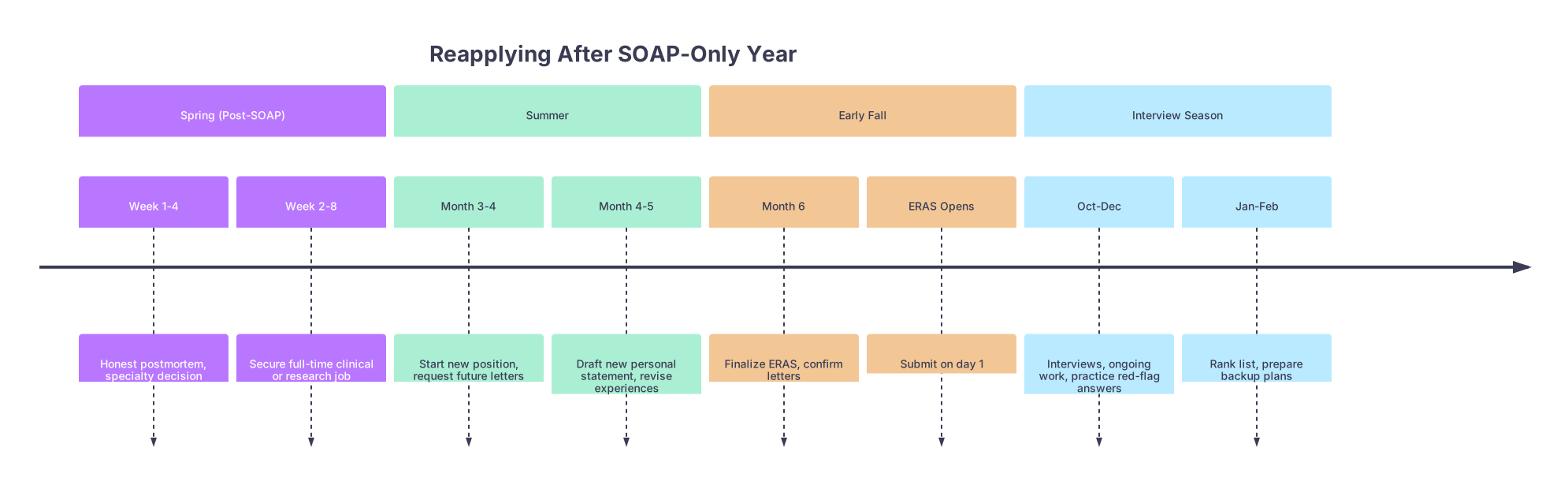
| Period | Event |
|---|---|
| Spring (Post-SOAP) - Week 1-4 | Honest postmortem, specialty decision |
| Spring (Post-SOAP) - Week 2-8 | Secure full-time clinical or research job |
| Summer - Month 3-4 | Start new position, request future letters |
| Summer - Month 4-5 | Draft new personal statement, revise experiences |
| Early Fall - Month 6 | Finalize ERAS, confirm letters |
| Early Fall - ERAS Opens | Submit on day 1 |
| Interview Season - Oct-Dec | Interviews, ongoing work, practice red-flag answers |
| Interview Season - Jan-Feb | Rank list, prepare backup plans |
Also track where your energy actually goes:
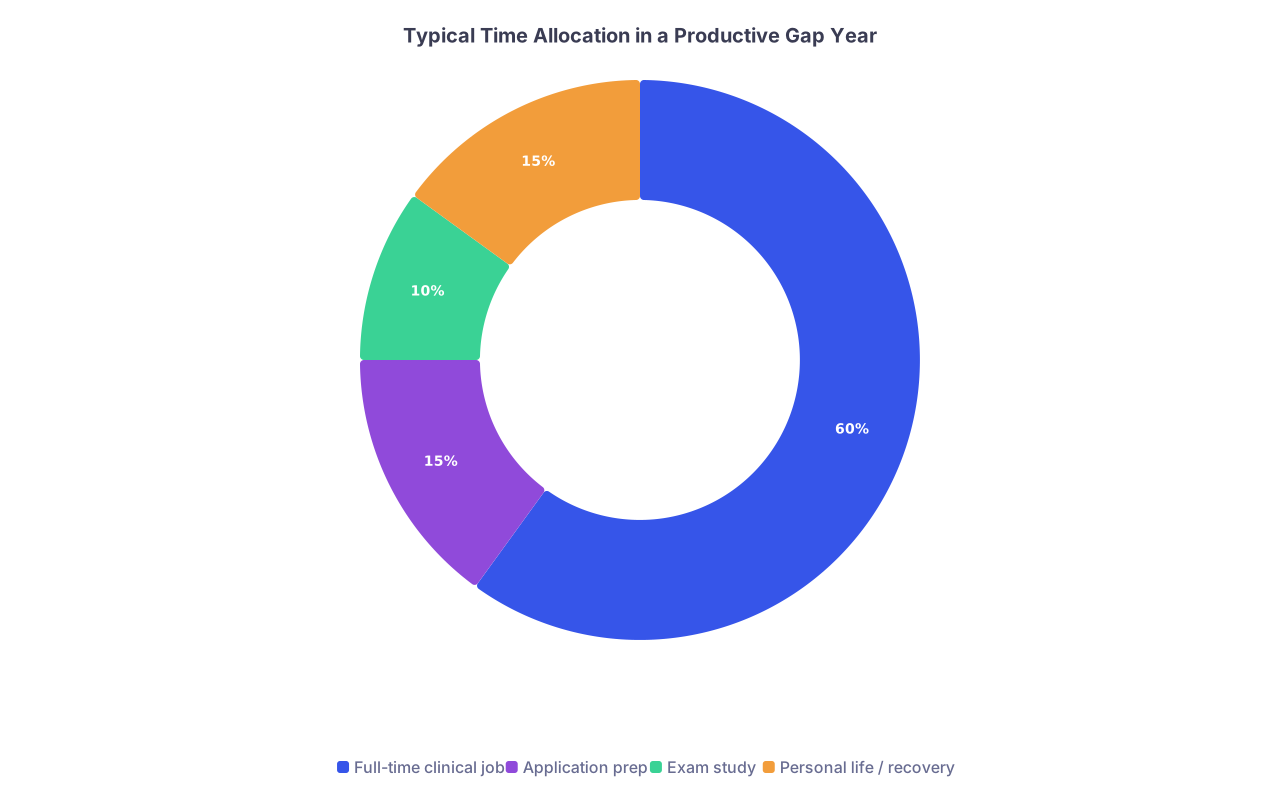
| Category | Value |
|---|---|
| Full-time clinical job | 60 |
| Application prep | 15 |
| Exam study | 10 |
| Personal life / recovery | 15 |
If your real life is:
- 10% work
- 60% doomscrolling and self-pity
- 30% vague “studying”
…then your odds next year will look a lot like this year’s.
Key points to walk away with
- Do a ruthless, specific postmortem on why you didn’t match; if you can’t explain it clearly, you’re not ready to reapply.
- Your gap year must look like the life of a future resident: full-time clinical or clinically-adjacent work, new strong letters, visible growth.
- Change the inputs: specialty choice (if needed), application content, where and when you apply, and how you talk about your red flags—otherwise round two will just be a more expensive rerun of round one.