It’s January of your fourth year. ERAS is a few months away. You open your email and see it again: the professionalism citation. Maybe it was a formal write-up. Maybe a “professionalism concern” logged in your file. Maybe it triggered a referral to the professionalism committee.
You’ve rotated since then. You’ve done better. But now you’re lying awake at 2 a.m. thinking one thing: “Is this going to tank my residency application?”
Here’s the reality: it can hurt you. It does not have to end you. But you do not get to ignore it and hope nobody notices. Programs are paying more attention to professionalism now than they did 10 years ago. Some will ask directly. Some will call your dean. Some will read between the lines in your MSPE.
So your job, right now, is two-fold:
- Minimize the practical fallout in your official record.
- Build a rock-solid, believable story of growth that PDs can actually trust.
I’m going to walk you through exactly how to do that.
Step 1: Get Very Clear on What’s in Your Record
You cannot fix what you only half-remember.
First move: find out exactly what’s documented, where, and in what language.
A. Request a professionalism/academic file review
Set up a meeting with:
- Your student affairs dean (or equivalent)
- Or the person who oversees professionalism/academic conduct
Go in prepared and direct:
- “I’m applying for residency this cycle. I know I had a professionalism citation regarding X on [approximate date]. I’d like to understand exactly how it’s documented and whether it will appear in my MSPE, dean’s letter, or any other report programs see.”
Ask for specifics:
- Exact wording of the incident in your record
- Whether it triggered any “adverse action” category at your school
- Whether it will be in:
- MSPE “Performance Concerns”
- A separate letter
- Or not mentioned at all
Take written notes. Verbatim language if you can.
If they hesitate to show you the exact text, ask:
- “Can you please tell me the exact sentence(s) or phrasing that will be used so I can be prepared to address it honestly in my application or interviews?”
You’re not arguing. You’re gathering facts.
B. Clarify the severity level
Not all “unprofessionalism” is equal. Programs know this. Your strategy depends heavily on what category you’re in.
| Type of Issue | Typical Impact Level |
|---|---|
| Single late assignment / form | Low |
| Missed clinic / repeated lateness | Moderate |
| Disrespectful behavior/argument | Moderate-High |
| Dishonesty / falsification | High |
| Boundary violation / harassment | Very High |
Ask your dean bluntly:
- “If you were a program director and saw this in an MSPE, how would you interpret it on a severity scale?”
- “Do you consider this a professionalism concern that requires explicit disclosure on my MSPE?”
You want their insider perspective, not a sugar-coated reassurance.
Step 2: Own the Facts Without Self-Destructing
Before you start “fixing” anything, you need a stable narrative in your own head.
Take 30 minutes, alone, and write down:
- What actually happened (no excuses, just facts)
- What you actually did wrong
- Who was affected (staff, patients, colleagues, institution)
- What consequences you faced (meeting, probation, remediation)
Then write the hardest line:
“If I were the program director reading about this, the concern I would have about me is: ______.”
Examples:
- “That I might not show up reliably when scheduled.”
- “That I might argue instead of listening to feedback.”
- “That I might cut corners and not be honest.”
- “That I might disrespect staff or cross boundaries.”
If you can’t identify the concern, you will sound evasive later. Programs pick up on that instantly.
Your goal is not self-flagellation. It’s clarity. A PD wants to see: this person understands exactly what the red flag means from our perspective.
Step 3: Do Concrete Remediation Before You Apply
I don’t mean the remediation your school forced you to do. I mean what you choose to do now, proactively, to show you’re not the same person who got cited.
The remediation needs to match the sin. Alignment matters.
A. If the issue was reliability (lateness, missed shifts, poor follow-through)
You need:
- A stretch of rotations (at least 3–4 months) with:
- Strong comments on punctuality and reliability
- No missed clinics, no last-minute call-outs without clear documentation
- An attending or advisor who can honestly write: “One of the most reliable students I’ve worked with. Always early. Follows through.”
Tactical moves:
- Ask attendings directly at the end of rotations:
“I’ve been working hard on being extra reliable and responsive. Have you seen that in how I’ve shown up on this rotation?” - If they say yes, that’s someone you want as a letter writer.
B. If the issue was disrespect/disruptive behavior
You’re rebuilding trust in your interpersonal maturity.
Consider:
- Formal workshops on communication, conflict management, or teamwork (not the checkbox online ones if you can avoid it—something with interaction)
- Volunteering or leadership roles where you work with nurses, MAs, or staff and can show you collaborate well
You want faculty to be able to truthfully say:
- “Nurses and staff loved working with them.”
- “Handles feedback calmly and professionally.”
- “Calm under stress, never blaming or dismissive.”
C. If the issue was dishonesty or documentation/falsification
This is serious. Program directors hate dishonesty more than almost anything.
Your only shot is:
- Zero further incidents
- Explicit track record of:
- Meticulous documentation
- Owning errors immediately
- Transparency
Strong moves:
- Take a formal ethics/professionalism course (with documentation you completed it)
- Ask a trusted faculty mentor to review a narrative you write about what you learned about honesty, trust, and patient safety from the incident. If they’re comfortable with it, later that mentor can speak to your current reliability and integrity in a letter.
D. If the issue was boundary violations / harassment / major conduct
You need to understand: some programs simply will not touch these cases. Period. That’s reality.
Your work:
- Confirm exactly how your school labels this and how it’s described
- Complete any recommended therapy, coaching, or professionalism program
- Get a senior faculty mentor or dean who knows the full story and is willing to (truthfully) say you’ve done the work and changed
And you may need to:
- Apply more broadly
- Aim at less competitive programs
- Accept that some specialties may not be realistic this cycle
Step 4: Build a “Growth Story” That’s Actually Believable
You’re not selling a fairy tale. You’re building a before-and-after arc that a rational PD can buy.
The structure I’ve seen work:
- Clear acknowledgment of the issue
- Direct ownership (no passive voice, no “mistakes were made”)
- What concrete steps you took
- What’s different about how you behave now
- Brief evidence that others have seen the change
For example (reliability case):
- “During my clerkships, I was cited for unprofessionalism after arriving late to clinic and missing a scheduled half-day without communicating appropriately with my team. I recognized that my time management and prioritization were not at the level required of a physician. Since then, I’ve put strict structure in place for tracking my commitments, I show up early for shifts, and I communicate proactively if there is any change. On my last three rotations, faculty have specifically commented on my reliability and responsiveness, and I’m committed to maintaining that standard.”
Or (disrespect case):
- “I received a professionalism citation after I responded defensively and disrespectfully to feedback from my attending in front of the team. I was frustrated, but I handled it poorly. Since then, I’ve worked with my advisor and a counselor to develop healthier ways to respond to criticism, especially when I feel stressed. On subsequent rotations, I’ve made a point to ask for and reflect on feedback regularly. Residents have told me they appreciate that I listen, adjust, and do not take feedback personally.”
You’re not begging for forgiveness. You’re presenting yourself as someone who screwed up, grew up, and can work safely with patients and teams now.
Step 5: Strategize Letters and MSPE
This is where a lot of applicants with professionalism issues either sink or swim.
A. Decide who needs to know the full story
Two groups need the unvarnished version:
- Your dean / student affairs (they already know)
- At least one mentor / letter writer you trust
Why? Because if your MSPE mentions a professionalism issue and none of your letters even hint at your growth or current professionalism, PDs assume the worst: that nobody would vouch for you.
Ideal scenario:
- One letter from someone who knows about the incident and can say:
- They’re aware of it.
- They’ve seen a clear pattern of improvement over time.
- They would trust you as an intern.
Don’t script them. But you can say:
- “I had a professionalism citation in M3 year related to [short description]. Since then I’ve worked hard on [X, Y]. If you’re comfortable, it would help if your letter could speak specifically to how you’ve seen me show up professionally on your service.”
B. Understand what your MSPE will say and plan around it
If the MSPE will include a line like:
- “Student received a professionalism citation for repeated tardiness to clinic in the third year.”
Then somewhere—either in your personal statement (if relevant), secondary question responses, or interviews—you need to have your version that:
- Matches the facts
- Shows growth
- Does not minimize
What you don’t do:
- Attack the school.
- Argue they were wrong.
- Claim it was all a misunderstanding.
Programs hate applicants who blame their school for professionalism write-ups.
Step 6: Decide When and Where to Disclose
Some applications (ERAS, supplemental questions, program-specific questions) will ask directly:
- “Have you ever been subject to disciplinary or professionalism action during medical school?”
If the correct answer is yes, you answer yes. Lying here is program-suicide. It’s the easiest “no thanks” a PD will ever get to make.
If the question is open-ended, your options:
- Brief mention in the personal statement if it connects to your growth story
- Or hold it for interviews and “disciplinary action” questions
Rule of thumb:
- If it’s in the MSPE or dean’s letter: be prepared to address it anywhere.
- If it’s not in any official document: you still answer application questions honestly, but you may not need to feature it in your personal statement.
You want consistency across:
- MSPE language
- Application checkboxes
- Your verbal explanation
If any of those three contradict each other—big red flag.
Step 7: Recalibrate Your Application Strategy
Whether you like it or not, a professionalism citation usually shifts your risk profile in PDs’ eyes. You adjust.
A. Program list strategy
You may need to:
- Apply to more programs than your stats alone would suggest
- Widen geographic preferences
- Include more community programs and less “prestige hunting”
For example:
- Mid-tier Step 2, solid clinical grades, one professionalism hit for tardiness? You can still target a reasonable spread of mid-tier academic + community.
- Serious dishonesty or harassment issue? You may need to flood the zone with applications and lean toward community and programs with a history of holistic review.
B. Specialty choice reality check
Some specialties are more risk-averse than others.
| Specialty | Sensitivity to Red Flags |
|---|---|
| Dermatology | Very High |
| Plastic Surgery | Very High |
| Ortho/ENT/Uro | High |
| EM | Moderate-High |
| IM/FM/Peds | Moderate |
| Psych | Variable by program |
This is not gospel, but it’s roughly what I’ve seen.
If you’re shooting for an ultra-competitive surgical subspecialty with a professionalism hit, you should have:
- A serious back-up plan (e.g., general surgery, prelim year, different specialty)
- A brutally honest talk with your dean about viability
Step 8: Practice Your Interview Answer Until It’s Boring
There’s a specific moment that will come on interview day. You’ll be halfway through a friendly conversation and the interviewer will say:
“I see there was a professionalism concern mentioned in your MSPE. Can you tell me about that?”
If you look panicked, ramble, get defensive, or blame others, they will write that down.
So you script and rehearse. Out loud. Many times.
Structure:
- One-sentence headline of what happened.
- One or two sentences taking responsibility (no excuses).
- Two to three sentences on what you did afterward to improve.
- One tight sentence on how you operate now.
Example (missed shift):
- “In my third year, I received a professionalism citation after I missed a scheduled clinic session and failed to communicate appropriately with my team.”
- “There were personal stressors that I didn’t manage well, but ultimately it was my responsibility to show up and to let the team know if I couldn’t. I didn’t do that.”
- “After that, I met with student affairs, adjusted my schedule, and worked with a counselor on time management and stress responses. I put in strict systems for tracking my commitments, and on my subsequent rotations I had no further issues, with multiple attendings commenting on my reliability.”
- “Today, my teammates know me as someone who shows up early, communicates clearly, and takes ownership when things go wrong.”
Say it smoothly, calmly, without drama. Then stop talking. Let them ask follow-ups if they want.
Step 9: Protect Yourself From a Second Hit
You do not have bandwidth for another question mark in your file. None. Zero.
From now through Match:
- Document everything:
- If you’re sick and miss a day, email + text the right people and keep the receipts.
- Be early. To clinic, to the OR, to rounds.
- Be boringly professional in all written communications. No sarcasm in emails. No “jokes” that can be misread in group chats with residents.
- Double-check documentation and signatures. Don’t cut corners.
You’re under a microscope, whether people say it out loud or not. Your job is to become the easiest “they fixed it and they’re solid now” story on a PD’s desk.
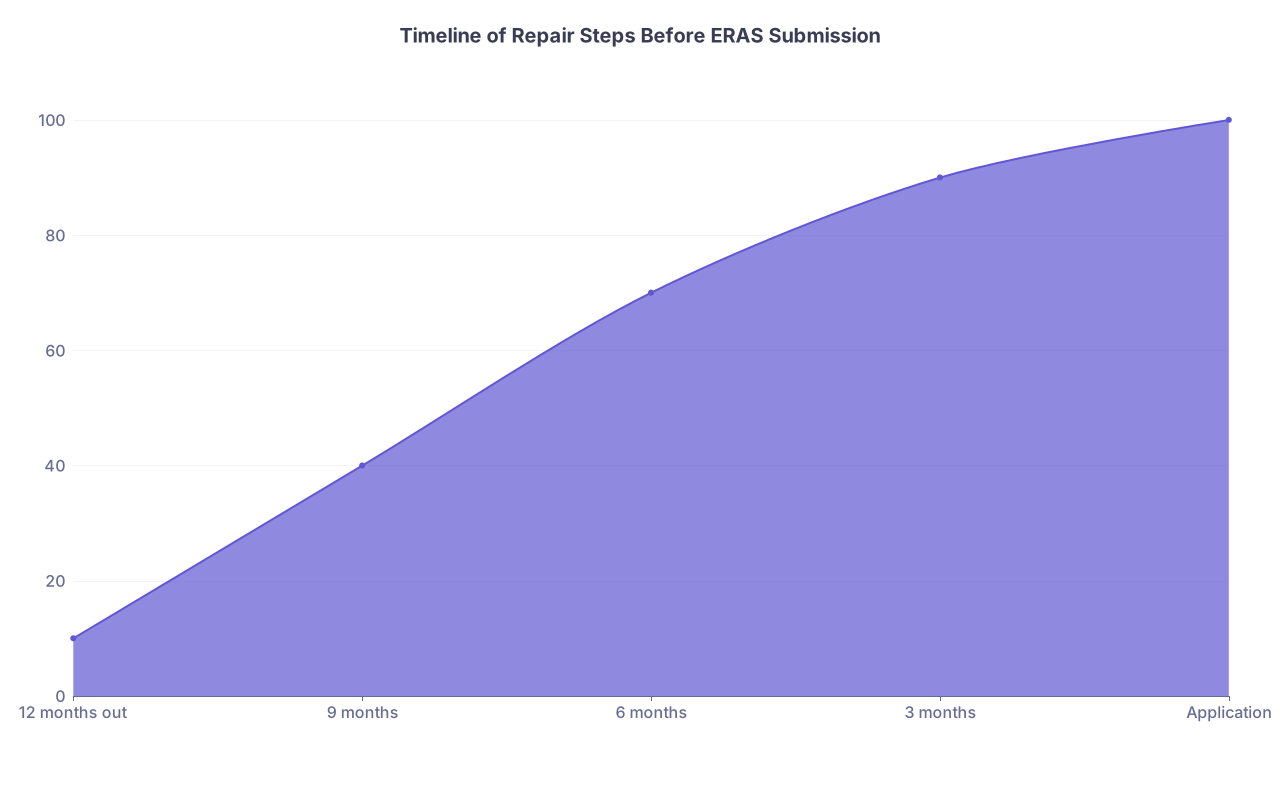
| Category | Value |
|---|---|
| 12 months out | 10 |
| 9 months | 40 |
| 6 months | 70 |
| 3 months | 90 |
| Application | 100 |
Step 10: Decide if You Need an Extra Year or a Different Path
Sometimes the honest answer is: you’re not ready to apply this cycle.
Signals that you might need more time:
- Your professionalism issue was recent (within last 6 months).
- You have no post-incident letters that clearly reflect your growth.
- Your dean is lukewarm at best about this cycle.
- You’re stacking this on top of other red flags (Step failures, leaves of absence, etc.).
Options:
- Take a research year where you also:
- Build a new reputation with a mentor
- Accumulate strong, recent letters
- Delay graduation by a year to:
- Rack up clean rotations
- Show a long stretch of good behavior
Not fun. But much better than tanking a cycle and now having to explain failed match + professionalism in the next round.

| Step | Description |
|---|---|
| Step 1 | Incident Occurs |
| Step 2 | Clarify Documentation |
| Step 3 | Assess Severity |
| Step 4 | Targeted Remediation |
| Step 5 | Secure Strong Letters |
| Step 6 | Craft Growth Narrative |
| Step 7 | Adjust Application Strategy |
| Step 8 | Practice Interview Answer |
| Step 9 | Maintain Clean Record |
FAQs
1. Should I bring up the professionalism citation in my personal statement?
Only if:
- It’s significant enough that it will clearly appear in your MSPE or dean’s letter, and
- You can tie it to a genuine story of growth that informs why you’ll be a better resident.
If it was a relatively minor issue (e.g., single tardiness that’s barely mentioned), or if your dean says it will not be in your MSPE, you can skip it in the personal statement and instead be prepared to address it in interviews or specific “disciplinary action” questions. You’re not trying to spotlight your worst moment unless there’s a strategic advantage and a clean narrative of change.
2. What if I think the professionalism citation was unfair or politically motivated?
Happens more than schools admit. But residency programs can’t referee your school’s politics. If your MSPE says there was a professionalism concern, arguing that it was all unfair usually backfires. It makes you look defensive and blame-shifting.
Your best angle:
- Acknowledge what’s written.
- Briefly note if there was context (without attacking individuals).
- Pivot quickly to what you learned and how you operate now.
For example: “I disagreed with parts of how the situation was handled, but I recognized that I still had responsibility for X, and I’ve since done Y and Z to improve.” That shows maturity. Just don’t turn your interview into a grievances session.
3. Can a strong Step 2 score or high grades “erase” a professionalism issue?
No. It can offset risk, but it does not erase it. PDs see professionalism and patient safety as a separate axis from test performance. A 260+ Step 2 with a major honesty violation in the file is still a big problem. That said, strong academic performance helps convince programs that:
- You’re capable.
- You’ve stayed engaged and stable since the incident.
Think of it as: scores and grades get you looked at; a believable professionalism repair story gets you trusted.
4. How many programs should I apply to if I have a professionalism red flag?
It depends on severity, specialty, and the rest of your application, but I’ll give rough ranges for core specialties:
- Mild issue (e.g., documented tardiness, no repeat problems), solid stats: add 10–15 more programs than your advisor would otherwise recommend.
- Moderate issue (e.g., disrespect, missed shifts, formal remediation): think in the 50–70+ range for IM/FM/Peds/Psych, more for EM or borderline-competitive fields.
- Serious issue (dishonesty, boundary violation): you may be in “apply very broadly” territory (70+ for core specialties), and you should strongly consider a backup specialty or extra year to strengthen your file.
The key is to integrate your school’s advising. Ask your dean: “If you were me, how many programs would you apply to in this specialty given my record?” Then add a cushion.
You’re not going to pretend this didn’t happen. You’re going to make it the worst story someone could tell about you—and then bury it under two years of consistent, boring, professional behavior and strong endorsements from people who know you now.
If you do the work I just outlined—clarify the record, remediate in real life, line up honest letters, craft a tight narrative, and protect yourself from a second hit—you give yourself a real chance to match as the “they had an issue, fixed it, and they’re solid now” candidate.
With this piece of the puzzle under control, you can shift your energy to the rest of your application: strong letters, smart program list, and interviews that highlight who you’ve become, not who you were at your worst. The match is still ahead of you. This just means you’ll walk into it more prepared—and more honest—than a lot of your peers.