
The biggest mistake applicants make about mental health leaves is thinking they owe programs a confession. You do not.
If you took a leave of absence (LOA) for mental health and you’re heading into residency applications, you’re in a tricky but manageable situation. Programs absolutely notice LOAs. Some will jump to conclusions. A few will handle it gracefully. Your job is to control the story just enough that it doesn’t control you.
I’m going to walk you through what to say, what not to say, and how to protect yourself while staying honest.
1. Understand What Programs Actually Care About
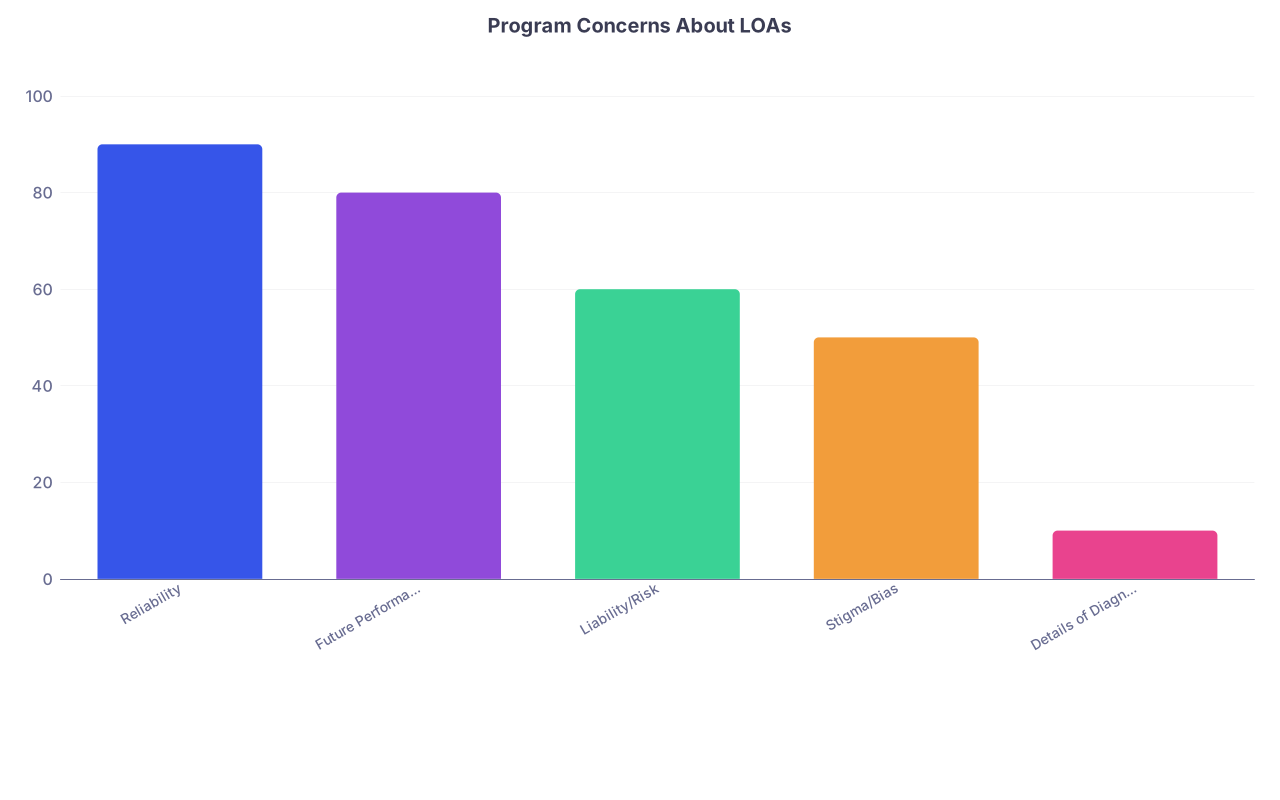
| Category | Value |
|---|---|
| Reliability | 90 |
| Future Performance | 80 |
| Liability/Risk | 60 |
| Stigma/Bias | 50 |
| Details of Diagnosis | 10 |
Programs don’t care about your diagnosis. They care about risk.
They’re trying to answer three questions:
- Will this person show up reliably?
- Will they be able to handle residency stress without breaking down or disappearing mid-year?
- Are there hidden landmines (disciplinary issues, professionalism concerns, major impairment)?
That’s it. They are not sitting around debating your DSM-5 label.
So your communication strategy needs to hit three points:
- There was a defined problem.
- It’s been addressed in a credible, structured way.
- You’ve demonstrated sustained stability and functioning since.
What you do not need:
- Your exact diagnosis.
- Your medication list.
- Detailed symptom descriptions.
- Trauma narratives.
Those details do not help you. They only give people more to judge.
2. Decide: Do You Even Need to Disclose the Reason?
Let me be blunt: “Mental health” is health. You’re not morally obligated to label it as such.
When you usually must say something
You generally need some kind of explanation if:
- There’s a formal LOA on your transcript.
- There’s a gap in your med school timeline (e.g., M2–M3 took 3 years).
- Your dean’s letter (MSPE) mentions a leave, delay, or interruption.
- A secondary application or ERAS question explicitly asks about interruptions.
But “say something” does not equal “say it was depression/anxiety/etc.”
You have three basic disclosure levels:
| Level | Description | Risk to You | Transparency to Program |
|---|---|---|---|
| Minimal | “Personal health reasons” | Lowest | Lowest |
| Moderate | “Health reasons, including mental health” | Medium | Medium |
| Full | Specific mental health condition | Highest | Highest |
When minimal disclosure is enough
If all of these are true:
- Single, time-limited leave (e.g., one semester or one year).
- You returned and completed without further breaks.
- No failures, professionalism issues, or patterns around it.
- You have strong recent performance.
Then a short, non-detailed explanation is usually safest and sufficient. You don’t win bonus points for extra vulnerability in this context. This is not therapy.
3. Crafting Your Core Explanation (Template + Examples)
You need one main “script” you can adapt for:
- ERAS explanation boxes
- Personal statement (if you choose to include it)
- Interviews
- Conversations with mentors/letter writers
The structure should be:
- Brief reason (high-level).
- Action: what you did to address it.
- Outcome: what’s different now.
- Evidence: how long you’ve been stable and functioning well.
That’s it. Four beats.
Minimal-disclosure example (safest for most people)
Use this if you want to avoid explicitly naming mental health:
“During my second year, I took a medical leave of absence for personal health reasons. I used that time to address the issue with my physician and make structured changes to how I manage stress, sleep, and support. Since returning, I’ve completed all subsequent coursework and clinical rotations on schedule with strong evaluations, and I’ve continued to maintain those strategies successfully.”
Notice what this does:
- Confirms it was health-related (not disciplinary).
- Emphasizes structured treatment and changes.
- Points directly to sustained, measurable stability (time since return, evaluations).
No diagnosis. No drama.
Moderate disclosure example (if you’re comfortable naming mental health)
This can help in psych, family med, or specialties that tend to be more mental-health-aware, but you still need to be careful.
“Early in my training, I took a brief medical leave to address a mental health condition that had been under-recognized for some time. I engaged in formal treatment, adjusted my support systems, and learned very concrete tools for managing stress and workload. Since returning, I’ve completed [X years] of training without interruption, maintained strong clinical performance, and continued in regular follow-up to stay well.”
This gives more clarity without oversharing. It still focuses on function, not symptoms.
What not to say
Avoid:
- “I had a complete mental breakdown.”
- “I was burnt out and couldn’t handle the pressure.”
- “I was severely depressed and suicidal for months.”
- “I just needed time off to focus on myself.”
Those phrases scream “ongoing risk” to a PD reading quickly between meetings. You’re not lying by skipping graphic detail. You are editing for relevance.
4. Where to Address the LOA in Your Application
You do not need to (and usually should not) talk about it in every possible place. Be strategic.
ERAS “Interruptions in Education” / Additional Info boxes
This is the primary place to address the LOA clearly and briefly.
Aim for 3–5 sentences. No story arc. No inspirational TED Talk.
Example:
“My medical education was interrupted from August 2021 to January 2022 due to a personal health issue. I took a formal medical leave of absence, received appropriate treatment, and made durable changes in how I manage my health and workload. Since returning, I have completed all required coursework and clinical rotations without further interruption, with strong clinical evaluations and no professionalism concerns.”
That’s enough. Do not turn this into a personal statement.
Personal statement: should you include it?
My stance: only include it if:
- The LOA is clearly visible on your transcript, and
- You can link it to a genuinely relevant, forward-looking insight (not just “I’m resilient now”), and
- You can do it in one concise paragraph.
If you include it, it should be one paragraph, not the centerpiece.
Example:
“Halfway through medical school, I took a brief medical leave for a personal health issue. That time forced me to confront my own limits and to build a more sustainable way of working—one that includes asking for help early, maintaining consistent follow-up with my physician, and using specific strategies to manage stress. Returning with those tools has made me a more reliable teammate and a more empathetic clinician for patients navigating their own health setbacks.”
If you cannot write about it this cleanly, don’t force it into your personal statement. Handle it in the ERAS explanation box instead.
MSPE (Dean’s letter)
You usually don’t control this. But you can:
- Ask your student affairs dean how it will be described.
- Request they frame it as “medical leave” without unnecessary diagnostic detail.
- Make sure it’s factually accurate and not editorial (“struggled to cope,” “not ready for clinical work” — those phrases are poison).
If they insist on clunky language, your own explanation elsewhere becomes even more important.
5. Interview Day: Real-Time Handling Without Oversharing
Here’s where people panic. You’re across from a PD and they say:
“So I see there was a leave of absence in your second year—can you tell me about that?”
Your goals:
- Stay calm and matter-of-fact.
- Use the same structure as your written explanation.
- Shut the door gently on further digging.
A solid, reusable verbal script
Something like:
“Yes, during my second year I took a medical leave of absence for a personal health issue. I worked closely with my physician, made some important changes in how I manage my health and stress, and returned after [X months]. Since then I’ve completed all of my rotations on time with strong evaluations, and I’ve continued the same strategies that have kept me stable and functioning well.”
Then stop talking. Don’t nervously fill silence.
If they push for detail (“Was it mental health?” / “What specifically was going on?”), you can still hold the line respectfully:
“It did involve my health, including mental health, and I’ve been advised to keep the specific diagnosis between me and my treating physicians. What I can say confidently is that it’s been well managed for [X years] now, and my performance since then reflects that.”
If someone keeps prying after that, that’s a red flag about the program, not about you.
6. What To Tell Mentors and Letter Writers
You need at least one person in your corner who understands the LOA context and can vouch for your stability.
Choose carefully:
- Someone senior enough that PDs respect (clerkship director, PD at your home institution, trusted attending).
- Someone who has seen you perform after your return.
- Someone who isn’t weird about mental health.
Be more open with them than with programs. You want them to be able to say, if asked:
- “Yes, there was an LOA earlier in training.”
- “I’ve worked with them since then and have no concerns about their ability to handle residency.”
- “They show up, they function, and they’ve grown from the experience.”
Ask explicitly:
“My transcript shows a leave of absence. I’d appreciate if, in your letter, you could speak to my reliability and performance since that leave. Programs may worry about my stability, and hearing from you that you don’t have concerns would help counter that.”
That’s not manipulative. It’s directing people to address the exact risk programs are worrying about in the shadows.
7. When the LOA Was for a Severe Episode (Hospitalization, Suicidality, etc.)
If your leave was for something serious, the instinct is to over-explain so they’ll “understand.” That usually backfires.
You deal with it the same way, just with even tighter boundaries.
Key points to emphasize:
- Time since the episode (distance matters).
- Ongoing treatment/follow-up (shows you’re not in denial).
- Functional stability (rotations, responsibilities, no additional crises).
- Any external validation (awards, leadership, solid Step 2, etc.).
Example for a more serious history:
“I had a significant health episode in my second year that required a medical leave and intensive treatment. That period was difficult but ultimately very clarifying. Since returning in 2021, I’ve been in consistent care, have had no further interruptions, and have completed [X] years of full-time clinical work with strong evaluations. My current treatment plan is stable and has allowed me to function reliably in demanding settings.”
You are not their patient. You’re not there to prove your illness was “bad enough” or fully dissected. You’re there to show it is now managed enough.
8. Legal and Ethical Boundaries (And How to Use Them Without Sounding Combative)
Programs cannot legally require you to disclose a mental health diagnosis. But hiding behind the law too aggressively during an interview just makes things tense.
The right balance is:
- You answer the functional question (am I reliable now?).
- You decline detailed disclosure politely.
- You keep the tone calm, not defensive.
If someone is blatantly inappropriate (e.g., “Do you have bipolar disorder?”):
You can say:
“I’d prefer to keep specific diagnoses between me and my treating clinician. What I can say is that I’ve been stable on my current treatment plan for [X years] and have completed all of my clinical responsibilities without issue during that time.”
If they keep going down that road, mentally cross that program off your list. If they’re this tone-deaf before you’re hired, imagine them as your employer.
9. Concrete Prep: What To Do This Week
Let’s get practical. If you’re in this situation, here’s your actual to-do list.

| Step | Description |
|---|---|
| Step 1 | Review Transcript & MSPE |
| Step 2 | Choose Disclosure Level |
| Step 3 | Write ERAS LOA Statement |
| Step 4 | Draft Optional PS Paragraph |
| Step 5 | Create Interview Script |
| Step 6 | Brief Key Mentors |
| Step 7 | Practice Out Loud |
Pull your transcript and MSPE.
- Highlight where the LOA appears.
- Note exact dates; you’ll be asked.
Decide your disclosure level (minimal vs moderate).
- Err on the side of less unless a trusted advisor in your specialty strongly recommends more.
Write and polish:
- 3–5 sentence ERAS explanation.
- Optional 1-paragraph personal statement mention (only if you can do it cleanly).
- A 2–3 sentence interview script.
Run it by:
- At least one advisor who has read a lot of applications in your target specialty.
- Ask them specifically: “If you were a PD, would this reassure you about my reliability?”
Practice saying it out loud.
- In the mirror.
- To a friend.
- Until you can say it without your voice tightening or oversharing in a panic.
Line up at least one letter writer who can speak to:
- Your performance after the LOA.
- Your reliability, work ethic, and emotional steadiness.
10. A Final Reality Check
Let me be clear: some programs will see “LOA” and quietly move on, no matter how perfectly you phrase it. That’s not about you. That’s about their risk tolerance and bias.
Your job is not to convert everyone. Your job is to:
- Be honest but not exposed.
- Show concrete stability and growth.
- Give reasonable programs enough reassurance to take you seriously.
If your LOA was for mental health, you’re not disqualified from residency. But you do need to treat this like the red-flag-adjacent issue that it is and handle it with deliberate strategy, not raw emotion.
Keep these three points at the front of your mind:
- You owe programs a coherent, concise explanation of the interruption, not a confessional about your mental health.
- Every time you talk about the LOA, hit the same beats: brief reason, structured help, sustained stability, and evidence of strong performance.
- Your tone and consistency matter as much as the words. Calm, rehearsed, and matter-of-fact will carry you much farther than oversharing or over-defensiveness.