
What do you actually do when “Step 2 CK – Pass (3rd attempt)” is carved into your ERAS history and you still want a real shot at residency?
Let me skip the pep talk and get to the point: a multiple-attempt Step 2 CK is a red flag. Program directors notice it. Some will screen you out automatically. Some will not care as much. A small but important group will look very closely at what you did after that stumble.
Your job now is to move yourself as fast as possible from “automatic discard” to “I have to at least look at this application.”
This is how you do that.
1. Understand Exactly How Bad (or Manageable) Your Red Flag Is
If you had to retake Step 2 CK, you’re worried about one big question: “Can I still match?”
The more precise question is: “For which specialties, and under which conditions, am I still competitive?”
Multiple failures is not the same problem as barely passing after one failure. And different specialties treat this very differently.
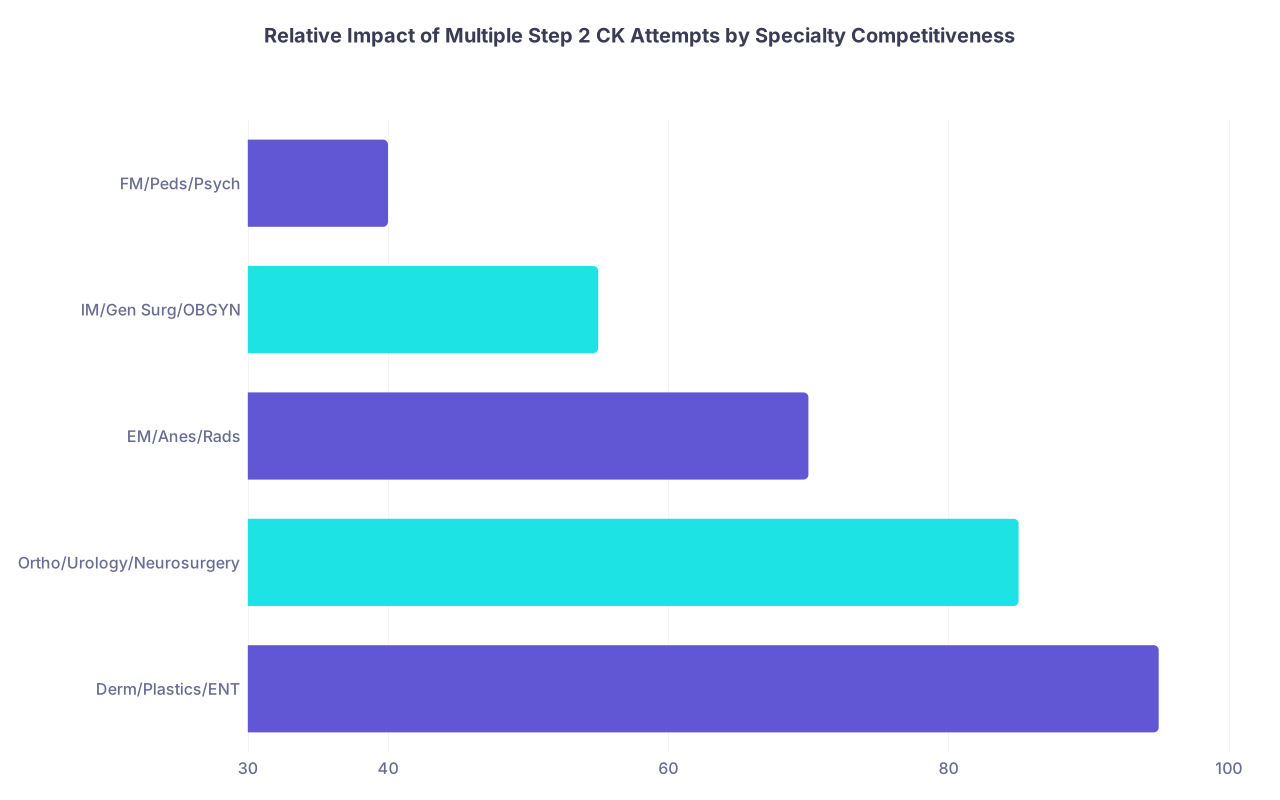
| Category | Value |
|---|---|
| Derm/Plastics/ENT | 95 |
| Ortho/Urology/Neurosurgery | 85 |
| EM/Anes/Rads | 70 |
| IM/Gen Surg/OBGYN | 55 |
| FM/Peds/Psych | 40 |
Think in categories, not absolutes.
- Hyper-competitive (Derm, Plastics, Ortho, ENT, Neurosurgery)
- Multiple Step 2 attempts is close to a death blow unless:
- You’re reapplying
- You have insane research or connections
- And even then, it’s uphill in the snow.
- Multiple Step 2 attempts is close to a death blow unless:
- Competitive but not insane (EM, Anesthesia, Radiology, some IM programs, some Gen Surg)
- You’re not automatically out, but you are below the median.
- You must prove:
- Upward trend
- Strong clinical performance
- Very clear explanation.
- Bread-and-butter core fields (FM, Psych, Peds, many IM, many community-based programs)
- Multiple attempts is a problem but not a wall.
- I’ve seen plenty of people match these with two or even three attempts, when the rest of the application is tight and honest.
Now, severity by scenario:
- Failed once, passed second time with a solid score (say 230+):
- Programs will notice but many will move on if everything else is strong.
- Failed once, passed second time with barely passing:
- Bigger issue. They’ll worry about in-training exams and boards.
- Failed twice, passed third time:
- You’re in significant damage-control territory.
- Matchable? Yes, in the right context. But only with careful specialty choice and a very strong story.
You cannot fix this by pretending it is a small issue. Program directors are not stupid. They look at your USMLE transcript in about 3 seconds and know exactly what happened.
Your advantage is not hiding it; your advantage is explaining it better and backing it with actual evidence of competence.
2. Reconstruct What Actually Went Wrong (Not the Fluffy Version)
Before you even think about personal statements or advisor meetings, you need a brutally honest postmortem of why you needed multiple attempts.
“I’m a bad test taker” is not an explanation. It is an outcome.
Break it down into concrete buckets:
- Content deficit:
- You genuinely didn’t know the material.
- You crammed rotations, borrowed notes, and never built a real foundation.
- Process problem:
- Poor question strategy, timing issues, panicking on test day.
- Life event:
- Death in the family, major illness, depression, serious personal crisis.
- Structural issue:
- Learning disability, untreated ADHD, sleep disorder.
- Judgment error:
- Took exam too early.
- Ignored practice test scores.
- Didn’t postpone when you should have.
Write this for yourself first:
- What were my NBME/UWorld self-assessment scores before each attempt?
- Did they actually predict a pass?
- Why did I take the exam anyway?
- What changed between attempts?
If what you’re telling yourself is “I don’t know, it just happened,” that will show up in your explanation. And that kind of vague answer is what makes PDs nervous.
You want to get to something like:
- “I sat for Step 2 CK with NBME scores in the borderline range and didn’t push the date. That was a mistake.”
- “I underestimated how much anxiety would hit me on exam day. The first time I ran out of time on two blocks.”
- “Between the first and second attempt, I barely changed my strategy. I repeated questions instead of fixing fundamentals.”
That level of specificity is what lets you credibly say, “Here’s what I changed—and here’s why it will not happen again.”
3. Build a Concrete Competence Narrative (Not a Sob Story)
You’re not just reframing the failure. You’re reframing your competence.
Because that’s what PDs actually care about:
“Can this person safely and reliably take care of my patients, pass in-training exams, and clear the boards?”
Your narrative needs three components:
- What went wrong (brief, specific, and owned).
- What you changed (detailed and believable).
- What evidence you now have of competence.
Example A: Weak narrative (what I see too often)
“I struggled with standardized tests and had personal challenges around the time of Step 2 CK. I learned resilience and worked harder, and on my third attempt I passed. This experience taught me perseverance and will make me a better physician.”
This says nothing. Everyone writes this.
Example B: Stronger, competence-focused narrative
“I failed Step 2 CK twice. Before my first attempt, my practice tests were borderline, and I chose not to postpone. Between the first and second attempt, my approach didn’t change much—I continued to re-do question blocks without addressing core weaknesses, especially biostatistics and management algorithms.
Before my third attempt, I changed my strategy completely. I worked with our learning specialist, completed weekly timed blocks with strict timing, and did targeted review of missed concepts with faculty tutors. My last three practice exams were comfortably above the passing range, and on my third attempt I passed.
Since then, I’ve passed every shelf exam on the first attempt, scored in the top quartile in internal medicine and pediatrics, and I’m consistently at or above expectations on my rotation evaluations, especially in clinical decision-making. I now use structured weekly study plans and timed question sets, which I’ll continue into residency and board preparation.”
Same failure. Different impression.
The second version tells a PD:
- You tell the truth.
- You analyze your own performance.
- You can implement a new plan and stick with it.
- You already have data showing improvement.
That’s reframing competence. Not pretending you never failed. Showing you learned how not to fail the same way again.
4. Decide How (and Where) To Explain It
You’ve got three main places to address your multiple attempts:
- Personal statement
- ERAS experiences / “Other Impactful Experiences”
- Interviews (if and when you get there)
Here’s what usually works best.
Personal Statement: Short, direct, professional
You do not turn your personal statement into “My journey with Step 2 CK.” That’s a good way to make sure they never think about anything else.
You give it one concise paragraph, usually in the mid-to-late section, framed in growth and current competence.
Structure:
- 1–2 sentences: Acknowledge factually (no drama).
- 2–3 sentences: What you changed practically.
- 2–3 sentences: Concrete outcomes since then.
That’s it. Then get back to why you’re a good fit for the specialty.
ERAS Additional Info / Experiences
If your school gives you a dedicated “Academic Difficulties” section or you use the ERAS “Other Impactful Experiences” text box, that’s where you can unpack more detail. Calmly. No over-sharing.
Use that space to:
- Anchor what happened (dates, attempts).
- Emphasize interventions (tutoring, counseling, structured prep).
- Connect to subsequent performance (shelves, sub-I’s, research productivity, etc.).
Interview: Clean, 60–90 second response
They’ll ask:
“I see you had multiple attempts on Step 2 CK. Can you tell me about that?”
Your answer should sound something like this:
- Brief description of what happened.
- Clear ownership.
- What you changed in behavior.
- Objective outcomes showing growth.
- Tie to how you’ll handle exams in residency.
Example:
“I failed Step 2 CK twice. Initially, I underestimated the exam and sat with marginal practice scores, and I didn’t adjust my study strategy much between the first and second attempts. That was my error in judgment. For the third attempt I worked with a learning specialist, used timed blocks daily, and did targeted review of weak systems. My last practice scores were comfortably above passing, and I passed on the third attempt. Since then I’ve passed all shelf exams on the first attempt, scored in the top quartile in medicine and pediatrics, and I’ve carried forward that structured approach. I now treat exams as part of my job, not as an afterthought, and I plan to use that same method for in-training exams and the boards.”
You say it. You don’t squirm. And you move on.
5. Back Your Story With Data: What You Need in the Rest of the Application
Words only work if numbers and evaluations back them up. This is where most people with multiple attempts either rescue themselves—or sink.
You need evidence across several domains.

1. Clinical Performance
You can’t afford mediocre rotation evals.
You need:
- Strong comments on:
- Clinical reasoning / decision-making
- Reliability, follow-through
- Work ethic
- Ideally: Sub-I or acting internship evaluations that read like, “Functions at intern level; would be an asset to our program.”
If your school gives you a narrative dean’s letter (MSPE), those comments matter more than usual in your case. PDs will look there to see if your “test struggle” is isolated or part of a bigger pattern of marginal performance.
2. Shelf Exams and Local Exams
If you’ve got failing or barely passing shelf scores stacked on top of multiple Step 2 attempts, you have a bigger problem.
If possible:
- Highlight any above-average shelves, especially in the specialty you’re applying to.
- If your shelves improved over time, that’s gold. It fits your “upward trajectory” story.
3. Research and Productivity (Optional but Helpful)
You don’t fix a Step 2 red flag with one case report. Let’s be honest.
But research does help in three ways:
- It shows you can finish long-term projects.
- It gives someone (a mentor) a stake in you.
- It signals “I care enough about this field to contribute.”
Focus on getting:
- A mentor who actually knows you well and will speak to your growth and reliability.
- At least something submitted/accepted, not just “working on a manuscript.”
4. Letters of Recommendation: These Matter More For You
You need letters that explicitly vouch for your:
- Clinical reasoning
- Ability to learn from feedback
- Reliability and professionalism
- Preparedness for residency despite exam history
Tell your letter writers the truth:
“I struggled with Step 2 CK and needed multiple attempts. I’ve worked hard to address it and improve. If you feel comfortable, could you comment on my clinical competence and growth? Programs may be wondering if my exam history reflects my performance with patients.”
You’re giving them a frame. Strong attendings know exactly what PDs will be thinking and can write directly to it.
6. Adjust Your Strategy: Specialty Choice, Program List, and Timing
Here’s where I see people sabotage themselves: they try to pretend their application is “average” and apply like nothing happened.
That’s how you end up with 60+ applications, 2 interviews, and a SOAP scramble.
Be realistic, not fatalistic.
| Lever | Conservative Choice | Risky Choice |
|---|---|---|
| Specialty | FM, Psych, Peds, IM (community-heavy) | Ortho, Derm, Plastics, Neurosurg |
| Program Type | Community, university-affiliated, smaller IM | Big-name academic, top 10 departments |
| Geography | Broad, including less desirable locations | Only coastal cities, major metros |
| Application Count | 60–90+ in primary specialty | 20–30 “favorite” programs |
| Backup Plan | Built-in parallel specialty or prelim year | “All or nothing” on one competitive field |
Some concrete rules of thumb:
- If you have multiple attempts:
- Highly competitive specialties are mostly off the table unless there are extraordinary circumstances.
- You should:
- Favor community and university-affiliated community programs.
- Apply more broadly geographically (yes, that includes cities you’d never vacation in).
- Consider a backup specialty you could actually see yourself doing.
- If you’re an IMG or DO with multiple attempts:
- Double or triple the conservative application numbers.
- Focus on specialties and programs historically open to IMGs/DOs.
Is it unfair? Sure. But this is the board you’re playing on.
7. Reframing Competence for Yourself (Not Just For Them)
One more piece people ignore: how you view your own competence.
If, in the back of your mind, you’ve decided “I’m the one who failed Step 2 twice, I’m not as good as my peers,” that will leak into:
- How you present yourself on rotations.
- How confidently you answer questions.
- How you handle new responsibilities.
You passed. That means you met the standard.
Now you need to act like someone who earned that pass, not someone who snuck by.
I’ve watched students with multiple attempts turn into phenomenal residents because they did three things:
- They built structured, boring, consistent study habits and never again cut corners with exams.
- They leaned into feedback instead of hiding from it.
- They stopped letting the failure define their identity and treated it as data from one chapter.
You are not trying to erase the failure. You’re trying to make it one part of a larger story where the last several chapters show a different pattern: reliable, competent, growth-oriented.

| Step | Description |
|---|---|
| Step 1 | Multiple Step 2 CK Attempts |
| Step 2 | Brutal Self-Assessment |
| Step 3 | New Study Systems & Supports |
| Step 4 | Improved Shelves & Rotations |
| Step 5 | Targeted Specialty & Program List |
| Step 6 | Honest, Competence-Focused Narrative |
| Step 7 | Stronger Interview Performance |
| Step 8 | Realistic but Solid Match Outcome |

8. What To Do This Week If You’re In This Situation
If you’re reading this with USMLE transcript in hand, here’s what I’d do in the next 7–10 days:
- Write your honest postmortem of the exam attempts.
- List concrete changes you made (or still need to make) in how you study and prepare.
- Meet with:
- A trusted faculty mentor.
- Your dean/advisor (yes, even if it’s awkward).
- Draft:
- One paragraph for your personal statement dealing with Step 2.
- A 60–90 second spoken explanation for interviews.
- Audit your program list:
- Mark anything that is clearly unrealistic given your record.
- Add at least 20–30 more realistic programs if your list is too aspirational.
And if you still have time before you apply or reapply:
- Pile up clean wins:
- Strong sub-I.
- Great letters.
- A small but real research product.
- Good in-service or shelf performance.
You’re building a wall of evidence that says, “The exam story is over. This is who I am now.”

FAQ (Exactly 5 Questions)
1. Is it even worth applying if I failed Step 2 CK more than once?
Yes, but only if you’re strategic. If you have multiple attempts, you should usually focus on less competitive specialties and community or university-affiliated programs, apply broadly, and present a very clear story of improvement. I’ve seen applicants with two or even three attempts match FM, Psych, Peds, and many IM programs when the rest of the file was strong.
2. Should I address my multiple Step 2 attempts directly in my personal statement?
Briefly, yes. One concise paragraph is usually enough. Acknowledge what happened, own your role, describe specific changes you made, and then point to objective improvements (shelves, rotation performance). Do not turn your personal statement into a confessional about Step 2. Hit it cleanly and move on.
3. Will some programs automatically reject me because of multiple attempts?
Absolutely. Some have hard filters. You will never know which ones they are. That’s why you apply broadly and intentionally include programs more likely to be flexible: community programs, less competitive regions, and specialties with historically lower score emphasis. Your goal is not to convince everyone—just enough programs to get a critical mass of interviews.
4. How important are letters of recommendation in my situation?
Crucial. For you, strong letters that specifically speak to your clinical reasoning, reliability, and growth can partially offset exam concerns. Ask letter writers who know your work closely, especially on sub-I’s or key rotations, and explicitly tell them that programs may worry about your exam history so they can address your readiness head-on.
5. How do I keep Step 2 from defining me during interviews and on the wards?
Prepare a clean, rehearsed explanation so you’re not flustered when it comes up. Then shift the focus to your current performance—cases you’ve managed, feedback you’ve received, how you study now, and what attendings say about your readiness. On the wards, over-prepare, show up reliable every day, and let your behavior repeatedly contradict the idea that you’re not competent. Over time, your daily work will matter more than an old exam transcript.
Key Takeaways
- Multiple Step 2 CK attempts are a real red flag, but not an automatic death sentence—if you’re honest, specific, and show clear, documented growth.
- You must build a competence narrative backed by data: stronger shelves, solid evaluations, targeted letters, and a realistic program list.
- Your goal isn’t to erase the failure; it’s to make it one chapter in a much larger story where the ending is: “This person is now reliable, prepared, and safe to trust with patients.”