
Three “Honesty” Mistakes That Look Like Dishonesty to Programs
What happens when you think you are being “transparent” on your residency application… and the program director quietly moves you to the risk pile because it looks like you are hiding something?
I have watched this happen. More than once. A student insists, “But I told them the truth,” while the faculty in the selection meeting says, “I just do not trust this application.”
You cannot afford that gap.
Let me be direct: residency programs do not need proof that you lied. They only need the impression that you might not be fully honest. That tiny doubt is enough to push you below the line when they are sorting 800 applications for 12 spots.
And here is the trap: some of the things applicants do precisely because they want to be honest or “not oversell themselves” are the very things that look like dishonesty to programs.
We will walk through three big ones. If you avoid these, you eliminate a major category of red flags that destroy otherwise strong applications.
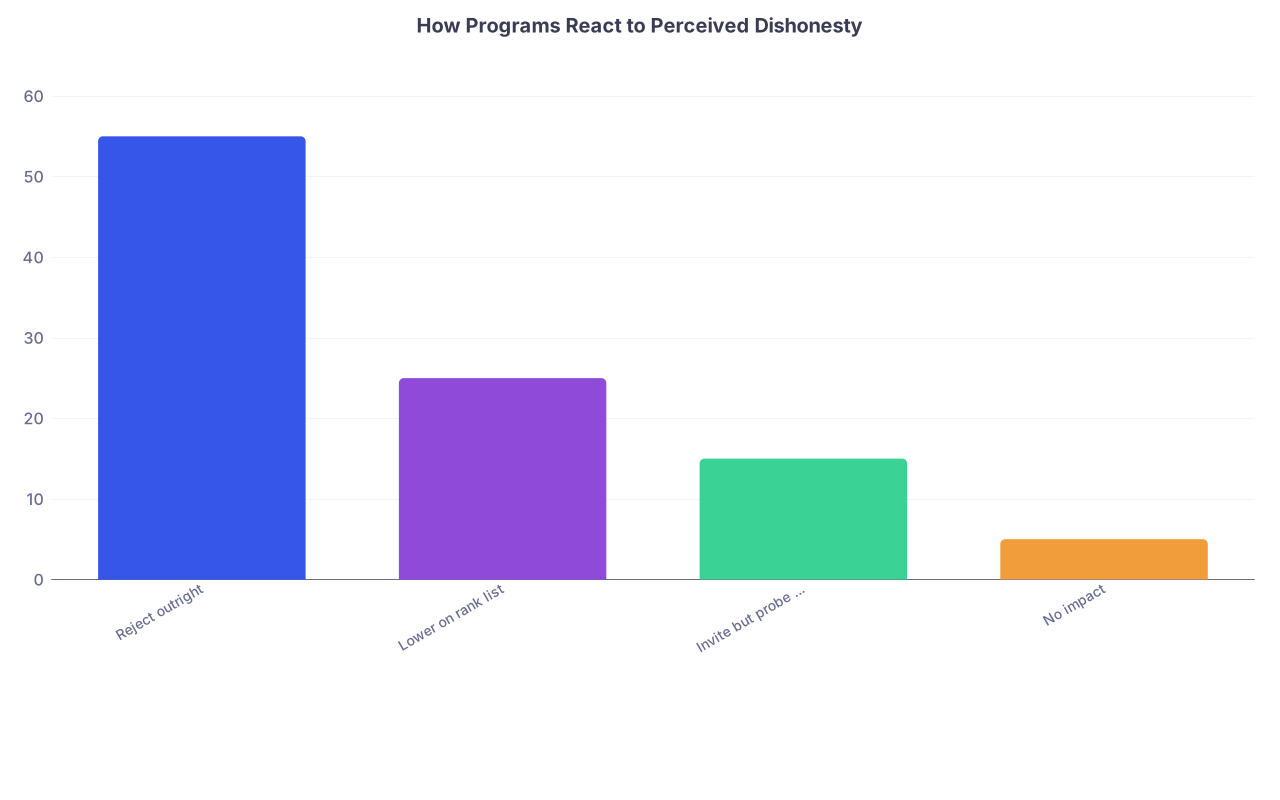
| Category | Value |
|---|---|
| Reject outright | 55 |
| Lower on rank list | 25 |
| Invite but probe heavily | 15 |
| No impact | 5 |
Mistake #1: Inconsistent Stories Across ERAS, LoRs, and Interviews
Most applicants think “honesty” is about not making things up. Programs know better. They look for internal consistency across everything you submit.
When the story shifts, it does not look like nuance. It looks like you are editing the truth for convenience.
How this mistake shows up
I keep seeing the same patterns:
- Different dates and responsibilities
ERAS says you were a “research assistant” from 06/2021–06/2023 in a cardiology lab.
Your letter writer says, “I met her in January 2022 when she joined our lab.”
On interview day, you casually mention, “I started right before M3, around July 2022.”
Three different timelines. The committee will not sit there and triangulate the truth. The reaction is simple: “If they cannot keep their dates straight, what else is off?”
- Conflicting reasons for red flags
Your personal statement: “I took a leave of absence for personal reasons and returned with renewed commitment.”
Your MSPE: “Leave of absence granted for academic remediation after failing two courses.”
In the interview: “It was really more about mental health and burnout.”
Those can all be partially true. But when they hear three versions, programs do not think “complexity.” They think “spin.”
- Different “why this specialty” narratives
ERAS experiences emphasize health policy, advocacy, and primary care.
Your personal statement says pediatrics changed your life.
Your faculty letter reads like a glowing internal medicine application.
Then, on interview day for a surgery spot, you claim you have always wanted to be a surgeon.
This is where committee members start saying things like: “I don’t actually know what this person really wants.”
Why programs read this as dishonesty
Program faculty live in a world where details matter. Medication doses. Call schedules. Duty hours. They evaluate residents partly on whether they document accurately and communicate consistently.
So when your application has:
- Mismatched dates
- Different descriptions of the same event
- Multiple explanations for failures or gaps
They do not label it “poor memory.” They label it “unreliable narrator.”
And “unreliable” is a killer word in a rank meeting.
No one wants to find out in December that the resident who forgot a Step 2 date also “forgot” to mention professionalism concerns from their home institution.
How to avoid this mistake
You fix this before you hit submit.
Build a single master timeline
Write out, month-by-month, your:- Undergrad graduation
- Pre-med or pre-clinical years
- Clerkships
- Research start/end dates
- Jobs and leadership roles
- Leaves of absence, LOAs, or time away
- Exam dates (Step/Level, repeats)
This is your reference document. Every version of your story must align with it.
Cross-check your application against your letters
No, you cannot edit your letters. But you can avoid creating contradictions.If your research mentor knows you as the student who joined in 2022, do not stretch the lab dates back to 2021 to make it look longer. If your advisor is writing about your remediation, your personal statement cannot pretend it was just “time to reflect.”
Practice your “short version” out loud
Programs hate rambling, shifting explanations. You need clean, consistent, 1–2 sentence summaries for anything that could raise questions.For example:
- Leave of absence: “I took a one-year leave after failing two courses during a difficult family situation. I repeated the year, passed all courses, and developed much better study and coping strategies.”
- Research dates: “I joined Dr. X’s lab in July 2022 and worked there until graduation, averaging about 8–10 hours a week.”
One version. Everywhere.
Audit your own materials like a PD would
This is where most applicants are lazy. You must read your entire application as if you are looking for reasons not to trust you.Ask a blunt friend or mentor: “Does any part of this make you question whether I am telling the whole truth?”
If you wait for interviews to find and fix inconsistencies, you are already in the danger zone.

Mistake #2: Half-Truths About Red Flags (Especially Exam Failures and Leaves)
Here is the most dangerous “honesty” instinct applicants have: they admit the red flag, but they sanitize it so much that it stops being believable.
Programs would rather hear an uncomfortable truth than a polished half-truth. And they are very good at smelling polish.
Common half-truth patterns
- The vague failure
ERAS: “I faced a challenge earlier in medical school that required growth and reflection.”
Personal statement: “An early academic stumble taught me resilience.”
MSPE: “Student failed Step 1 on first attempt; passed on second attempt.”
You think you are being honest because you did not deny the problem. But you also never clearly said, “I failed Step 1.” You danced around it.
Programs notice the dance.
- The sanitized LOA
You took a year off due to severe depression and burnout. Tough situation. No shame there.
Your explanation says: “I pursued research opportunities and personal development during a leave approved by my school.”
Technically true. But the MSPE hints at “personal health issues” and “supportive measures.” Your advisor mentions “struggled with stress and adjustment.”
Now it looks like you were trying to hide the mental health piece. That is what reads as dishonest. Not the depression itself.
The “I do not remember exactly” excuse
This one shows up when applicants are cornered in interviews.PD: “Why is there a gap between January and June 2022?”
Applicant: “I was kind of doing some family stuff and preparation for rotations… I don’t remember the exact timeline.”
Everybody remembers the time they had to stop medical school or were not enrolled. They may not remember which Tuesday it started. But they remember the reason.
So when you play vague, it looks like you are hiding the reason.
Why programs care more about clarity than perfection
Program directors accept that humans have problems. Plenty of excellent residents:
- Failed Step 1 or Step 2 once
- Repeated a clerkship
- Took a leave for mental health
- Had family crises mid-year
Those are not automatic disqualifiers.
Being slippery about them is.
Because residency is high-stakes. Attendings need to trust that when you make a mistake managing a patient, you will tell the full story. Not a softened version that makes you look better.
So they are not just evaluating your history. They are evaluating your instinct when confronted with uncomfortable facts.
How to be fully honest without oversharing
There is a difference between “complete enough to be trustworthy” and “every raw detail of your therapy sessions.” You want the first, not the second.
Use three questions to structure any red-flag explanation:
What specifically happened?
Clear, factual, no euphemisms.- “I failed Step 1 on my first attempt.”
- “I took a one-year leave of absence approved by my school for mental health treatment.”
- “I failed my internal medicine clerkship and repeated it successfully.”
What did you do about it?
Concrete actions, not vague “I tried harder.”- “I enrolled in a structured board prep course, completed X NBME practice exams, and changed my study schedule.”
- “I began regular therapy, met with student wellness services, and reduced outside commitments.”
- “I met weekly with my clerkship director, used standardized patients, and requested more feedback from attendings.”
What changed in measurable terms?
Programs want evidence that the issue is unlikely to repeat.- “My Step 2 score improved by 18 points over my Step 1 performance.”
- “After my leave, I passed all remaining clerkships on the first attempt, with honors in surgery and pediatrics.”
- “I have had no further professionalism or academic concerns since that event, as documented in my MSPE.”
If anything about your story does not fit comfortably into those three buckets, you are probably either oversharing or under-sharing.
Do not twist events to sound better. The goal is not “inspiration story.” The goal is “this person owns their history and has demonstrated real change.”
| Situation | Weak, Suspicious Explanation | Strong, Trustworthy Explanation |
|---|---|---|
| Failed Step 1 | “I had personal issues and did not perform to my potential.” | “I failed Step 1 on my first attempt. I addressed this by restructuring my study plan, completing 6 NBME practice exams, and meeting weekly with a faculty advisor. I passed on my second attempt and later scored 240 on Step 2.” |
| LOA for mental health | “I took time off for personal and family reasons.” | “I took a one-year leave of absence for mental health treatment during M2. During that time I engaged in therapy, worked with student wellness services, and returned with a reduced extracurricular load. Since returning, I have passed all courses and clerkships without concerns.” |
| Failed clerkship | “The evaluation did not reflect my true commitment.” | “I failed my initial internal medicine clerkship due to difficulty synthesizing data and presenting plans. I repeated the rotation, worked closely with my attending on daily feedback, and passed with solid evaluations focused on improved organization and clinical reasoning.” |

| Step | Description |
|---|---|
| Step 1 | Identify Red Flag |
| Step 2 | Write Factual Summary |
| Step 3 | Add Actions Taken |
| Step 4 | Show Objective Improvement |
| Step 5 | Check for Consistency with MSPE/Letters |
| Step 6 | Practice 1-2 Sentence Explanation |
Mistake #3: Misrepresenting Responsibility and Workload (a Subtle but Deadly One)
This is the form of “dishonesty” almost no one thinks they are guilty of. And yet residency selection committees complain about it constantly:
Applicants inflating what they did. Or using language that strongly implies more responsibility than they actually had.
Sometimes it is intentional. Often it is clumsy wording. Programs do not care which. They only care that it makes them doubt your judgment.
Where this shows up
- Overblown research roles
ERAS entry: “Led a project evaluating outcomes of X intervention; performed data analysis and drafted manuscript.”
Interview reality: You entered data in REDCap, attended lab meetings, and wrote part of the introduction for a paper that still is not submitted.
You helped with all of those things. You did not lead. Programs know the difference.
- Exaggerated clinical experience
ERAS: “Managed panel of patients in free clinic, providing longitudinal care and follow-up.”
What actually happened: You volunteered one evening every other week, shadowed closely, and sometimes presented to the attending who made final decisions.
Again, you contributed. You did not “manage a panel.”
- Leadership titles with no substance
ERAS: “Co-director, Student Wellness Initiative.”
Reality: The prior co-director graduated, your name was added to the roster, you helped run one event, then died off when clerkships got busy.
Programs read “director” and expect sustained responsibility, coordination, and outcomes.
- Weak publications dressed up as more
- Listing something as “accepted” that is actually still “submitted.”
- Calling a local poster presentation a “national” presentation because the parent organization is national.
- Writing “in press” when acceptance is conditional and not finalized.
This is where faculty on the committee start pulling up PubMed mid-meeting. If your name is not there when you say it should be, the trust hit is real.
Why this looks much worse than you think
Here is what people on selection committees say in rooms you never see:
- “If they are willing to stretch about being ‘first author’ on a QI poster, what will they do about duty hours?”
- “They called themselves ‘lead’ for something their letter writer clearly describes as a minor role.”
- “If they exaggerate on paper, they will exaggerate in their notes and handoffs.”
Again, these people live in a world where wording has consequences. “Tylenol given” vs “Tylenol ordered but not given” is not a trivial difference.
So when your verbs are stronger than your actual responsibilities, you are sending one loud message: “I do not fully appreciate accuracy.”
That is another word you do not want attached to your name in a rank meeting.
How to describe your work accurately without underselling
You do not need to sound small. You need to sound precise.
Two rules:
Match verbs to actual responsibility level
Use “assisted,” “contributed,” “participated,” “supported,” when:- Someone else designed the project
- Someone else had final authority
- You worked under supervision the whole time
Reserve “led,” “managed,” “directed,” when:
- You were the primary driver
- You coordinated other people’s work
- You made key decisions and were accountable for outcomes
Example correction:
- Weak/honesty-risk wording: “Managed a research team of 5 students working on sepsis outcomes.”
- Strong/accurate wording: “Coordinated data collection for a 5-student team on a sepsis outcomes project under Dr. X; responsible for tracking enrollment and maintaining the REDCap database.”
Anchor your claims to something verifiable
Exaggeration unravels when someone looks up your work.Clean approach:
- “Poster presented at the [Conference Name], Regional Meeting, 2023.”
- “Manuscript in preparation; draft reviewed by mentor and targeted for submission to [Journal].”
- “Volunteer, student-run free clinic, 2 evenings/month, primarily obtaining histories and presenting to supervising physician.”
You are not being humble. You are being credible.
And credibility is a currency you need much more than “impressive-sounding” verbs.

The Hidden Fourth Mistake: “I’ll Explain It in the Interview”
One more thing applicants do that silently destroys them: they treat the written application like a placeholder and assume they can clarify any misunderstandings on interview day.
You may not get that chance.
Programs screen you based on what they see before they invite you. If your application raises even mild questions about honesty or consistency, there is a good chance you never make it to the interview list.
And if you do get an interview, you are not guaranteed a long, gentle conversation about every detail. You may get:
- One rushed 15–20 minute faculty interview
- A resident who does not care about the nuance of your LOA
- No one assigned to read your file deeply until after the interview
So if the written record makes you look slippery, confused, or inconsistent, that impression may never be fully repaired.
Your application itself must be able to stand up to scrutiny as if no interview will happen.
Quick self-audit checklist before submission
Read through your entire application and ask yourself, ruthlessly:
- Does every date match across ERAS, CV, MSPE, and what I plan to say out loud?
- Is every explanation for a red flag clear, direct, and consistent with institutional documents?
- Could any verb be read as overstating what I actually did or the level of responsibility I had?
- Is there anything that I am hoping to “fix later” in an interview?
If you are relying on “I’ll fix it later,” you are already making a high-risk bet.
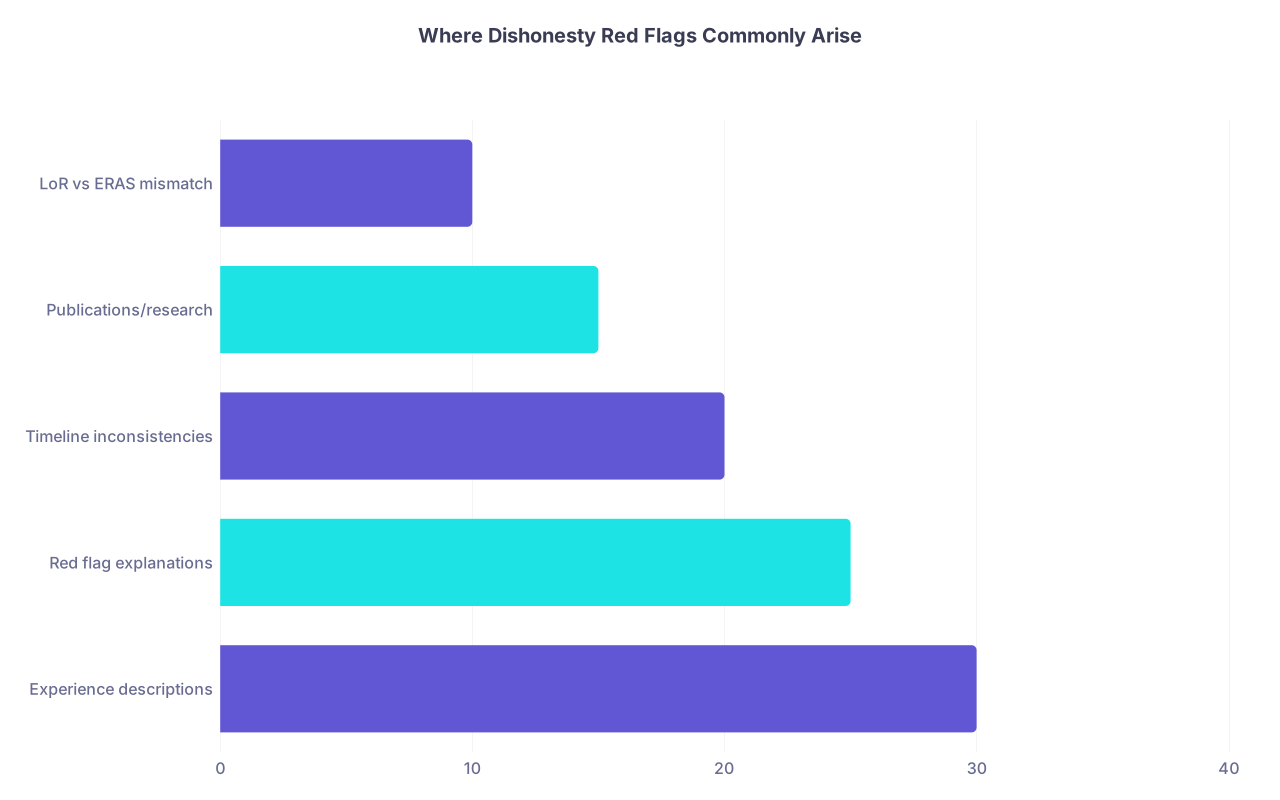
| Category | Value |
|---|---|
| Experience descriptions | 30 |
| Red flag explanations | 25 |
| Timeline inconsistencies | 20 |
| Publications/research | 15 |
| LoR vs ERAS mismatch | 10 |
Final Tight Summary: What You Must Not Get Wrong
Three points to carry with you, and then you can go fix your ERAS draft:
Inconsistency kills trust. If your dates, stories, or explanations change between ERAS, MSPE, letters, and interviews, you look unreliable, not nuanced. Build a single, precise master timeline and stick to it everywhere.
Half-truths about red flags are worse than the red flags themselves. Clearly name what happened, what you did to address it, and how your performance changed. Do not euphemize failures or leaves of absence into vague “personal challenges.”
Inflated roles and fuzzy verbs look like dishonesty. Match your wording to your real level of responsibility, and anchor claims to verifiable facts. Being precise about what you actually did makes you look trustworthy, not small.
If you fix these, you stop looking like a risk and start looking like what programs actually want: a resident they can believe.