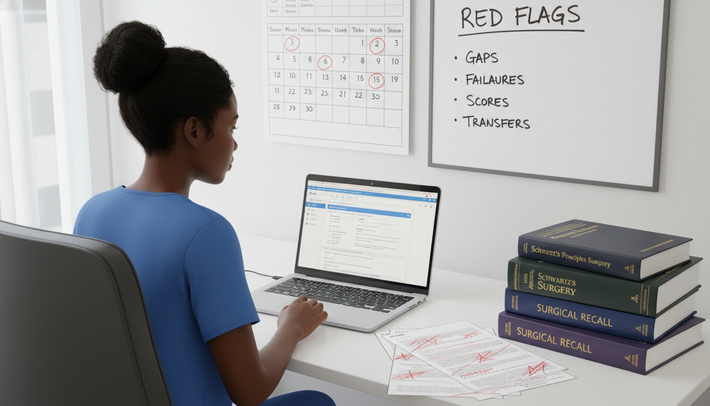
The fastest way to torpedo a residency application is to copy‑paste explanations across programs and assume nobody will notice.
They notice.
Program directors, coordinators, and faculty reviewers see hundreds of applications in a season. They’re not fooled by generic “I’m especially interested in your program because…” paragraphs you slap onto every ERAS application. And they absolutely remember when your explanation for a leave of absence or red flag sounds eerily identical to the one they just read for another program.
Let me walk you through why this backfires, what it signals, and how to avoid branding yourself as lazy, insincere, or dishonest.
The Ugly Truth: Program Directors Trade Stories
I’ve sat in rank meetings where someone reads a line from a personal statement out loud and another faculty member says, “Hold on, I’ve seen that exact sentence before.” They had. Different applicant. Same recycled fluff. We Google. We compare. We roll our eyes.
When you copy‑paste:
- Your “interest in the program” sounds indistinguishable from what others write
- Your explanation for red flags sounds scripted and evasive
- Your email language matches what you sent to 40 other programs
That’s not “efficient.” That’s a red flag.
Here’s the mindset you’re accidentally broadcasting:
- “I don’t care enough about your program to write something real.”
- “I’m doing the bare minimum and hoping no one digs deeper.”
- “My story is canned; I’m managing optics, not telling the truth.”
Programs aren’t naïve about applicants using templates. But there’s a huge difference between using structure and copying explanations verbatim everywhere.
Copy‑pasting is how you cross the line from “organized” to “disingenuous.”
Where Copy-Paste Hurts You Most
Let’s go section by section. These are the hot zones where recycled language does the most damage.
1. “Why Our Program?” Paragraphs
This is the #1 area where lazy copy-paste screams at reviewers.
Common mistakes I see:
- Using the same three adjectives for every program: “supportive environment,” “strong clinical training,” “diverse patient population”
- Dropping in the wrong city or institution name
- Complimenting features the program doesn’t even have
- Writing something so bland it could apply to 90% of programs
Example of what backfires badly:
“I am particularly drawn to your program’s commitment to underserved care, robust research opportunities, and strong sense of camaraderie among residents.”
I’ve seen that sentence, or close cousins of it, hundreds of times. Change “underserved” to “diverse,” swap “research” with “innovation,” it’s still the same mush.
What it tells readers:
- You probably didn’t look past the homepage
- You couldn’t be bothered to learn anything specific
- You want us to believe we’re “top choice” when this is clearly mass‑distributed
And yes, programs compare. When two applicants both write “I would be honored to pursue my training at your esteemed institution known for its tight‑knit community,” we know you pulled that from somewhere.
2. Explanations for Red Flags (LOA, Failures, Gaps)
This is more dangerous.
Explaining the same complex life event to 40 programs using identical, overly polished language is a problem. It often reads like it came straight from a dean, advisor, or ChatGPT instead of from you.
Program directors are especially wary when:
- Your explanation feels sanitized beyond belief
- The wording is identical to other applicants from your school
- You clearly copy‑pasted a long paragraph with no program‑specific context
What’s risky to copy‑paste:
- Explanations of:
- Leave of absence
- Step/COMLEX failures
- Course or rotation failures
- Professionalism concerns
- Institutional actions
The most suspicious pattern: a perfectly phrased, PR‑like explanation, repeated word‑for‑word, with no variation.
Why it backfires:
- It looks coached and inauthentic
- It makes interviewers assume your story is fragile; they expect the “real” version to leak under pressure
- It makes them wonder what you’re omitting
You MUST be consistent across programs, but “consistent” does not mean “identical canned paragraph with zero nuance.”
3. Post-Interview Emails and Interest Signals
Another minefield.
Programs talk to each other. Especially within the same city or region. If your “you’re my top choice” language looks suspiciously similar across institutions, someone will mention it.
Examples that get people burned:
- Sending the same “you are my top choice” email to multiple programs
- Copy-pasting the same post‑interview thank-you note to all faculty you met
- Reusing the same “I will rank you highly” language across multiple places that share faculty or residents
Faculty aren’t stupid. Many have trained, worked, or moonlighted at multiple institutions. They compare notes over coffee. I’ve literally heard:
“Funny, they told us we were their clear #1, but my colleague at X Hospital got almost the same message.”
You don’t want your name attached to that story.
4. Letters You “Helped Draft”
Unpleasant truth: some students quietly draft parts of their own letters of recommendation. Sometimes the writer asks for “bullet points,” sometimes for “a draft.” It happens.
The mistake: reusing almost the exact same bullet‑point language for:
- Multiple letters from different attendings
- Personal statement
- Experiences section
Then your entire file starts sounding like one voice. The same phrases. The same adjectives. The same stories repeated with eerily similar wording and sentence structure.
Programs notice when:
- Your personal statement and your “LOR” use the same odd phrase
- Two different letter writers “independently” describe you with identical language
- The same specific anecdote appears in multiple places with near‑identical wording
Now they’re not just doubting your judgment. They’re doubting the authenticity of your whole application.
The Deeper Problem: What Copy-Paste Really Signals
Let’s be blunt. Copy‑pasting explanations doesn’t just look lazy. It triggers very specific concerns in PDs’ minds.
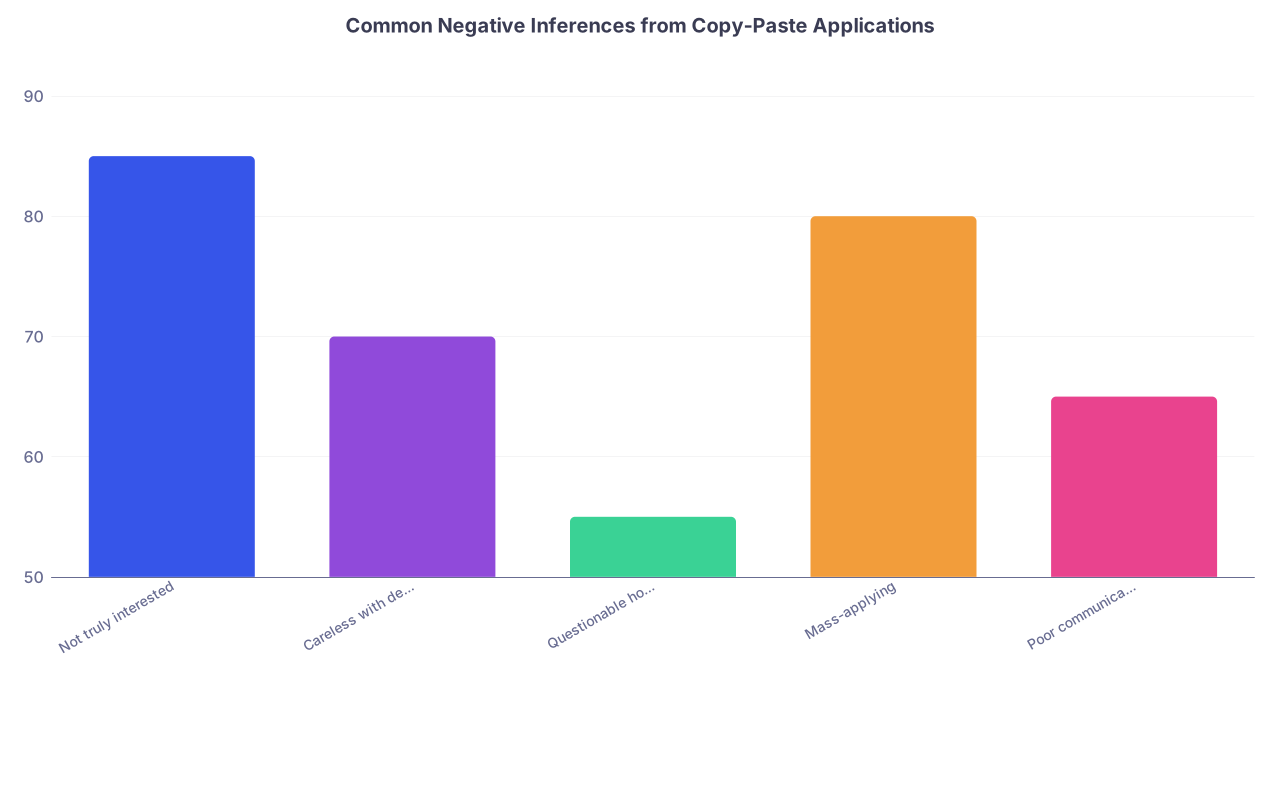
Here’s what they infer, fairly or unfairly:
You’re not actually interested in their program
If you can’t be bothered to write 3 user‑specific sentences, why should they invest thousands of dollars and three years of training in you?You may be careless with details
Copy‑pasting is how you end up telling a rural community program how excited you are about “tertiary quaternary care and advanced transplant” they do not offer.You might struggle with honesty under pressure
Especially for red flags. When your explanation sounds scripted and over‑managed, they worry about your ability to own mistakes in real clinical settings.You’re treating the process like a numbers game, not a match
It tells them you’re shotgunning applications without thought. That you care more about “anywhere” than about “here.” And programs want residents who chose them intentionally, not by default.
| Category | Value |
|---|---|
| Not truly interested | 85 |
| Careless with details | 70 |
| Questionable honesty | 55 |
| Mass-applying | 80 |
| Poor communication skills | 65 |
Those percentages aren’t from a formal study; they’re roughly where PD opinions cluster when you listen to them long enough.
Where You Can Reuse Structure Safely
Now, don’t overcorrect and reinvent the wheel 100 times. That’s how you burn out midway through application season.
There’s a difference between copying content and reusing structure.
Safe(ish) places to reuse:
- The core story of your personal statement
- A consistent narrative for red flags (content stable, wording slightly adapted)
- A general explanation of your career goals that stays same across programs
But here’s the key: you must build in slots for genuine customization.
Think of it as a template with required fields you cannot leave generic.
A Practical Anti–Copy-Paste System
You need a system that keeps you efficient without making you look like a robot.
Step 1: Create a Core Document Library
Write a master version of:
- Personal statement (with clearly marked spots to customize for program type if needed)
- Red flag explanations (one for ERAS experiences/PS, one shorter for interviews)
- A neutral post‑interview thank-you template (for structure only)
Never send the raw master. Always adapt.
Step 2: Build Program-Specific Snapshots
For each program, do 10–15 minutes of focused research:
- 2–3 specific strengths (actual rotations, tracks, hospitals, faculty)
- 1–2 features that match your background or goals
- Any red flag you have that’s especially relevant (e.g., need for visa, couples match, location constraints)
Put this into a simple doc or spreadsheet.
| Program | 2 Specific Features | 1 Personal Fit Point |
|---|---|---|
| County IM | Safety-net hospital, Spanish clinic | Prior FQHC work |
| University Neuro | EMU, MS center | MS research experience |
| Community FM | OB track, rural sites | Grew up rural |
Now, when you write, you’re not inventing from scratch, but you’re also not pasting the same nonsense everywhere.
Step 3: Force Yourself to Write 2–3 Unique Sentences per Program
Non‑negotiable rule: You must include at least two sentences that only make sense for that program.
Bad generic line:
“Your program’s diverse patient population will prepare me to care for a wide range of conditions.”
Good specific line:
“Your continuity clinic at Eastside Community Health, with its large Somali patient population and integrated behavioral health, aligns with my prior work with immigrant communities and my goal of practicing community psychiatry.”
That sentence cannot be safely copy‑pasted to another program without sounding wrong.
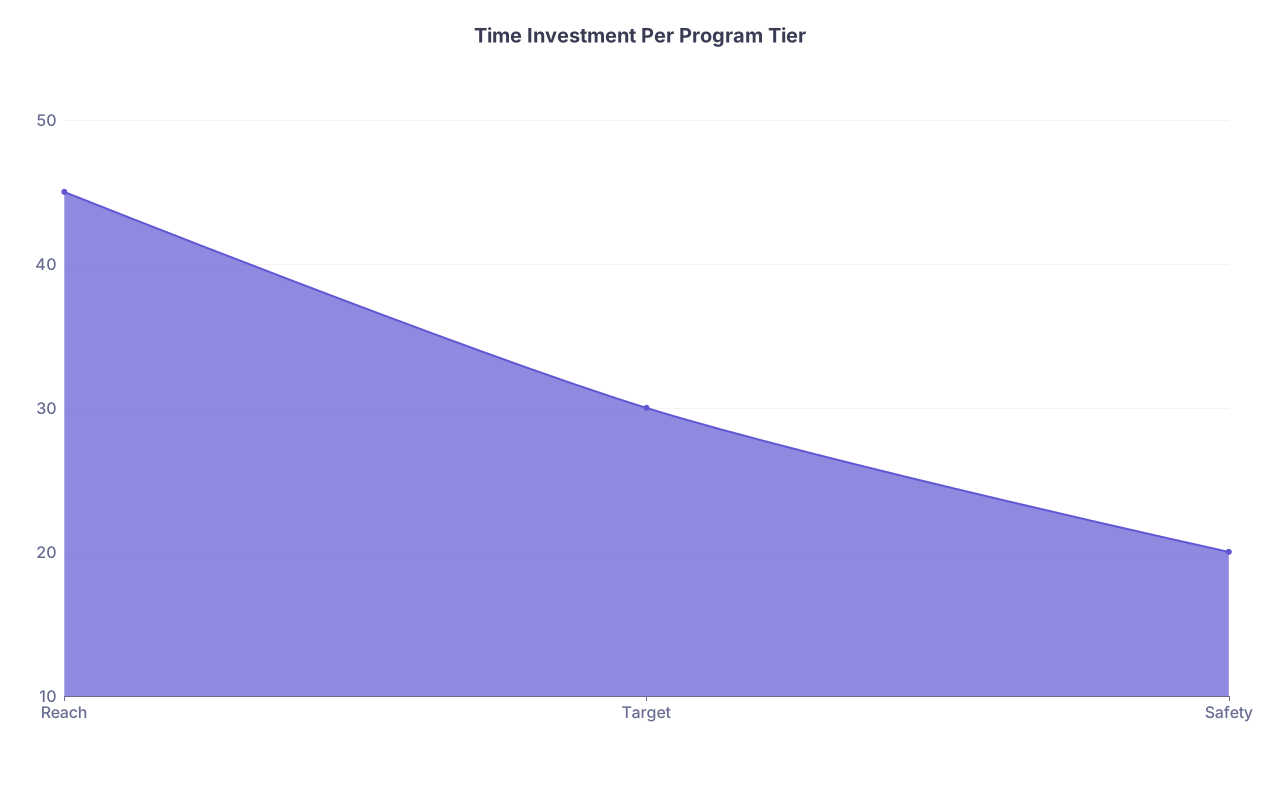
Step 4: Separate Content for Different Program Tiers
Let’s be honest. You’re more invested in some programs than others. That’s fine. But don’t make it obvious by sending obviously recycled content to the “backups.”
Here’s a tiered approach that avoids disaster:
| Category | Value |
|---|---|
| Reach | 45 |
| Target | 30 |
| Safety | 20 |
Reach programs – 45–60 minutes each
- Deep research
- Very specific explanation of fit
- Strong program‑tailored paragraphs
Target programs – 25–35 minutes each
- Solid research
- 2–3 specific details tied to your story
Safety programs – 15–25 minutes each
- Still: at least 2 real details
- No lazy copy-paste of obviously generic praise
You still must avoid sending anything blatantly canned. Even to your “safeties.” Especially to your safeties. They can tell.
Red Flags in Red Flag Explanations
Let’s dig more into the sensitive area: explaining problem spots.
What NOT to Do
Do not use the same overly polished paragraph everywhere with zero variation.
It reads like it came from your advisor’s email folder.Do not change the story between programs.
You can adapt emphasis, but the core facts must be identical. If your narrative shifts, and programs cross‑talk, that’s a serious professionalism concern.Do not overstuff with emotional buzzwords.
“Journey,” “resilience,” “growth,” “transformative,” “unprecedented challenges.” Overuse screams template.Do not pretend the red flag is unique to this one program.
Don’t say, “I wanted to be transparent with your program about my Step failure” as if you’re only telling them. That’s manipulative.
What TO Do Instead
Keep a consistent backbone story:
- What happened (concisely)
- What you learned, specifically
- What you changed, concretely
- Evidence of improvement (scores, evals, responsibilities)
Then adjust:
- A sentence about how you’ve proven reliability in the settings that matter to that specialty/program
- Emphasis on aspects that align with their environment (heavy inpatient? lots of autonomy? strong remediation culture?)
You’re not changing the facts. You’re showing why, in their environment, you’re safe and ready.
The Tech Trap: Overusing AI to “Polish” Everything the Same Way
Let’s address the obvious: people are using AI tools to draft and “refine” their applications. The red flag isn’t using tools; it’s using them the same way for every single program.
Patterns PDs are starting to see:
- Same hyper‑polished style across PS, experiences, and emails
- Awkwardly formal or verbose language inconsistent with how the applicant speaks
- Identical sentence structures and buzzwords, application‑wide
When all your content sounds like a LinkedIn motivational post, programs tune out. Worse, they question who did the real thinking.
Use tools to:
- Catch grammar errors
- Shorten overlong sentences
- Suggest alternate words if you’re stuck
Do not use them to:
- Generate your entire personal statement
- Produce your “why this program” answers from scratch
- Draft one red flag explanation you then paste 40 times
You’re not “optimizing.” You’re erasing your voice.
A Simple Pre-Send Checklist to Avoid Copy-Paste Disaster
Before you hit submit or send for ANY program‑specific content (ERAS PS, secondary response, email), check:
Program name and location correct?
You’d be amazed how often people screw this up.At least two sentences that ONLY fit this program?
If you can read it and reasonably send it to five other programs, it’s too generic.No references to features this program doesn’t have?
Double check tracks, fellowships, hospital names.Consistent with your overall narrative?
Red flags, goals, and strengths should not morph between programs.If someone forwarded this to another PD, would I be embarrassed?
That’s the real test. Assume anything you send can travel.
Visualizing the Safer Process

| Step | Description |
|---|---|
| Step 1 | Start Application |
| Step 2 | Draft Master Documents |
| Step 3 | Create Program Snapshot |
| Step 4 | Insert 2-3 Unique Sentences |
| Step 5 | Check for Copy-Paste Red Flags |
| Step 6 | Submit/Send |
| Step 7 | Program-Specific Enough? |
If you’re skipping straight from A to G in practice—just pasting from last time—you’re the person this article is warning.
FAQs
1. Is it really that bad to use the same personal statement for all programs?
Using the same core personal statement is generally fine, especially within one specialty. The problem is when you pretend it’s “tailored” but it’s obviously generic, or when you leave in half‑baked, program‑specific sentences that could apply anywhere. If you don’t have a “why this program” section or specialty‑specific variations, one master PS per specialty is acceptable. Just don’t lie to yourself about it being customized when it isn’t.
2. How different do my “why this program” sections need to be?
They need to be different enough that if I swapped program names, something would break or clearly seem off. Two or three concrete details that tie their actual features to your real experiences or goals is usually enough. If all you’re changing is the program name and one adjective, you’re still in copy‑paste territory.
3. Can I reuse the same explanation for a Step failure or LOA everywhere?
You should keep the facts and structure consistent, but you shouldn’t send a 100% identical block of text without thought. Slightly adjust emphasis depending on what matters to that program (e.g., heavy ICU vs. outpatient focus), but don’t change the story. Think of it as one core explanation with small, honest tweaks for context—not 40 clones.
4. What if my school gives me a template for addressing red flags?
Use it as a starting point, not a script. Templates often sound exactly like what they are: institutional CYA language. If ten people from your class submit the same phrasing, everyone looks worse. Take the structure (brief description, lessons, changes, evidence of improvement) and rewrite it fully in your own words.
5. How do I stay efficient without falling into copy-paste?
Build a smart system:
- One master PS per specialty
- One core red flag explanation you tweak slightly for context
- A simple snapshot doc per program with 2–3 specific features and 1–2 personal connections
- A basic email structure (greeting, specific reference, gratitude, closing) that you fill with real, individualized content
Efficiency comes from reusing structure and thought process, not from cloning your words across every program.
Key points to remember:
- Copy‑pasting explanations across programs doesn’t look “efficient”; it looks lazy, insincere, and sometimes dishonest.
- You can safely reuse structure and core narratives, but you must inject specific, program‑unique details and your own real voice.
- Assume programs compare notes. If you wouldn’t want your words read aloud in a PD group chat, don’t send them.