
12 Ways Applicants Accidentally Magnify Red Flags in ERAS and PS
It is 1:30 a.m. You are on your fourth “final” draft of your personal statement. ERAS is open in another tab. You keep rereading the same paragraph about your leave of absence and that Step 1 fail. You know these are red flags. What you do not realize is that the way you are trying to “explain” them is actually making them look worse.
That is what this is about. Not the red flags themselves. The unforced errors that make programs say, “Hard pass.”
I have watched otherwise decent applications die on the table because the applicant magnified their issues in ERAS and the personal statement. Not because of the underlying problem, but because of:
- How they framed it
- What they chose to emphasize
- Where they tried to hide or spin things
Let me walk you through the big ways people shoot themselves in the foot.
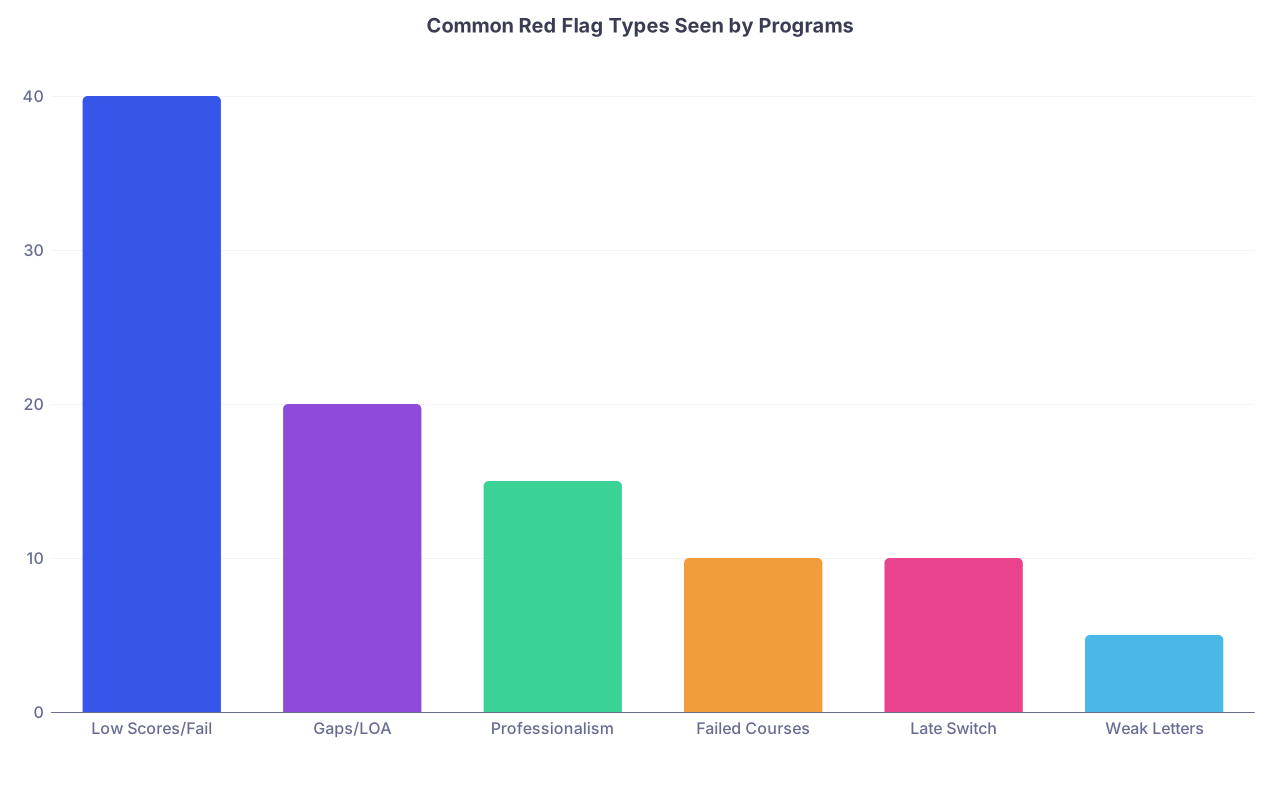
| Category | Value |
|---|---|
| Low Scores/Fail | 40 |
| Gaps/LOA | 20 |
| Professionalism | 15 |
| Failed Courses | 10 |
| Late Switch | 10 |
| Weak Letters | 5 |
1. Turning a Manageable Red Flag into the Centerpiece of Your Personal Statement
The first big mistake: building your entire personal statement around the worst thing in your file.
You had a Step 1 failure. Or a leave of absence. Or you repeated a year. That is not ideal. But when your personal statement becomes a 1,000-word defense brief about that one issue, you do the program’s job for them: you tell them the risk defines you.
Bad pattern I keep seeing:
- Two lines about why you like the specialty
- One line about a patient
- Then four giant paragraphs about “resilience” and “overcoming” your Step failure
By the end, all the reader remembers is: “This applicant failed Step. Feels fragile. Still talking about it.”
What to do instead:
- The personal statement is for: who you are, why this specialty, how you work, how you fit into a team.
- If you must address a red flag here, give it 2–4 sentences. Clear, factual, past tense, and move on.
- Let your broader narrative show that you are reliable and stable now, not glued to your lowest point.
Do not turn your application into a memorial to your worst academic day.
2. Writing Defensive or Bitter Explanations in ERAS Text Boxes
The “Additional Information” or “Education Interruptions” sections are land mines if you treat them like a courtroom.
Common ways people ruin themselves:
- Blaming: “My Step 2 performance was affected because the school did not adjust for COVID…”
- Attacking: “The clerkship director unfairly evaluated me…”
- Legalistic tone: long, argumentative paragraphs that sound like a grievance letter
Program directors read that and think: difficult to work with, lacks insight, will blame others.
How to avoid this:
- One to three sentences. Max.
- Stick to: what happened, why in one neutral line, what is different now.
- No adjectives like “unfair,” “biased,” “hostile,” “toxic.” You will lose that argument every time.
Example of what not to write:
“I received a professionalism citation due to a misinterpretation of my intent by the attending physician during an extremely stressful rotation, which I still believe was not handled appropriately by the administration.”
You just told them you have not learned anything from it.

3. Trying to Hide Red Flags Instead of Owning Them Briefly
Another predictable disaster: trying to bury something the program will definitely see.
Examples:
- Not listing a failed course or LOA that is on your transcript
- Hoping no one notices the Step 1 fail in the USMLE transcript
- Leaving the interruption section blank when you repeated a year
Here is what actually happens: a coordinator or PD compares ERAS to your transcript and discovers the omission. Now the red flag is not the failure. It is your honesty.
You are not going to “sneak” something past modern residency programs. They are used to this. They look. They talk. Some share information.
Better option:
- Acknowledge the required items where ERAS asks you.
- Provide a concise, matter-of-fact explanation.
- Then demonstrate consistency afterward: better grades, passed Step 2 on first attempt, strong clinical evaluations.
You cannot outsmart the system. Trying to hide almost always creates a second red flag: integrity.
4. Overexplaining Personal Problems and Making Programs Worry About Future Reliability
There is a quiet line between “reasonable context” and “future liability.” Many applicants blow past that line.
I have seen explanations like:
- “I took a leave of absence because I was going through a very difficult time with my relationship and was not able to concentrate.”
- “My Step failure occurred during a major depressive episode with suicidal ideation.”
- “I had multiple panic attacks during clerkships and had to miss shifts.”
I am not minimizing any of that. Those are real, serious issues. But most programs are thinking: can this resident safely handle a 28-hour call, cross-covering 60 patients, with three codes at once? They are not your therapist. They are responsible for patient care and team stability.
What helps, what hurts:
Helps:
- Brief mention of a health or family issue, if relevant
- Clear statement that it is resolved or well-managed
- Evidence afterward: consistent performance, no further gaps, letters mentioning reliability
Hurts:
- Detailed psychiatric history
- Ongoing instability (“I still struggle a lot but I am trying…”)
- Suggesting you may need more time off in residency
You owe yourself privacy. Do not put your full mental health chart into ERAS. It will not help you.
5. Using the Personal Statement as a Confessional Dump
There is this odd belief that residency programs want a dramatic redemption arc. They do not. They want people who function.
Things I have actually seen applicants confess in personal statements:
- Cheating in undergrad (then “finding integrity”)
- Repeated substance abuse during preclinical years
- Being “checked out” and not caring on rotations
- Chronic lateness and blowing off responsibilities
Even if those things are in your distant past, making them the emotional centerpiece of your PS tells the reader: this is either still who you are, or you have poor judgment sharing it here.
Red flags to avoid broadcasting voluntarily:
- Past cheating or academic misconduct that is not already documented
- Substance issues that are not formally in your file and are now stable
- Personality traits that scream “unprofessional”
Your personal statement is not a memoir. It is targeted marketing. Do not add new red flags that nobody asked about.
| Approach | Bad Example | Stronger Example |
|---|---|---|
| Tone | “I was extremely anxious and the test was unfair…” | “I underperformed on Step 1 due to inadequate preparation.” |
| Length | Full paragraph, emotional | 2–3 sentences, factual |
| Focus | Past problem | Current performance and growth |
| Follow-up | No data | Step 2 score, clinical success |
6. Contradicting Yourself Between ERAS, MSPE, and Personal Statement
Program directors are not skimming just one part of your file. They are triangulating.
Common contradictions that raise eyebrows:
- PS: “I have always been passionate about internal medicine.” MSPE: “Originally committed to neurosurgery until late M4.”
- ERAS education interruption: “Family reasons.” MSPE: “Student took a leave of absence for academic remediation after failing multiple courses.”
- PS: “I am punctual and reliable.” MSPE comments: “Frequently late to clinic. Failed to complete notes on time.”
When stories do not align, they assume the least flattering explanation: you are minimizing, spinning, or not fully honest.
Fix this by:
- Reading your MSPE and transcript before finalizing explanations.
- Making sure your stated reasons at least roughly match what is in the official documents.
- Not trying to reinvent the past in your PS.
You do not have to give every detail. But you cannot tell a different reality.
7. Overcompensating with Cringe “Resilience” Language
There is a particular genre of red-flag explanation that screams desperation. You will recognize it:
“I emerged from this experience as a stronger, more resilient, and more empathetic future physician.”
If you write that after a Step failure or failed course and have no evidence to back it up, it sounds hollow. They are not moved. They are annoyed.
Symptoms of overcompensation:
- Buzzwords: resilience, grit, growth mindset, adversity
- Excessive emotional adjectives: incredibly, extremely, profoundly
- Dramatic tone completely disproportionate to the event (failing one exam is not a Greek tragedy)
Program directors want to see that you learned something, not that you copied “adversity essay” templates.
A better frame:
- One sentence: what went wrong (specific, non-dramatic)
- One sentence: what you changed (study strategy, time management, getting tutoring)
- One sentence: objective evidence of improvement (higher Step 2, honors, strong evals)
Save the inspirational poster language. They are not looking for that.
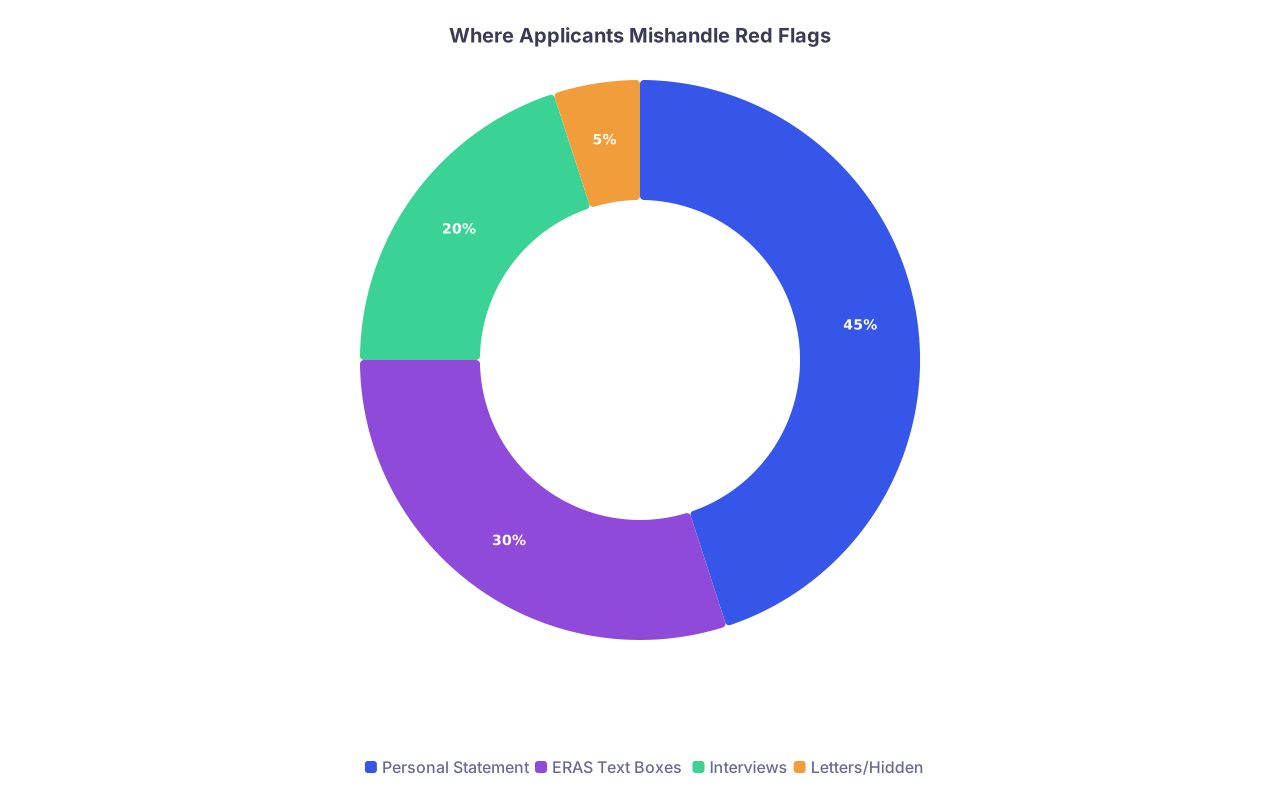
| Category | Value |
|---|---|
| Personal Statement | 45 |
| ERAS Text Boxes | 30 |
| Interviews | 20 |
| Letters/Hidden | 5 |
8. Choosing the Wrong Person to Address Your Red Flag in a Letter
Sometimes it is appropriate for a letter writer to comment on a past issue. Many applicants mishandle who and how.
Bad moves:
- Asking a lukewarm attending to “explain” your professionalism citation
- Letting someone write, “Despite his prior issues with punctuality, he has improved significantly” when the program had no idea you ever had punctuality issues
- Selecting a dean who focuses more on “context” for your failures than on your abilities
Letters that amplify red flags often sound like they are trying too hard to rehabilitate you. That backfires.
When a letter can help:
- The writer actually knows you well, post-issue.
- They can credibly say: “He had X problem then, and in the last year I have seen consistent, reliable performance.”
- The concern is already obviously in your file (e.g., a remediation year).
Do not recruit someone to “explain away” your problems. Recruit people who can vouch for current reliability with concrete examples.
9. Making Career Indecision Look Like Instability
You are allowed to change your mind about specialty. Lots of people do. But if you narrate that shift poorly, you will look impulsive or flaky.
Application-killing patterns:
- PS that reads like you still might want another specialty
- Describing three or four major switches in interest during M4
- Talking at length about your “identity crisis” with specialty choice
Example of what programs read between the lines:
- “I spent most of medical school committed to orthopedics, but late in my fourth year I realized my true calling was psychiatry…” → They wonder: did you just not match into ortho? Are you running to psych or just running away?
How to not magnify this:
- If you switched once, fine. Say you explored X, then found Y better aligned with your strengths and what you enjoyed day-to-day.
- Emphasize the clinical experiences in your chosen specialty that confirmed the fit.
- Do not drag them through months of inner turmoil.
Stability sells. Whiplash does not.

| Step | Description |
|---|---|
| Step 1 | Academic/Professional Issue Occurs |
| Step 2 | Documented in Transcript/MSPE |
| Step 3 | Omission Discovered |
| Step 4 | Neutralized |
| Step 5 | Red Flag Magnified |
| Step 6 | Context Without Spotlight |
| Step 7 | Letters and Interviews Reinforce Stability |
| Step 8 | Address in ERAS? |
| Step 9 | Address in PS? |
10. Turning “Context” into an Excuse Parade
There is a subtle but critical difference between context and excuse.
Context:
“I failed Step 1 because I underestimated the exam and relied too heavily on passive learning. I adjusted by restructuring my study schedule, using question banks daily, and seeking faculty guidance.”
Excuse:
“I failed Step 1 because my school did not teach us well and the pandemic made it impossible to focus.”
Programs are allergic to excuses. Once they detect the pattern—always something external, always someone else at fault—they stop believing anything else you say.
Watch out for these phrases:
- “The administration…”
- “My school did not…”
- “The exam was unfair because…”
- “The attending did not like me…”
You can mention external factors lightly if they were extreme (major family crisis, serious illness). But if every problem in your record has a different villain, the common denominator is you.
Own your role. Then show what changed.
11. Packing ERAS with Filler to Distract from Red Flags
Some applicants try to bury their issues under an avalanche of “activities.” The result is the exact opposite.
Red flags this creates:
- 18 “research projects,” none with publications or clear role
- Dozens of minimal-involvement volunteer entries that look like padding
- Overblown descriptions of trivial roles (“Led strategic initiatives for departmental transformation” = you made a flyer)
Program directors skim, not count. When they see a bloated activities list, they assume you are compensating.
Better approach:
- List substantive things where you actually did work.
- Write concise descriptions with specific actions and outcomes.
- Accept that a solid but not flashy experiences list is better than obviously inflated noise.
Trying to “out-quantity” a red flag does not work. They notice the quality drop first.

12. Letting Someone Else Rewrite Your Voice into Something Inauthentic
Final land mine: outsourcing your narrative so much that it does not sound like a real human.
You send your PS to five residents, three attendings, and a “professional editor.” They Franken-edit it into:
- Corporate buzzwords
- Ultra-polished, generic clichés
- Zero trace of how you actually think or speak
Programs are very good at spotting canned essays. When your writing style in the PS does not match your emails, your interview manner, or even the rest of your ERAS entries, it raises a quiet red flag: who are we actually getting?
Even worse, sometimes these “helpers” advise terrible red-flag amplifications:
- “Lean into your adversity more.” (You end up oversharing.)
- “You have to tell the full story of your depression.” (No, you do not.)
- “Blame COVID more; everyone will understand.” (They will roll their eyes.)
Get feedback, yes. But maintain control:
- Keep your explanations brief and in your own language.
- Reject edits that add drama, victimhood, or excessive “resilience” rhetoric.
- Read your final PS out loud. If you would never say these sentences, fix them.
You are the one whose name is on the match list. The voice on the page should actually be yours.
Final Thoughts: Do Not Help the Red Flags
Three things I want you to walk away with:
- Do not spotlight your worst moments. Acknowledge them briefly, factually, and show who you are now, not who you were on your worst day.
- Avoid blame, drama, and overexposure. Programs want stable, reliable residents, not extended narratives of chaos and grievance.
- Consistency beats spin. Make sure ERAS, MSPE, your PS, and (if needed) letters all tell the same calm, coherent story.
Your issues are probably not unique. Plenty of residents have matched with worse. The real danger is not the red flag itself.
It is how you write it.