
The most dangerous part of disclosing a mental health leave is not the leave itself. It is how you talk about it.
Programs are not automatically scared of your depression, anxiety, burnout, or hospitalization. They are scared of three things: unpredictability, liability, and extra work. If your application feeds those fears—by how you frame your leave—you have just built your own red flag.
Let me walk you through the most common ways applicants sabotage themselves when addressing mental health–related leaves, and what to do instead.
The Core Reality You Cannot Ignore
Before we get into specific mistakes, you need to understand the playing field.
Residency programs care about three non-negotiables:
- Will you show up reliably?
- Will you be safe for patients and colleagues?
- Will you complete the program?
Your mental health history, on its own, does not answer “no” to any of those. Your story about it might.
The wrong way to address mental health leave signals:
- Ongoing chaos
- Poor judgment
- Lack of insight
- Blame-shifting (“they did this to me”)
- Fragility under stress with no clear plan forward
The right way signals:
- Stability now
- Maturity and insight
- Concrete recovery steps
- Realistic understanding of residency demands
- Evidence you can function at a high level again
Keep that lens in your head as we go. You are not trying to win sympathy. You are trying to neutralize concern.
Mistake #1: Over-Sharing Your Psychiatric Chart in an Application
The most common and most damaging error: turning your ERAS application into a psychiatric case report.
I have seen personal statements and “red flag explanations” with sentences like:
- “I was hospitalized for suicidal ideation two times during MS3…”
- “My bipolar II disorder flared and I went off my medications for several months…”
- “I developed severe PTSD after a relationship ended and could not function…”
This level of detail feels “honest” to the applicant. To a program director, it reads as:
- High risk of recurrence
- Poor boundaries
- Questionable judgment
You are not talking to your therapist. You are talking to an employer evaluating risk.
The specific ways over-sharing kills you
Unnecessary clinical labels
You volunteer diagnoses you are not required to disclose:- “Borderline personality disorder”
- “Bipolar I with psychotic features”
- “Severe recurrent major depressive disorder with suicide attempts”
Programs are not legally allowed to ask for this level of detail. When you give it freely, they start imagining worst-case scenarios: leave during intern year, disruptive behavior, emergency remediation.
Graphic symptom descriptions
Describing:- Suicide attempts
- Self-harm behaviors
- Psychotic episodes
- Substance misuse in explicit terms
This creates a mental image of crisis, not recovery.
Minute-by-minute emotional narrative
Three paragraphs on:- How lonely you felt
- How betrayed you were
- How unfair the school was
That is diary material, not professional explanation.
How to avoid this
Stick to functional language, not diagnostic drama:
- Wrong: “I was suicidal and had to be hospitalized twice.”
- Better: “I required a brief medical leave to address an acute health issue, which has been fully treated and stable since [date].”
Limit detail to what is necessary to explain:
- The leave
- Any academic gap or failure
- How you are functioning now
Ask yourself: “Does this detail reduce concern, or increase it?” If it increases concern, remove it.
Mistake #2: Swinging to the Other Extreme—Hiding Everything
The opposite problem is just as dangerous: pretending the leave did not happen when it is clearly visible.
Applications where I have seen this blow up:
- Large unexplained gap between clerkships
- Failed Step 1 or Step 2, followed by a semester off
- Transcript showing “LOA – personal” with no comment anywhere
You might think: “If I do not mention it, maybe they will not ask.”
They will. And if they feel you were evasive, the trust deficit is worse than the leave itself.
Why silence becomes a red flag
Programs think:
- “If they will not address this in writing, will they be honest when something goes wrong with a patient?”
- “Are they still in denial about what happened?”
- “Are they hiding ongoing instability?”
You never want your interviewer to be the one to bring up the elephant in the room. That is when tone shifts from curiosity to suspicion.
How to avoid this
If there is:
- A documented leave of absence
- A term withdrawal
- A clear multi-month gap in training
You should address it briefly in one of:
- The education interruption section
- A short ERAS explanation comment
- Very occasionally, a brief line in your personal statement if central to your trajectory
Example of sufficient disclosure:
- “During my third year, I took a one-semester medical leave to address a health issue. I returned with full clearance, completed all remaining clerkships on schedule, and have maintained stable functioning since.”
No diagnosis. No graphic detail. But also no void.
Mistake #3: Making the Story About Your Pain Instead of Your Recovery
The personal statement that is 80% suffering and 20% “I’m better now” is a problem.
Programs are not interviewing you to be a mental health advocate first. They are hiring a resident. Your narrative must prove you can do the job.
Red-flag narrative patterns
Watch for these structures:
“Everything fell apart” → 5 paragraphs of collapse → 1 sentence of “I’m stronger now”
Trauma essay with:
- Detailed childhood adversity
- Family conflict
- Relationship breakdowns
- But almost no operational details of what you are doing now to stay well
Vague resilience claims:
- “This made me more empathetic.”
- “I learned to value self-care.”
- “Now I know how to handle stress better.”
No specifics. No actual systems.
What programs actually want to hear
They want to know:
- What changed concretely?
- Who is on your support team now?
- How has your performance looked after your return?
Replace emotional monologue with evidence of functioning:
- “Since returning from leave in January 2023, I have completed all clerkships without needing schedule adjustments and have received strong evaluations in high-intensity rotations such as internal medicine and surgery.”
- “I continue regular outpatient care with both a therapist and psychiatrist, maintain a stable medication regimen, and have not required any additional time away from training.”
If you cannot point to a sustained stable period (ideally 6–12 months or more), you need to be very cautious about applying at all, not just about what you write.
Mistake #4: Blaming Your School, Your Attending, or “The System”
There is a special breed of essay that silently gets filtered into “do not rank” piles. It is the one where every problem was someone else’s fault.
I have seen versions like:
- “The administration refused to accommodate my condition.”
- “My dean was unsupportive and forced me to take leave.”
- “The culture at my school was toxic and exacerbated my depression.”
Some of that might be absolutely true. It still reads poorly.
Why blame is radioactive in residency applications
Program leadership reads:
- “If something goes wrong here, they will attack us too.”
- “This is someone who will be quick to complain, slow to self-reflect.”
- “Potential HR nightmare.”
You do not want that.
How to strike a safer balance
You can acknowledge systemic issues without making them your whole story.
Worst version:
- “My school punished me for seeking help and forced me out.”
Better version:
- “During a period of health-related difficulty, I worked with student affairs and my clinical leadership to take an approved medical leave, focus on treatment, and return when I was ready to resume full responsibilities.”
Notice:
- No vilification.
- No emotional indictment.
- Clear message: “I collaborate with institutions, I do not burn them down.”
If you truly had a hostile school experience, process that with a mentor or therapist, not in ERAS.
Mistake #5: Turning Your Mental Health Story into Your Brand
Another subtle trap: making your mental health history the centerpiece of who you are as an applicant.
Some applicants try to own their story so hard that it dominates the application:
- Personal statement entirely about their depression or hospitalization
- All “most meaningful experiences” tied to mental health advocacy after their own crisis
- Interview answers that constantly loop back to “because of my struggles”
This can backfire.
Programs want:
- A future intern
- With clinical skills
- Who can manage stress
- Who can handle night float and difficult patients
If your narrative is: “Mental health is my whole identity,” programs may silently worry that residency will re-trigger you every day.
When to not center your mental health story
You should avoid making it the main storyline if:
- Your leave was short, clearly resolved, and not central to your career choice
- You have sufficient other strengths: research, leadership, teaching, strong clinical comments
- The explanation is needed only to clarify a gap, not to define your candidacy
In those cases, the safest move is:
- Minimal, factual explanation in the disruption section
- Focus your personal statement on:
- Why this specialty
- What you have done in it
- How you work in teams
- What kind of resident you will be
The leave becomes a footnote, not your brand.
Mistake #6: Offering Vague Reassurance Instead of Concrete Stability
Hand-wavy “I’m better now” language convinces no one.
Programs are trained to look for patterns, not promises.
Common weak reassurances:
- “Since then, I have learned better coping strategies.”
- “I now understand the importance of balance.”
- “I know how to ask for help.”
These are empty if they stand alone.
What strong reassurance looks like
Specific, measurable, time-based.
Compare:
Weak:
- “I have been working on my mental health and am doing much better now.”
Stronger:
- “Over the past 18 months since returning from leave, I have completed [X] consecutive clinical rotations without any missed time, maintained a consistent outpatient treatment plan, and taken on additional responsibilities such as [teaching, research, leadership role] while maintaining solid evaluations.”
That tells a program:
- Stability has a track record
- You function under stress
- There is a system keeping you well, not just willpower
If you cannot point to:
- At least several months of stable performance
- No repeated crisis interventions
- Concrete routines (therapy, medication adherence, sleep hygiene, exercise, boundaries)
Then the problem is not your wording; it is your timing. You may be applying too soon.
Mistake #7: Volunteering Information in the Wrong Places
Another subtle but fatal pattern: dropping mental health disclosures in informal or unnecessary spaces.
I have seen applicants:
- Confess in thank-you emails:
- “I was so anxious because last year I had to take a leave for depression…”
- Overshare in casual pre-interview chatter with residents:
- “Yeah, I failed Step 1 because I was in a really bad place mentally…”
- Put long explanations in the personal statement when there is already a dedicated ERAS area for leaves or interruptions
Residency selection is not the space to experiment with vulnerability.
Where disclosure belongs (if needed)
Appropriate, controlled settings:
- Official application fields for:
- “Education interruptions”
- “Leaves of absence”
- Very brief mention in your personal statement only if:
- It truly shaped your path to the specialty and
- You can describe it without over-sharing risk factors
- Direct, succinct response if asked in an interview:
- “Can you tell me more about the leave on your transcript?”
Where it does not belong
- Random conversational asides
- Thank-you notes
- Social dinners with residents
- Flippant jokes or comments to “seem relatable”
Residents talk. Faculty remember stray comments that raised their eyebrows. Do not create new red flags when the written ones are already hard enough.
Mistake #8: Ignoring Legal and Ethical Boundaries
Another misconception: you “owe” programs your diagnosis to be honest.
You do not.
You are not required to:
- List DSM diagnoses
- Disclose psychiatric hospitalizations
- Describe disability details
- Explain specific medications
You are expected to:
- Be truthful about leaves, failures, dismissals
- Not falsify or hide documented academic interruptions
- Accurately reflect dates and statuses
| Category | Must Disclose? | Recommended Approach |
|---|---|---|
| Dates of leave of absence | Yes | Factual, brief |
| Exact psychiatric diagnosis | No | Omit or generalize as needed |
| Reasonable accommodations used | No | Discuss only if you choose |
| Failed course/board exam | Yes | Explain + show improvement |
| Hospitalization details | No | Reference as “medical care” |
Programs must follow disability and employment law. They cannot legally discriminate based on diagnosis alone. They can make decisions based on:
- Documented performance issues
- Repeated absences
- Evidence of instability
Do not volunteer information that creates fear while adding no reassurance.
Visualizing a Safer Process: How to Decide What to Say

| Step | Description |
|---|---|
| Step 1 | Documented LOA or gap? |
| Step 2 | No explanation needed |
| Step 3 | Was it health-related? |
| Step 4 | Explain as academic/personal |
| Step 5 | Use medical/health framing |
| Step 6 | Brief factual explanation in ERAS |
| Step 7 | Consider minimal or no mention |
| Step 8 | Short, controlled mention in PS |
| Step 9 | Keep out of PS |
| Step 10 | Is leave visible on transcript? |
| Step 11 | Central to specialty choice? |
Use this as your guiding mental flow. When in doubt, default to:
- Minimal
- Factual
- Stability-focused
Mistake #9: Not Getting a Realistic Second Opinion
Too many applicants write these sections alone, in a vacuum, driven by shame or over-correction.
Common pattern:
- They are terrified of being seen as “hiding things” → overshare.
- Or they are terrified of being rejected → hide everything obvious.
Both are emotional responses, not strategic ones.
You need input from at least one of these:
- A trusted dean or student affairs dean who has:
- Seen many applications
- Sat on rank committees
- A faculty mentor who actually reads residency applications
- A residency program director you trust at another institution
Do not rely solely on:
- Classmates
- Parents
- Random online forums
- People who say, “Just be totally open, if they do not want you they do not deserve you”
That last line sounds empowering. It is also how people land in SOAP wondering what happened.
Ask your reviewer very specific questions:
- “Does this make me sound unstable?”
- “Does this raise more questions than it answers?”
- “If you were on a selection committee, would this reassure you or worry you?”
And listen when they tell you to cut details.
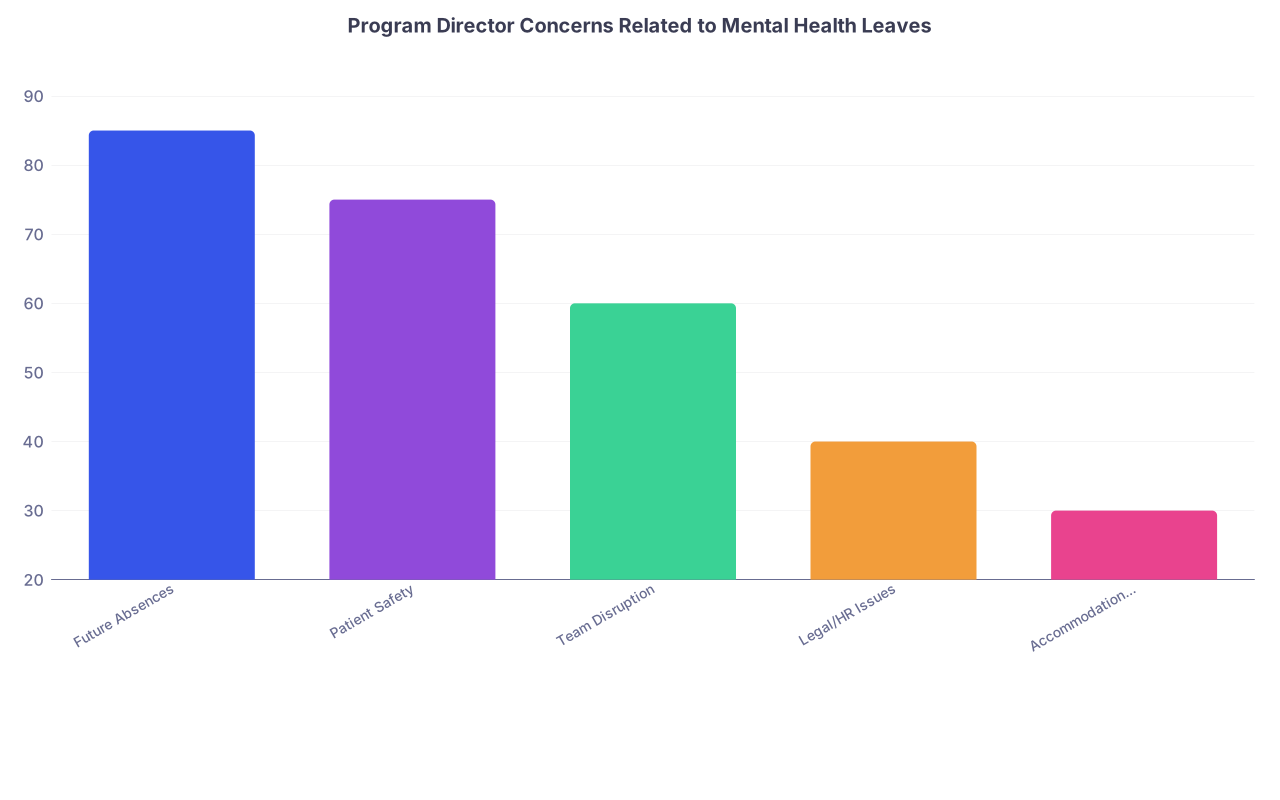
Chart: What Actually Scares Programs
| Category | Value |
|---|---|
| Future Absences | 85 |
| Patient Safety | 75 |
| Team Disruption | 60 |
| Legal/HR Issues | 40 |
| Accommodations Needed | 30 |
Those numbers are not from a single official survey; they mirror the hierarchy of concerns I have consistently heard in PD meetings and rank-list discussions. Notice what is not on there: “has had depression.” What matters is what that implies for those five categories.
Your goal is to show, implicitly:
- Low risk of future extended absences
- No current safety risk
- Stable, not disruptive behavior
- No active legal disputes or threats
- Any accommodations are reasonable and already working
Mistake #10: Framing Yourself as Precarious Instead of Capable
The final, more subtle mistake is tonal.
If your overall application, not just the mental health section, reads like:
- “I barely made it through.”
- “I am terrified of residency.”
- “I hope programs will take a chance on me.”
You are selling the wrong product.
Your mental health history is part of your story. It is not your selling point. Your selling point is:
- Competence
- Reliability
- Insight
- Ability to work with others
- Commitment to the specialty
Do not write:
- “I know residency will be challenging, and I worry sometimes if my mental health will hold up…”
You have just said aloud the one thing programs are privately afraid to ask.
Instead, if you must reference it at all:
- “I have built a sustainable system of support and habits that have allowed me to perform consistently in demanding clinical environments, and I am prepared for the rigors of residency.”
Concrete. Grounded. Not grandiose.
FAQ: Mental Health Leaves and Residency Applications
1. Do I have to disclose that my leave was specifically for mental health?
No. You must disclose that you took a medical or health-related leave if it is documented, but you do not have to specify that it was psychiatric. “Medical leave” or “health issue” is accurate and sufficient.
2. Should I mention my mental health leave in my personal statement?
Usually no. Use the formal ERAS section for interruptions. Consider a brief mention in your personal statement only if:
- The experience directly shaped your path to the specialty, and
- You can describe it succinctly, without over-sharing, and with strong evidence of long-term stability.
3. What if an interviewer directly asks why I took a leave?
Answer honestly but narrowly:
- “I had a health issue that required a brief medical leave. I received appropriate treatment, returned cleared to full duties, and have performed consistently since then.”
You do not have to discuss diagnosis or detailed symptoms unless you personally choose to.
4. Will programs automatically reject me for having a documented mental health leave?
No. I have seen many applicants with mental health leaves match successfully, including into competitive specialties. They matched because:
- Their explanation was concise and professional
- They had a sustained track record of stability and performance afterward
- Their letters and evaluations reassured programs about reliability and teamwork.
5. What if my mental health is still fragile—should I hide that and apply anyway?
Do not make that mistake. If you are still in active crisis, or your stability is measured in weeks instead of many months, applying is premature. Focus on solidifying your health and function first. A rushed application from a precarious place often leads to no match, more stress, and a worse outcome.
Remember:
- The danger is not the fact that you had a mental health leave. It is how you talk about it.
- Over-sharing, hiding, blaming, and vagueness all create red flags that did not need to exist.
- Your job is to present a concise, factual, stability-focused explanation that reassures programs you can show up, be safe, and finish.