Most residency applicants either say too much about their red flags or almost nothing. Both can sink you.
You are not being judged only on the red flag itself. You are being judged on how you handle it. And most applicants handle it badly.
Let me be blunt. Programs are not looking for perfection. They are looking for safety. They are asking one quiet question as they read your file:
“Is this applicant a risk to my residents, my patients, or my accreditation?”
Over-disclosing and under-disclosing are just two different ways of accidentally answering “yes.”
This is about finding the balance: enough disclosure to be trustworthy, not so much that you become radioactive.
1. The Two Big Mistakes: Saying Too Much vs. Saying Almost Nothing
There are two common failure modes.
Over-disclosing: Turning context into a confession
Over-disclosing looks like this:
- Writing three paragraphs in your personal statement about your Step 1 failure
- Describing every detail of a depressive episode, including medications and hospitalizations, unprompted
- Volunteering a long story about interpersonal conflict during an interview when the question was simply, “Tell me about a challenge”
- Naming specific faculty you clashed with and recounting the drama
What this signals to a program:
- Poor judgment about professional boundaries
- Emotional dysregulation or unresolved issues
- A tendency to center yourself and your struggles rather than the patients or the team
- Possible ongoing instability (“Is this going to explode mid-residency?”)
I have watched strong applicants tank interviews because they essentially gave the PD a reason to worry. Not because of the original issue—but because of the way they could not stop talking about it.
Under-disclosing: Hoping they will not notice
Under-disclosing has its own ugly version:
- Failing Step 1 or Step 2 and never mentioning it anywhere
- A one-year leave of absence listed with no explanation
- Multiple “course remediations” on transcript, zero context
- A professionalism citation in the MSPE that you pretend does not exist
- Gaps in your CV explained only as “personal reasons” with no clarification anywhere
What this signals:
- Lack of accountability
- Possible dishonesty by omission
- Immaturity (“I will just ignore it and hope it goes away”)
- A bigger, hidden problem behind the silence
Program directors are not naïve. They read MSPEs for sport. They know how to scan transcripts. If they see something unexplained, they do not think “maybe it is nothing.” They think “what are they hiding?”
2. What Actually Counts as a Red Flag You Must Address
Do not make the opposite mistake and start confessing every imperfect moment from medical school. Not everything is a red flag. But some things absolutely are.
Here is the basic breakdown.
| Issue | Needs Explicit Addressing? |
|---|---|
| Single B/C grade in pre-clinical | No |
| Pattern of low pre-clinical performance | Sometimes (if severe) |
| Step 1 or Step 2 failure | Yes |
| Course or clerkship remediation | Usually yes |
| LOA (personal/medical/family) | Yes |
| Probation or professionalism concern | Yes |
| Minor event, no MSPE mention | No |
You should plan to briefly address:
- Any licensing exam failure (NBME subject exam failure is borderline; COMLEX/USMLE failure is non-negotiable)
- Any formal professionalism issue documented in your MSPE
- Any leave of absence beyond a short, clearly explained administrative leave
- Any pattern suggesting instability (multiple failed rotations, repeated remediations)
- Legal issues that are discoverable (arrests, DUIs, etc.), especially if they affect licensing
You generally do not need to highlight:
- A single weak shelf score with no remediation
- One lukewarm clerkship evaluation with otherwise strong performance
- A minor conflict with a resident that never rose to formal documentation
- Old MCAT issues, as long as your medical school performance is solid
If there is a note in the MSPE, transcript, or a glaring gap in your timeline, assume it needs at least a sentence or two of clean, controlled explanation. Silence is not neutral. It is suspicious.
3. The Framework: How to Talk about Red Flags Without Making Them Worse
There is a simple structure that works. Most applicants ignore it and instead emotionally process on paper. Do not do that.
Use this three-part framework:
- Name the issue clearly and briefly
- Provide minimal, relevant context
- Show what changed and how risk is now controlled
1. Name the issue clearly
Do not dodge the actual words. Program directors hate vague language.
Weak:
“I had some challenges that affected my performance during that period.”
Stronger:
“I failed Step 1 on my first attempt.”
Or:
“I took a one-year leave of absence for a health-related issue that is now resolved.”
Be direct. Be concise. One sentence is usually enough to name the problem.
2. Provide minimal, relevant context
This is where over-disclosers go off the rails. They dump their entire trauma file. You do not need that.
Bad approach:
Six sentences about your childhood, your relationship with your parents, and the detailed symptom list of your depression.
Better approach:
- 1–2 sentences max
- Focus on what affected performance, not your full story
- Avoid graphic medical/psychiatric detail
Example:
“During my second year, I struggled with untreated anxiety and poor study strategies which contributed to my failing Step 1. I sought help, started working with a counselor, and adjusted my approach.”
Or for LOA:
“I took a one-year leave of absence during my third year for a medical issue. I received appropriate treatment and have had no ongoing limitations affecting my training.”
You do not need to name diagnoses unless directly relevant to ability to practice. You definitely do not need to share medication lists or hospital course.
3. Show what changed and demonstrate stability
This is the part programs actually care about: are you a different, safer, more reliable person now?
You must concretely demonstrate:
- Specific actions you took
- Objective evidence that performance has improved
- Time since the event without recurrence
Strong example:
“After failing Step 1, I enrolled in a structured prep course, worked closely with our academic support office, and implemented a disciplined schedule of question banks and spaced repetition. I passed Step 1 on my second attempt and later scored 242 on Step 2. Since then, I have completed all clinical rotations on time with strong evaluations.”
Notice what that does:
- Owns the failure
- Shows insight and responsibility
- Provides objective data (Step 2 score, rotations)
- Proves the problem is controlled, not just “I learned a lot…”
Programs want evidence, not just reflection.
4. Where to Disclose: PS, ERAS “Notes,” or Interviews?
Another common mistake: putting red flag explanations in the wrong place.
Personal Statement: Only if it is central and concise
Do not turn your personal statement into a defense memo.
Reasonable to briefly mention in PS if:
- The red flag truly shaped your path or specialty choice
- You can address it in 2–3 sentences and move on
- It connects to growth that is relevant to residency
Not reasonable:
- Half the statement about failing Step 1
- Detailed play-by-play of your LOA
- Emotional, raw confession with no clear resolution
If the event is central to your narrative (for example, a medical illness that drove your interest in psychiatry), then a brief appearance in the PS is fine. Otherwise, use other venues.
ERAS Experiences / “Other Impactful Experiences” / Additional Info
The safer, cleaner place for explicit red-flag explanations is usually:
- ERAS “Education” or “Experience” descriptions (if tied to an LOA or remediation)
- The “Additional Information” text box (if available)
- A short note in the MSPE if your Dean’s Office helps frame it
This allows your personal statement to stay focused on who you are as a future resident, not your worst moments.
Interviews: Do not volunteer, but be prepared
Key rule: Do not lead with your red flag in every answer.
But if you are asked directly—“Can you tell me about your Step 2 failure?”—you must:
- Stick to the same 3-part framework
- Avoid sounding defensive or bitter
- Avoid oversharing under stress
Practice an out-loud, 60–90 second answer. With an actual human listening. The rambling, tearful, or oversharing versions usually come from people who never practiced saying it out loud.
5. Mental Health, Substance Use, and Legal Issues: The Minefield
This is where applicants make the most damaging mistakes. Either confessional essays about their depression and hospitalizations, or complete silence about events that deeply affected training.
You have to thread this needle very carefully.
Mental health conditions
You do not need to disclose:
- A private diagnosis that has never affected your performance, licensing, or training
- Treatment you received that left no record in your MSPE, transcripts, or evaluations
You usually should briefly explain:
- A mental health episode that led to LOA, rotation failures, or significant performance problems that are documented
But do not write a psychiatric intake note in your application. Programs care about:
- Stability
- Treatment adherence
- Insight
- Functional status
So you emphasize:
- “I sought care with a psychiatrist/therapist.”
- “We identified and addressed X.”
- “Since returning, I have completed Y without further issues.”
You do not list specific meds, diagnoses, or hospital course unless absolutely unavoidable.
Substance use and DUIs
This is very high-risk territory because it intersects with licensing.
If you have a DUI that appears on a background check, your safest path is:
- Discuss with your Dean’s Office and, if possible, GME/physician health program for your state
- Align your application explanation with what will appear on licensing forms
- Show a track record of treatment/compliance if required
Classic mistake: glibly minimizing a DUI as “a one-time issue” when in reality you completed mandated counseling or monitoring. Programs will find out during credentialing.
6. Common Over-Disclosure Disasters (And How to Avoid Them)
Let me walk through a few versions I have actually seen.
Disaster 1: The Trauma Essay
Applicant fails Step 1, also has a rough family background. They then write a personal statement that is essentially a trauma memoir.
Problems:
- Emotional weight overwhelms the reader
- No clear resolution or stability
- The red flag (exam failure) gets drowned in chaos
Fix:
- Move most of the personal history out of the PS
- One sentence on family context at most
- Focus on concrete recovery steps and solid performance since
Disaster 2: The Oversharing Interview
Applicant is asked: “Can you tell me about your LOA?” They proceed to:
- Describe detailed suicidal ideation
- Cry during the explanation
- Share ongoing struggles without clear treatment plan
Programs hear: “Unstable. High risk under stress. Possible future LOA during residency.”
Fix:
- Practice a scripted version that is honest but contained
- Emphasize treatment, follow-up, and functional recovery
- If your situation is still very fragile, you may need to address stability before applying, not try to “sell” it in ERAS
Disaster 3: The Blame Game
Applicant with professionalism concerns writes:
“I was unfairly targeted by a faculty member who did not like me. The evaluation was not representative of my performance.”
Programs see: zero insight, high conflict potential.
Fix:
- Own your part, even if you feel mistreated
- You can acknowledge complexity without assigning blame
- Emphasize what you changed in your behavior
For example:
“During my surgery clerkship I received feedback that my communication sometimes came across as defensive. While I initially disagreed, over time I realized that my stress responses were affecting how others perceived me. With coaching from my advisor, I have worked on receiving feedback more openly, and subsequent clerkship evaluations have reflected this growth.”
7. Common Under-Disclosure Traps (And Why Programs Hate Them)
Now the other side—people who act like red flags do not exist.
Trap 1: The Silent Transcript
Your transcript shows:
- Failed Internal Medicine clerkship
- Remediated in summer
- Barely passing grade after remediation
Your application: not one word about it.
Programs will absolutely notice. They will assume:
- Either you are oblivious to how serious this looks
- Or you are hoping they are too lazy to look
Neither is good.
You do not need a full narrative, but you do need:
- A short, honest sentence in an “Additional Info” area, or
- A clear explanation in the Dean’s letter that you have reviewed and agree with
Trap 2: The Vanishing Year
You have a 12-month gap labeled “Leave of Absence” with no explanation anywhere.
This screams:
- Legal trouble?
- Substance use?
- Psychiatric hospitalization?
- Academic meltdown?
Even if the real reason is something straightforward (family caregiving, surgery recovery), the imagination always fills with worst-case scenarios.
You defuse this with one or two calm, direct lines:
“I took a one-year leave of absence during my third year to care for a seriously ill family member. During this time, I remained in contact with my school and returned to complete my clerkships without delay or performance concerns.”
Do not try to be mysterious. Mysterious is not attractive to people who run residency programs.
8. Quick Red-Flag Disclosure Checklist
Before you submit ERAS, ask yourself:
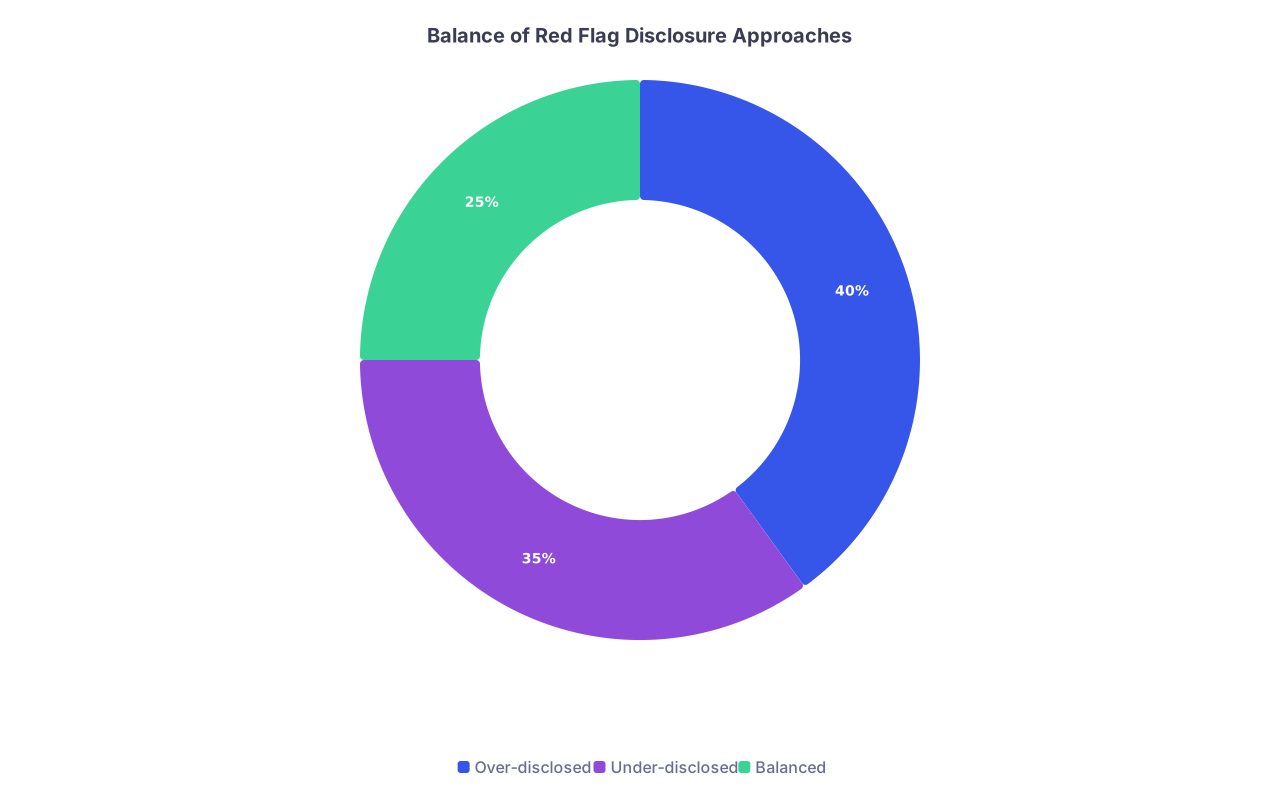
| Category | Value |
|---|---|
| Over-disclosed | 40 |
| Under-disclosed | 35 |
| Balanced | 25 |
- Does every obvious red flag in my file have a brief, factual explanation somewhere?
- Have I avoided turning my personal statement into a red-flag essay?
- Are my explanations focused on actions and outcomes, not just emotions?
- Is there objective evidence of recovery or improvement (scores, evaluations, completion of rotations)?
- Have I practiced my spoken explanation for likely interview questions about these issues?
- Have I kept sensitive medical/psychiatric detail to a minimum, while still being honest about functional impact?
If you are not sure, have someone with actual experience—Dean’s Office, faculty mentor, or a PD-type person—look at how you are framing things. Peers are usually too lenient or too dramatic.

| Step | Description |
|---|---|
| Step 1 | Red Flag in Application |
| Step 2 | Probably no formal explanation needed |
| Step 3 | Consider brief context only if pattern exists |
| Step 4 | Use 3-part framework: name, context, change |
| Step 5 | Place in Additional Info / Deans letter |
| Step 6 | Prepare matching interview answer |
| Step 7 | Is it visible in MSPE, transcript, or timeline? |
| Step 8 | Affects exams, LOA, professionalism, or multiple failures? |