
It’s mid-January. You’re scrolling through Interview Broker or Thalamus, and your classmates are posting their fifteenth, twentieth invite. You have… five. Maybe eight. And in the back of your mind is that one thing you know programs are noticing: the extra year. The leave. The repeated course. The extended graduation.
You keep telling yourself, “They look at the whole application.”
Let me tell you what really happens behind that conference room door when they see a gap or delay and your classmates don’t.
How PDs Actually “Stack” You Against Your Class
Here’s the first uncomfortable truth: you are never read in a vacuum. Every PD I know—IM, EM, surgery, psych, you name it—mentally lays you on top of three comparison groups:
- Your own med school classmates
- Other applicants from similar-tier schools
- The entire pool for that specialty this cycle
You care about #3. They obsess about #1.
Because your school gives them context: grading system, culture, how often people delay, the reliability of your dean’s office. When there’s a gap, that “within school” comparison becomes brutal and very specific.
Inside the selection committee room, the conversation sounds like this:
“This applicant took 6 years to finish. How long is the curriculum at [Your Med School]?”
“Four years.”
“How many others from that school took extra time this year?”
“Just them.”
“Why?”
That “Why?” is where you live or die.
The Unspoken Matrix They Use
Nobody shows you this, but mentally they’re doing a fast calculation:
Did this person finish “on time” compared to classmates?
If not, why? Is the explanation:
- Academic?
- Health-related?
- Personal/family?
- Research or dual degree?
- Disciplinary/professionalism?
And most importantly:
- Does the rest of the file stabilize the concern or amplify it?
Programs don’t hate non-linear paths. They hate risk. And a gap or delay is a big red flag that triggers the “future headache” radar.
I’ve watched PDs say, almost verbatim: “I don’t mind that he took an extra year. I mind that nothing since then convinces me it won’t happen again.”
That’s the standard you’re being held to, whether anyone tells you or not.
Types of Gaps and How They’re Really Interpreted
Let’s walk through the major categories and what actually gets said in closed-door meetings. This is the part nobody at your school phrases honestly.
1. Academic Delays or Repeating Time
This is the one you’re probably the most anxious about. Rightfully.
What they see in the file:
- Extra year before clinicals or between clerkships
- Delayed Step 1 or Step 2
- Remediation of courses or a repeated year
How the conversation actually goes:
“They were extended in second year, had to remediate two blocks.”
“How did they do on clinicals?”
“Mostly High Pass, a couple Honors.”
“Step scores?”
“Step 1 Pass, Step 2 244.”
“OK, so they rebounded. Not ideal, but they recovered.”
Flip side:
“They failed two preclinical blocks, took an extra semester, barely passed the shelf exams, and Step 2 is 219.”
“So the academic problem never really went away.”
“Right.”
“We have 400 apps without those issues. Pass.”
Programs compare you to your classmates along three trajectories:
- Preclinical vs. clinical performance – Did you mature academically?
- Timing of boards – Did the delay correlate with better performance, or did you just… delay?
- Consistency after the delay – Any more small “cracks” (missed deadlines, late LORs, weak MSPE language)?
The academic delay is survivable only if the later record clearly outperforms your earlier self. If your classmates improved and you stayed flat, you sink.
2. Health-Related Leaves or Personal Medical Issues
These scare PDs in a different way.
They’re not worrying about your “worthiness.” They’re thinking about:
- Call schedules
- Coverage
- FMLA leave
- Whether you’ll need repeated extended absences
I once heard a PD in internal medicine say: “I’m not punishing them for getting sick. I’m punishing the future version of me that has to cover an empty night float for three months if this recurs.” Harsh? Yes. Real? Also yes.
Here’s what calms them down:
- Clear, brief explanation in the MSPE or your personal statement
- Documentation that you returned, completed full-time coursework/rotations successfully
- No pattern of “partial” attendance, missing rotations, or repeated incomplete grades after the event
If you took a semester off for treatment and then came back, did full clinical rotations, showed up, no extra drama—they compare you to classmates and say: “Fine, they’re functioning at the same level now.”
If your record looks like: “LOA → incomplete clerkship → delayed Step 2 → light clinical year,” it tells them your functioning is still unstable. They will not choose you over a classmate who did the same curriculum without those issues. They just won’t.
3. Personal/Family Leaves
Serious family illness. Death. Caregiving. Sometimes your own kid.
These are treated more leniently. But only if they see:
- A finite, well-bounded leave
- A clean re-entry
- Professional behavior documented in MSPE and letters
What kills applicants here is vagueness and ongoing impact. A PD might say:
“They took a year to help with a sick parent. Fine. But then their attendance comments are ‘frequently late,’ and they failed to complete clinic notes on time. That’s not just the leave. That’s functioning.”
Again, they look at your classmates: did others in your class also have major life events and still finish on time? They know the answer. Your dean’s letter hints at that, even if it doesn’t spell it out.
So your job isn’t to prove your hardship was real. They usually believe that. Your job is to prove that the hardship is past tense in terms of impact on your functioning as a resident.
4. Research Years, Dual Degrees, and “Planned” Extensions
If your “delay” was:
- Research year
- MPH, MBA, PhD time
- Funded fellowship year
This is the least threatening form of delay—when done right.
Programs compare you to classmates in two ways here:
- Did your classmates who took these years produce more than you did?
- Did your extra time actually convert into something meaningful?
I’ve watched PDs pull up prior years from the same school:
“Last cycle we had someone from [Your School] who took a research year. They had six pubs, three first-author, and strong letters from big names.”
“This applicant took a ‘research year’ and has one poster from a regional conference.”
“So… they took a year off to study for boards, basically.”
They are absolutely making that comparison, even if they never tell you.
Worse: if your “research year” coincides with a Step 1 fail, or “needed time for boards,” it no longer reads as scholarly ambition. It reads as hiding an academic problem under a research label.
If you’re going to extend for research, it needs to look like:
- Output that justifies 12 months (or more) of time
- Letters from research mentors describing you as high-functioning, reliable, and productive
- Boards taken and passed in a clean, timely way relative to your new schedule
Otherwise, your extended path compares unfavorably to classmates who did 4 straight years and matched fine without the “extra time.”
5. Disciplinary / Professionalism-Related Delays or Gaps
This is the worst category. PDs are savagely risk-averse here.
They’re reading:
- MSPE professionalism sections
- Codes like “concerns about judgment” or “required additional faculty guidance”
- Hints about “academic integrity issues” or “professionalism remediation”
And then they ask one question: “Is this better than the average risk profile I already have in my rank list?”
If the delay was for something like:
- Academic dishonesty
- Boundary violations
- Recurrent unprofessional behavior
- Alcohol or substance-related incidents that disrupted training
You’re not being compared to your classmates anymore. You’re being compared to every problem resident that program has ever had. And they remember those cases in painful detail.
I’ve watched committees do this in real time:
“We had a resident three years ago with a very similar narrative. Took a leave for ‘personal reasons’ and it turned into constant coverage disasters.”
“I’m not doing that again. I don’t care how good their letters are.”
Can you get past this? Sometimes. But then your letters have to explicitly say you turned a corner. Not “improved.” Not “growing.” Language like:
- “They demonstrated a sustained pattern of professional behavior after X.”
- “We had no further professionalism concerns during clinical training.”
- “I would unreservedly rank this student to match.”
Anything less, and you lose to your clean-record classmates. Every time.
How They Use Your School’s Internal Context Against (or For) You
Here’s something your dean’s office rarely spells out: PDs quietly keep mental “profiles” of schools.
They know:
- Which schools extend a lot of students for minor issues
- Which schools never extend anyone unless it’s catastrophic
- Which schools sugarcoat problems in the MSPE
- Which schools are brutally honest
I’ve seen emails between PDs that basically say: “Heads up, [X School] under-reports professionalism problems; read between the lines.” That affects all of you from that school, including how they view gaps and delays.
So if your school tends to graduate people in 5–6 years more often, your delay may not look that unusual. But if 98% of your class finishes in 4 years and you’re at 6, you stand out.
They absolutely look at:
- How many applicants from your school this year
- Whether any others have LOAs/delays
- Patterns from previous years
And they will compare you to prior “problem” or “star” residents they’ve had from your school.
You’re not just “Applicant A.” You’re “Applicant A from [School X], which had that resident who went on leave mid-PGY2 and never came back.” Unfair? Maybe. But this is how the game is played.
The MSPE, LORs, and How Gaps Get Framed Behind Your Back
You’re obsessed with your personal statement. PDs glance at it, sure. But for gaps and delays, they go straight to:
- MSPE “academic progress” and “unique characteristics”
- Clerkship comments, especially about reliability and work ethic
- Departmental letters from the specialty you’re applying to
Behind closed doors, they’re looking for three things.
1. Does the Narrative Match?
If you or your dean say:
“Student took a leave for personal reasons, returned and performed well.”
They want that backed by:
- Strong clinical comments (“always early, prepared, reliable”)
- No more “incompletes,” repeated courses, or extended rotations
- Shelf and Step 2 scores at or above your school’s mean
If your story is “I came back stronger,” and your MSPE shows mediocre clinical ratings and marginal boards, the committee will literally say: “No, you didn’t.”
2. Do Letters Acknowledge the Gap?
The best letters when you have a delay are not the ones that pretend it never happened. They are the ones that quietly, but clearly, contextualize it:
“After returning from a leave, they quickly demonstrated reliability and accountability. I had no concerns about their ability to function at the level of their peers.”
That type of line does more for you than three paragraphs of generic praise. It tells the committee: this attending knew about the situation and is not worried.
Letters that ignore big obvious gaps or delays can actually increase suspicion, because PDs assume writers were told to stay quiet.
3. Does Anything Sound Like Code?
PDs are experts at reading between the lines of MSPE and LORs. They flag phrases like:
- “With appropriate support, will be successful.”
- “Improved in time management, though this remains an area for continued growth.”
- “When reminded, completed tasks appropriately.”
Let me translate: “High risk under pressure.”
If you have a gap and also have these comments, you are not getting chosen over your classmates who do not have them.
How to Compete Against Your Own Classmates When You Have a Gap
Now the practical part. Because no, you’re not doomed by default. But you’re not going to “holistic review” your way out of this with vague fluff.
The core question you must answer in your file is:
“Am I clearly safer and more reliable than my past suggests and at least as safe as my classmates?”
That’s the bar.
Make the Post-Gap Period Impeccable
Programs look at your post-gap months as a test case.
You want:
- No failed or repeated clerkships
- No professionalism comments
- Solid or rising evaluations over time
- Step 2 taken on a normal or slightly early schedule with a respectable score
If you have a gap and then drag Step 2 until the last possible minute, they see that as unresolved functioning issues, not “strategy.”
Use Targeted, Not Over-Explaining, Disclosure
You don’t win by writing a 900-word trauma essay in your personal statement. PDs don’t want to be your therapist. They want a simple frame:
- What happened (in one line, no gory detail)
- That it’s resolved or stable
- Evidence: your performance since returning
The tone should be: “This happened. I addressed it. Here’s my performance since. I’m ready to train.”
Not: “Please feel sorry for me and overlook the risk.”
Choose Letter Writers Who Saw You After the Gap
Your most valuable letter is someone who:
- Knew about the leave or delay
- Worked with you after it
- Can honestly say you functioned normally or better than peers
That’s the person who can reassure a suspicious committee better than any narrative you write.
Apply in a Way That Matches Your Risk Profile
Here’s another truth: if you have gaps or delays, you do not get to be “picky” in the same way as your clean classmates.
Programs, tiers, and geographic regions see your file differently. Often a mid-tier community program that’s had successful residents from non-linear paths will be much more forgiving than a top-tier academic place that has a surplus of “perfect” applicants.
You combat the comparison to classmates by:
- Applying broadly enough that not every program is competing to avoid risk
- Including a healthy mix of places that historically interview your school’s “non-standard” grads
- Using away rotations or sub-Is (if you still can) to get in front of faculty who will vouch for you despite the delay
How This All Plays Out on Rank Day
Final little behind-the-scenes detail.
When rank lists are built, committees cluster applicants:
- “No risk, strong”
- “Some risk, high upside”
- “Real risk, might rank low”
- “Do not rank”
You, with gaps or delays, almost never land in “No risk, strong.” You’re fighting to stay in “Some risk, high upside” instead of dropping into “Real risk, might rank low” or “DNR.”
The only way you beat a clean-record classmate is if:
- Your upside is clearly higher (stronger scores, stronger letters, more maturity), and
- Your recent record convincingly shows the risk has already materialized and been dealt with
I’ve sat in those meetings and watched this exact argument:
Faculty A: “Yes, they took an extra year, but look at the last 18 months. They’re better than half our clean applicants.”
Faculty B: “And the letter from our own sub-I says they’re reliable. I’m fine ranking them.”
PD: “Okay. They’re not top 10, but they can definitely be in the middle third.”
That’s the realistic win here. Not erasing the past. Showing you’ve already paid the price for it and are now a safe bet going forward.
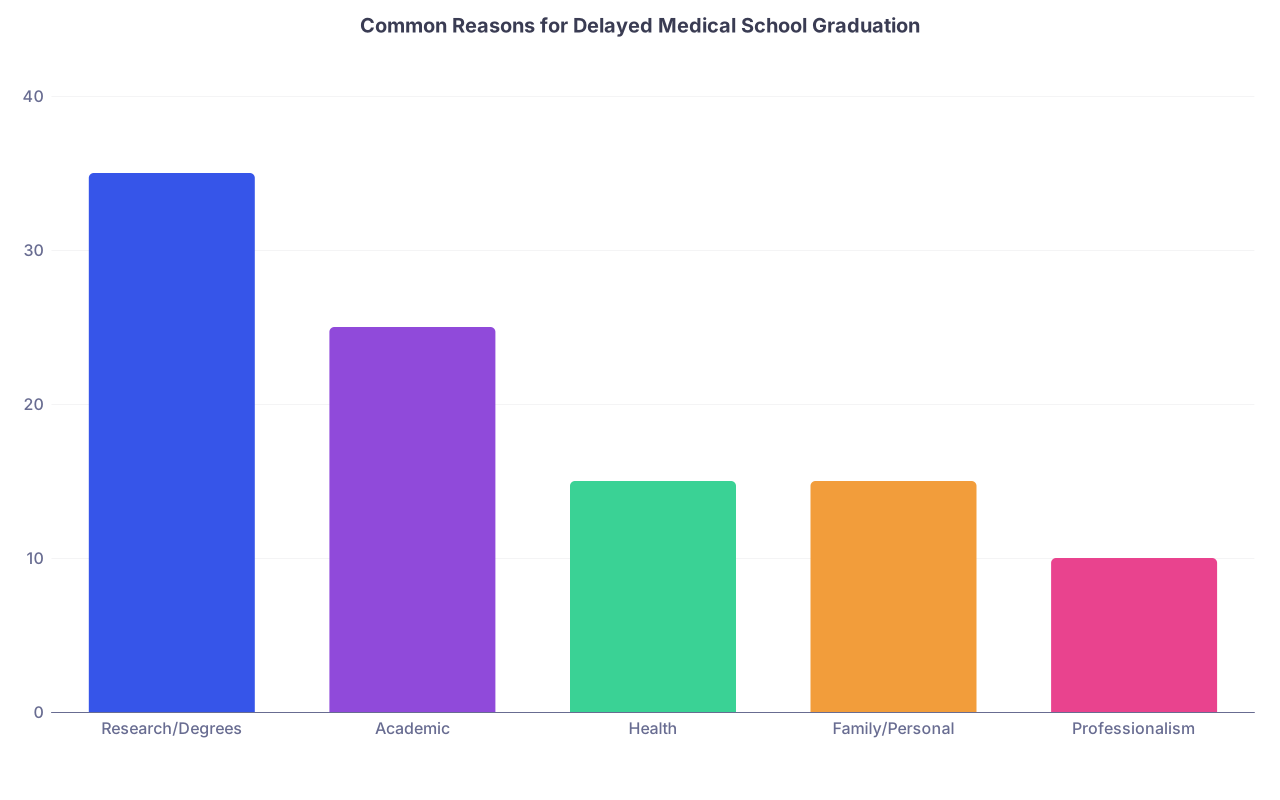
| Category | Value |
|---|---|
| Research/Degrees | 35 |
| Academic | 25 |
| Health | 15 |
| Family/Personal | 15 |
| Professionalism | 10 |

| Type of Gap/Delay | Default Risk Perception | What Improves It Most |
|---|---|---|
| Research / Dual Degree | Low–Moderate | Strong output, strong mentor letters |
| Health-Related Leave | Moderate | Clean, full-time performance after return |
| Family / Personal Leave | Moderate | Stable functioning, no ongoing disruptions |
| Academic Remediation/Delay | Moderate–High | Clear academic rebound, strong Step 2 |
| Disciplinary / Professional | Very High | Explicit letters showing sustained turnaround |

| Step | Description |
|---|---|
| Step 1 | See Gap/Delay |
| Step 2 | Academic |
| Step 3 | Health/Personal |
| Step 4 | Research/Degree |
| Step 5 | Disciplinary |
| Step 6 | High Risk: Likely DNR |
| Step 7 | Question Motivation: Lower Rank |
| Step 8 | Rank - Some Risk, High Upside |
| Step 9 | Prefer Clean Classmates |
| Step 10 | Type of Gap? |
| Step 11 | Post-gap Performance? |
| Step 12 | Productive Year? |
| Step 13 | As Strong as Classmates Now? |
FAQ (4 Questions)
1. Should I directly explain my gap or delay in my personal statement?
Yes, but briefly and clinically. One or two sentences: what happened, that it’s resolved or stable, and that you returned and performed well. Then spend most of the statement on who you are as a future resident. Over-explaining or emotional oversharing makes PDs nervous; they want reassurance of stability, not a detailed narrative.
2. Does a research year really help if my underlying issue was academic?
Only if you produced real work and your academic trajectory improved afterward. A “research year” with almost no output, followed by mediocre clinical performance and a soft Step 2, looks like an attempt to hide an academic problem, not elevate your profile. If the primary issue was academics, your post-gap grades and Step 2 score matter more than the research itself.
3. How much does it hurt if I took longer than all my classmates to graduate?
It hurts, but the damage is not fixed; it depends on the story your later performance tells. If everyone else finished in 4 and you took 6, PDs will absolutely ask why. If your final 18–24 months show strong, consistent performance and solid letters, many programs will still rank you—just not at the same level as a similar applicant who finished on time. Without that rebound, you fall to the bottom or off the list.
4. Can strong away rotation performance overcome a red flag gap?
Sometimes, yes. A stellar sub-I where attendings explicitly say you functioned at or above the level of their average intern can move you from “too risky” to “worth ranking.” But it needs to be documented in letters, not just your memory of working hard. A glowing home or away rotation letter is often the single most powerful counterweight you have to a gap, because it shows how you actually behave in the environment PDs care about: their wards, their patients, their system.
If you remember nothing else: programs compare you to your own classmates first, then to the broader pool. A gap or delay is survivable only if your post-gap record clearly beats your earlier self and plausibly matches your peers. And no, they don’t care that the path was hard. They care that you’ve already proven you can function like the resident they need now, not someday.