
The biggest lie in residency advising is “a single red flag will ruin your chances.” It will not. What ruins people is drifting into ERAS season without a repair plan and a timeline.
You fix red flags on a clock. Miss the window, and they calcify into “fatal” problems. Hit the window, and they become “context” instead of “concern.”
Here is how to run Red Flag Rehab from MS2 through the day ERAS opens.
Big Picture: When You Can Actually Fix Things
Before we go month‑by‑month, you need the global map.
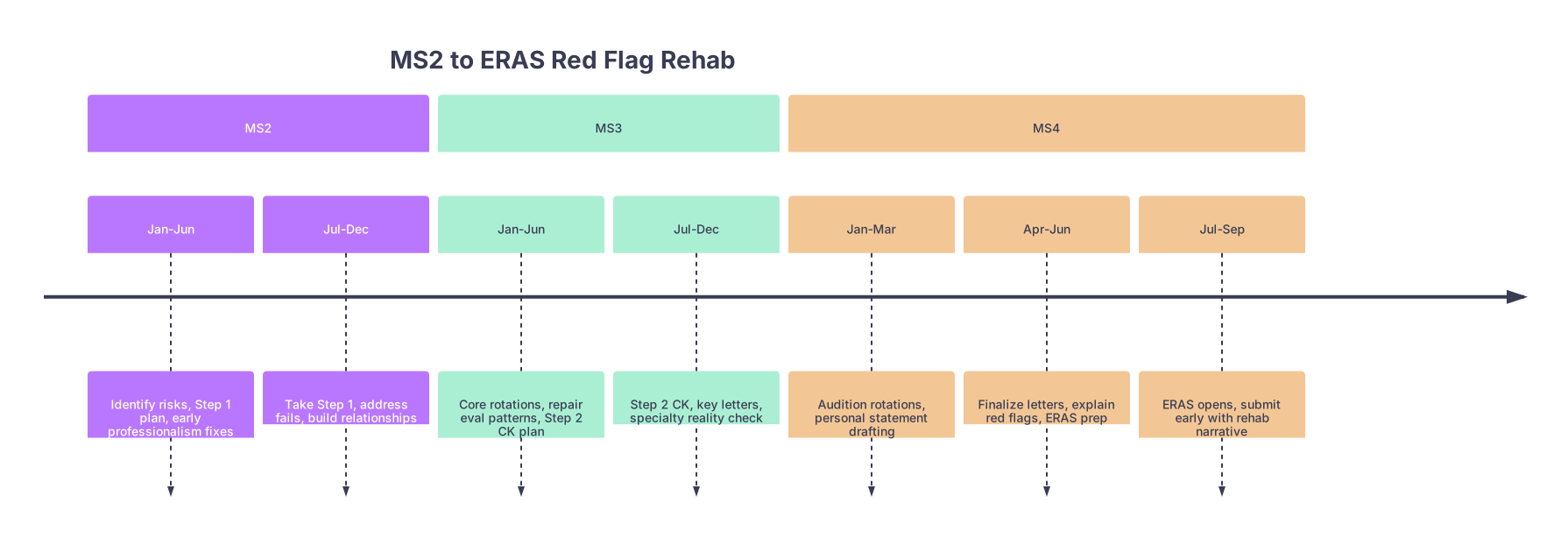
| Period | Event |
|---|---|
| MS2 - Jan-Jun | Identify risks, Step 1 plan, early professionalism fixes |
| MS2 - Jul-Dec | Take Step 1, address fails, build relationships |
| MS3 - Jan-Jun | Core rotations, repair eval patterns, Step 2 CK plan |
| MS3 - Jul-Dec | Step 2 CK, key letters, specialty reality check |
| MS4 - Jan-Mar | Audition rotations, personal statement drafting |
| MS4 - Apr-Jun | Finalize letters, explain red flags, ERAS prep |
| MS4 - Jul-Sep | ERAS opens, submit early with rehab narrative |
At each stage you are doing three things:
- Prevent new red flags. No more unforced errors.
- Repair existing damage. Scores, professionalism, narrative.
- Build counter‑evidence. Stronger clinical performance, letters, and consistency to outweigh the problem.
MS2: Identify the Damage and Stop the Bleeding
At this point you should stop guessing and get brutally honest. MS2 is where you either prevent the biggest red flags or set them in motion.
Jan–March MS2: Red Flag Audit and Step 1 Setup
Your main risks right now:
- Future USMLE Step 1 pass/fail issues
- Pattern of marginal preclinical performance
- Early unprofessional behavior in the file
- Lack of any mentor who knows you well
At this point you should:
Do a Red Flag Inventory.
Sit with your dean, advisor, or a brutally honest faculty mentor and review:- Any course failures/remediations
- Prior LOA, academic probation, professionalism notes
- Current class rank/percentile if your school reports it
- Shelf scores from early clinical exposure (if applicable)
Ask one question: “If I applied today, what would program directors worry about?” Write it down.
Plan Step 1 with your risk profile in mind.
If you are already barely passing classes, Step 1 is a landmine. At this point you should:- Build a 12–16 week Step 1 study calendar
- Schedule NBME practice exams every 2–3 weeks once you are 4–6 weeks out
- Move your test date early enough that if your practice scores tank, you can delay before a fail appears on record
Non‑negotiable: do not “just see what happens” with Step 1. A fail is one of the hardest red flags to rehab.
Clean up professionalism and attendance.
If you are already “the late one” or “the email ignorer,” that reputation follows you into MS3 evaluations.At this point you should:
- Respond to school emails within 24 hours
- Fix any incomplete requirements (HIPAA modules, TB testing, etc.)
- Show up early to required sessions for the next 3–4 months. Yes, people notice.
Start building one relationship.
You need at least one faculty member who can later say, “This student matured.” Without that, every red flag looks static.Minimal move: pick one preclinical course director or small‑group faculty and:
- Go to office hours twice this semester
- Ask for advice about Step 1 and rotations
- Follow that advice. Then report back.
You are not “fixing” anything yet. You are surfacing risk and closing the tap on new problems.
April–June MS2: Step 1 and Early Damage Control
This is Step 1 season for most students. It is also where people accidentally earn their biggest red flag.
At this point you should:
Use NBME scores as a stop sign.
If your last 2 NBMEs are:- Below the passing prediction range, or
- Getting worse instead of better
You do not test on schedule just to stick to the calendar. You move the exam and extend prep. A Step 1 fail will follow you into every ERAS filter list.
If you fail Step 1, lock into rehab mode immediately.
Do not go dark and sulk for weeks. Program directors care about:- How fast you re‑organize
- What changes you make
- What the retake score looks like
First 7–10 days after a fail:
- Meet with your dean and a learning specialist
- Build a very specific remediation plan (daily hours, resources, question targets)
- Schedule retake only when your NBME trend is clearly above passing
If you pass comfortably, shift focus.
Strong Step 1 (even as P/F) is now neutral, not a strength. Your leverage moves to:- Clinical performance on MS3
- Step 2 CK
- Professionalism narrative
Start reading basic clinical skills and common presentations now. It smooths your MS3 start and prevents “slow start” comments.
By the end of MS2, your goals are simple:
- No fresh professionalism incidents
- Either no Step 1 issues, or a clear, organized plan to repair a fail
- At least one faculty member who knows you beyond your ID number
MS3: Clinical Year – Where Most Red Flags Are Created or Repaired
MS3 is red‑flag central. This is where narratives about you harden: “reliable,” “disengaged,” “weak knowledge,” “great with patients but…” You either fix your earlier damage here or you make it worse.
Let us go quarter by quarter.
July–September MS3: First Rotations – Avoid New Red Flags
At this point you should assume every evaluator is writing your future letters.
Your main risks now:
- Bad early evaluations (“below expectations,” “needs improvement”)
- Shelf exam failures or chronically low scores
- Continued unprofessional behavior (lateness, charting issues, poor communication)
At this point you should:
Over‑communicate and over‑prepare on your first rotation.
Before day 1:- Email the clerkship coordinator and confirm start time, location, dress code
- Review common notes and presentations for that specialty (admit H&P, progress notes)
On week 1:
- Ask your senior or attending: “What does a top student on this service do?”
- Then mirror it. Relentlessly.
Get mid‑rotation feedback in writing.
Middle of every rotation:- Ask explicitly: “Anything I can improve now before the end of the rotation?”
- If you hear “seems disengaged,” “too quiet,” “needs to read more”, treat it like a red alert.
- Fix it that same week. Tell them you are working on it. Then actually change.
I have seen students rescue a rotation by flipping that script in the second half. But only when they asked early.
If you fail a shelf, respond like a professional, not a victim.
First, understand what that means for your dean’s letter and transcript. Then:Within 1 week of a failed shelf:
- Meet the clerkship director
- Ask what concrete steps they recommend
- Document your plan (extra qbank blocks per day, tutoring, next shelf scheduled)
A single shelf failure can be rehabbed if later shelves are solid and someone can attest to your work ethic. Repeated failures with no visible change — that becomes fatal.
October–December MS3: Pattern Check and Early Specialty Reality
You are now far enough in that patterns are visible.
At this point you should:
Do a mid‑MS3 Red Flag Check.
Look back over your rotations:- Any “Below expectations” on professionalism or work ethic?
- More than one borderline shelf or remediation?
- Patterns in feedback like “quiet,” “unassertive,” “disorganized”?
If yes, you have a pattern red flag, which programs hate more than a single event.
If professionalism has ever been questioned, over‑correct now.
This includes:- Showing up late
- Missed pages
- Minimal participation on rounds
For the next 2–3 rotations:
- Be in the hospital early enough that you could pre‑round twice if needed
- Volunteer for the unglamorous tasks (calling families, tracking labs)
- Tell your residents upfront you are trying to improve reliability and ask them to push you
Program directors love the phrase “showed real growth.” They hate “no change despite feedback.”
Start aligning specialty choice with your record.
At this point you should stop playing fantasy match. If you have:- Step 1 fail + weak early shelves + no standout letters
- Or a professionalism note in your file
Then applying to Derm, Ortho, ENT is self‑sabotage. You need a specialty where:
- Programs are more flexible about Step or shelf issues
- There is room to compensate with personality, work ethic, and letters
Talk to the actual clerkship director or a program director, not just peers. Ask directly: “With X and Y in my record, is [specialty] realistic if I apply broadly and early?”
This is where you design your rehab strategy by specialty: Internal Medicine vs FM vs Psych vs EM all weigh red flags differently.
January–March MS3: Step 2 CK as Damage Control
If Step 1 or early clinical work hurt you, Step 2 CK is one of your best rehab tools.
At this point you should:
Time Step 2 CK deliberately.
Target date: usually late spring / early summer after you have:- Finished most core rotations
- 6–8 dedicated weeks for review
But if you had:
- Step 1 fail, or
- Chronic shelf struggles
Then you need more structure, not less. Build:
- Daily qbank goals (UWorld or equivalent)
- Weekly practice tests (NBME, UWSA) for at least the final 4–6 weeks
Aim for Step 2 CK to be clearly stronger than Step 1.
For someone with a Step 1 fail, program directors want to see:- A solid pass on retake, and
- A competent or strong Step 2 CK that suggests the fail was an outlier, not your ceiling
You will not erase the fail. You will show that your current trajectory is upwards.
Clean up any remaining rotation issues.
Last few rotations of MS3:- Prioritize those in your intended specialty or adjacent fields
- Ask for feedback early and fix issues quickly
- Aim for at least 2 rotations where your evals say some version of “top student,” “hard‑working,” or “would take as resident”
By end of MS3, your rehab goals:
- No new professionalism concerns
- Clear pattern of improving clinical performance
- Step 2 CK date scheduled with a serious study plan, ideally before mid‑summer MS4
- Realistic specialty choice aligned with your actual record
MS4: Turn the Rehab Into a Coherent ERAS Story
MS4 is not the time to “fix” new things. It is the time to present what you have fixed and control the narrative.
April–June MS4 (Late MS3 / Early MS4 for Some Schools)
At this point you should:
Lock in audition / sub‑I rotations strategically.
If you have red flags, away rotations are not for tourism. They are for proving people wrong.Choose:
- Home institution sub‑I in your chosen specialty
- 1–2 away rotations at realistic programs that know your school
- Settings where your work ethic and personality can shine (small to mid‑size programs often better than massive name‑brands for this)
On these rotations your primary job is simple: become the student about whom attendings say, “I wish every red‑flag applicant worked like this.”
Identify “rehab advocates” for letters.
You need at least one letter writer who:- Knows about your red flag(s)
- Still strongly supports you
- Can honestly mention your growth if necessary
At the end of a strong rotation:
- Ask: “Would you feel comfortable writing me a strong letter for residency?”
- If they hesitate, move on. You do not want a neutral letter on a red‑flag file.
Draft your personal statement with the red flag in mind.
Not every red flag needs to be in your statement. But major ones often do:- Step 1 fail
- LOA for non‑medical reasons
- Formal professionalism or conduct issues
The structure:
- 1–2 concise sentences naming the issue directly (no vague euphemisms)
- 3–5 sentences on what changed: behaviors, systems, insight
- The rest about your current strengths and why you fit the specialty
You are not confessing. You are showing accountability and growth.
July–September MS4: ERAS Opens – Final Rehab Execution
Here is where timing matters down to the week.
| Timeframe | Top Rehab Priority |
|---|---|
| July (MS4) | Finalize Step 2 CK + score release |
| Early August | Lock in letters & MSPE alignment |
| Late August | Draft red flag explanation emails |
| ERAS Opening (Sept) | Submit complete, early application |
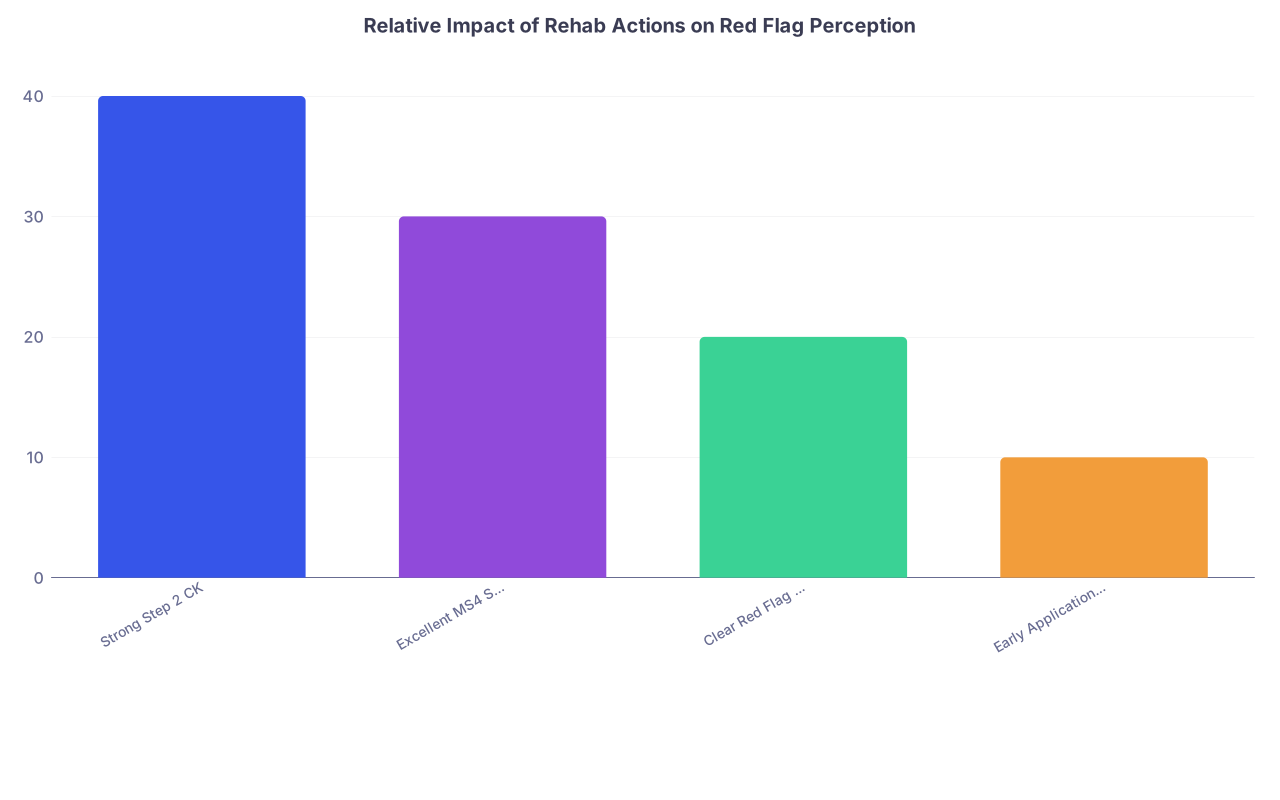
| Category | Value |
|---|---|
| Strong Step 2 CK | 40 |
| Excellent MS4 Sub-I | 30 |
| Clear Red Flag Explanation | 20 |
| Early Application Timing | 10 |
At this point you should:
Have Step 2 CK taken and (ideally) scored before ERAS submission.
For red‑flag applicants, a pending Step 2 is a problem. Programs may not risk it.Best case:
- Take Step 2 CK by early July
- Score back by early August
- Include score in initial ERAS submission
If you blew this timing, you accept reality and email programs once the score is back, highlighting improvement.
Coordinate your MSPE (Dean’s Letter) language.
Meet with the dean’s office:- Ask how your red flag(s) will be described
- Clarify any objective errors
- You cannot censor the MSPE, but you can ensure it is accurate and framed with context
This matters. Inconsistent stories between MSPE, your statement, and any emails are death.
Write a concise, honest “red flag note” for programs that ask.
Some programs have additional questions or will ask during interviews. Have a standard 3–4 sentence script ready.Example for Step fail:
- “I failed Step 1 on my first attempt, which reflected poor study structure rather than my capability. In response I reorganized my approach completely, worked with a learning specialist, and treated preparation as a full‑time job. I passed on retake and then scored [Step 2 score] on Step 2 CK, which I believe better reflects my current knowledge and discipline.”
You say it once. Calmly. Then move on to what you have done since.
Submit ERAS early and complete.
With red flags, you lose the right to a “late but perfect” application. At ERAS opening:- Personal statement done
- Letters uploaded
- Scores in
- Programs list ready (and broad)
Aim for submission within the first week ERAS allows. Many programs screen first by completeness, then by red flags.
Apply broadly and strategically.
You cannot fix a red flag and then apply like a superstar. Your list should:- Skew toward community and mid‑tier academic programs
- Include regions where your school has matched before
- Be heavier on programs known to consider holistic review (talk to upperclassmen, not Reddit)
A red‑flag applicant in IM, FM, Psych may apply to 60–100 programs. In more competitive fields, many will also dual‑apply to a less competitive backup.
Day ERAS Opens to Interviews: Maintain the Narrative
Your rehab is not over once you click submit.
At this point you should:
Reply to interview invitations instantly.
You are already a risk on paper. Do not add “slow to respond” to the narrative.Have your red flag story refined for interviews.
The structure live:- Brief factual statement of what happened
- One sentence of ownership (no blaming)
- Two sentences on concrete changes
- One sentence connecting to your current strengths
Then shut up. Do not over‑defend. Shift to your current performance.
Use interviews to showcase reliability and warmth.
Many programs will think: “If we take a risk on this applicant, will they show up, work hard, and be teachable?”So your job on interview day:
- Show punctuality (log on early, arrive early)
- Be engaged, ask real questions
- Reference specific feedback you have used to improve
You are selling your trajectory, not perfection.
Key Takeaways
- Red flags are a timeline problem, not a death sentence. Identify them early (MS2), repair them in real time (MS3), and package them coherently before ERAS (MS4).
- Programs care less about the existence of a red flag than about your response. Clear improvement in Step 2, clinical evals, and professionalism can outweigh a Step fail or early stumble.
- By the time ERAS opens, you should have three things ready: a stronger track record, advocates who can vouch for your growth, and a concise, consistent explanation that turns your red flag into a story of competence and maturity.