
The worst Step timing is not failing early. It is failing right before ERAS. And you are not out of the Match yet.
You are, however, on a clock.
What you do in the next 8–10 weeks will decide whether your application looks like a controlled setback or a slow-motion train wreck. I have seen both. The difference is almost always timeline discipline.
Below is a concrete, week-by-week plan assuming this scenario:
- You just got a failing Step result (Step 1 or Step 2 CK) between late July and mid‑September.
- You planned to apply this ERAS cycle (September).
- You are debating: do I still submit? Do I delay? How do I repair this?
We will walk through:
- Immediate 72‑hour response
- First 4 weeks: damage control + retake prep
- Next 4–6 weeks: retake, ERAS strategy, communication with programs
- How to adjust if your test date or ERAS deadline shifts
Use this as a scaffold. Then fill in your dates.
First 72 Hours: Stop the Bleeding
At this point you should not be making big decisions. You should be gathering intel and stabilizing.
Day 0–1 (Score Release Day)
Read the score report once. Then close it.
- Confirm:
- Which exam (Step 1 vs Step 2 CK)
- Exact fail status (not just “low”)
- Any performance profile (content areas/competencies)
- Do not spend 3 hours zooming in on every bar. You will just catastrophize.
- Confirm:
Tell only the people who matter for planning.
That usually means:- Your academic advisor or Dean’s office contact
- Your home PD or faculty mentor in your intended specialty
- Step coach / tutor if you have one
Not your entire group chat. Not yet.
Schedule an urgent meeting (within 48 hours) with:
- Your Dean of Student Affairs or equivalent
- A trusted specialty advisor
Email should be short and blunt:
“I received a failing Step [1/2 CK] score yesterday and am registered to apply in this ERAS cycle for [specialty]. I need guidance on retake timing and application strategy. Can we meet in the next 48 hours?”
Day 2–3: Information and Reality Check
At this point you should be clarifying your options, not guessing.
In your meetings, you need answers to:
- School policies:
- Are you allowed to apply with a fail on record and no retake yet?
- Does your school require a pass before they release your MSPE or certify ERAS?
- Timeline feasibility:
- Earliest realistic retake window (Prometric availability + your study needs)
- Latest date programs in your specialty will realistically wait for a new score
- Specialty‑specific attitudes:
- How toxic is a fail in your chosen specialty this late?
(Derm, Ortho, Plastics, ENT = brutal. FM, Psych, Peds, IM = more forgiving with a pass + strong rest of file.) - Is dual‑applying or switching to a less competitive specialty recommended?
- How toxic is a fail in your chosen specialty this late?
Bring your calendar, current rotation schedule, and any upcoming major obligations (sub‑I, away rotation, family event). You are building a Gantt chart in your head.
Week 1: Decision Framework and Test Date
At this point you should decide on your retake strategy and application posture.
Step 1: Pick the Retake Date Range
You want the earliest date you can pass, not the earliest date you can physically sit.
General rules:
- If you failed by a wide margin (e.g., Step 2 CK < 205 or > 1 SD below pass):
- Aim for 6–8 weeks of focused prep.
- If you just barely failed (e.g., a few points under pass):
- 4–6 weeks may be enough if you can go high‑intensity.
Block it out:
- Look at your rotation schedule.
- If you are on a light elective, you can study around it.
- If you are on ICU or a brutal sub‑I, negotiate:
- Ask about swapping blocks with a classmate.
- Convert to research/elective if your school allows.
Your target: retake by late October to mid‑November if you are still trying to be viable in this ERAS cycle.
Step 2: Choose an Application Strategy
You have three main patterns. Pick one this week.
| Strategy | When It Fits | Key Risk |
|---|---|---|
| Apply now, await retake | Mild fail, decent app, less competitive specialty | Programs may screen you out before new score |
| Delay submission until near retake | School allows, you can push ERAS a bit | Fewer interview spots left |
| Skip this cycle, reapply next year | Large fail, competitive specialty | Delayed residency, extra year to explain |
You should decide:
- Will you still submit ERAS this year?
- If yes, will you:
- Submit in September with a fail on record and a clear explanation?
- Wait and submit closer to your retake, noting “score pending”?
Your advisors should help. But you have to commit.
Step 3: Build the Study + Application Calendar
This is where most people fail. They treat it like two separate crises. It is one integrated project.
Sketch a calendar for the next 8–10 weeks:
- Weekly:
- Study hours targets
- Dedicated NBME/UWorld self‑assessment dates
- ERAS tasks (personal statement, LoRs follow‑up, program list)
- Hard deadlines:
- ERAS opening / submission (usually mid‑September)
- MSPE release (October 1)
- Your retake date
- Any away rotation dates
Lock this in a written or digital calendar. Not in your head.
Week 2: Stabilize Academics + Start Focused Prep
At this point you should be actively studying and cleaning up your application file.
Academic / Scheduling Cleanup
- Confirm rotation changes that create study time.
- Notify relevant clerkship directors if your exam prep will affect availability (without oversharing your fail unless necessary).
- If you are on a sub‑I, be realistic. You cannot do heroic 80‑hour weeks and fix a Step failure in 4 weeks.
Core Study Plan (Step 1 or Step 2 CK)
You do not reinvent the wheel. You diagnose the failure.
Autopsy your performance:
- Review the Step performance profile:
- Which content areas are weak?
- Did you bomb one domain (e.g., biostats, psych, renal)?
- Review your previous prep:
- Did you actually finish UWorld or an equivalent QBank?
- Did you take NBMEs and ignore the data?
- Review the Step performance profile:
Create a 4–8 week study template:
- Daily:
- 40–80 high‑quality questions (UWorld/AMBOSS) in timed, random blocks
- Active review with Anki or similar for weak topics
- Weekly:
- 1 self‑assessment every 2 weeks (NBME/Free 120/COMSAE if DO)
- Dedicated review of one or two historically weak systems
- Daily:
You are not doing five resources. You are doing one QBank, one core text/video, and disciplined review.
ERAS Prep This Week
Whether you ultimately submit this cycle or not, at this point you should:
- Draft or refine your personal statement.
- Update your CV and experiences.
- Identify and contact letter writers:
- Be honest but brief if they ask: “I recently received a failing Step score and am retaking in [month]. I would still be grateful for a strong, supportive letter focusing on my clinical performance.”
You are buying future options. Even if you defer a year, these pieces will not be wasted.
Week 3: Program Strategy + First Objective Checkpoint
At this point you should be aligning your specialty choice with your performance trajectory.
Objective Score Check
By the end of Week 3, you should have:
- At least:
- ~300–500 new QBank questions completed with honest review
- One self‑assessment (NBME or equivalent) since restarting prep.
Compare:
- NBME after your fail vs NBME now:
- Are you moving toward the passing cutoff?
- Or still stagnant / decreasing?
If you are not improving at all, you must extend your retake date. A second failure is worse than a delayed ERAS.
Program and Specialty Targeting
Now you build or revise your program list.
Assess competitiveness honestly:
- Look at:
- Your class rank / clerkship grades
- Any honors, AOA, research, leadership
- Whether you already have solid home‑institution support
- Look at:
**Decide on:
- Single specialty application with careful program selection
- Dual application (e.g., IM + FM, Neuro + Psych)
- Fully pivoting to a less competitive specialty this year
You should also categorise programs:
- “Reach despite fail” (strong academic centers but your home program or where you have connections)
- “Realistic with pass” (community / mid‑tier with histories of taking applicants with bumps)
- “Safety” (often community, less competitive regions)
If you are still planning to submit this cycle, start drafting a concise ERAS explanation for the failure, ready to use in:
- Personal statement (1–2 sentences, not the whole essay)
- Interviews
- Email updates to PDs
Week 4: ERAS Submission (or Not) and Intensified Prep
For most applicants, Week 4 lines up with mid‑September or shortly after. Timelines vary, but the structure holds.
If You Are Submitting ERAS This Cycle
At this point you should:
Submit ERAS if:
- Your advisors agree it is reasonable.
- You have a clear retake date scheduled.
- You are already trending toward a passing range on practice exams.
Tactics when submitting with a fail:
- In ERAS:
- Answer honestly. You failed. You are retaking. Do not hide it.
- In your personal statement:
- One tight paragraph at most:
- Acknowledge briefly.
- Take responsibility.
- Emphasize what changed and how you prepared differently.
- One tight paragraph at most:
- In your experiences:
- Highlight sustained clinical excellence, resilience, and any leadership or teaching roles.
- In ERAS:
Program list strategy:
- Broader than your classmates:
- 60–120 programs for IM/FM/Peds/Psych.
- More if you are in a competitive field and still trying, though frankly many of those applications will be wasted.
- Broader than your classmates:
If You Delay or Skip This Cycle
If your plan (wisely) is to not submit ERAS now:
- Maintain:
- Full‑time focus on passing the retake.
- Continued clinical engagement (elective, research, teaching) so you do not vanish for a year.
- Start informal networking:
- Attend virtual open houses.
- Email PDs after you pass with a “non‑cycle” introduction and your intent to apply next year.
Week 5–6: Peak Study + Communication Plan
At this point you should be 2–3 weeks from your retake date.
Academic: Peak Performance Phase
- QBank:
- You should be at or nearing completion of your main QBank.
- Focus on:
- Incorrect question review
- Weak systems (from NBMEs / performance profile)
- Self‑assessments:
- Take at least one NBME every 7–10 days.
- Your goal:
- Solidly passing range, ideally 10–15 points above the official passing cutoff to buffer test‑day noise.
If you are not in that range by about 10–14 days out, strongly consider:
- Pushing the test back 1–3 weeks if allowed.
- Recalibrating expectations about this ERAS cycle.
Communication with Programs (If You Submitted ERAS)
This is where people either disappear (bad) or over‑email (also bad).
Use a simple approach:
- After your retake is scheduled:
- Draft a short, professional email template to PDs for selected programs:
- State that you are aware of the fail.
- Note your retake date.
- Emphasize clinical and professionalism strengths.
- Promise an update as soon as your new score posts.
- Draft a short, professional email template to PDs for selected programs:
- Do not spam 80 PDs. Focus on:
- Home program.
- Programs where you rotated.
- A curated list of 10–20 realistic targets.
You are trying to look proactive and self‑aware, not desperate.
Week 7–8: Retake and Score Waiting Period
At this point you should be crossing the finish line of the retake and pivoting back to full ERAS mode.
Week 7: Final 7 Days Before Retake
- No major life changes.
- No new resources.
- Tight schedule:
- 1 full‑length practice exam (4–6 days before) if your tutor/advisor agrees.
- Light review of weak areas.
- Sleep discipline.
Test day:
- Treat it like a job shift. Controlled, methodical.
- After the exam, do not immediately start drafting apology emails or second‑guessing. Wait for data.
Week 8: Wait for Score and Prepare the Update Package
Step scores usually return in 2–4 weeks depending on the exam and date.
While waiting:
- Update ERAS materials where possible:
- New evaluations from recent rotations.
- Any fresh publications or posters.
- Prepare two canned letters/emails, ready to fill in with your actual score:
If you pass with a solid margin:
- “Since my initial application, I have successfully passed Step [1/2 CK] with a score of [XXX]. I learned a lot from my first attempt and adjusted my study strategy accordingly. I remain highly interested in [Program] and would be grateful for interview consideration.”
If you barely pass:
- Emphasize the pass, trend upward, and your strong clinical performance.
- Skip detailed score analysis. Focus on the overall arc.
If, unfortunately, you fail again:
- You stop emailing programs.
- You meet immediately with your Dean and mentors.
- You accept that this ERAS cycle is effectively over and shift to rehabilitation for the next one.
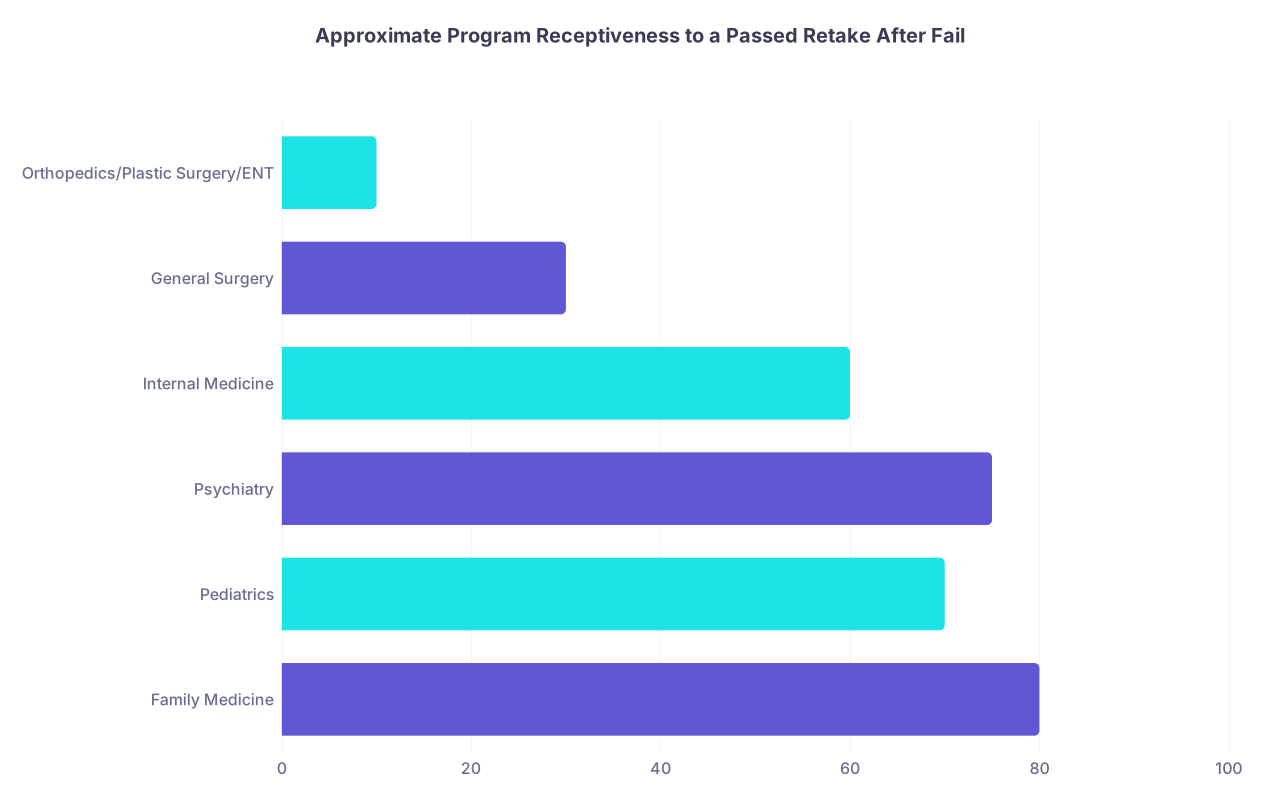
How Programs Actually See a Late Fail
You need a realistic mental model, not fantasy.
| Category | Value |
|---|---|
| Family Medicine | 80 |
| Pediatrics | 70 |
| Psychiatry | 75 |
| Internal Medicine | 60 |
| General Surgery | 30 |
| Orthopedics/Plastic Surgery/ENT | 10 |
These percentages are not official. They are pattern recognition:
- FM, Psych, Peds: Many programs will consider you if:
- You pass on the second attempt.
- You have clear letters praising your clinical work and professionalism.
- IM: Mixed. Community and lower‑tier programs may be flexible, especially if your Step 2 CK pass is solid.
- General Surgery and above: One fail close to ERAS is often fatal for this cycle, especially if Step 2 CK. People do match with red flags, but they usually have heavy connections, research, or are willing to pivot to prelim years or another specialty.
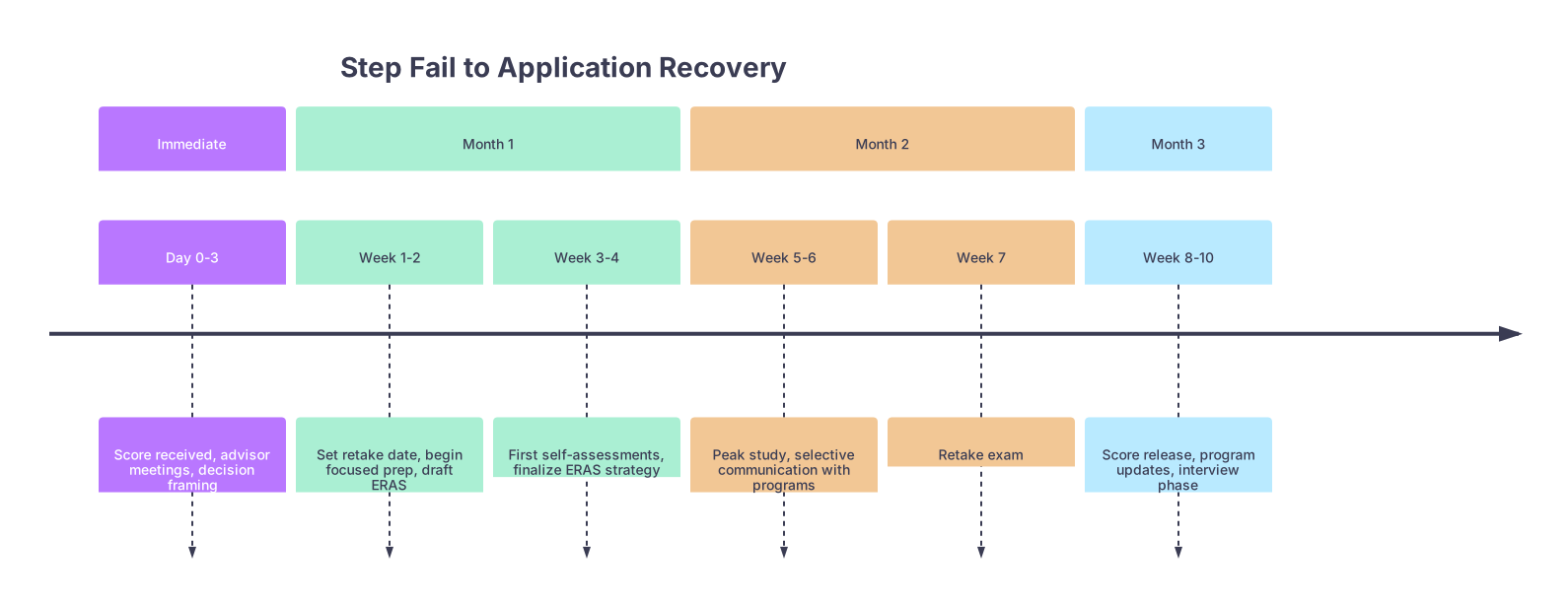
Alternative Timelines: If Your Dates Shift
Not everyone fails in August. Some fail in September or October. That changes the calculus.
| Period | Event |
|---|---|
| Immediate - Day 0-3 | Score received, advisor meetings, decision framing |
| Month 1 - Week 1-2 | Set retake date, begin focused prep, draft ERAS |
| Month 1 - Week 3-4 | First self-assessments, finalize ERAS strategy |
| Month 2 - Week 5-6 | Peak study, selective communication with programs |
| Month 2 - Week 7 | Retake exam |
| Month 3 - Week 8-10 | Score release, program updates, interview phase |
If your fail comes after October 1:
- Many programs have already started reviewing files.
- Your MSPE is out.
- You have two main options:
- Retake quickly and hope your new score posts while interviews are still being offered.
- Accept that this cycle is likely compromised and build a stronger file for next year (research, extra clinical time, possibly a preliminary year).
If your fail is on Step 1 only, and you have:
- Strong clerkship performance
- Strong Step 2 CK (either already or on the retake)
- Supportive letters
…then some programs, especially in primary care fields, will largely “forgive” the Step 1 fail once you have demonstrated later success.
If your fail is on Step 2 CK, programs are more cautious, because that exam correlates more with residency performance and board pass rates.
Emotional Management and Narrative Control
One more thing. You cannot let this become your entire personality in ERAS.
Programs care more about:
- How you responded than the fact that you failed.
- Whether your story is consistent:
- Clear challenge → honest reflection → specific changes → improved outcome.
Your narrative should sound like this:
- “I underestimated the exam and did not use practice tests effectively. The failure was humbling. I restructured my approach, made UWorld and NBMEs central, and treated my retake like a full‑time job. The result is [passing score]. That process has changed how I prepare for everything, including residency.”
Not:
- A 2‑page essay on anxiety, testing conditions, or how unfair the exam is.
The One Thing You Should Do Today
Pull out your calendar and block the next 8 weeks by week:
- Retake date (even if approximate)
- Dedicated study hours
- ERAS tasks (whether this cycle or next)
- Self‑assessment dates
If your calendar is blank or fuzzy beyond “study a lot,” you are not in recovery mode. You are in denial. Fix the calendar first; everything else hangs on that.