
A chief resident once closed the door after an interview day, tossed a file on the table, and said, “Cool person, great story… never getting past the committee.” The student’s face during the interview hadn’t given away a thing. On paper, they looked solid. But there was one detail that turned what you’d call a “concern” into a hard “dealbreaker.”
Let me walk you through how that actually happens behind the closed doors you never see.
This “red flag” language gets thrown around in med school hallways like it’s binary: either you’re fine or you’re doomed. That’s not how program directors think. In the room where rank lists are made, we’re not asking “red flag or no red flag?” We’re asking two very different questions:
- Is this something we just have to watch?
- Or is this something we simply cannot risk?
That’s the real difference between a “concern” and a “dealbreaker.” And if you do not understand that line the way faculty do, you’ll give the wrong explanations, send the wrong signals, and tank chances you could have salvaged.
Let’s pull the curtain back.
How Programs Actually Classify Red Flags
Here’s the quiet reality: almost every applicant has something that makes someone at the table raise an eyebrow.
What faculty rarely admit openly is this: red flags are not just about the event itself. They’re about what that event predicts for:
- Patient safety
- Reliability on call
- Ability to finish the program
- How much drama you’re going to bring into a residency that’s already stretched thin
So on the back end, we mentally sort issues into two bins:
- “Concern” red flags → Need context. Might lower you in the rank list. But you can still absolutely match.
- “Dealbreaker” red flags → No amount of spin saves you. The program will not rank you (or will put you so low it’s meaningless).
Let me be blunt. A well-handled concern can be forgiven. A dealbreaker cannot. The tragedy is that students often present a fixable concern in a way that converts it into a dealbreaker.
We’ll get to that. But first, you need a clean comparison.
| Type | Concern Red Flag | Dealbreaker Red Flag |
|---|---|---|
| Academics | Single Step failure, one repeat year | Multiple failures, pattern of marginal passes |
| Professionalism | One documented professionalism issue, resolved | Repeated or recent professionalism violations |
| Legal/Behavioral | Past DUI with treatment and stability | Recent substance diversion, untreated addiction |
| Communication | Awkward interview, vague answers | Dishonesty, contradicting documents/letters |
| Fit/Reliability | Some lateness, minor issues with feedback | Unreliable, hostile, blames others consistently |
None of this is written in ERAS. But this is exactly how discussion sounds when doors close.
Concern Red Flags: The Ones You Can Survive (If You Handle Them Right)
Let me give you the kinds of things programs argue about, not walk away from.
1. Single Step Failure or Board Bump in the Road
Here’s the conversation I’ve heard more times than I can count:
“They failed Step 1 once but passed Step 2 solidly. Clean MS3 evals. Good letters.”
“Do we think they’ll pass boards on first attempt during residency?”
“Yeah, looks like they corrected course.”
That’s a concern. Not a coffin.
If you have:
- One failed exam (Step 1, Step 2, or a major shelf)
- Then a clear pattern of passing, preferably with improvement
Faculty read that as: something went wrong, then you figured it out. They want to see:
- A concrete reason: not vague “test anxiety,” but a real shift — wrong strategy, overload, life event.
- A changed behavior: new study structure, tutoring, fewer commitments, accommodations if appropriate.
- Stability: no repeated failures, no spotty shelves after the big crash.
Handled well in your application and interview, a single failure is a concern: they’ll flag you, watch you, maybe check in more as an intern. But you’re not dead in the water.
Where you screw this up is with:
- Excuses (“The school didn’t prepare us.”)
- No explanation (“I just had an off day.” Nobody buys that.)
- No evidence of change (Step 2 barely passed with a whisper of a margin).
2. A Repeat Year or LOA for Non-Catastrophic Reasons
Repeat a year for academics or take a leave? The instinctive fear is: “I’m done.”
Not exactly.
Programs see all of these:
- Students who repeat M2, then perform solidly on rotations.
- Leaves for family illness, mental health, pregnancy, burnout.
Most PDs are not monsters. They don’t blacklist you for stumbling once. What they look for:
- The why
- The distance from the event
- The trajectory afterward
If you repeated M2, then Step 1 was fine, step 2 fine, clinical comments say “hardworking, prepared, pleasant to work with,” this sits in the “concern” category. They might say, “We should ask about it in the interview,” but they won’t immediately toss your file.
You move this toward dealbreaker territory if:
- You’re vague or slippery in your explanation.
- You blame everyone else.
- The repeat year is recent and your newer performance is still borderline.
3. One Professionalism Incident That Actually Resolved
Academic deans love these phrases: “professionalism concern,” “behavioral issue,” “communication challenges.” The words are loaded, but the reality is nuanced.
If you had:
- One incident of unprofessional email
- One late assignment that triggered a write-up
- A conflict with a resident that led to a remediation plan
That’s a concern, not an automatic no — if the story arc ends with: you got feedback, you adjusted, and the pattern stopped.
In faculty discussions, you’ll hear:
“They had a professionalism note in M3 but nothing afterward, and the later letters call them ‘reliable’ and ‘team-based.’ I think they were immature then and grew.”
That’s survivable.
You kill yourself if you come across as:
- Defensive: “The attending was out to get me.”
- Minimizing: “It wasn’t a big deal.” (If it made your MSPE, someone thought it was.)
- Unreflective: “I guess I just misunderstood.” That reads as: hasn’t really learned.
4. Sparse Research, Non-Traditional Path, Odd Transcript
These are small-time concerns that mostly affect competitiveness, not viability.
- No research in a research-heavy specialty.
- A gap year that’s loosely explained.
- Odd electives distribution.
People will ask questions. You might drop a bit on the rank list. But these are not moral failings or threats to patient care. Programs classify them under “concern” in the sense of “is this person a strong fit here?” not “will this person blow up on us?”
Handled honestly, with a clean narrative, these rarely become dealbreakers.
Dealbreaker Red Flags: Where Committees Quietly Draw the Line
Now the part students never hear clearly: the stuff that makes programs say, “We just can’t risk this.”
These patterns will usually lead to “Do Not Rank” at a lot of places, no matter how you spin them.
1. Repeated, Recent Professionalism Problems
One professionalism write-up? Concern.
Three, over multiple years, some recent? That’s a dealbreaker at many programs.
Think patterns like:
- Multiple comments about “late,” “unreliable,” “does not respond to pages promptly.”
- Attitude: “argumentative,” “challenged feedback,” “difficult to supervise.”
- Recurrent boundary issues with staff, patients, or classmates.
On the back end, the question faculty ask is not “Were they right or wrong in that conflict?” It’s “Do I want to get frantic 2 a.m. calls about this person for the next three years?”
If your MSPE uses language like “required ongoing professionalism monitoring,” “multiple episodes,” “continued concern,” I’ve watched committees quietly put a line through your name. Not because you’re evil. Because residency is already on fire and they cannot add gasoline.
2. Multiple Failures Without Clear Recovery
One failed exam can be framed as bad strategy, rough life event, or misjudged timing.
Three failed exams, multiple shelves near the cutoff, Step 2 barely passed on the second try? That doesn’t read as “bad luck.” It reads as “this person may not be able to clear in-training exams or ABMS boards.”
Here’s what gets said in meetings:
“We are not in the remediation business for the entire program.”
“If they fail boards as a PGY-3, we’re all stuck.”
At that point, your file stops being an individual application and starts being a potential institutional problem. Nobody wants the ACGME breathing down their neck over board pass rates.
If you’re in this boat, we’re talking serious strategy decisions — specialty choice shift, research years, extended training, very targeted programs. But don’t kid yourself: this is dealbreaker territory at a lot of mid-to-high tier programs.
3. Dishonesty, Inconsistency, or Shadiness
This one is non-negotiable. If there’s one thing that moves someone instantly from “Maybe” to “No” in faculty minds, it’s a whiff of dishonesty.
Concrete examples I’ve seen:
- CV lists a “first-author manuscript in submission” → faculty member personally checks PubMed or contacts the PI → paper doesn’t exist or student’s role was inflated.
- Inconsistent story: personal statement, interview answer, and dean’s letter give three different explanations for the same event.
- Letters carefully avoid commenting on important things (e.g., “I did not directly observe their clinical work” for someone on a sub-I — yes, we notice what’s not said).
Once a PD or faculty member says, “I don’t trust this person’s story,” you’re done. They will not rank you above people they can trust. Period.
This is where poorly coached “spin” backfires. When you over-polish, over-edit, or contradict your own documents, you slide from “slightly messy but honest” concern into “dealbreaker” without realizing it.
4. Unstable Substance Use or Legal Issues Without Real Recovery
Notice the qualifiers. I said unstable and without real recovery.
A DUI 5–7 years ago, fully disclosed, went through treatment, long period of clean evals and strong performance? That’s a concern. Programs will ask questions. But many will move forward.
Active substance use, recent impairment, diversion, or unclear timeline of sobriety? Dealbreaker at most places.
Why? Programs are responsible for:
- Patient safety and DEA compliance
- Liability
- Other residents’ workload when someone implodes
You can overcome a past substance or legal issue if your story is coherent, well-documented, and distant in time with sustained stability. If those are missing, it’s not “judgmental” for them to pass — it’s self-preservation.
5. Clearly Toxic Behavior Patterns
This is the part schools obscure with soft language, but PDs can read the code.
Phrases that make people push your application aside:
- “Struggled in team-based environments.”
- “Required close supervision to manage interpersonal dynamics.”
- “Feedback about communication style did not consistently translate to behavior change.”
That’s not an awkward introvert. That’s, “They made people miserable and didn’t adjust.”
Residency isn’t just medicine. It’s night float, cross-coverage, long months with the same handful of residents. One chronically hostile or volatile person wrecks the entire atmosphere. Programs know it. They are ruthless about avoiding it.
The Hidden Factor: How You Talk About the Red Flag
Here’s the uncomfortable truth: the same underlying issue can land as a concern at one program and dealbreaker at another largely because of how you handle it.
I’ve seen two applicants with the same skeleton in the closet walk into interviews.
- Applicant A: vague, defensive, rehearsed lines that dodge responsibility.
- Applicant B: clear, concise, owns their part, shows what specific changes they made since.
Applicant B gets ranked. Applicant A gets a “No, thanks” email.
This is how we subconsciously score you when you talk about your red flag:
- Ownership – Do you clearly accept your part without grandstanding or self-flagellation?
- Insight – Do you actually understand what went wrong at a behavioral level?
- Change – Can you point to specific, sustained changes after the event?
- Stability – Has enough time passed with no repeats?
If you hit those four, even a sizable concern stays in the “concern” column. If you miss them, even a mid-level issue smells like a bigger risk.
What Moves a “Concern” Toward “Dealbreaker”
You want the real behind-the-scenes filter? It’s this: pattern + recency + attitude.
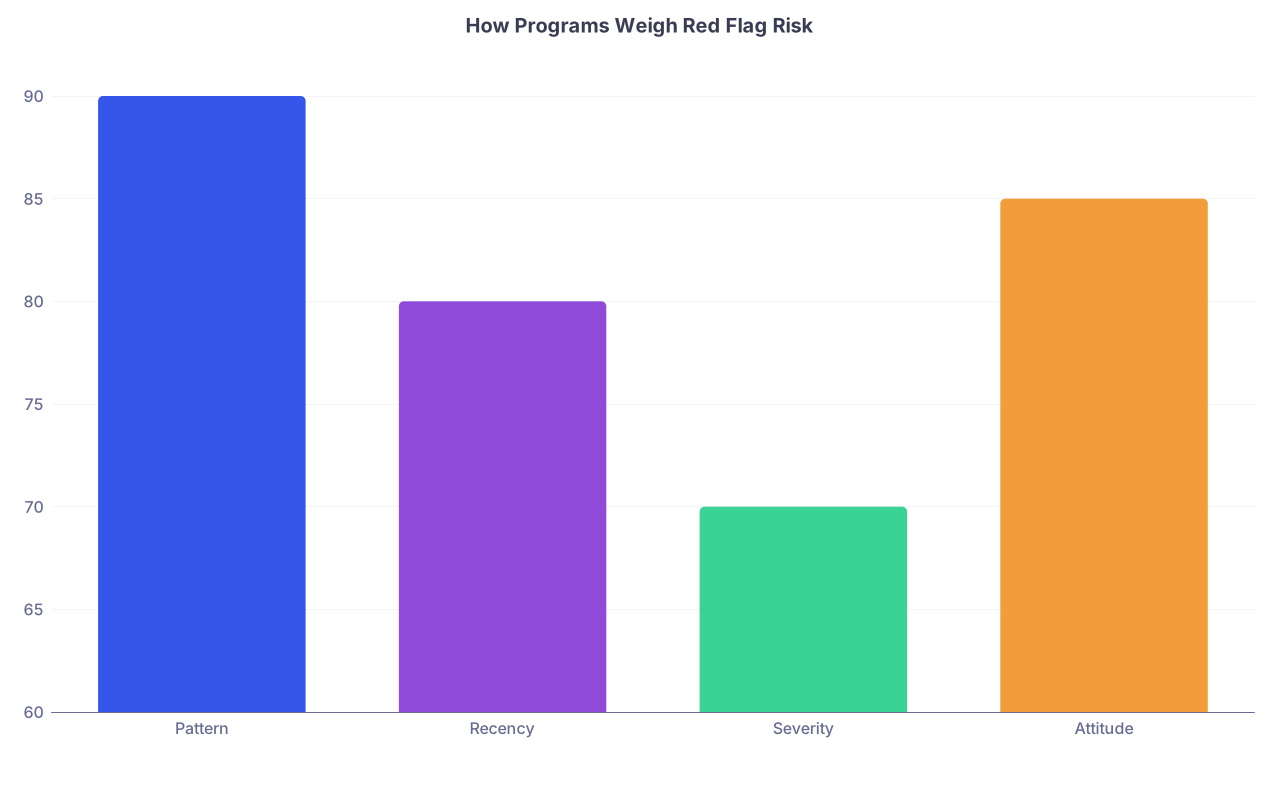
| Category | Value |
|---|---|
| Pattern | 90 |
| Recency | 80 |
| Severity | 70 |
| Attitude | 85 |
Most faculty would tell you “severity” is what matters most. They’re lying to themselves. What they actually react to is:
- Pattern – one-off vs repeated.
- Recency – five years ago vs last semester.
- Attitude – “I learned from this” vs “This wasn’t my fault.”
Take a single Step failure:
- If it’s 3 years back, followed by improved scores and positive evals, humble explanation → concern.
- If it’s last year, with barely passing follow-up and vague answers → many will quietly slide you toward dealbreaker.
Same with professionalism:
- One angry email in M2 followed by clean M3 and glowing letters → concern.
- One angry email in M2, then a conflict on surgery clerkship, then a “communication issue” note in sub-I → most places will not gamble on you.
You don’t need perfection. You need a clear break in the pattern and a believable story of change.
What You Should Actually Do If You Have a Red Flag
Let’s be practical. You can’t rewrite history, but you can control three things: clarity, consistency, and strategy.
Get Your Story Straight — Before You Touch ERAS
Sit down and answer, in plain language:
- What exactly happened?
- What part of this was on me?
- What changed immediately afterward?
- What’s the evidence that the change stuck?
Write it the way you’d explain it to someone who doesn’t like BS. Then align:
- Personal statement
- ERAS descriptions (where appropriate)
- Any “additional information” text boxes
- Your interview answer
No contradictions. No dramatization. No overly lawyered phrases.
Decide What’s Explainable vs What Needs a Different Strategy
Some problems you explain; others you plan around.
- Single fail, one professionalism note, an LOA? You face it head-on.
- Multiple failures, or very recent major issue? You may need to adjust specialty choice, apply more broadly, or lean toward programs known to be more forgiving or with personal connections.
Don’t let your ego force you to aim at programs that have no real chance of touching your file.
Use Your Dean or Mentor, But Don’t Let Them Over-Sanitize You
Schools like to scrub your story until it sounds “professional.” That’s how you end up with sterile nonsense that screams, “Scripted by committee.”
I’ve watched PDs roll their eyes at lines like:
“Through this experience, I developed resilience and a deeper appreciation for professionalism.”
Give me:
“I screwed this up. Here’s exactly what I changed afterward, and here’s what’s happened since.”
You can absolutely be polished and still sound like a human adult who learned something.
How This Plays Out On Rank List Night
I’ll show you what you’re not in the room for.
Picture a sleepy conference room at 8 p.m., two weeks before rank lists are due. Laptops open, piles of printouts, half-eaten takeout. Your application comes up.

| Step | Description |
|---|---|
| Step 1 | Review Application |
| Step 2 | Rank Based on Overall Strength |
| Step 3 | Discuss Context |
| Step 4 | Classify as Concern |
| Step 5 | Rank Lower but Include |
| Step 6 | Borderline Rank Position |
| Step 7 | Do Not Rank |
| Step 8 | Any Red Flags? |
| Step 9 | Pattern/Recent? |
| Step 10 | Trust Applicant? |
Somebody says, “They failed Step 1.” Another says, “Yeah, but look at Step 2 and the letters.” Someone else: “I liked them on interview, owned it, seemed solid now.”
You get a rank. Maybe not top 5. But you’re on there.
Or:
They say, “Multiple professionalism issues, and when I asked them about it they didn’t really take ownership.” Someone else: “We’ve already got three applicants without that risk at the same tier.”
Your name disappears. Not with malice. Just risk management.
That’s the line you’re trying to stay on the right side of: not perfection vs imperfection, but predictable vs risky.
One More “Insider” Reality You Need to Hear
Some of you reading this are trying to convince yourselves that something clearly in dealbreaker territory is just “a concern” if you phrase it nicely. I won’t lie to you.
There are red flags that will close doors no matter how beautifully you explain them. Recent diversion. Multiple unremediated professionalism hits. Repeated exam failures without clear upward trend. Aggressive or evasive behavior in the interview.
You may still match — but not everywhere, and not necessarily in your dream specialty or city. The quiet truth is that not all paths are salvageable to the same level.
What you control is:
- Not making it worse with denial or spin.
- Choosing a strategy that fits reality, not fantasy.
- Showing up as someone who learned, not someone still in the middle of the same problem.
If you do that, many “concerns” stay just that — issues to watch, not reasons to discard you.
FAQs
1. Should I always proactively bring up my red flag in every interview, even if they don’t ask?
No. Don’t lead with your worst moment. If it’s in the MSPE, on your transcript, or in your ERAS, you must be ready with a clear, concise explanation when asked. Some programs will bring it up directly; others won’t. For major, obvious issues (failed Step 1, repeat year), it’s reasonable to address it briefly if they ask about your academic journey or challenges, but you don’t need to hijack the whole interview to talk about it.
2. Can a strong letter from a well-known faculty member “override” a red flag?
Very rarely. A powerful letter can reassure people about a concern — one failure, one professionalism episode, a non-traditional path. It almost never cancels out a dealbreaker pattern (repeated professionalism issues, multiple failures, serious honesty concerns). If your mentor is known and trusted by the PD, it can nudge you from “on the fence” to “let’s rank them low but on the list.” It won’t convert a clear no into a yes.
3. Is it better to under-explain or over-explain my red flag?
Both extremes are bad. Under-explaining (“stuff happened, I moved on”) reads evasive or shallow. Over-explaining with a long emotional saga makes you look unstable or still in crisis. Aim for about 30–60 seconds verbally: what happened, your role, what you changed, and what’s been stable since. Then stop talking. If they want more detail, they’ll ask.