
"We only have abstracts" is not a harmless answer. It is a score-dropping answer.
I've seen applicants say it with a shrug, as if the limitation itself explains everything. It doesn't. To an interviewer, that line often sounds like: I stop thinking when the evidence gets inconvenient. That's the real problem. Not the abstract. Your response to it.
Abstract-only projects are common. Conference work is messy. Manuscripts lag. Data are incomplete. Fine. Real life is full of incomplete evidence. Residency is, too. Your job is not to whine about the constraint. Your job is to show judgment inside the constraint.
A strong answer does three things fast:
- names what the abstract actually tells you,
- admits what it cannot tell you,
- and connects that to a sensible clinical or research next step.
That's what scholarly maturity sounds like. Calm. Specific. Useful.
This article will show you what good sounds like, what red flags tank your score, and how to fix this today with a practical structure you can use in your next mock interview.
Don't Say "We Only Have Abstracts", It Signals Weak Evidence Handling
The mistake is simple: you use "we only have abstracts" as a catch-all excuse instead of showing you know how to extract, judge, and apply evidence anyway.
Don't make this mistake.
Interviewers are not expecting perfection. They are expecting competence under imperfect conditions. If you act as though an abstract is the end of the conversation, you undermine confidence in two things:
Your scholarly maturity
- Can you separate signal from noise?
- Can you identify study design limitations?
- Can you resist overclaiming?
Your ability to function in real clinical environments
- New data are often preliminary.
- Consultants disagree.
- Guidelines lag behind emerging evidence.
- You still have to think clearly.
When you say, "We only have abstracts," with no further analysis, you sound passive. Almost helpless. That's a bad look in a residency interview.
A better answer sounds like this:
- "We only had abstract-level data at that stage, so I focused on what we could responsibly assess."
- "From the abstract, we could identify the study population, endpoint, and direction of effect, but not fully verify methodology or external validity."
- "So I treated the findings as hypothesis-generating rather than practice-changing."
That answer protects you. It shows restraint without sounding lost.
The Core Problem: "Abstracts Only" Hides the Real Work
Here's the misconception: abstracts are not useless. They're just incomplete.
Your task is not to worship them or dismiss them. Your task is to interpret them responsibly and triangulate with other sources when possible.
The weak applicant paraphrases the result and stops there:
- "It showed a significant improvement."
- "The intervention was promising."
- "The results supported our hypothesis."
That is thin. Interviewers hear memorization, not analysis.
The stronger applicant does the real work behind the abstract:
- What was the study design?
- Who was the population?
- What was the comparator, if any?
- What was the primary endpoint?
- Was the endpoint patient-centered or just a surrogate?
- Was the sample size tiny?
- Was follow-up short?
- Were inclusion and exclusion criteria narrow enough to limit generalizability?
- Was the result statistically significant but clinically trivial?
- Did the abstract omit enough methods detail that conclusions should stay cautious?
That's the difference.
A common pitfall is answering as if the abstract equals the whole study. It doesn't. Abstracts often compress methods, mute limitations, and oversell conclusions. I've seen applicants confidently say an intervention "works" because a conference abstract reported a significant p-value. Bad move. A p-value without context is not proof of durable clinical benefit. It may reflect a surrogate endpoint, a small underpowered sample, a subgroup analysis, or a design with enough bias to make the result wobble.
Another common failure: you summarize findings but never translate them.
Interviewers do not care only that you can read research. They care whether you can ask:
- Does this change patient care?
- Does this affect how I counsel patients?
- Does this support risk stratification, triage, or quality improvement?
- Is this hypothesis-generating and worth a larger study?
- Or is it just interesting conference noise?
If you don't make that translation, you sound academically decorative. Not useful.
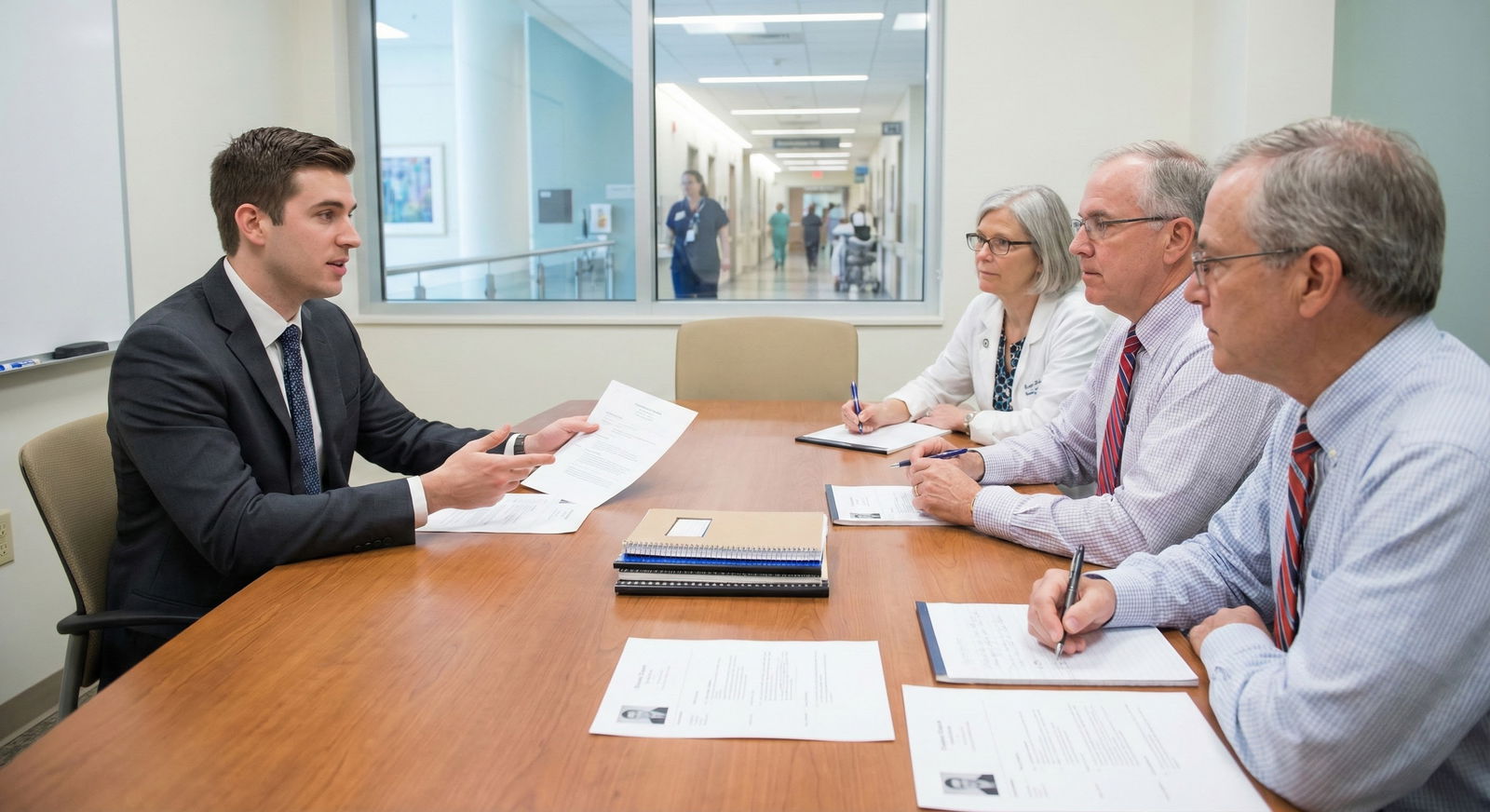
What Interviewers Hear Instead: Confidence, Judgment, and Application
You need to translate your answer into interviewer language. They are listening for three things:
- Can this person critique evidence?
- Can this person synthesize incomplete information?
- Can this person apply it responsibly?
That's it. That's the game.
The protective pivot is simple:
- Acknowledge the constraint briefly
- Show what you could determine
- Name what you could not determine
- Explain the practical implication
This is what credibility sounds like:
- "The abstract suggested benefit in the measured endpoint, but because the methods detail was limited, I treated the finding cautiously."
- "We could identify the population and outcome direction, but without the full manuscript we couldn't fully assess confounders, endpoint definitions, or durability of effect."
- "That made it more hypothesis-generating than practice-changing."
Notice the tone. Calm. Specific. Solution-oriented.
Don't blame your institution. Don't blame your PI. Don't blame the literature. Complaining makes you sound immature. You're being evaluated on how you think, not on whether the project was perfectly packaged.
When available, mention details that make you sound like someone who actually understands evidence:
- endpoints,
- effect size or direction of effect,
- inclusion/exclusion themes,
- statistical support,
- whether the result is exploratory or robust,
- whether it could plausibly generalize to actual patients.
That level of specificity changes the whole interview.
How to Answer the Question: A 30-60 Second Script You Can Use
Use this structure every time:
- Constraint
- What you can responsibly conclude
- Limitations
- What you'd do next
That structure keeps you from rambling and, more importantly, keeps you from overclaiming.
Script A: Research experience question
If they ask about your project, say something like:
"Because the work was still at the abstract stage, I was careful not to overstate the findings. From the data we had, we could identify the patient population, the main outcome, and the direction of the association. The results suggested [insert actual finding], but the limitations were important, especially [small sample size / retrospective design / short follow-up / incomplete methods detail]. So I viewed it as hypothesis-generating rather than definitive. The next step would be to review the full protocol or manuscript, confirm endpoint definitions and statistical methods, and see whether the finding holds in a larger or more clinically representative cohort."
That answer does not sound defensive. It sounds mature.
Script B: Evidence critique question
If they ask what you think of a study or abstract, say:
"Based on the abstract alone, I'd say the finding is interesting but not enough to claim practice change. I'd want to know the study design, comparator, primary endpoint, and effect size, not just whether it reached statistical significance. If the abstract reports benefit, I'd still ask whether the endpoint was clinically meaningful, whether the sample was large enough, and whether the population resembles the patients we actually treat. So at this stage, I'd describe the result as supportive or hypothesis-generating, depending on the design, and I'd look for the full manuscript or trial registry details before making strong conclusions."
That's a safe answer. Strong, but safe.
Don't make these mistakes
- Don't claim efficacy you can't support.
- "It works" is dangerous language if all you have is an abstract.
- Don't confuse statistical significance with clinical significance.
- A tiny effect with a p-value is still maybe a tiny effect.
- Don't use vague filler words.
- "Promising" and "significant" are lazy if you can't explain what they mean.
- Don't invent missing details.
- If the abstract doesn't report effect size or confidence interval, say so.
Replace weak phrasing with strong phrasing
Weak:
- "The results were significant."
- "It was promising."
- "It showed improvement."
Better:
- "The abstract reported improvement in the primary endpoint."
- "The direction of effect favored the intervention, although the magnitude wasn't fully clear from the abstract."
- "The finding reached statistical significance in the abstract, but without full methods and effect size reporting, I'd be cautious about clinical interpretation."
That's how you sound like someone who won't hurt patients with sloppy reasoning.
The Fix: Build an "Abstract-to-Action" Checklist (So You Never Sound Lost Again)
You need a repeatable checklist. Not vibes. Not improvisation.
Use this every time you review an abstract:
The Abstract-to-Action checklist
- Study design
- RCT? Retrospective cohort? Case series? Secondary analysis?
- Population
- Who was studied? Is it similar to real patients you might treat?
- Comparator
- Against what?
- Primary endpoint
- What was actually measured?
- Effect size
- How big was the difference or association?
- Statistical support
- P-value? Confidence interval? Any adjustment?
- Outcome definitions
- Hard outcomes or surrogate markers?
- Follow-up duration
- Long enough to matter?
Red-flag filters
These are the traps people miss:
- No comparator
- Endpoint switching or unclear primary outcome
- Surrogate outcomes presented like patient-centered outcomes
- Broad conclusions from narrow data
- Underpowered sample with overconfident language
- Short follow-up sold as durable benefit
If you catch these, say so. Politely. Clearly. That raises your score.
Triangulate whenever possible
If the abstract is all you were originally given, fine. But don't stop there if you have time. Check:
- full text through library access,
- preprints,
- poster presentations,
- trial registry entries,
- related abstracts from the same group,
- guidelines,
- systematic reviews.
This matters because it shows initiative. I've seen applicants rescued by one smart sentence: "I also cross-checked the trial registry to understand the prespecified endpoints." That is interviewer gold.
If you truly can't access more
Then say that directly and move to the next best action:
- "I'd ask my PI for the protocol or manuscript draft."
- "I'd verify whether the trial registry clarified the endpoint structure."
- "I'd look for related presentations or prior publications from the same group."
Uncertainty is acceptable. Passive helplessness is not.
Common Failure Modes (and How to Avoid Them on Interview Day)
I've heard all four of these. They sink interviews quietly.
1) Turning the limitation into your personality
Bad:
- "That's just how it is here."
- "We only had abstracts, so there wasn't much to say."
This sounds resigned and unserious.
Better:
- "Because the project was at the abstract stage, I focused on what we could responsibly interpret and what would need confirmation."
2) Saying an intervention "works" because the abstract said "statistically significant"
No. Stop doing this.
Better:
- "The abstract reported a statistically significant difference in the measured endpoint, but I'd want to assess the effect size, endpoint relevance, and study design before calling it clinically effective."
That one sentence saves you from sounding reckless.
3) Skipping patient relevance
A lot of applicants never bridge the gap. They stay trapped in conference-speak.
Fix it:
- "If valid, this could affect risk stratification."
- "This may help guide which patients need closer follow-up."
- "At this stage, it's more useful for research direction than immediate treatment decisions."
Now you sound like a future resident, not just a student who memorized a poster.
4) Refusing to engage
Bad:
- "I don't know. We only had the abstract."
That answer dies on the table.
Better:
- "Based on the abstract, we can say X. We can't confirm Y without the full manuscript or registry details. The next step would be Z."
Structured uncertainty is powerful. It protects accuracy while proving you can still think.

You do not need perfect evidence to give a strong answer. You need disciplined reasoning. That's what interviewers reward.
If this is a weak spot for you, fix it before your next mock interview. Pick three abstracts tonight. Practice the same 30-60 second structure on each one. Constraint. Conclusion. Limitations. Next step. Record yourself. Cut the vague language. Strip out the excuses. Keep the judgment.
Do that, and you won't sound like someone trapped by incomplete data. You'll sound like someone residency programs can trust.