
Rambling answers will quietly kill an otherwise strong residency applicant.
Not low scores. Not a thin CV. Rambling.
I have watched smart, capable applicants talk themselves from “rank them high” to “probably not a fit” in a single 4‑minute monologue. Same person, same accomplishments. Different control over their answers.
You are not being judged only on what you have done. You are being judged on whether attendings can imagine rounding with you at 6:30 a.m. If your answers are disorganized, meandering, and twice as long as they should be, the answer is no.
Let me show you how to fix that.
Step 1: Understand Why You Ramble (So You Can Stop)
Most applicants do not ramble because they lack content. They ramble because they lack a structure.
Here is what usually drives rambling in residency interviews:
Anxiety fill‑in
You get a question, your brain panics, and you start talking just to avoid silence. You “think out loud” with the interviewer as your audience. Bad move.Over-compensation
You feel like you must prove you are hard‑working, compassionate, a team player, a leader, reflective, and resilient every time you open your mouth. So one question gets ten stories.No clear endpoint
You start an answer with no idea how or when you will finish. Unsurprisingly, you do not.Chronological storytelling
You re‑tell the whole movie instead of the key scene: “So first year of med school I thought about… then in second year… then on my surgery rotation…”
Interviewers do not need the prequel.Trying to sound “impressive” instead of clear
You add layers of context, hedging, and caveats because you are afraid of being judged. It bloats everything.
You will not fix this with generic advice like “be concise.” You need a concrete, repeatable framework that forces you to be brief.
That is what we build next.
Step 2: Use the 3‑Layer Answer Framework
You need something simple enough that you can remember it when your heart rate is 120 and the PD is staring at you.
Here is the framework I teach:
3‑Layer Answer Framework = HEADLINE → PROOF → SNAPSHOT
HEADLINE (1 sentence)
Directly answer the question in a short, clear sentence.PROOF (2–3 sentences)
One specific example or mini‑story that backs up your headline.SNAPSHOT (1 sentence)
Tie it to what it means for you as a resident / future physician.
That is it. 4–7 sentences total. Usually under 90 seconds if you do it correctly.
Let me show you what this looks like in practice.
Example: “Tell me about yourself.”
Rambling version (what I actually hear):
“Sure, so I was born in… then we moved to… I always knew I wanted to do something in science, and in college I actually started as an engineering major but then I switched to biology because I really liked my first organic chemistry class, and that took me to some time volunteering at a free clinic which was really eye‑opening because I had never seen…”
Stop.
3‑Layer version:
HEADLINE:
“I am a detail‑oriented, team‑focused medical student with a strong interest in [specialty] and a background in [relevant experience].”PROOF:
“During my third‑year [specialty] rotation, I took on a QI project looking at reducing unnecessary labs on our service. I worked with the residents to collect data, presented it at our noon conference, and we implemented a simple checklist that cut redundant labs by about 20% over a month. That experience reinforced how much I like working within a team to improve systems, not just individual patients.”SNAPSHOT:
“So I see myself as someone who brings that same structured, team‑oriented approach to residency—taking care of patients, but also helping the service run a little better.”
Direct. Concrete. Tied to residency.
You can apply this exact 3‑layer structure to 80% of interview questions.
Step 3: Shorten Your Default Answer Length
If you do not consciously control answer length, you will overshoot.
Most residency applicants talk 3–5 minutes per answer if left unchecked. Interviewers mentally check out around 60–90 seconds unless the story is exceptional.
Use this rule:
Standard question (e.g., “Why this specialty?”):
Aim for 60–90 seconds.Big question (“Tell me about yourself”, “Why this program?”):
Aim for 90–120 seconds maximum.
Anything longer is self‑sabotage.
To see why, look at this rough breakdown of where your interview time actually goes.
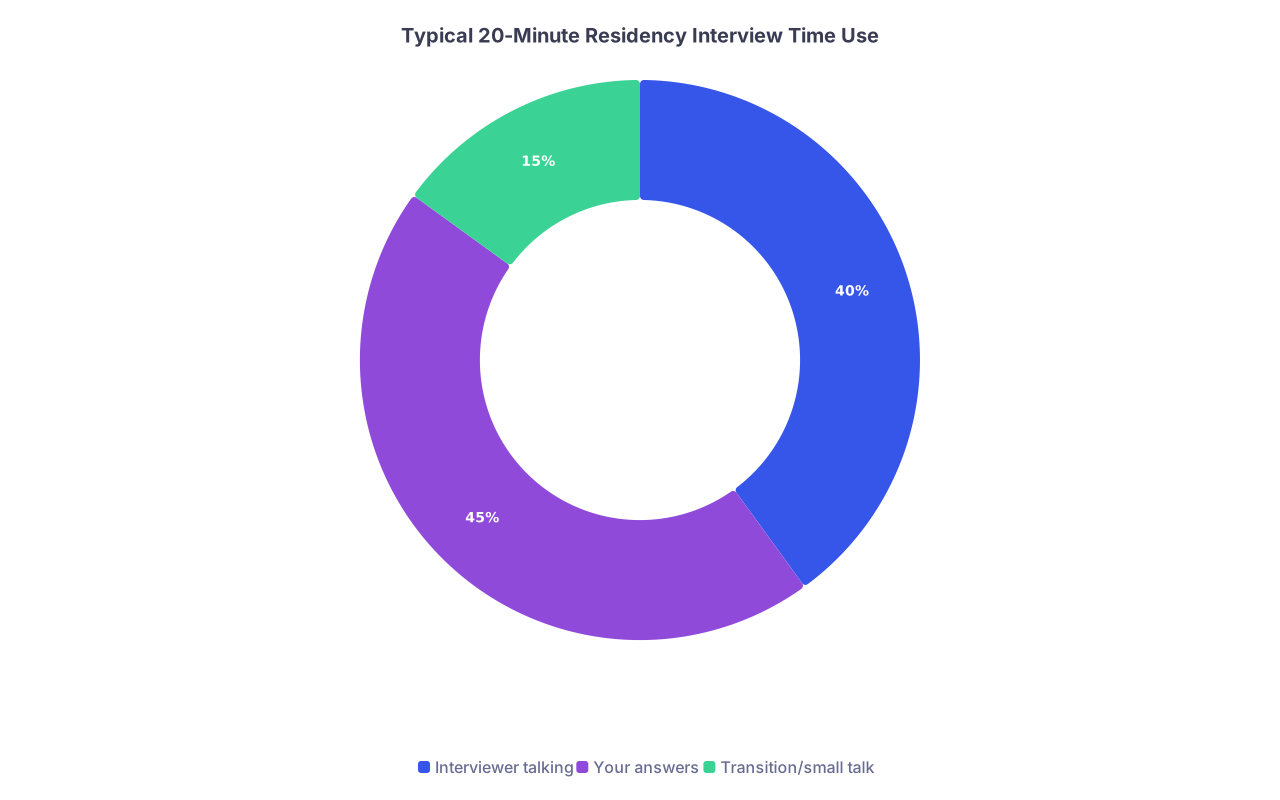
| Category | Value |
|---|---|
| Interviewer talking | 40 |
| Your answers | 45 |
| Transition/small talk | 15 |
You get maybe 8–10 minutes of real talking time. If two answers eat 7 minutes, you have just thrown away chances to show dimension.
Practical fix:
- Record yourself answering three common questions.
- Time each answer.
- Cut each by one‑third without losing the core message.
You are not cutting value. You are cutting fluff.
Step 4: Convert Rambly Content into Tight Structure
You probably already have long, messy answers in your head. Good. We are going to compress them.
Here is a systematic way to do it.
4.1 Start with your messy version (yes, really)
Take a question like: “Why this specialty?”
Write or speak your full, unfiltered answer. No time limit.
Now you are going to operate on it.
4.2 Extract the HEADLINE
Ask yourself: If I had to answer this in one sentence, what would I say?
Example raw thoughts:
- “I like continuity.”
- “I enjoy procedures.”
- “I like acute care.”
- “I really admire the residents I worked with.”
Condense into a clean headline:
- “I am drawn to internal medicine because I like complex problem‑solving, longitudinal relationships, and being the “home base” for patients with multiple conditions.”
If you cannot write a single clear sentence, you do not understand your own answer yet. Fix that first.
4.3 Pick ONE proof story
Not three. Not a paragraph of vague observations.
Choose:
- One patient
- One project
- One specific moment
Bad:
“I had a lot of experiences on my neurology rotation that made me realize how much I enjoy complex cases…”
Better:
“On my neurology rotation, I followed a patient with new‑onset seizures and an unclear diagnosis for three weeks, and I loved being part of the stepwise workup and discussing the differential each day with the team.”
Then give 2–3 sentences: context → your role → what you learned.
4.4 Finish with a residency‑focused SNAPSHOT
Do not end your answer with philosophy. End with how you will function in their program.
Examples:
- “That is the kind of diagnostic puzzle that keeps me engaged, and it is why I am excited about a residency where I will manage complex inpatients regularly.”
- “That experience showed me I work well in high‑acuity environments and enjoy quick decisions, which is what pulls me toward EM.”
This last sentence is the bridge between your story and their reality.
Step 5: Use Question‑Specific Mini‑Frameworks
Some questions show up so often it is foolish not to have a structure for them.
Here is how to answer the big ones concisely without sounding robotic.
5.1 “Tell me about yourself” (TTAY)
Framework: Present → Past → Future (plus our 3 layers).
HEADLINE (present focus)
“I am a fourth‑year at [School] interested in [specialty] with a strong focus on [clinical/research/teaching interest].”PROOF (selective past)
2–3 sentences covering:- Where you trained
- One or two defining experiences
- A thread that logically leads to your specialty
SNAPSHOT (future / residency)
“So right now I am looking for a residency where I can [two specific features that match their program].”
No childhood origin story. No family lore. No ten‑year timeline.
5.2 “Why this specialty?”
Framework: 3 C’s → Case → Connection
Core reasons (3 C’s, pick your own)
Example: Content (you like the work), Context (patient relationships, setting), Core self (fits your personality).Case (1 patient or experience)
One short story that illustrates these reasons in action.Connection to residency
1 sentence: “This is the kind of work I want to be doing day in and day out, which is why I am pursuing [specialty].”
5.3 “Why this program?”
Most people ramble here because they list everything from the website. That screams unprepared and insincere.
Framework: 3‑2‑1
- 3 specific program features
- 2 personal experiences that connect you to them (elective, mentor, research, geography)
- 1 sentence about fit
Example skeleton:
- “Three things stand out to me about your program: the strong exposure to [X], the early autonomy on the wards, and the emphasis on resident education with the weekly [named] conference.”
- “I saw that firsthand when I rotated here in August and worked with Dr. Smith’s team. I appreciated how the residents handled sign‑out and were really owning the plans.”
- “Given my interest in [Y] and wanting to train in a program that [Z], I see a really strong fit here.”
If you cannot name three concrete features in one sentence each, you did not research the program deeply enough.
5.4 “Tell me about a conflict / challenge / failure”
These are where rambling gets lethal, because people relive the story in high resolution.
Framework: STAR‑L (Situation, Task, Action, Result, Learning)
But compressed.
Situation/Task (1–2 sentences)
Who, what, when. No backstory novella.Action (2–3 sentences)
What you personally did. Not what “we” did.Result (1 sentence)
Outcome or what changed.Learning (1 sentence)
What you do differently now as a resident.
The trap here is over‑justifying your side of the conflict. Avoid the urge to litigate. Show maturity, not a legal defense.
Step 6: Use Visual Cues to Keep Yourself on Track
You are not going to be able to hold six frameworks in your head on interview day. So you simplify.
Take a look at this. It is how I tell people to think about answers in their notes.
| Question Type | Structure Note |
|---|---|
| Tell me about yourself | PAST → PRESENT → FUTURE |
| Why this specialty | REASONS → CASE → FIT |
| Why this program | 3‑2‑1 |
| Conflict / Failure | STAR‑L |
| Strength/Weakness | CLAIM → PROOF → FIX |
Write this kind of shorthand at the top of your notebook for interview day. You do not need full scripts. You need skeletons.
Then, every time you hear a question, you mentally tag it:
- “Okay, this is STAR‑L.”
- “This is 3‑2‑1.”
- “This is HEADLINE → PROOF → SNAPSHOT.”
That half‑second of labeling keeps you from free‑associating your way into a ramble.
Step 7: Cut Filler Phrases and Verbal Junk
Some people could cut their answer length by 30% just by removing noise words.
You probably use several of these:
- “So that was kind of when I really started to realize that…”
- “I guess you could say that…”
- “In a way…”
- “I mean, basically…”
- “To be honest…”
These do nothing for you. They make you sound uncertain and eat your time.
Concrete drill:
- Record a practice answer.
- Transcribe it (use any basic tool).
- Highlight every filler phrase and hedge.
- Rewrite the same answer without any of them.
Example:
Before:
“I think that was sort of the moment when I really started to realize that I was kind of drawn more to the continuity of care that you get in internal medicine.”
After:
“That experience showed me I am drawn to the continuity of care in internal medicine.”
Shorter. Cleaner. Confident.
Step 8: Practice Under Realistic Conditions (Not in Your Head)
Thinking your answers through in the shower does not count as practice. It feels good. It is not effective.
You need live‑fire drills.
8.1 Use the “10‑Question Circuit” twice a week
Pick 10 high‑yield questions:
- Tell me about yourself.
- Why this specialty?
- Why our program?
- Strengths.
- Weaknesses.
- Tell me about a conflict.
- Tell me about a failure.
- A time you received critical feedback.
- A time you showed leadership.
- What do you do outside of medicine?
Once or twice a week:
- Have a friend / resident / mentor ask you all 10, back‑to‑back.
- Record video.
- Time each answer.
Your criteria:
- Under 2 minutes for TTAY and “Why this program.”
- Under 90 seconds for all others.
- Clear HEADLINE in the first 15 seconds.
If you exceed time, you must cut, not talk faster.
8.2 Watch like an attending, not like your mom
When you review recordings, do not ask, “Do I sound smart?” Ask:
- Did I answer the actual question directly in the first sentence?
- Would I want to listen to this at 4:30 p.m. after six other applicants?
- Did I tell one clear story or three half‑stories?
- Could I summarize my own answer in one sentence afterward?
If you cannot summarize it, your interviewer will not either. They will just write: “Talked a lot. Hard to follow.”
Step 9: Read the Interviewer and Adapt in Real Time
Concise does not mean rigid. You still have to respond to the human in front of you.
Here is the part almost nobody teaches:
You should watch their micro‑signals while you talk.
Things that mean “wrap it up”:
- They stop taking notes.
- They look down at their list of questions.
- They shift in their chair or glance at the clock.
- Their follow‑up questions start getting shorter.
If you see any of this and you are mid‑story:
- Finish your current sentence.
- Deliver your SNAPSHOT line.
- Stop.
You can even be explicit if you are mid‑thought:
- “The short version is that it went well, and what I took from it was…”
- “Long story short, that experience is why I value…”
They will appreciate the self‑awareness.
On the other hand, if they lean in, nod, and ask specific follow‑ups about your project or patient, you have permission to expand a little. But still with structure.
Step 10: Build a Personal “Answer Bank” (Without Sounding Scripted)
You do not want scripted monologues. You do want reusable modules.
I tell applicants to build a small “answer bank” of:
- 3–4 patient stories
- 2 conflict/failure examples
- 2 leadership/initiative examples
- 2 “growth / feedback” stories
- 1–2 outside‑of‑medicine anecdotes
Then map them to the question types they can answer.
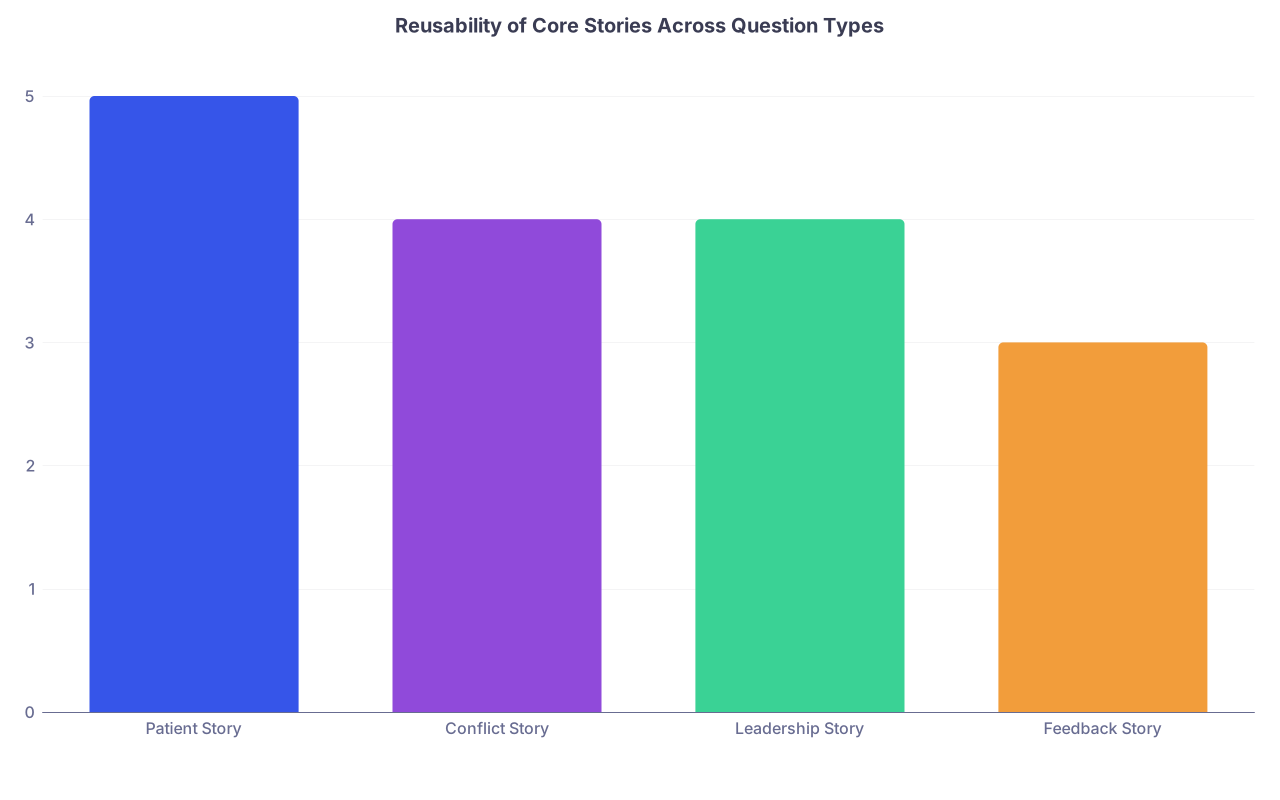
| Category | Value |
|---|---|
| Patient Story | 5 |
| Conflict Story | 4 |
| Leadership Story | 4 |
| Feedback Story | 3 |
A good patient story, for example, can answer:
- “Tell me about a meaningful patient.”
- “Tell me about a time you made a mistake.”
- “Tell me about a time you went above and beyond.”
- “What kind of patients do you enjoy working with?”
- “Tell me about a challenging situation on the wards.”
You are not inventing 50 new stories. You are repurposing 8–10 strong ones with different headlines and snapshots.
This reduces cognitive load and makes concise answers much easier.
Step 11: Have a Pre‑Interview Reset Ritual
Rambling is often worse in the first 5–10 minutes of an interview, when adrenaline is high. You want a way to dial that down before you start talking.
Use a short pre‑interview ritual you repeat for every interview:
- 3 slow breaths (inhale 4, hold 4, exhale 6).
- Mentally repeat your mantra: “Answer first, then explain.”
- Glance at your cheat sheet structures (3‑2‑1, STAR‑L, etc.).
- Remind yourself: Silence for 2 seconds before speaking is fine.
That last point is important.
Most rambling starts because people jump in before they have decided on their HEADLINE. Give yourself 2–3 seconds after each question to think:
- “What is the question type?”
- “What is my 1‑sentence headline?”
Then you talk.
You will sound more thoughtful. Not less.
Step 12: Pressure‑Test With Real Residents
You need at least one brutal, honest run‑through before you face program leadership.
Ask a resident you know (ideally in your specialty) for 30 minutes. Tell them:
“I want you to be blunt. If I ramble or dodge a question, I need you to tell me.”
Have them:
- Ask 5–7 typical questions.
- Interrupt you if you pass 2 minutes on any answer.
- Rate each answer on two things:
- Clarity (did you answer the question directly?)
- Brevity (was it the right length?)
Then ask one final question:
- “Which answer made you least excited about working with me, and why?”
You will get at least one painful but extremely useful piece of feedback. Fix that answer first.
A Quick Visual: How Your Interview Should Flow
This is how an efficient, non‑rambling interview day feels from your side.

| Step | Description |
|---|---|
| Step 1 | Interviewer asks question |
| Step 2 | Use 3-2-1 or 3-layer |
| Step 3 | Use STAR-L |
| Step 4 | Past-Present-Future |
| Step 5 | State HEADLINE |
| Step 6 | Give 1 specific proof story |
| Step 7 | End with residency-focused SNAPSHOT |
| Step 8 | Stop talking |
| Step 9 | Identify question type |
| Step 10 | Interviewer cues? |
You are not winging it. You are running a simple decision tree in the background while having a human conversation.
Your Next Step Today
Open a blank document and pick one high‑yield question:
“Why this specialty?” or “Tell me about yourself.”
- Write your full, messy answer exactly as you would say it. No filter.
- Underneath, force yourself to write:
- One‑sentence HEADLINE.
- 3–4 sentence PROOF story.
- One‑sentence SNAPSHOT tied to residency.
- Read both versions out loud and time them.
If your revised version is not at least 30% shorter and 2x clearer, repeat the compression.
Do that for three core questions this week. That is the foundation. Once you can consistently hit those with clean, concise responses, the rest of your interview prep gets much easier.