
What do you say when a program director looks at your transcript, pauses, and then asks, “So, tell me about your clinical performance,” and you know you have one (or zero) clinical honors?
If that question makes your stomach drop, this is for you.
You’re not trying to become a master storyteller in the abstract. You’re trying to walk into residency interviews with a transcript that screams: mostly “Pass,” maybe one “High Pass,” maybe one honor in Psych from a super-chill clerkship director. And you’re competing against people with walls of honors and AOA.
Let’s deal with that situation directly.
Step 1: Get Clear on Why You Have Limited Honors
Before you prep answers, you need your actual story straight. Not the sanitized version you think they want. The real one.
Run through these questions and write down answers, brutally honest:
- Were your pre-clinical grades strong, average, or weak?
- Any personal stuff during clerkships? Illness, family, mental health, pregnancy, caregiving.
- Any specific rotations where you felt you performed well but still got a Pass?
- Any concrete trends? Early passes, then improvement? Or random?
- Any structural factors? Non-home rotations, grading quirks, strict school, NBME-heavy grading.
You’re trying to identify which of these buckets you land in:
| Pattern | Core Issue |
|---|---|
| Strong knowledge, few honors | Strict grading / NBME weighting |
| Early Passes, later improvement | Adjustment and growth curve |
| Personal hardship | Bandwidth and focus limits |
| Weak clinical skills then improved | Genuine performance growth |
| Across-the-board mediocrity | Fit concerns / learning gaps |
That bucket determines your strategy.
If you skip this and just “hope it doesn’t come up,” you’ll ramble and look evasive. Program directors smell that instantly.
Step 2: Understand What Programs Actually Worry About
You’re not being punished for not being perfect. You’re being evaluated for risk.
When they see limited honors, they’re wondering:
- Will you struggle with the clinical workload?
- Are you coachable or defensive?
- Is there a professionalism or reliability problem?
- Are your test scores and clinical performance misaligned (and why)?
- Will this be a remediation headache in PGY1?
Notice what’s missing: “Are you a bad person?” Nobody cares about that. They care about safety, competence, and hassle.
Your interview goal is to quietly answer those questions before they ask:
- “Can this person function clinically?”
- “Can they improve?”
- “Do they take feedback seriously?”
- “Are they self-aware?”
So every story you tell, every answer you give, has one job: de-risk you.
Step 3: Build a Coherent, Non-Defensive Narrative
You need a through-line for your clinical performance. Not excuses. A narrative.
Three rules:
- Own your record.
- Explain it clearly.
- Show what changed.
Structure it like this:
- Brief acknowledgment of the pattern
- Specific contributing factors (no pity party, no 10-minute saga)
- Concrete changes you made
- Evidence that those changes worked
Example for someone who improved over time:
“You’ll see that my early clerkship grades are mostly Passes with few honors. I came into third year strong on knowledge but slower on efficiency and documentation, and I was honestly overwhelmed adjusting to the pace. After my IM rotation, I asked for specific feedback, started pre-rounding differently, built a note template, and met regularly with my advisor. By the time I reached my later core rotations and sub-I, my evaluations consistently noted improved efficiency and clinical reasoning, and I received my strongest comments and highest scores during that period.”
Notice what that does: admits the issue, shows reflection, explains action, shows outcome. No whining. No blaming.
You need your version of that.
Write it out. Say it out loud. Cut anything that sounds like an excuse or a complaint about your school.
Step 4: Prepare for the Question You’re Dreading
They may ask it bluntly:
- “I notice you have limited honors in your core rotations. Tell me about that.”
- “How do you see your clinical performance?”
- “If I called your clerkship director, what would they say about you as a clinician?”
You cannot look surprised. Or offended. Or like you’ve been waiting to litigate every grade.
Use a three-part response:
- Acknowledge + frame
- Specific example or context
- Present-day takeaway
Sample answer for strict grading / NBME-heavy school:
“You’re right, I don’t have a long row of honors. At my school, honors are heavily tied to NBME scores and final attendings’ rankings, and early on my test scores were solid but not top-decile. For example, on my surgery rotation, my written comments highlighted strong work ethic and good team communication, but my NBME score put me just below the honors cutoff. I realized I was under-prioritizing subject exam prep during busy rotations, so for later clerkships and my sub-I, I built UWorld and Anki into my daily routine. You can see that same change reflected in my improved subject exam performance and my Step 2 score.”
For personal hardship (keep it brief, factual, not a trauma monologue):
“During the first half of my core clerkships, I was managing a significant family health situation that pulled some of my time and focus away from studying outside the hospital. I met with my dean, disclosed the situation, and we discussed options. I decided to continue my rotations but was realistic that my grades might not reflect my full capability. Once that situation stabilized, my performance and feedback improved, and I’ve continued to build on that, particularly in my sub-I where I received strong evaluations for reliability and clinical reasoning.”
For genuine early poor clinical skills:
“I’ll be direct: I was slow to adjust to clinical medicine. I was thorough but inefficient and I struggled to prioritize. Feedback on my internal medicine clerkship was very clear about that. I started shadowing the senior resident’s pre-rounding routine, changed how I organized my notes, and asked for mid-rotation feedback on a weekly basis instead of just at the end. By my sub-I, my attending specifically commented on how much more focused and efficient I’d become.”
The tone matters as much as the content. Calm. Matter-of-fact. Not bitter.
Step 5: Make Your Strengths Louder Than Your Grades
If your transcript is quiet, everything else has to speak up.
You need to walk into interviews with 3–4 “anchor strengths” you’re going to lean on. Things that are hard to ignore even if your honor count is low.
Could be:
- Strong Step 2 score relative to your class
- Consistently strong narrative comments even when grades were Pass
- Heavy, real leadership (not “treasurer of a dead club”)
- Serious research output
- A clear track record of reliability: worked as a scribe, EMT, night shift tech, etc.
- Outstanding sub-I or away rotation performance in this specialty
Lay them out:
| Weak Area | Counterbalancing Strength |
|---|---|
| Few honors | Strong Step 2 score |
| Uneven clerkships | Glowing sub-I evaluations |
| No AOA | Serious research + strong letters |
| Quiet transcript | Robust leadership / work history |
You’re not pretending the low honors don’t exist. You’re saying: “Yes, and here’s the rest of the picture.”
Example of how to pivot mid-answer:
“While my honors are limited, my evaluations consistently describe me as reliable, thorough, and good with patients. My sub-I in internal medicine, which is closest to intern-level responsibility, was my strongest performance and confirmed that once I understood expectations, I functioned very well at the level of responsibility I’m applying for.”
That last clause is doing a lot of work. You’re anchoring them on the level that matters: intern year.
Step 6: Use Your Letters and Sub-I as Your “Clinical Proof”
Programs trust a few things more than your transcript:
- Strong, specific letters from people they know or respect
- Sub-I comments that sound like: “This student is ready to be an intern”
- Away rotation feedback that shows you weren’t a disaster outside your home institution
If your honors are thin, your letters need to be thick.
If interviews are coming and letters are already in, you still can leverage them.
On interview day, weave your letters into your clinical story without sounding like you’re quoting Yelp reviews of yourself.
Example:
“On my sub-I, I asked my attending for candid feedback on whether I functioned at an intern level. She pointed out that my notes were clear, my sign-outs were safe, and I handled cross-cover pages appropriately. That feedback really reassured me that while my early clerkship grades weren’t eye-catching, my current level of clinical functioning is where it needs to be for residency.”
You’re not saying “my letter says I’m amazing.” You’re walking them through the same evidence the letter-writer saw.
If you’re still early in the cycle and can influence things:
- Pick a sub-I where you know the attending actually writes detailed letters.
- Tell them directly: “I’m hoping to show that my clinical performance is stronger than my early clerkship grades suggest; I’d really appreciate candid feedback as we go.”
Then actually act on the feedback.
Step 7: Anticipate Behavioral Questions That Expose Weakness
A lot of “tell me about a time” questions are traps for people with shaky clinical track records. You can mishandle them and accidentally highlight your weaknesses.
Common landmines:
- “Tell me about a time you received constructive feedback.”
- “Tell me about a time you made a mistake.”
- “Tell me about a time you struggled on a team.”
- “What would your senior resident say was your biggest area of growth?”
You want to pick stories that:
- Acknowledge a real shortcoming (not a fake “I care too much” flaw)
- Show you changed behavior
- End with a clearly improved state
Do not pick:
- A bitter story about unfair grading
- A story where you were clearly the victim and never took ownership
- A catastrophic mistake that will make them question your judgment forever
Example answer that subtly references earlier performance issues but ends in strength:
“On my early internal medicine rotation, my attending pointed out that while my presentations were thorough, they were unfocused and too long for busy morning rounds. I felt defensive at first because I equated thoroughness with being a good student. But I asked her to model the level of detail she wanted, rewrote my presentations that night, and practiced with my resident. Over the next week, my team specifically commented that my presentations had become more concise and actionable. Now, on my sub-I, the feedback I get most often is that I present clearly and to the point, which is a complete 180 from where I started.”
That’s how you turn “I was not great at this” into “I’m coachable and I actually fixed it.”
Step 8: Control the First Impression in Open-Ended Questions
Programs often start with some version of:
- “Tell me about yourself.”
- “Walk me through your path to this specialty.”
- “What should I know about you that I can’t see on your application?”
If you have a weak or borderline aspect of your application, you can either:
- Pretend it doesn’t exist and let them bring it up cold
- Or front-load your strengths and your growth story so when they get there, it fits into a larger narrative
I strongly prefer the second.
Example “Tell me about yourself” for someone with limited honors but strong growth:
“I’m a fourth-year at [School] who started clinicals a little slower than I wanted but have grown into someone who thrives on busy inpatient services. I’m the kind of person who likes clear expectations and feedback; once I understood how to manage my time and how to think like the team, my performance and confidence improved dramatically. Outside of rotations, I’ve invested heavily in [research/teaching/quality improvement], which has taught me how to own long-term projects and work well with multidisciplinary teams. All of that has reinforced that [specialty] is where I do my best work.”
You’re not hiding. You’re framing: “I had a growth curve. I climbed it.”
Step 9: Match Your Body Language to Your Story
The content can be perfect, and your face can ruin it.
If you tense up every time your grades or honors come up, the room will feel it. You’ll radiate “this is a sore spot” and you’ll look less mature than your words claim.
When you practice these answers:
- Pay attention to your tone – keep it calm, measured, not rushed
- Avoid over-laughing or dismissive jokes about your performance
- Watch for eye-rolls or facial expressions when you mention grading or school policies
- Don’t sound like you’re cross-examining your own transcript
You want the vibe of: “Yes, that’s true. Here’s what happened. Here’s what I did about it. And here’s who I am now.”
Confidence without arrogance. Accountability without self-flagellation.
If you’re not sure how you come across, record yourself on Zoom answering:
“Can you walk me through your clinical performance?”
Then watch it back. It will be painful. Do it anyway.
Step 10: Practice with Actual, Brutal Questions
Your friends and school mock interviews are often too nice. Residency faculty are not always that gentle.
Here’s a set of questions you should rehearse, out loud, multiple times:
- “Why do you think you didn’t get more honors?”
- “If you could redo your third year, what would you do differently?”
- “Your transcript suggests you’re a solid but not outstanding clinical performer. Why should I believe you’ll excel here?”
- “What’s one piece of feedback you received repeatedly from different attendings?”
- “If I asked your sub-I attending whether you’re ready to be an intern, what would they say?”
Write bullet answers. Don’t script complete essays—that sounds robotic. Practice until you can answer smoothly, in 60–90 seconds each.
To track your progress and timing:
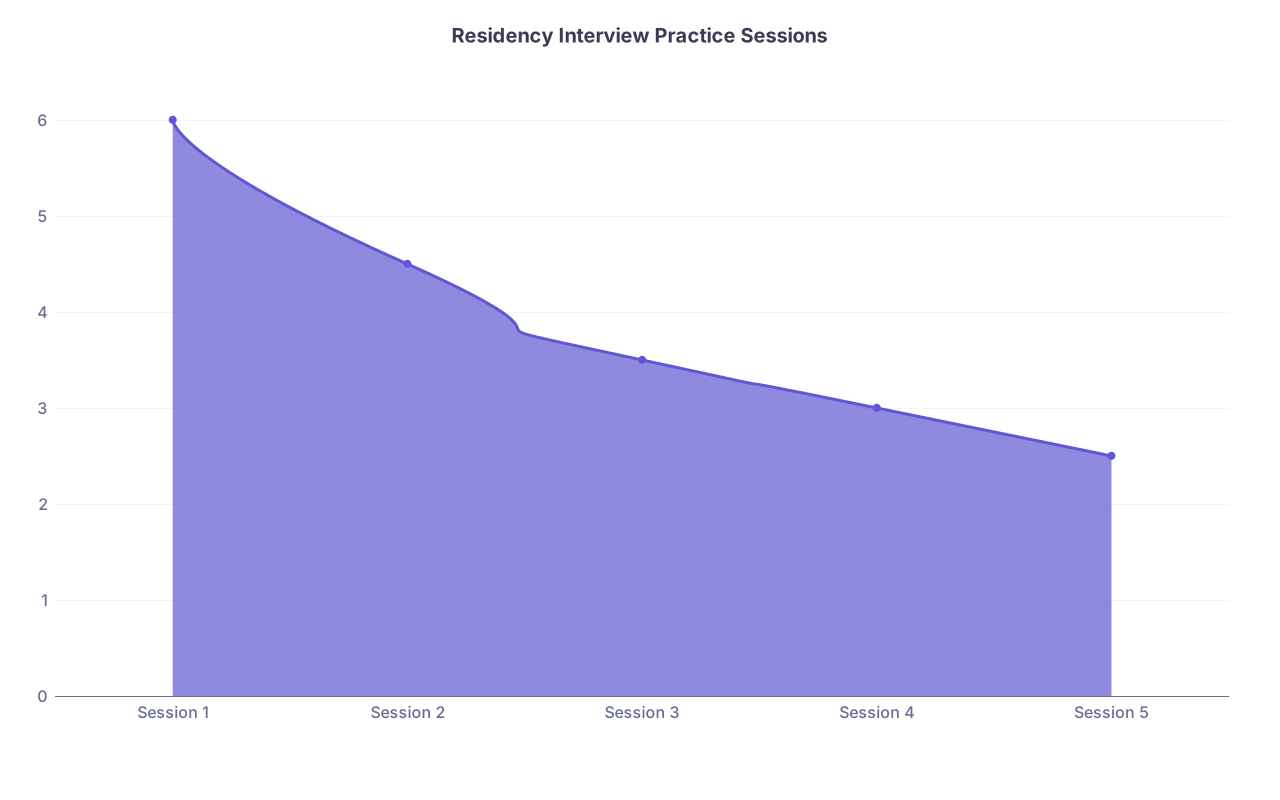
| Category | Value |
|---|---|
| Session 1 | 6 |
| Session 2 | 4.5 |
| Session 3 | 3.5 |
| Session 4 | 3 |
| Session 5 | 2.5 |
That’s average minutes of rambling per hard question; you want that trend going down.
Step 11: Use Your Rank List Strategically
You can absolutely match with limited honors. Happens every year. But if your ego is still writing checks based on your Step score alone, you’ll get hurt.
Programs roughly break down into three categories for someone in your situation:
| Program Type | Fit for You |
|---|---|
| Hyper-elite academic | Reach, not impossible |
| Solid academic / community hybrid | Strong target |
| Community-heavy, high-service | Often most realistic match |
If mid-tier and community programs like you, and you like them, do not rank them below a bunch of places that visibly flinched at your transcript during interviews.
Pay attention on interview day:
- Did anyone ask thoughtfully about growth, or did they just probe your weaknesses and move on?
- Did residents talk about supporting each other, or only about prestige and fellowships?
- Did you feel like they saw your whole application or just your grade sheet?
You need a program that actually wants to invest in your development. Not one that barely tolerated your presence on interview day.
A quick mental flow:

| Step | Description |
|---|---|
| Step 1 | Interview Experience |
| Step 2 | Rank Higher |
| Step 3 | Rank Lower |
| Step 4 | Middle of List |
| Step 5 | Supportive about growth? |
| Step 6 | Prestige only reason? |
This is not about lowering your standards. It is about being realistic about who will train you well.
Step 12: After the Interview – What You Can Still Do
Once interviews start, the transcript is frozen. But your impression is not.
You can still:
- Send a targeted thank-you email that reinforces your growth story (“I appreciated the chance to discuss how my performance evolved over the course of medical school…”).
- Have your home program or a trusted mentor reach out with a quiet advocacy call to one or two realistic program choices.
- Tighten your narrative between early and late interviews based on which answers landed poorly or well.
Don’t do:
- Long defensive emails explaining your grading one more time
- Extra essay-length paragraphs about your hardships
- Desperate “I will rank you #1 if you rank me” messages (unless it’s a genuine, single, carefully worded communication later in the season)
One more visual to keep your priorities straight during this phase:

| Step | Description |
|---|---|
| Step 1 | Finished Interview |
| Step 2 | Send Brief Thank-You |
| Step 3 | Reflect on Questions |
| Step 4 | Adjust Answers for Next Time |
| Step 5 | Discuss Strategy with Mentor |
| Step 6 | Update Rank List Thoughts |
Your job post-interview is refinement and relationship, not relitigating your transcript.
Quick Reality Check: What Actually Matters Most
If you’re still reading, you care enough to fix this. Let’s be blunt about what matters and what doesn’t for someone with limited honors.
Things that matter a lot:
- How you explain your clinical performance
- Whether your sub-I and letters back up your story
- Your Step 2 and subject exam trend
- How you talk about feedback, mistakes, and growth
- The overall “would I trust this person on my team at 2 a.m.?” gut feeling
Things that matter less than you think:
- The exact number of honors
- Whether you can prove your school’s grading system is unfair
- Whether you squeezed out one more strong rotation after ERAS went in
- Perfectly polished, generic answers
Use visuals like this to remind yourself where to put your energy:
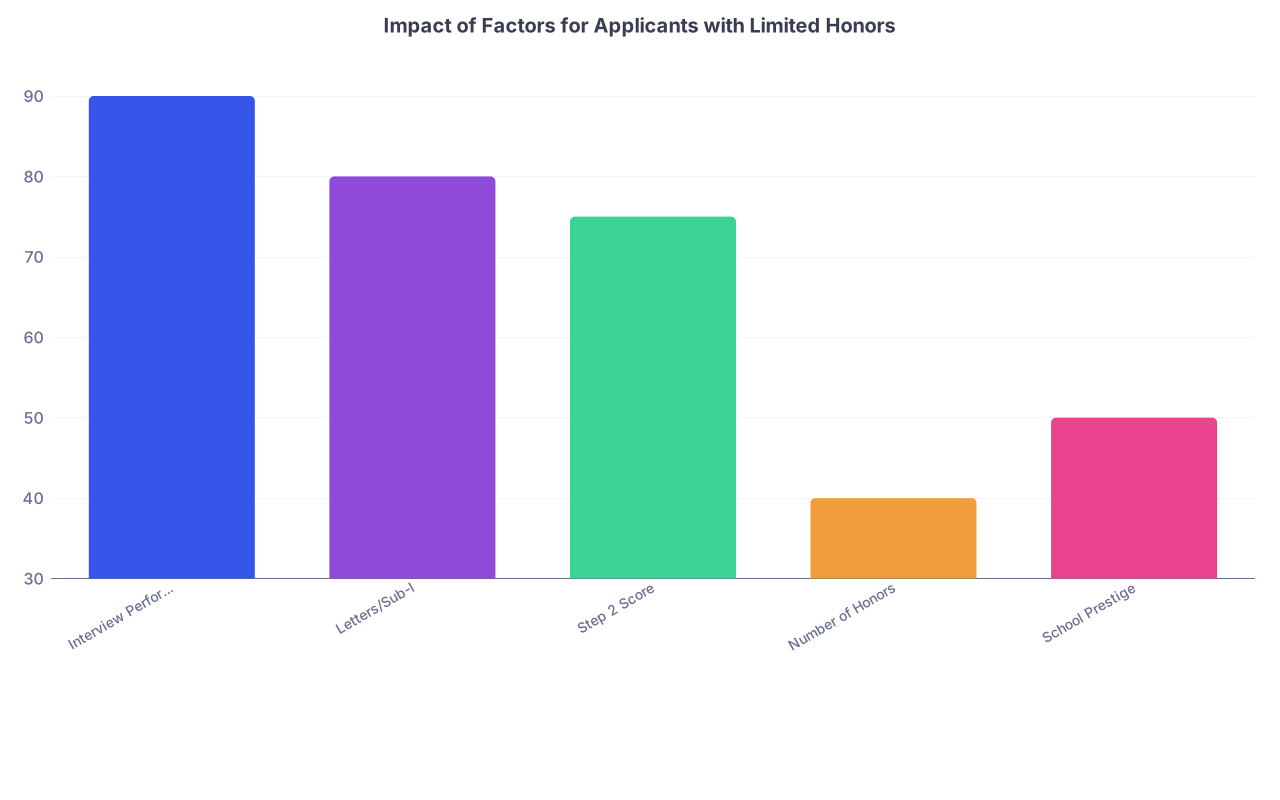
| Category | Value |
|---|---|
| Interview Performance | 90 |
| Letters/Sub-I | 80 |
| Step 2 Score | 75 |
| Number of Honors | 40 |
| School Prestige | 50 |
No one is sitting in a ranking meeting counting your honors one by one. They’re saying:
“Are we comfortable with this person as an intern?”
“Do I believe their story?”
“Did their references line up with how they came across today?”
That’s what you’re actually competing on.
Final Takeaways
- Do not dodge your transcript. Build a clear, honest, practiced explanation that shows awareness, action, and improvement.
- Make your current clinical ability loud: strong sub-I, strong letters, clear growth, and calm, confident answers to tough questions.
- Rank programs that genuinely value your growth and who you are now, not just the shorthand of how many honors you collected on the way here.