How Over-Rehearsed Residency Interview Answers Backfire with PDs
It is 8:12 a.m. You are in a Zoom waiting room with your camera off, tie slightly too tight, notes open just out of frame. You have spent weeks crafting and memorizing “perfect” answers from Reddit, friends, and last year’s interview book.
You get admitted into the room. Smiling PD. Two faculty. “So, tell us about yourself.”
And you launch into it. The 90‑second monologue you have said into your bathroom mirror fifty times. It sounds polished. It sounds structured. It also sounds… fake. One interviewer glances down at your ERAS, another starts typing. The energy drops. You feel it, even if you do not know why.
This is where over-rehearsal bites people. Not lack of practice. Wrong kind of practice.
Let me be blunt: program directors are not impressed by “perfect” sounding, over-memorized answers. They are turned off by them. They smell them a mile away. And they will absolutely rank you lower for it.
You think you are sounding professional and prepared. They think: “Scripted. Inauthentic. I cannot tell who this person actually is.”
Let us go through how over-rehearsed answers backfire, why PDs react so strongly, and what to do instead so you do not sabotage your own rank list.
The Biggest Misconception: “Polished = Impressive”
Most applicants make the same wrong assumption: that residency interviews are like an oral exam. That if you can give the “right” answer in the “right” way, you win.
That is not how PDs think.
They are not grading you on a rubric for “correctness.” They are screening for three things:
- Can I trust this person at 2 a.m. with real patients?
- Do I believe what they are telling me about who they are?
- Do I want to sit next to this person in the workroom for three years?
Over-rehearsed answers attack all three.
You sound less trustworthy because your speech does not match your written application or your casual conversation. You sound less believable because no one in real life talks like a Step 1 review book. And you sound less like someone they want to hang out with because everything feels staged and stiff.
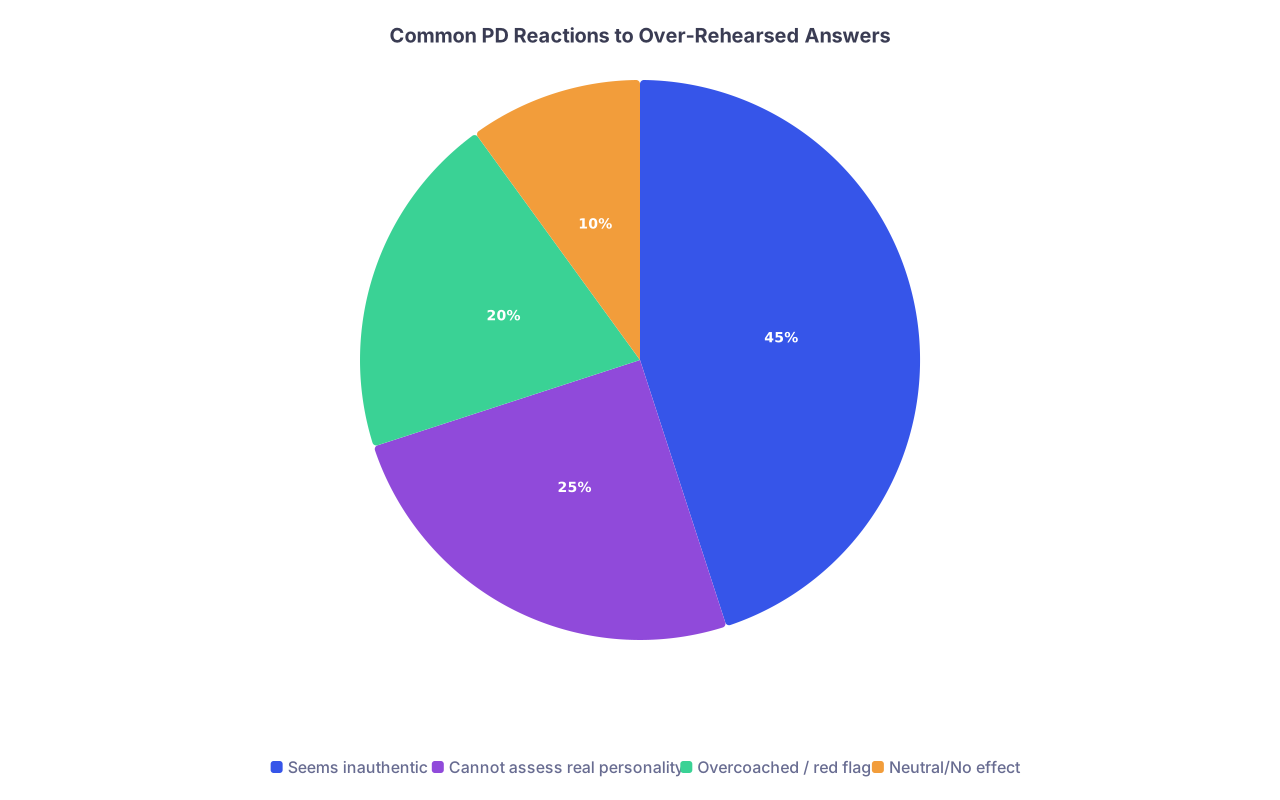
| Category | Value |
|---|---|
| Seems inauthentic | 45 |
| Cannot assess real personality | 25 |
| Overcoached / red flag | 20 |
| Neutral/No effect | 10 |
I have heard PDs say this verbatim after a debrief:
- “That was a great answer. I do not believe a word of it.”
- “She sounded like she memorized Reddit.”
- “He was interviewing for a different person than the one on his application.”
If a “perfect” answer destroys their ability to read you accurately, it is not perfect. It is a problem.
How PDs Spot Over-Rehearsed Answers Within 30 Seconds
You are not the first applicant to memorize a script. PDs and faculty sit through dozens of interviews a day. Same questions. Same tropes. Same buzzwords.
They notice patterns very quickly.
Here is what throws up red flags for them:
The “personal statement in spoken form” answer
You repeat sentences almost word-for-word from your personal statement: the same metaphors, the same “aha moment” in the ICU. They read it last night. Now you are reciting it. Congratulations, you just convinced them you are performing, not reflecting.Perfectly packaged “tell me about yourself”
You hit every cliché in order: childhood hardship → shadowing → first code → loved teamwork → this specialty is my calling. No pauses. No thinking. No natural detours. It sounds like a commercial. And they do not trust commercials.Robotic delivery
Same tone from start to finish. No inflection changes. No genuine laughs. You are essentially reading from an invisible teleprompter in your head. Faculty who teach communication pick up on this instantly.Identical answers all day long
On a panel day, multiple interviewers compare notes. “Did he tell you the story about the Spanish-speaking patient?” “Yes, exactly the same.” That is not “consistent.” That is rehearsed to the point of artificial.Mismatch between answers and off-the-cuff moments
During your structured questions you sound like a TED Talk. During casual small talk you stumble, use completely different language, and seem like another person. That inconsistency screams “scripted.”Overuse of buzzwords
“I am passionate about interdisciplinary collaboration and longitudinal continuity of care…” No one on the wards talks like this. You sound like you swallowed a brochure.
Here is the quiet truth: PDs do not need you to be slick. They need you to be congruent. Over-rehearsal breaks congruence.
The Psychology: Why Over-Rehearsal Makes You Worse, Not Better
There is a cognitive side to this too. Over-rehearsal actually degrades your performance under stress.
When you memorize long form answers, you create a fragile mental script. Under real interview conditions—laggy Zoom, unexpected follow-up, PD who interrupts—you cannot run the script from start to finish. Your brain glitches.
What does that look like?
- Blank stares when they ask a slightly different version of a memorized question
- Panic when they interrupt your story and ask “So what did you actually do?”
- Losing your place mid-answer and awkwardly restarting sentences
- Falling back on filler: “Uh, well, um, I guess… yeah… like…” even though you “prepared”
You rehearsed for a narrow path. Real interviews do not stay on that path.
Over-rehearsed answers also:
- Increase anxiety. You are now not just trying to answer; you are trying to remember the right wording. Any deviation feels like failure.
- Reduce responsiveness. You are talking at the interviewer instead of with them. You ignore their facial expressions and cues because you are busy reciting.
- Flatten your personality. Memorization strips away the spontaneous details and reactions that make you sound like an actual person, not a candidate template.
I have watched strong applicants completely tank because they could not let go of their pre-written speech even when an interviewer tried to have a simple conversation.
Where Over-Rehearsal Hurts You Most: The Core Questions
There are a few questions almost every program asks. Ironically, these are the ones people over-rehearse the most, and therefore screw up the most.
Let us break down how that happens.
1. “Tell me about yourself.”
Over-rehearsed version: 90–120 seconds. Chronological. Packed with jargon about “lifelong calling,” “early interest in pathophysiology,” and some dramatic story that sounds like it could be anyone’s.
How it lands with PDs: Generic. Forgettable. Grade: C.
What they actually want: A short, clear, human snapshot of who you are and how you got here. Not your entire life story. Not your CV read aloud. Something that makes them think, “I get this person.”
If you cannot answer this in a conversational way, you sound like you built a persona instead of developing a career.
2. “Why this specialty?”
Over-rehearsed version: You list every standard reason. The perfect mix of “I love procedures / continuity / acute care / long-term relationships.” You name-drop classic experiences (“first code blue,” “first delivery,” “first big diagnosis”). It sounds like 80% of other answers.
How it lands: Interviewer nods politely but does not write much. Why? Because they have heard this speech every day for 3 weeks.
What they actually want: Specific triggers, honest trade-offs, and real exposure. Something that shows you understand what the field actually looks like at 3 a.m., not just at noon conference.
If you sound like you got your answer from a blog post titled “Top Ways to Answer ‘Why [Specialty]?’” you will blend into the pile.
3. “Tell me about a challenge / conflict / failure.”
Over-rehearsed version: The fake failure. You pick something safe, like “I used to overwork” or “I care too much.” You deliver a perfectly structured STAR (Situation, Task, Action, Result) story, with a moral at the end.
How it lands: Contrived. Insincere. Sometimes annoying.
PDs notice when your “failure” never actually put a patient at risk, never made you truly uncomfortable, and magically resolved with no help from anyone else. They do not want your PR version. They want to know if you can honestly self-critique.
4. “What questions do you have for us?”
Over-rehearsed version: You ask your pre-printed list of questions you got from a group chat. Same wording. Same generic stuff you could have found on their website.
How it lands: Lazy. Surface-level interest. Missed chance.
PDs clock immediately whether you are actually curious or just going through the motions. Over-rehearsed “smart” questions make you look less smart when they are obviously canned.
The Hidden Risk: You Start Sounding Like Everyone Else
There is another nasty side effect of copy-paste preparation. You erase the only real competitive advantage you have: being different.
When you borrow answers from:
- Reddit threads
- YouTube “top residency interview answers”
- Commercial coaching packages
- Older residents’ handouts
…you salt away your distinctiveness and replace it with polished mediocrity.
| Aspect | Over-Rehearsed Signal | Authentic Signal |
|---|---|---|
| Tone of voice | Even, memorized, stiff | Variable, responsive |
| Content details | Vague, generic, cliché | Specific, concrete, personal |
| Reaction to follow-up | Disrupted, confused | Engaged, adaptive |
| Alignment with ERAS | Feels “too perfect” | Feels consistent |
| PD’s confidence level | “I cannot read this person” | “I know who this is” |
On paper, lot of applicants look similar. Same scores, same clerkship comments, same research jargon. The interview is where they are trying to separate “good on paper” from “good in person.”
If you sound like you bought your personality from a test-prep company, you make that job harder. And PDs do not reward people who make their job harder.
The Line Between Prepared and Over-Rehearsed
Here is the nuance people miss: PDs hate scripts. They do not hate preparation.
What they dislike is how most students “prepare”: by memorizing paragraphs instead of building ideas.
You need to prepare your content, not your sentences.
Think in terms of bullet points, not monologues.
Idea clusters, not screenplays.
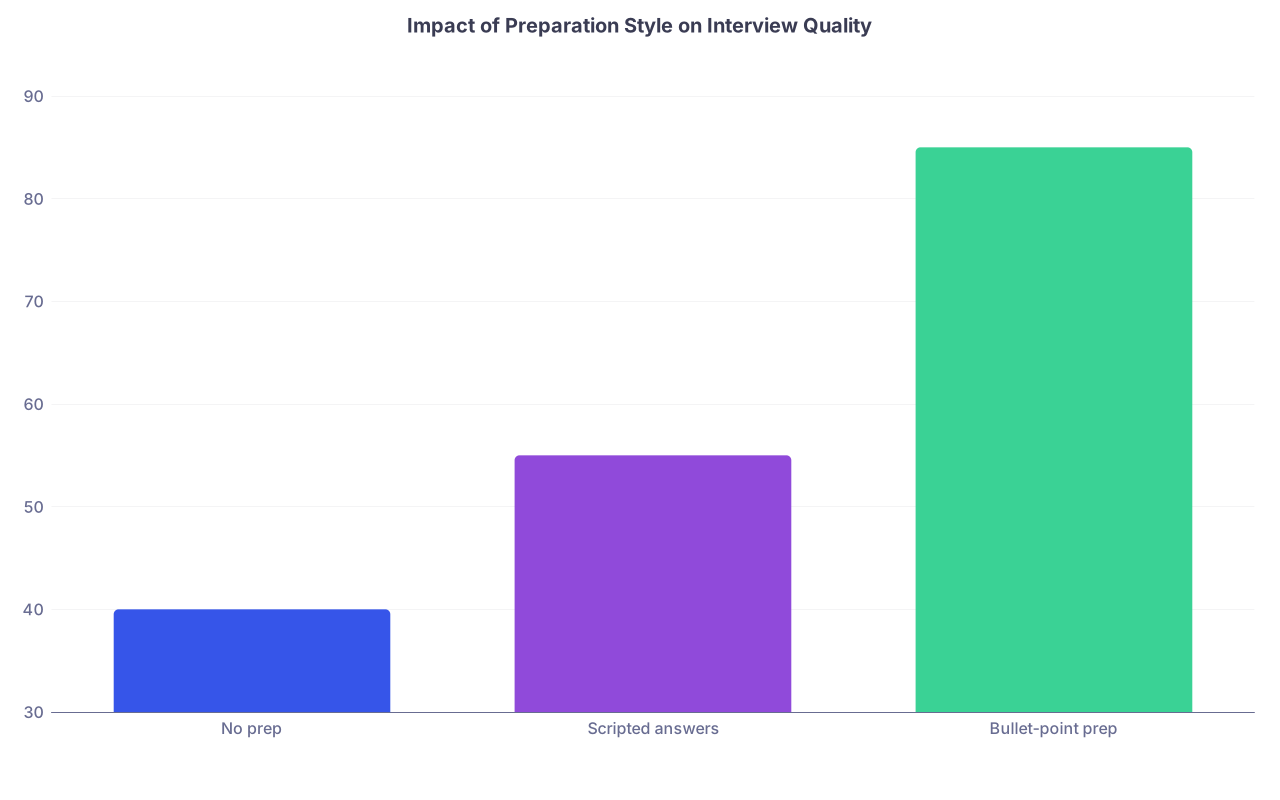
| Category | Value |
|---|---|
| No prep | 40 |
| Scripted answers | 55 |
| Bullet-point prep | 85 |
(This is the pattern I have seen again and again: no prep is bad; heavy scripting is only slightly better; flexible, bullet-point-level prep is far better.)
A useful rule: if you can hear the exact wording in your head before the interviewer even finishes asking the question, you are probably over-rehearsed.
How to Prepare Without Sounding Scripted
You still need structure. Otherwise you will ramble. The trick is to prepare in a way that survives real-world variation.
1. Build “answer skeletons,” not speeches
For each common question, jot down 3–4 bullet points, not full prose.
Example for “Tell me about yourself”:
- Where you are from / background (1 line)
- Key pivot to medicine (specific moment / theme)
- Why this specialty fits you (1–2 concrete reasons)
- One personal detail outside medicine (non-cringe)
That is it. In the interview, you speak from the skeleton, not at it. Your wording will change each time, which is exactly what you want.
2. Practice variability on purpose
When you practice (and yes, you should), intentionally change:
- The order of stories
- The specific examples you use
- The opening sentence
If your answer collapses when you switch order, you were relying on a script, not understanding.
You want to be able to answer “Why this specialty?” three different ways with the same core message. That is what real comfort looks like.
3. Use real memories, not manufactured anecdotes
Do not invent a special moment because you think you “need a story.” Use events you revisited in your own head long before interview season. Ones that stuck for a reason.
Real memories come with natural, messy details: what the room smelled like, what you did after, who you called. Those details make you sound alive, not rehearsed.
4. Get feedback from someone who will not flatter you
Mock interviews are useful only if the person is willing to say, “You sound fake.” Many will not.
Find:
- A resident you trust
- A blunt faculty member
- A friend outside medicine who can smell BS
Tell them clearly: “If I sound scripted or inauthentic, say so directly.” If no one ever tells you that, assume you might be over-rehearsed.
The Red Flag Moments PDs Really Remember
There are a few moments where over-rehearsal does lasting damage. These are the ones that stay in the PD’s notes.
When you dodge a follow-up question
PD: “You mentioned that conflict with a nurse. What did you actually say to her in the moment?”
You: “Well, I think it is really about communication and teamwork and making sure the patient is at the center…”
Translation in their head: You did not prepare beyond your script. You cannot handle real-time pressure.
When your demeanor shifts between rooms
In the PD interview you deliver crisp, politically perfect answers. In the resident room you suddenly relax, change your story a bit, and talk more like yourself.
Residents notice. They report: “Kind of two different versions of this person.” PDs pick up on that discrepancy quickly. Over-rehearsal in “important” rooms, sloppiness elsewhere, makes you look strategic instead of sincere.
When your story contradicts your evaluations
If you have a mediocre professionalism comment somewhere, and then deliver a flawless “I learned so much from that feedback, and now I am better than ever” speech, PDs will press. Hard.
If your improvement sounds too choreographed, they question whether the lesson was real. Over-rehearsed “growth narratives” are notorious for this.
How to Sound Prepared and Real in the Room
A few practical behaviors that separate genuine preparation from over-scripting:
Pause before you answer. Two or three seconds. This alone makes you seem like you are actually thinking, not hitting play.
Use short, plain sentences. “I grew up in X. I did Y. What pushed me toward Z was…” PDs are not grading your prose style. Overly ornate language screams “memorized.”
Watch their face and adjust. If someone leans in at a part of your story, expand on that. If they look bored or glance at the clock, land the plane. Scripted answers ignore feedback. Real conversations adapt.
Let a little imperfection in. It is fine to say, “I am trying to think of a specific example…” or “I handled that awkwardly at the time, to be honest.” Actual humans talk like this. Over-rehearsed ones do not.
Keep answer length under control. Most of your answers should be 45–75 seconds. Anything that goes beyond 2 minutes starts to feel like you are stuck on your script and cannot exit.

| Step | Description |
|---|---|
| Step 1 | Question asked |
| Step 2 | Pause 2-3 sec |
| Step 3 | Scan skeleton in mind |
| Step 4 | Answer with 3 key points |
| Step 5 | Watch interviewer cues |
| Step 6 | Add brief detail |
| Step 7 | Summarize and stop |
That is the mental model you want during the interview. Not “recite paragraph 3 exactly as written.”
Do Not Let Coaching Turn You Into a Robot
If you are using an interview coach, be careful. Many of them push hard toward polished monologues, because that is what they know how to sell.
You want someone who:
- Helps you clarify your stories, not script them
- Points out when you sound like someone else
- Accepts silences and thinking time in practice sessions
- Does not obsess over “perfect phrasing”
If every session ends with a word-for-word “model answer,” that coach is making you worse, not better.
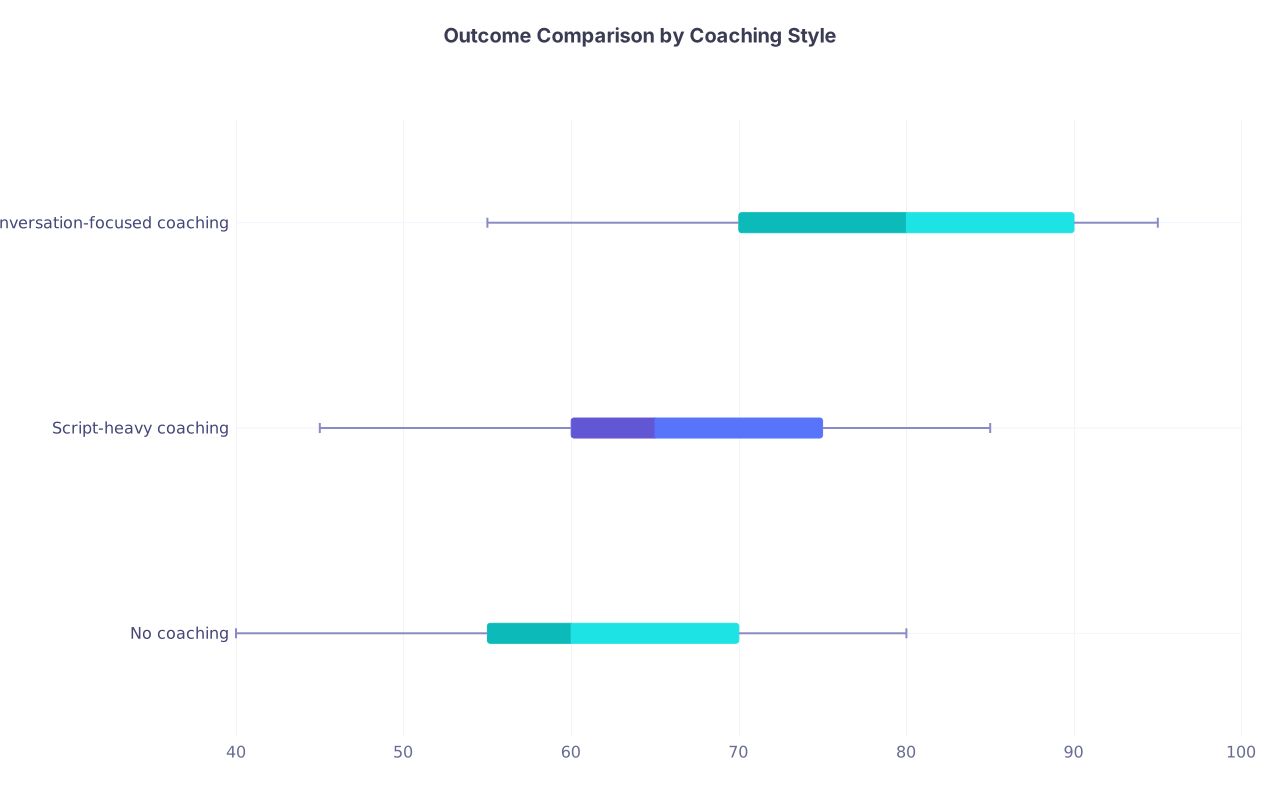
| Category | Min | Q1 | Median | Q3 | Max |
|---|---|---|---|---|---|
| No coaching | 40 | 55 | 60 | 70 | 80 |
| Script-heavy coaching | 45 | 60 | 65 | 75 | 85 |
| Conversation-focused coaching | 55 | 70 | 80 | 90 | 95 |
The best prep increases your range and flexibility. The worst prep narrows you into a narrow performance band that collapses under real conditions.
One Last Thing: Video Practice Can Save You From Yourself
Most applicants underestimate how strange they look and sound when they are in “script mode.” Your face goes flat. Your voice goes up half a register. Your hands, if visible, freeze.
Record yourself answering 5–6 core questions twice:
- First, with your current level of preparation
- Second, forcing yourself to change order and examples
Then watch both. No multitasking. No phone. Just watch your own performance like an attending watching an intern present.
You will see it:
- The moments where you stop being present and start reciting
- The dead air when you get derailed from your script
- The spots where your real personality flickers through and then you shut it down
That awareness is what lets you shift from “I must say this perfectly” to “I must respond honestly and clearly.”

Use Structure as a Safety Net, Not a Cage
You are not being judged on whether you memorized the “correct” answers. You are being evaluated on whether the person in front of them matches the story on paper and seems safe, honest, and decent to work with.
Do not make these mistakes:
- Do not turn yourself into a PR product. PDs are not buying it.
- Do not cling to scripts so tightly that you cannot handle a simple follow-up question.
- Do not sacrifice your one real asset—your actual personality—to sound like the median Reddit answer.
Prepare your ideas. Know your stories. Then walk into that interview ready to think, not to perform.