
They are not asking because they care about your life story. They are asking because it is the fastest way to decide if you are rankable… or forgettable.
I have sat in post‑interview meetings where an entire discussion about an applicant boiled down to: “That was the ‘tell me about yourself’ trainwreck, right?” followed by nods and a quiet drop to the bottom of the rank list. On the flip side, I have watched a single, sharp answer to that question carry someone with average stats into the top 10 of the rank order.
You think it is a soft, easy opener. Program directors know it is the most efficient screening tool they have.
Let me walk you through what is really happening on their side of the table.
What PDs Are Actually Testing With “Tell Me About Yourself”
Nobody on that committee woke up dying to hear about your childhood dog or your love of hiking.
They are testing five specific things in the first 60–90 seconds of that answer. Sometimes unconsciously. Sometimes very deliberately.
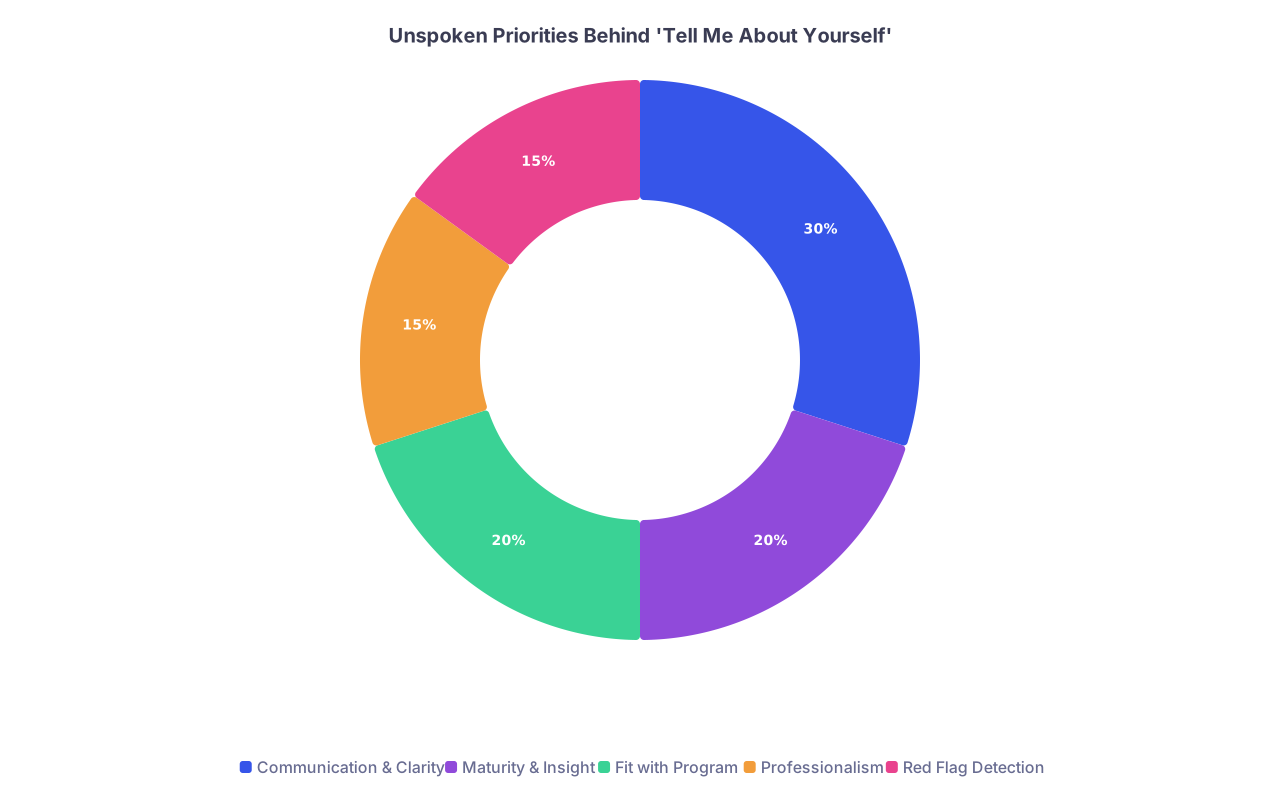
| Category | Value |
|---|---|
| Communication & Clarity | 30 |
| Maturity & Insight | 20 |
| Fit with Program | 20 |
| Professionalism | 15 |
| Red Flag Detection | 15 |
1. Can you communicate like a resident?
Residents present all day: to attendings, to consultants, to angry families at 2 a.m. The PD wants to know: if I put you in front of a room tomorrow, would you embarrass us?
They are watching for:
- Structure: Do you have a beginning, middle, end? Or are you just wandering?
- Brevity: Can you be concise without sounding robotic?
- Translation: Can you turn a complex path (research, extra degrees, nontraditional route) into something clear?
I have heard PDs literally use this phrase in debrief: “If they cannot answer ‘tell me about yourself’ in under two minutes, they cannot present a patient.”
That is the connection they make.
2. Do you actually understand who you are?
This sounds soft. It is not.
They are checking whether you’ve done any reflective work or you’re just stringing together resume lines. They’re looking for:
- A coherent identity: Are you “the teacher,” “the researcher,” “the late-bloomer with grit,” or are you 14 random facts?
- Consistency: Does this match your personal statement and your letters? Or does it sound like a different person?
- Insight: Can you pull out 2–3 meaningful through-lines from your experiences, not just list them?
Program directors smell “overly coached” answers a mile away. They still want authenticity, but they want it with spine and structure.
3. Will you fit with this program?
Every program has a personality. They won’t tell you that outright, but the faculty talk about it constantly when you are not there.
In your answer, they’re listening for cues that match their profile:
- Heavy research program? They want to hear intellectual curiosity, academic drive, comfort with uncertainty.
- County or safety-net program? They want to hear comfort with chaos, service, resilience, a bias toward action.
- Community program with tight-knit residents? They want team players, low drama, no ego.
If you give a generic “I love teaching, research, and patient care” monologue, you sound like everyone. And “everyone” does not get ranked at the top.
4. Are there any landmines we need to uncover?
“Tell me about yourself” is also a red-flag fishing expedition.
They’re listening for:
- Timeline weirdness you gloss over. The three-month “gap” that suddenly appears if they probe.
- Overcompensation. Endless talk about “always being a leader” sometimes signals insecurity or past conflict.
- Incongruent affect. Smiling while describing something that should clearly have been hard. Or being oddly flat about things that are supposed to matter to you.
I’ve watched PDs write in the margin: “Odd. Disconnected story. Something off.” That is not what you want on your file.
5. Are you someone I want on my team at 3 a.m.?
Under all the academic veneer, they’re asking: do I like you? Enough to suffer night float together?
They are reading warmth, humility, and groundedness in those first lines more than in any other question. Because this one is unscripted enough to show your default personality.
That is why weird humor, arrogance, or rehearsed-sounding “I’m so humbled” language can hurt you. It feels fake fast.
How PDs and Faculty Actually Use Your Answer in the Debrief
You need to understand how your answer gets weaponized (or used to help you) after you leave the room.
Here is what the real hallway conversation sounds like between interviews:
Attending 1: “Who is next?”
Attending 2: “The guy who grew up in rural Texas and then did Teach for America. The one who talked about the FQHC clinic.”
Attending 1: “Oh yeah, he was good.”
Notice what stuck. Not the Step score. Not the AOA status. The one-sentence story that came out of “tell me about yourself.”
Your answer becomes your shorthand identity on the rank list.

Your 1–2 sentence label
Every candidate ends up with a label in the committee’s mind. I have seen them typed directly into Excel columns.
Examples I’ve watched get written:
- “Nontrad engineer → switched to med, strong ICU interest”
- “Local kid, first-gen, very grateful, will stay”
- “High stats, bland, generic answer, maybe research but unclear”
- “Gap for ‘family reasons’ – not really explained”
That label comes almost entirely from your introduction.
If you do not give them one clean storyline, they will either invent one or you get the worst label of all: “???”
“???” applicants get buried. Nobody fights for them.
The anchor effect: first impression sticks
Behavioral science backs what you already suspect: the first strong impression anchors everything that follows. PDs know this, but they’re still human. They are not immune to it.
If you come out of the gate with a clear, confident, grounded answer, everything else you say is heard through that filter: “This is a thoughtful person with a coherent path.”
If you ramble or sound disjointed, your later good answers get discounted. The unspoken thought is, “Maybe that strong research explanation was rehearsed. The real them was in that messy intro.”
I have seen someone with a mediocre research portfolio get labeled “strong academic candidate” because they framed their background smartly in the intro. I have also seen a legit PhD come off as “confusing story” and get ranked under people with half their CV.
The Anatomy of a High-Yield Answer (From the PD’s Side)
Let’s be blunt: most of the sample answers you find online are garbage. Overwritten, saccharine, obviously memorized. They do not work in real rooms with tired faculty who’ve heard 200 versions already this season.
Here is what actually lands.
Structure: The 3-part spine
The best answers I’ve heard all follow a simple structure, no matter how different the content.
- Very brief background (10–20 seconds): Who you are in one line, where you’re from, your broad path.
- Two or three defining themes or pivots (60–90 seconds): The key experiences that shaped you as the kind of resident you’ll be.
- Clean present + near future (20–30 seconds): Who you are now and what you’re looking for in residency (aligned with their program).
Tight. Deliberate. No childhood epics.
Let me give you a real-world style example and then I’ll dissect why faculty liked it.
“I grew up in a small town in New Mexico and was the first in my family to go into medicine. I started college thinking I’d be a high school teacher, but tutoring pre-med classmates made me realize I loved explaining complex things and also wanted more direct impact with patients.
In medical school I found myself drawn to the inpatient side of care – I like rapidly changing situations and being part of a team that has to communicate well under pressure. I spent a year working at our county hospital’s admission unit, and that is where I got comfortable managing volume and uncertainty.
Right now I see myself becoming a hospitalist who stays heavily involved in teaching. I’m looking for a program like this one that has strong exposure to diverse, underserved patients, but also values resident autonomy and bedside teaching.”
This took maybe 90 seconds in the room.
Why did attendings like it?
- One clear identity: “New Mexico, first-gen, teacher-turned-clinician, wants to be a hospitalist and teacher.”
- Themes: Teaching, inpatient comfort, resilience and volume management, underserved care.
- Alignment: They were interviewing at a busy county program with a strong hospitalist track. This hit right on target without pandering.
Faculty wrote “NM first-gen teacher → wants hospitalist, good communicator” in the margin. That’s the goal.
The Common Ways Applicants Sabotage This Question
I’ve watched thousands of these. The patterns are painfully predictable.

1. Turning it into a mini-CV recital
“Tell me about yourself.”
And then: “So I went to undergrad at X, then did research in Y, then I went to medical school at Z, where I did research in A, B, and C, and then I presented at…”
They already have your application open in front of them. They don’t need you to read it back.
When you do this, you signal three things:
- You lack insight. You cannot prioritize.
- You are anxious and hiding behind lists.
- You will give the same kind of terrible, unfocused patient presentations.
This is where you lose attendings who are already half-checked out.
2. Starting too far back in childhood
Unless your childhood event is directly responsible for who you are as a physician and it’s clearly integrated into your later story, starting with “I was born in…” is usually a mistake.
I’ve heard people spend 90 seconds on immigration stories, family illness, or early poverty… then race through why they’re actually interested in the specialty in 10 seconds. That imbalance makes PDs suspicious. The thought: “Good story, but does this person know what they’re signing up for in residency?”
You can reference early experiences, but they must be tightly tied to who you are now. Not a standalone origin story.
3. Being weirdly scripted or overpolished
Ironically, the more you rehearse bad content, the worse it sounds.
You know the vibe: unnatural transitions, essay-like phrasing (“I have always been passionate about…”), no pauses, no natural inflection.
Faculty immediately think “This is a performance, not a person.” Then they start probing with more pointed follow-ups, and any mismatch between your script and the real you becomes a trust issue.
A strong answer should be practiced but not performed. You should know the beats, not the exact sentences.
4. Oversharing or dumping unresolved trauma
Some of you have genuinely heavy backgrounds. Major illness, death, abuse, serious mental health history. That matters and can be incredibly powerful context.
But “tell me about yourself” is not group therapy.
When applicants dump raw, unresolved trauma in those first two minutes, the room shifts. People get uncomfortable. Not because they do not care, but because this is not the space to process it, and now the PD is quietly asking: “Is this going to affect their functioning here? Am I stepping into something I cannot support?”
If your story includes hard things, it must be framed with distance and growth. “This happened. Here’s how I worked through it. Here’s how it informs, but does not overwhelm, who I am now.”
5. No clear landing
The number of people who end this answer with something like “…and yeah, that is basically me” is stunning.
You just fumbled the ball on the one-yard line.
Your last line should make it painfully easy for them to see you in their program. It should sound like: “That’s why I’m particularly drawn to programs like this one that [X, Y, Z that they actually are].”
No groveling. No “this is my dream program.” Just a clean tie-in.
How to Build Your Own Answer the Way PDs Process It
Let me walk you through a practical way to construct this that matches how they think.

| Step | Description |
|---|---|
| Step 1 | Brain dump key experiences |
| Step 2 | Group into 2-3 themes |
| Step 3 | Write 1-line identity statement |
| Step 4 | Match themes to program type |
| Step 5 | Draft 90-120 sec outline |
| Step 6 | Practice out loud and refine |
Step 1: Brain dump, then compress
Sit down and list the 10–15 most important experiences/traits that genuinely define you as an applicant: jobs, roles, pivots, hardships, strengths.
Then force yourself to collapse them into 2–3 thematic buckets like:
- Teaching / mentorship
- Systems/quality improvement
- Service to underserved
- Nontraditional background + adaptability
- Leadership in chaotic environments
- Research/curiosity
If you have more than three themes, you don’t have a story. You have noise.
Step 2: Decide your one-sentence identity
Write a single sentence that captures your arc. It does not need to be fancy.
Examples:
- “I’m a former engineer who came to medicine later, and I think about clinical problems like systems to fix.”
- “I’m a first-generation college grad who’s spent most of my training in safety-net settings and plans to stay in that world.”
- “I started out wanting to be a basic scientist and realized I’m happiest at the patient’s bedside, asking ‘why is this happening to this person?’”
This is the mental Post-it note you want faculty to leave with. Everything else is supporting evidence.
Step 3: Map that identity to the specific program
This part is where almost everyone gets lazy. They write one “tell me about yourself” and recycle it.
That is how you sound generic.
You do not have to rewrite your entire answer for each program, but you do need to slightly tilt the emphasis. At a hardcore research program, highlight the analytic, academic flavor of your themes. At a community workhorse program, highlight your comfort with volume, your reliability, your collaborative streak.
| Program Type | Emphasis in Answer |
|---|---|
| Tertiary Academic | Curiosity, research exposure |
| County/Safety-net | Resilience, underserved care |
| Community | Teamwork, reliability |
| Hybrid | Balance of both |
Step 4: Outline, don’t script
Write it as bullet beats, not a paragraph.
Something like:
- One-line identity: “First-gen, safety-net oriented.”
- Background: grew up X → first in family → college Y.
- Pivot: free clinic in M2 → realized I like [specific aspects].
- Theme: service, comfort with limited resources, team-based care.
- Present: now → want residency with [concrete features they have].
Then practice out loud until it flows in your own words. It should sound slightly different each time, but hit the same core beats.
Step 5: Pressure-test with someone blunt
Do not only test this on your best friend who tells you you’re amazing.
Run it by:
- A resident from your school who has sat on interview days.
- A faculty mentor who screens applicants.
- Someone outside medicine (for clarity).
Ask them three things:
- “What are the 2–3 words you’d use to describe me based only on that answer?”
- “What stuck? What was forgettable?”
- “Do I sound like I’m reading a script?”
If their three words do not match how you want to be seen, rewrite.
How Long Should Your Answer Actually Be?
Here’s the unsanitized truth faculty use but do not publish:
- Under 45 seconds: You sound shallow, unprepared, or like you have nothing to say.
- 45–90 seconds: Sweet spot for most programs, especially if they’re running behind.
- 90–120 seconds: Acceptable if you’re structured, engaging, and not rambling.
- Over 2 minutes: Unless you are incredible, people start internally checking their email.
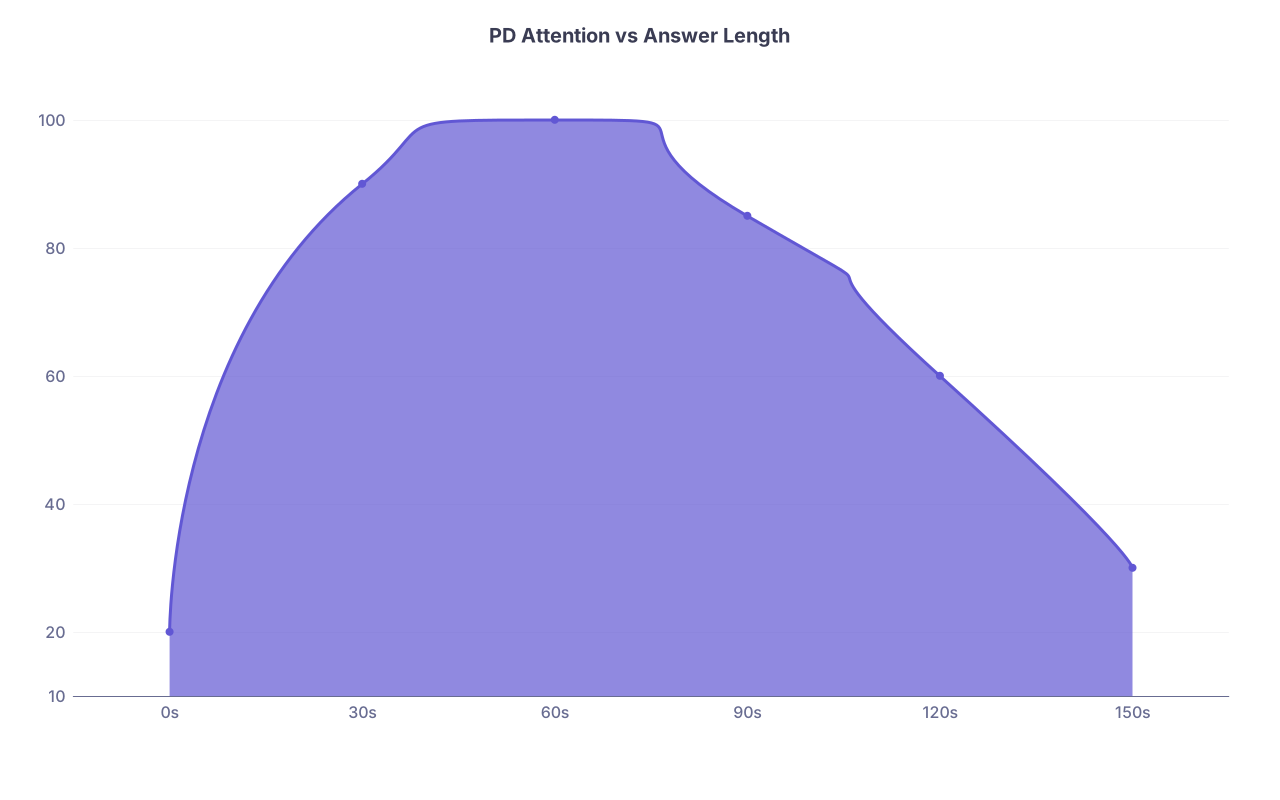
| Category | Value |
|---|---|
| 0s | 20 |
| 30s | 90 |
| 60s | 100 |
| 90s | 85 |
| 120s | 60 |
| 150s | 30 |
The “attention” curve peaks around 45–60 seconds. If you can be excellent in that window, do it. If you need 90 seconds to land your themes calmly, that’s fine. But if you are pushing past 2 minutes, you are no longer helping yourself.
Practice with a timer. Out loud. Not in your head.
The Shift When It Goes Well: What You Want the Room to Feel
When “tell me about yourself” lands, the whole interview changes.
I’ve watched it happen mid-morning on interview days full of zombies:
- The faculty sit up. Literally lean forward.
- Their questions become more conversational, less checklist-y.
- They stop trying to “catch you out” and start trying to “get to know this interesting person.”
Why? Because your answer gave them a hook. A reason to care.
Now the cardiologist in the room hears, “former engineer who likes systems,” and suddenly they’re asking about quality improvement. The chief resident hears “first-gen from this city” and starts selling you on how many grads stay local. The PD starts mentally putting you into the call pool and thinking, “They’d be solid.”
You controlled the narrative.

FAQs
How different should my “tell me about yourself” be between programs?
The core spine should be the same. You are not inventing new identities. But you should adjust emphasis. At a research-heavy academic center, lean into intellectual curiosity, any project work, comfort with scholarly thinking. At a community or county program, emphasize your reliability, work ethic, and commitment to real-world patients. Think 80% same, 20% tailored.
Is it okay to mention red flags (like a leave of absence) in this answer?
Usually no. “Tell me about yourself” is not the place to lead with damage control unless your entire story genuinely centers around that event and you’ve clearly grown from it. Even then, I’d keep it light here and be ready with a separate, clean, practiced explanation when they ask about it directly. Use this question to build a strong, coherent, positive frame first. Then address red flags later from that position of strength.
What if I freeze and forget my planned answer?
It happens. PDs see nerves all the time. Don’t apologize 10 times or make a joke about being “so bad at interviews.” Take a breath and default to your simple structure: one line about who you are, one or two key experiences that shaped you, one line about what you’re looking for in residency. If you have practiced the beats instead of a memorized speech, you can improvise the exact words and still sound grounded.
Key points: PDs use “tell me about yourself” as a high-yield screening tool for communication, maturity, and fit. Your job is to give them one clear, memorable identity in 60–120 seconds, not recite your CV. If you build a clean structure, tailor the emphasis to the program, and practice until it sounds natural—not scripted—you turn a throwaway opener into your biggest advantage on interview day.