
The worst mistake smart applicants make before residency interviews is simple: they never actually say their answers out loud.
They “prepare” in their heads. They outline bullet points. They skim common questions on Reddit. Then they walk into a high‑stakes interview and are shocked when their own voice betrays them—rambling, flat, or completely blank.
I have watched absolutely qualified applicants sink themselves this way. Not because they were lazy. Because they underestimated how different “I know what I’d say” is from “I can say it clearly, out loud, under pressure.”
You are about to compete against people who have rehearsed, recorded themselves, sat through mock interviews, and gotten grilled by attendings. If you think silent prep is enough, you are setting yourself up to lose a spot you could have earned.
Let me walk you through the specific traps here—and how to avoid getting burned by them.
The Silent Prep Trap: Why “I’ll Wing It” Fails
If you are not practicing out loud, you are making at least three dangerous assumptions.
Mistake #1: Confusing mental clarity with verbal performance
In your head, your story sounds great. Tight. Logical. Inspiring, even.
Out loud? Different animal.
What happens without spoken practice:
- You start a sentence and realize halfway through you do not know where it ends.
- You repeat the same phrase: “I think that… I think that… I think that…”
- You jump chronologically—M1 to M4 to M2 to this one random research year—because in your head the timeline feels obvious.
- Your key point shows up at minute 3 of a 90‑second answer. That is death in a structured interview.
I have heard this exact line too many times: “I knew what I wanted to say, it just did not come out right.”
That is not an accident. It is the direct result of never forcing your brain to do the full task: retrieve → organize → phrase → vocalize → monitor → adjust, all in real time.
Mistake #2: Underestimating anxiety’s chokehold
You might be calm on the wards. You might handle codes fine. Interviews are a different nervous system trigger.
Here is what anxiety does to unpracticed answers:
- Speeds up your speech so your content becomes a blur.
- Shortens your working memory, so you forget the middle of multi‑part answers.
- Makes your self‑monitoring hyperactive (“Do I sound dumb right now? Did they like that?”), which derails the actual answer.
If you have never heard yourself answer “Why this specialty?” out loud while even mildly nervous, you are basically test‑driving the car for the first time on race day.
Out‑loud practice is not just about the words. It is exposure therapy. You want your brain to think, “Oh, I have been here before,” not “What is happening to my mouth?”
Mistake #3: Ignoring the time reality of interviews
Most residency interviews are structured:
- 15–20 minute blocks.
- Multiple faculty and resident interviews.
- Each question gets 1–3 minutes, max.
If you have never timed yourself answering out loud, you are almost certainly:
- Too long (5–7 minute monologues that burn half the interview).
- Too short (15‑second answers that sound shallow and uninterested).
- Or wildly inconsistent (1 minute on strengths, 6 seconds on red flags).
You would never go into a timed exam without doing timed practice questions. Doing residency interviews without timed, spoken practice is the same level of reckless.
How Not Practicing Out Loud Shows Up In The Room
Programs will not tell you, “We ranked you low because you did not rehearse.” But I have sat in rank meetings. I have heard the subtext.
Here is how the “I prepared silently” mistake actually presents.
Red flag #1: Rambling, unfocused answers
Classic signs:
- Sentences that trail off: “So… yeah, that was really meaningful to me.” Silence.
- Chronological chaos: “During third year… well actually it started during my undergrad… then in M1 I… and then in sub‑I…”
- No clear endpoint: the interviewer nods, you keep talking, they look at the clock.
What the committee hears when this happens:
- “Not concise.”
- “Will struggle with handoffs, consults, and pages.”
- “Will not be efficient on rounds.”
The truth: most of these students were thoughtful. They just never trimmed their stories out loud, so they do not know what a 60‑second answer actually feels like.
Red flag #2: Over‑scripted, robotic delivery
The other extreme: people who did practice, but only by memorizing text.
You can spot a memorized, not‑owned answer instantly:
- Same cadence for every sentence.
- No adaptation even when the interviewer’s face screams “I do not care about this detail.”
- Panic if the question is asked slightly differently.
This is also a symptom of not practicing out loud properly. They wrote essays. They read them. But they never tested flexible, spoken versions.
Programs want someone who sounds like a thoughtful human, not a Step 1 anki card.
Red flag #3: Flat, low‑energy tone
If you do not practice out loud, you never hear your own affect. Many applicants are shocked when they first watch themselves on video:
- Monotone from start to finish.
- Zero vocal variation when talking about “what excites me about this specialty.”
- Nervous laugh tacked on to the end of every sentence.
This reads as:
- “Not actually enthusiastic about our program.”
- “Poor interpersonal skills.”
- “Might struggle connecting with patients or team.”
They are often the opposite. They care deeply. But in high‑stakes situations, their baseline tone drops to “bored robot” unless they have rehearsed bringing their energy up a notch.
Red flag #4: Inability to pivot or clarify
When you have only prepared silently, you are stuck in your own head. If an interviewer interrupts with:
- “Can you give a more specific example?”
- “Let me rephrase that—what I am really asking is…”
- “How did that make you feel in the moment?”
you will tense up. Because you do not have modular pieces of your story ready to move around. You have one rough story blob that only exists in your head.
Out‑loud practice forces you to:
- Tell the same story multiple ways.
- Shorten and expand on demand.
- Focus on different angles (teamwork, conflict, ethics, resilience) from the same case.
That flexibility is exactly what makes someone look comfortable and mature in an interview.
What Practicing Out Loud Actually Looks Like (And What It Is Not)
Let me be very clear: “I’ll think about what I would say” is not out‑loud practice.
Here is what real practice looks like—and how to avoid the common mistakes inside practice itself.
Step 1: Build a realistic question set
Do not “practice” 50 obscure brainteasers. You will never be asked, “If you were a fruit, what would you be?”
You will be asked the same core things, in slightly different packaging.
You need spoken answers for questions like:
- “Tell me about yourself.”
- “Why this specialty?”
- “Why our program?”
- “What are your strengths and weaknesses?”
- “Tell me about a time you made a mistake.”
- “Describe a conflict with a colleague or nurse.”
- “Tell me about a time you received critical feedback.”
- “What will be challenging for you in residency?”
- “How do you handle stress or burnout?”
- “Describe a clinical situation that changed you.”
Plus a few specialty‑specifics (e.g., for surgery, your comfort with long hours / OR culture; for psych, how you handle boundaries and safety).
Make a list of 15–20 core questions. That is your practice spine.
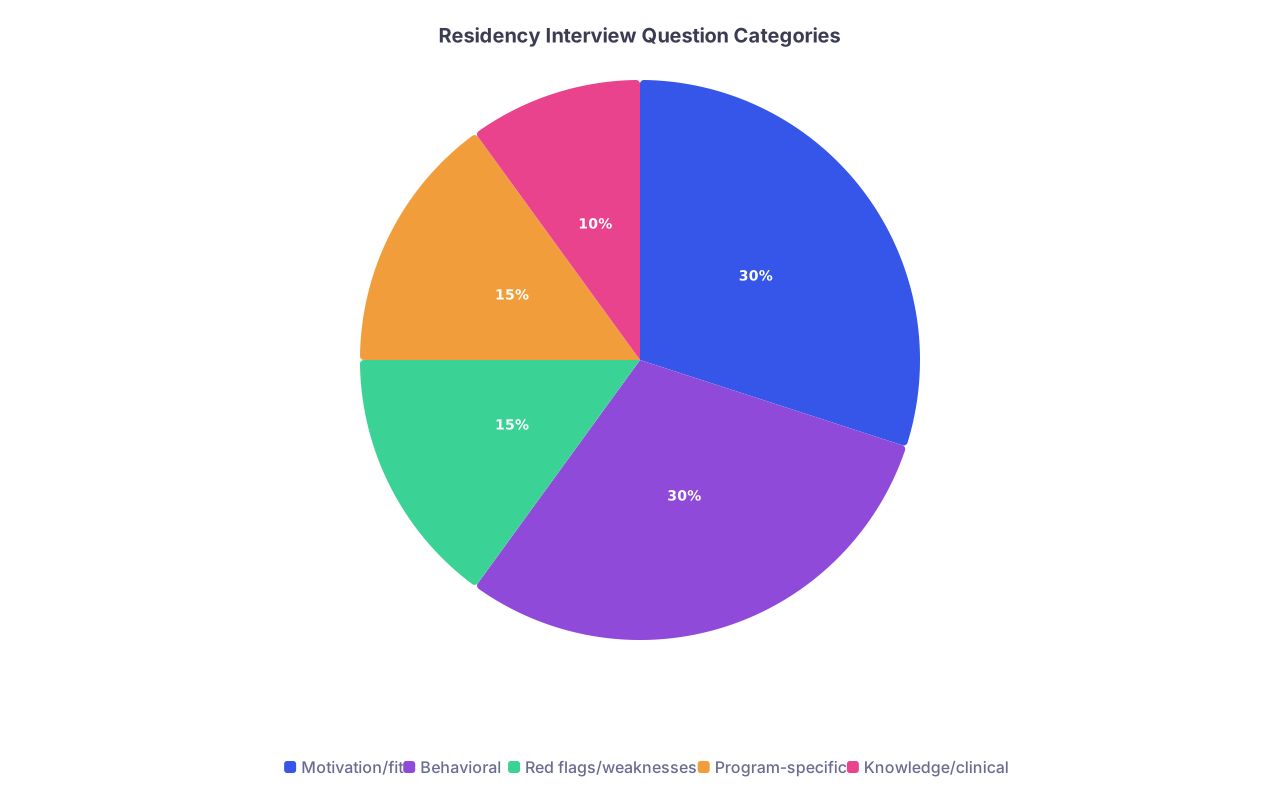
| Category | Value |
|---|---|
| Motivation/fit | 30 |
| Behavioral | 30 |
| Red flags/weaknesses | 15 |
| Program-specific | 15 |
| Knowledge/clinical | 10 |
Step 2: Talk. Out loud. Full volume.
This sounds stupidly obvious. Yet I watch students “practice” by:
- Mouthing answers silently.
- Whispering in their room.
- Half‑speaking while scrolling their phones.
That is not practice. That is pretending.
You need:
- Full voice.
- Full sentences.
- Full answers from start to finish.
Set a 2‑minute timer for each question and actually answer it out loud. Keep going until the timer goes off, even if you stumble. Especially if you stumble. That is the point.
Step 3: Record yourself (and resist the cringe)
You will not want to do this. You will feel ridiculous. Do it anyway.
Use your phone. Hit record. Answer 3–5 questions in a row. Then watch. Not in three weeks. Immediately.
Things to catch:
- Filler words: “like,” “um,” “you know,” “sort of.”
- Body language: looking down, fidgeting with a pen, staring at the ceiling.
- Verbosity: taking 3 minutes to say what could be said in 45 seconds.
- Energy: do you sound like you actually want to be there?
You will hate things about it. Good. Fix them now, not during an actual interview.

Step 4: Create skeletons, not scripts
Here is another big mistake: swinging from “I did not practice” to “I memorized a full page for every question.”
Memorized scripts sound stiff and crack under pressure. You forget one line and the whole thing collapses.
Instead, build skeletons—brief outlines for each answer:
Example for “Tell me about yourself”:
- Present: M4 at X, applying IM, describing current roles / interests.
- Past: key experiences that led to medicine + this specialty (1–2 stories).
- Bridge: what you are looking for in a residency.
- Personal: one short, humanizing detail.
You practice this out loud several times with the same structure, but slightly different wording each time. That way you keep:
- Consistency of message.
- Flexibility of phrasing.
You will sound prepared but natural, which is exactly where you want to land.
Step 5: Time and tighten
Your target ballpark:
- “Tell me about yourself” – 60–90 seconds.
- Behavioral / story questions – 90–150 seconds.
- “Why this specialty?” / “Why this program?” – 60–120 seconds.
Use your phone timer. Answer out loud. Check the time. Then cut.
Ask yourself:
- What details are self‑indulgent? (Nobody needs the entire backstory of your high school volunteering.)
- Where am I repeating the same idea twice?
- Did I actually answer the question asked, or did I just talk about a loosely related story?
You should be able to trim at least 20–30 percent of your first-draft spoken answers without losing any substance. That discipline is what separates impressive from exhausting.
Mock Interviews: The Practice Most Applicants Skip (And Regret)
If you stop at solo practice, you are still making a mistake. You need another human to stress your system.
Why real mock interviews matter
Program directors and faculty consistently comment on:
- “How they responded when I pushed a bit.”
- “Whether they could handle silence.”
- “If they stayed composed when I asked about a failure.”
You cannot simulate that alone. You already know your own questions and your own rhythms.
A real mock interviewer:
- Interrupts you.
- Asks follow‑ups you did not expect.
- Changes their facial expression to see how you react.
- Presses gently on red flags: low Step score, leave of absence, rocky eval.
You want those awkward first reps in a safe room, not in front of the PD at your dream program.
Who should run your mock interviews (and who should not)
Here is a quick comparison:
| Option | Pros | Cons |
|---|---|---|
| Career office advisor | Knows process, structured | Variable clinical insight |
| Faculty in specialty | Realistic, content aware | May be blunt, limited time |
| Senior resident | Knows current interview style | May overfocus on their own path |
| Peer (M4) | Low pressure, easy to schedule | May not challenge you enough |
| Commercial coach | Feedback expertise | Costly, quality varies |
Mistakes to avoid:
- Only practicing with close friends who tell you, “That was great!” when it was not.
- Avoiding anyone who might intimidate you. Those are exactly the people who simulate real interview dynamics.
- Doing exactly one mock and declaring yourself “ready.”
Aim for:
- 2–3 serious mocks with different people (at least one in your specialty).
- At least one where the person has your full ERAS and treats it like the real thing.
- Strict time limits and actual scoring or notes afterward.

| Step | Description |
|---|---|
| Step 1 | Collect common questions |
| Step 2 | Draft answer skeletons |
| Step 3 | Practice out loud solo |
| Step 4 | Record and review videos |
| Step 5 | Refine timing and clarity |
| Step 6 | Schedule mock interviews |
| Step 7 | Incorporate feedback |
| Step 8 | Final short daily run-throughs |
Specialty‑Specific Landmines When You Do Not Practice Out Loud
Not practicing out loud does not hurt everyone equally. Some specialties punish this more harshly.
Surgery and EM: Concision and command
Surgeons and EM attendings have a low tolerance for rambling.
If you cannot:
- Summarize a key clinical story in 60–90 seconds.
- Be direct about your weaknesses without a five‑minute monologue.
- Maintain eye contact and clear, confident tone.
you will trigger their bias: “This person will not communicate clearly in the OR/ED.”
Out‑loud practice should focus on:
- Short, high‑yield anecdotes.
- Clear “headline first” style: main point → brief context → takeaway.
Psychiatry and pediatrics: Warmth and reflection
These programs listen very carefully for:
- Emotional insight.
- Ability to discuss difficult patient situations with nuance.
- Warmth in tone, not just content.
If you only practice in your head, your answers may be technically correct but emotionally flat. You will say, “That was a meaningful experience,” in the same tone you use for “I like coffee.”
You need to hear yourself talk about:
- A challenging patient.
- Burnout.
- A time you were wrong.
and check: Do you sound like a human who has actually felt these things?
IM/FM/OB: Team dynamics and conflict
Internal medicine, family medicine, and OB/GYN weight:
- Teamwork.
- Conflict management.
- Handling hierarchy and feedback.
If you have never spoken through your conflict stories out loud, you will:
- Over‑blame others.
- Downplay your own role.
- Or add so many details that the main point disappears.
You need practiced, spoken stories where:
- Your role is clear.
- Your growth is explicit.
- You do not sound defensive.
How To Build This Into Your Actual Schedule
You do not need ten hours a day. You do need consistency and intention.
Here is a simple, realistic plan that avoids the most common mistakes.
2–3 weeks before interviews start
- Build your question list.
- Draft skeletons, not scripts.
- Start 20–30 minutes a day of out‑loud practice (5–8 questions per session).
- Record yourself twice a week for 15–20 minutes.
1–2 weeks before: mock-heavy phase
- Schedule 2–3 mock interviews.
- After each mock:
- Write down 3 things to keep.
- Write down 3 things to fix.
- Target your next 2–3 solo sessions on those issues only (e.g., shortening answers, reducing filler words, sounding more engaged).
Final week and interview days
- Daily 10–15 minute refresh:
- “Tell me about yourself.”
- “Why this specialty?”
- One strength story.
- One weakness/failure story.
- Do not cram entirely new stories or frameworks the night before. That is how you sound disjointed.
- Light vocal warm‑up the morning of: 3–5 questions out loud in your car or room so your first words of the day are not, “Hi, I am… uh…”
The Non‑Negotiables: What You Must Not Skip
If you remember nothing else, remember this: silent prep will fail you when it counts.
You avoid that fate by refusing to make these specific mistakes:
Relying on mental rehearsal only.
If you have not heard yourself answer the big questions out loud, you are not prepared. Period.Writing scripts instead of building flexible skeletons.
Scripts crack under pressure. Skeletons hold.Avoiding video and mock interviews because they feel uncomfortable.
The discomfort is the training. Lean into it now so you are not blindsided later.
Residency interviews do not reward the smartest applicant on paper. They reward the applicant who can clearly, calmly, and authentically articulate who they are. You cannot fake that in real time if you have never actually practiced it out loud.