
What do you think you sound like in residency interviews—and what do programs actually hear when you open your mouth?
If you get this wrong, it will not matter how strong your Step scores are, how shiny your letters look, or how impressive your research is. You can walk in as a top-tier candidate on paper and walk out as a “do not rank” in 20 minutes. I’ve seen it happen. More than once.
Let me walk you through the 10 answer styles that quietly kill your rank list. Most of them don’t look dangerous at all—until they’ve tanked your season.
1. The Rambling Lecture: “I’ll Just Talk Until They Stop Me”
You know this one. They ask, “Tell me about yourself,” and you launch a 4‑minute saga starting from childhood and somehow you’re still in undergrad by the time the interviewer is checking the clock.
This answer style screams a few things you don’t want associated with your name:
- Poor clinical communication
- Poor insight into what’s relevant
- Poor time awareness
The interviewer is thinking, “If this is how they answer a simple question, how will they present a patient on rounds? How will they sign out in 5 minutes in a busy ED?”
Programs do not want residents whose notes and presentations are verbal novels.
Common triggers for rambling:
- “Tell me about yourself”
- “Why this specialty?”
- “Why our program?”
- “Walk me through your application”
You ramble when:
- You didn’t pre-think your structure
- You’re trying to impress instead of communicate
- You’re talking to calm your anxiety rather than to answer the question
How to avoid this:
- Aim for 60–90 seconds for most answers; 2 minutes max for big ones
- Think “headline → 2–3 supporting points → quick example → stop”
- Stop talking before they stop listening
If you catch yourself mid‑answer thinking “I’m not sure where I’m going with this,” that’s your internal alarm. Finish your sentence. Stop. Let them ask the next question.
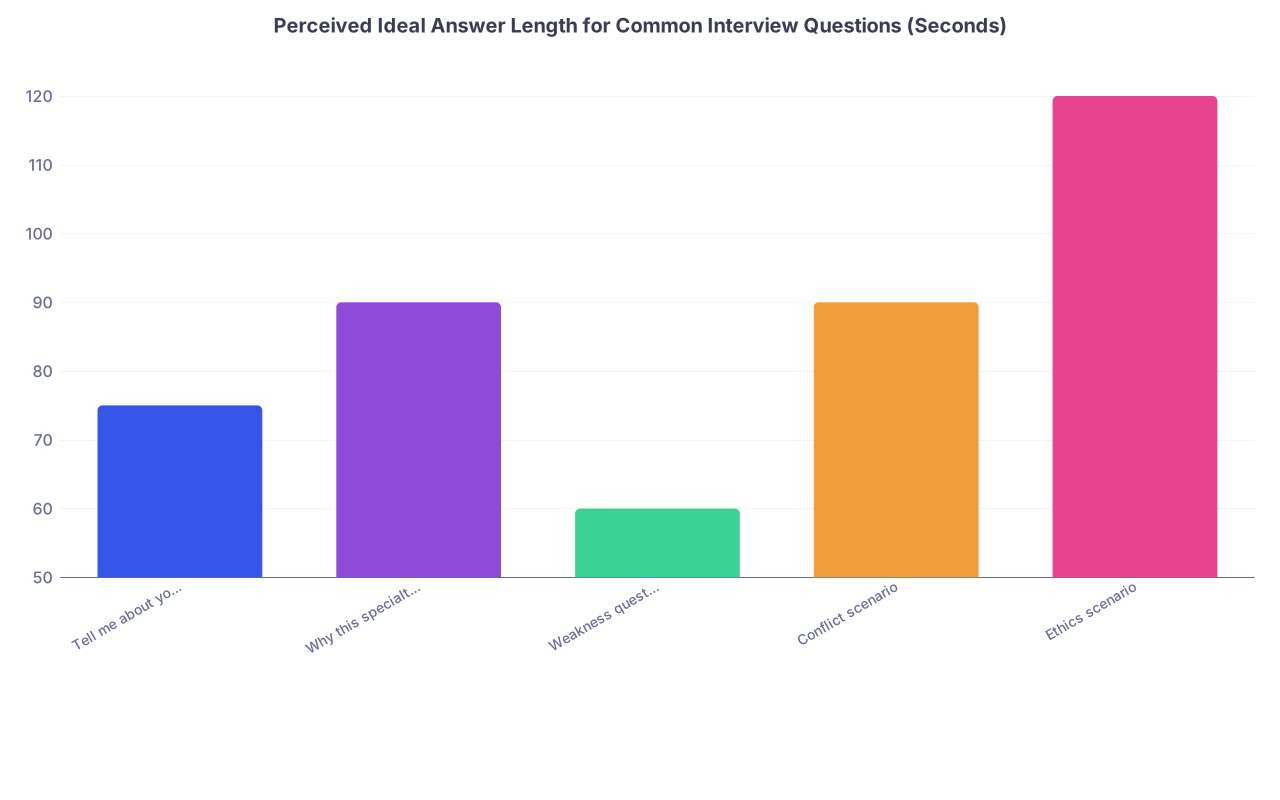
| Category | Value |
|---|---|
| Tell me about yourself | 75 |
| Why this specialty? | 90 |
| Weakness question | 60 |
| Conflict scenario | 90 |
| Ethics scenario | 120 |
2. The Scripted Robot: “I Memorized This from Reddit”
The opposite of rambling is not better; it’s equally deadly.
This is the answer style where every sentence sounds like it came from a “Top 50 Residency Questions” PDF:
“I’m passionate about lifelong learning, patient-centered care, and evidence-based medicine, and I know your program will help me grow into the best physician I can be.”
Congratulations. So did everyone else.
Scripted answers kill you because programs hear:
- You’re inauthentic
- You’re not thinking in real time
- You might crumble when the conversation goes off‑script
And yes—they can tell. Experienced PDs and faculty smell rehearsed language from the first four seconds. You’re not fooling them.
Common red-flag phrases:
- “I’ve always wanted to be a doctor since I was a child…” (followed by cliché)
- “I’m passionate about…” (with no specific example)
- “I want to work in an academic center where I can teach and do research and serve a diverse population…” (with no real detail about their place)
The problem isn’t practicing. It’s memorizing.
You should absolutely prepare structures, stories, and key points. But if you’re trying to recall the “right wording,” you’ve already lost.
How to avoid this:
- Bullet your points, don’t script paragraphs
- Practice out loud with different wording every time
- Ask a friend or mentor: “Do I sound like a person or like ChatGPT?”
If your answer would look perfectly at home as a generic blog post, it will not help your rank list.
3. The Overshare Confessional: “Let Me Show You My Deepest Trauma”
Yes, programs value vulnerability and resilience. No, your residency interview is not therapy.
I’ve watched applicants derail their entire impression in 90 seconds by oversharing about:
- Major untreated mental health struggles
- Highly charged political or religious conflicts
- Graphic clinical experiences
- Personal drama with classmates, exes, or family
Here’s the problem: once you put very intense content into the room, that becomes the only thing they remember about you. Not your work ethic, not your Step score, not your teaching experience. Just the chaos.
I’m not saying “never mention hardship.” That would be dishonest and frankly impossible for many applicants. I’m saying:
Don’t trauma‑dump.
Programs are listening for:
- Stability
- Insight
- Boundaries
- Whether you’re likely to crumble under residency-level stress
If your story makes them worry they’d be constantly managing your crises, you dropped down the rank list.
Good rule: if a story makes you feel raw, shaky, or emotional every time you tell it, it’s not ready for interview day.
When you can share difficult experiences:
- You speak calmly and briefly, no graphic detail
- You frame it around growth, not suffering
- You clearly show what support you used (therapy, mentors, wellness resources)
- You connect it to how you’re functioning well now
If you’re unsure whether something is “too much,” it probably is.
4. The Perfectionist Actor: “My Biggest Weakness Is That I Care Too Much”
This answer style tries to game the system. It backfires almost every time.
When you answer the “weakness” or “failure” question with:
- “I’m just too hard on myself.”
- “I care so much about my patients that I sometimes stay too late.”
- “I’m a bit of a perfectionist.”
…they don’t think you’re clever. They think you’re:
- Dishonest
- Lacking insight
- Possibly hiding something worse
They also immediately group you with the 30% of applicants who used the exact same line.
A better weakness answer:
- Is real, but not catastrophic (e.g., “procrastination so bad I almost failed rotations” is too far)
- Has a clear impact you can describe
- Has evidence you’re actively improving it
For example, “I used to over-document and spend too long on notes, especially early in third year. Feedback from residents helped me realize it, and now I structure my notes as…” That’s believable, safe, and shows growth.
The mistake you must avoid: trying to look flawless.
Residency training assumes imperfection. They’re not ranking gods. They’re ranking people who can learn, accept feedback, and not melt down when they’re wrong.
5. The Program Sales Pitch: “Let Me Tell You Why You’re Amazing”
This one feels polite. Harmless. Even strategic. It’s not.
Here’s how it sounds:
“I love your program because of the strong clinical training, diverse patient population, and opportunities in research and teaching. Your residents are so happy, and the sense of camaraderie is amazing.”
You could literally say that at 50 different programs with zero edits.
What they actually hear is, “This person copied the program’s website, plus whatever some PGY‑2 said on the pre‑interview social.”
The deeper problem: this style centers them instead of you. Ranking decisions are not “Do we love ourselves?” They already do. It’s “Can we picture this person fitting here?”
Programs get suspicious when you sound like:
- You’re applying to every program in the specialty with no real filter
- You’re saying what you think they want to hear
- You didn’t actually research them beyond the first 3 bullets on their homepage
Fix this by flipping the perspective.
Not: “Your program is great because X.”
Instead: “Because I’m interested in Y and Z, specific aspects of your program stand out to me, like [concrete thing], and I can see myself contributing by [concrete contribution].”

Don’t do generic flattery. Do targeted alignment.
6. The Negative Narrator: “Let Me Tell You What’s Wrong With Everyone”
This style is more common than applicants realize—and it’s lethal.
I’ve seen candidates sink themselves by:
- Blaming their school for poor clinical exposure
- Trashing a previous program, PI, or attending
- Complaining about “lazy” classmates or “toxic” environments
- Talking with visible resentment about a failed research project or exam
Programs know that residency is stressful, imperfect, and political. They are not naive. But they’re scanning for one huge risk factor:
Is this person going to be a constant source of drama and complaints?
If you radiate bitterness, they’ll assume you’ll do the same about their program.
Hard line here: Never badmouth institutions, people, or colleagues. Not subtly. Not as a “joke.” Not even when the interviewer opens the door with, “Yeah, we’ve heard things about that school.”
You can be honest without being negative.
Bad:
“My med school was disorganized and didn’t care about teaching.”
Better:
“Our curriculum was undergoing a lot of transition, so I had to be proactive about finding good learning experiences. That pushed me to seek out extra clinics and mentors, which ended up being really valuable.”
Same reality. Very different impression.
If they walk away thinking, “This person will complain more than they help,” you’re off the rank list.
7. The Unsafe Clinician: “Casual About Red Flags”
This is the answer style that terrifies programs, even when everything else you say is good.
It usually shows up in:
- Ethics questions
- “What would you do if you saw X?” scenarios
- Stories about mistakes or challenging patients
Danger signs:
- You minimize patient safety issues
- You prioritize “not rocking the boat” over escalating obvious problems
- You sound cavalier about death, serious harm, or near-misses
- You justify cutting corners because you’re tired or busy
Example of a quietly lethal answer:
“If an attending was clearly making a mistake on a patient, I’d probably just keep my head down. It’s not my place as a trainee.”
That’s an instant “No” for many PDs. They cannot risk matching someone who won’t speak up.
When they ask about ethical or safety scenarios, they’re not testing if you know “the one correct policy.” They’re testing if your instincts are:
- Patient-first
- Team-oriented
- Willing to seek help
- Aware of your limits
Safe pattern:
- Recognize the concern
- Prioritize patient safety and honesty
- Seek appropriate supervision or escalation
- Avoid pretending you’d handle everything perfectly solo
If your answer protects your comfort more than your patient, you’re quietly killing your ranking.
8. The Overconfident Star: “They’ll Be Lucky to Have Me”
Confidence is fine. Necessary, even. Arrogance is a rank‑list killer.
The overconfident style shows up as:
- Constant “I, I, I” with no acknowledgment of team
- Taking sole credit for multi-person projects or QI
- Dismissing feedback experiences or never mentioning any
- Talking like you’ll run the place as an intern
Programs are not looking for mini‑attendings. They want coachable, reliable, respectful interns.
Red flag statements I’ve heard:
- “I basically ran the service on that rotation.”
- “Residents didn’t really teach me anything; I’m pretty independent already.”
- “I don’t anticipate struggling much in residency; I’ve always handled everything fine.”
No one believes that. And it makes them worry you’ll ignore supervision, resist feedback, and create safety issues.
Better stance:
- Confident in your work ethic and ability to grow
- Clear about specific strengths
- Honest that residency will challenge you
- Respectful of what you don’t know yet
You can say, “I feel prepared to work hard and keep learning,” without pretending you’re already a PGY‑4.
9. The Vague Ghost: “I Answer Without Saying Anything”
This one is deceptively common and quietly destructive.
You technically answer the question. Words come out. Sentences are formed. But there’s no substance.
Examples:
Question: “Tell me about a time you had a conflict with a team member.”
Answer: “Sometimes misunderstandings happen, but I always try to be respectful and communicate openly. I think it’s important to listen and work together to find a solution.”
That’s…nothing. There’s no story. No action. No insight. Just buzzwords.
Or:
Question: “What are you looking for in a residency program?”
Answer: “Strong clinical training, good mentorship, and a supportive environment.”
Congratulations, that describes every decent program.
Vague answers kill you because:
- You’re forgettable
- They can’t picture how you actually behave
- You sound like every other mid-tier applicant
You need specifics:
- A concrete story (brief but real)
- Your actual role
- What you learned or would do differently
If they can’t recall one single thing you did by the end of the day, you won’t climb their rank list.

| Step | Description |
|---|---|
| Step 1 | Question Asked |
| Step 2 | Specific Story |
| Step 3 | Vague Generalities |
| Step 4 | Clear Picture of Applicant |
| Step 5 | Forgettable Impression |
| Step 6 | Higher Rank Potential |
| Step 7 | Lower or No Rank |
| Step 8 | Answer Type |
10. The Desperate Pleader: “This Is My Dream Program, Please Rank Me High”
This one comes from anxiety and scarcity, and it reeks of both.
You might think telling a program, “You’re my number one,” during the interview makes you sound committed. Often, it makes you sound:
- Desperate
- Uncertain you’ll match elsewhere
- Unaware (or dismissive) of NRMP rules and professionalism
Deadly versions:
- “If you rank me, I’ll rank you number one.”
- “This is my dream program; I don’t really have a backup.”
- “I’d be devastated if I didn’t match here.”
You’re trying to show enthusiasm. What they hear is pressure and risk.
Programs want enthusiastic, confident applicants. Not ones who give off “this match might break me” energy.
What to do instead:
- Express genuine interest without bargaining
- Be specific about what you like and how you’d fit
- Save any “I’ll rank you highly” type communication for a brief, professional post-interview note—if you choose to do that, and without violating Match ethics (“I will rank you very highly,” not “I will rank you #1”).
In the room, your goal is not to make emotional promises. Your goal is to show you’d be a solid, stable, teachable resident.
Quick Comparison: Answer Styles That Help vs Hurt
| Situation | Harmful Style | Helpful Style |
|---|---|---|
| “Tell me about yourself” | 4-min life story | 60–90s focused summary |
| “Weakness” question | Fake flaw/perfectionism | Real, managed weakness |
| Ethics/safety scenario | Minimize or avoid | Patient-first, escalate |
| “Why our program?” | Website buzzwords | Specific alignment points |
| Conflict/failure story | Vague, no details | Concrete story + insight |
How to Practice Without Turning Into a Robot
You’re probably seeing the trap now: practice too little and you ramble, practice too much and you sound scripted.
The sweet spot:
List 8–10 common question themes:
- Tell me about yourself
- Why this specialty / this program
- Strengths / weaknesses
- Conflict / difficult team member
- Failure / mistake
- Challenging patient
- Time you received tough feedback
- Career goals
For each, outline:
- 1–2 key points you want to hit
- 1 brief, specific story you can tell
Practice with:
- Live humans (classmates, residents you know, advisors)
- A timer (to avoid rambling)
- Phone recordings (you’ll hate this but it works)
Listen for:
- Filler (“like,” “um,” “you know”) dominating your speech
- Scripted buzzwords without examples
- Overly long backstories before you get to the actual event
If you can answer each big category in 60–90 seconds, with a concrete example, and a human reviewer can summarize your point in one sentence—you’re in a good place.
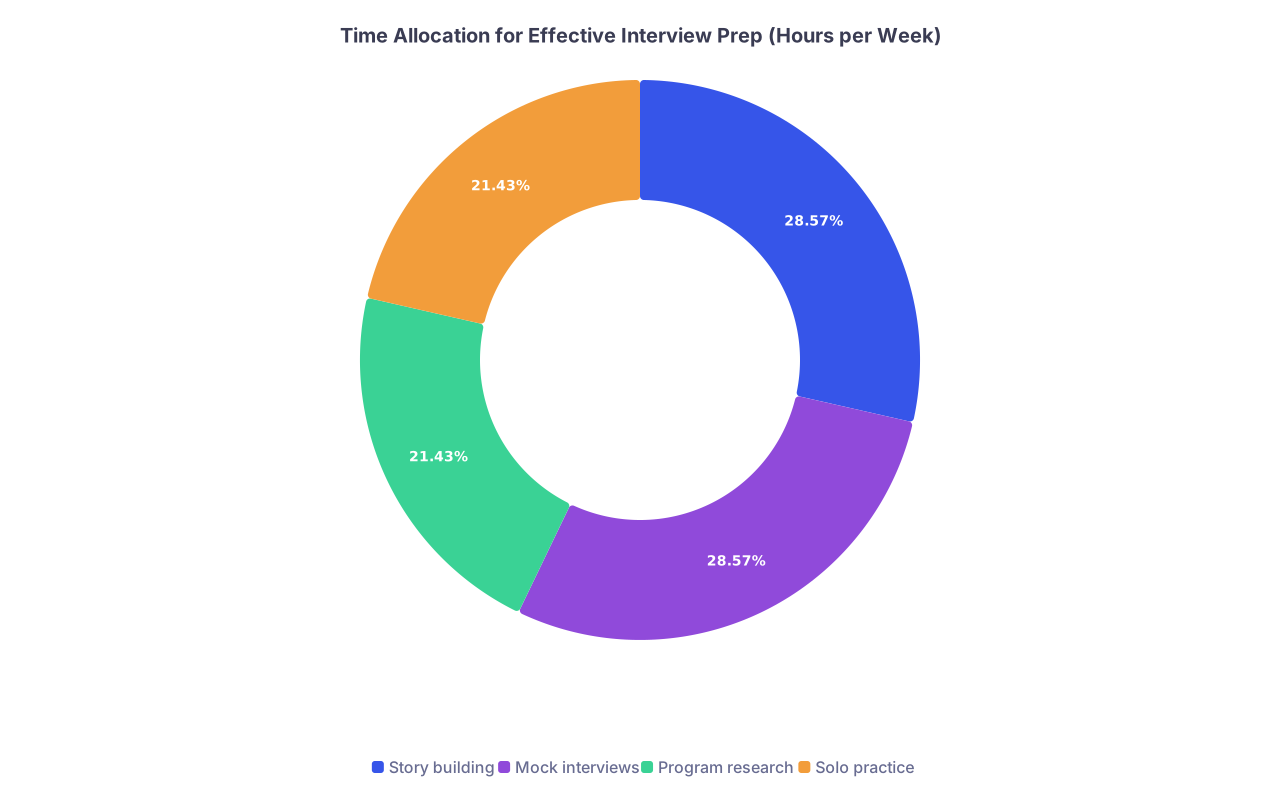
| Category | Value |
|---|---|
| Story building | 2 |
| Mock interviews | 2 |
| Program research | 1.5 |
| Solo practice | 1.5 |
Final Warnings Before You Walk Into That Room
You don’t have to be slick. You don’t have to be perfect. Programs are not looking for TED Talk speakers.
They’re looking for three things: safe, teachable, not miserable to work with at 3 a.m.
So avoid the answer styles that quietly scream the opposite.
Remember:
- Don’t ramble, script, or vague your way into forgettable territory. Clear, concise, specific answers win.
- Don’t broadcast risk—emotional chaos, bitterness, arrogance, or unsafe instincts will drop you down their list faster than any Step score ever could.
- Don’t try to game the interview. Be prepared, be honest, be grounded. They’re ranking a future colleague, not a performance.