
What do you say when the PD leans back, looks at you, and asks: “So… why this program?” — and your mind goes completely blank except for, “Uhh… strong clinical training and great research”?
If you think you can wing this question, you’re about to make one of the most painful, silent-killer mistakes in residency interviews.
This question is not small talk. It is a filter. Programs use it to separate:
- People actually interested in them
from - People shotgunning applications and repeating the same generic nonsense everywhere.
Let me walk you through the biggest traps I see over and over. The mistakes that cost people interviews, ranks, and sometimes their shot at a program they genuinely liked.
I’ll also tell you exactly how to avoid each one.
Mistake #1: Giving the “Copy-Paste” Generic Answer
You know the answer I’m talking about. I’ve seen it in hundreds of interviews and it always sounds something like:
“I’m really impressed by your strong clinical training, diverse patient population, and commitment to research and teaching.”
That could be literally any academic program in the country. It tells them nothing about:
- Why them
- Why you
- Why this fit actually makes sense
And programs are not stupid. They can tell you’ve used this line at 25 other places this week.
Why this is a red flag for programs
When they hear a generic answer, they assume:
- You haven’t done your homework
- You’d be just as happy anywhere
- You might rank them low or not at all
- You’re interviewing on autopilot
In tight programs (think Derm, Ortho, ENT, competitive IM programs, some community places with great reputations) that’s enough to drop you several spots on the rank list.
How to avoid it
You need receipts. Concrete, specific reasons that clearly apply only (or mostly) to that program.
Replace vague padding with 3–4 precise anchors:
- 1–2 program-specific features (curriculum, tracks, call system, rotations)
- 1–2 people or experiences you can name (residents, faculty, interview day, sub-I, social)
- 1–2 personal connections (how your goals match what they actually offer)
Do not say:
- “Strong research” — say “the clinical outcomes projects in heart failure with Dr. X”
- “Great training” — say “the night float system with resident autonomy and senior backup”
- “Diverse population” — say “serving a largely immigrant / safety-net / rural population similar to my medical school clinic”
If they can copy your answer into their neighboring program’s interview and it still makes sense, your answer is useless.
Mistake #2: Only Repeating Their Website Back to Them
Another common failure: you did check the website…but your whole answer sounds like reading their About page out loud.
“You’re a tertiary referral center with level 1 trauma, a 3+1 schedule, and strong board pass rates.”
That’s not insight. That’s a brochure.
Programs want to know: what about those features actually matters to you?
The subtle tell they’re looking for
They’re not testing whether you visited the website.
They’re testing whether you understood the program.
Huge difference.
Anyone can say:
- “You have a 3+1 system.”
Fewer can say:
- “Your 3+1 system is appealing to me because I’ve learned I retain more and do better scholarly work when I can separate clinic weeks from inpatient. During my third-year IM rotation I had a taste of that structure and was much more effective.”
See that? Same fact. Entirely different depth.
How to avoid it
Pick 2–3 “brochure” elements and push one level deeper:
- What does that feature mean for your day-to-day life as a resident?
- How does it connect to something you’ve already experienced?
- How does it tie into your future goals?
If you say:
- “You’re a large county hospital with strong exposure to underserved populations.”
Push it further:
- “I worked in a county system during med school and realized I need that complexity and patient mix to feel engaged. The way your residents described navigating social barriers and coordinating care with limited resources is exactly the type of training I’m looking for.”
Do that and you separate yourself from the herd fast.
Mistake #3: Making It All About Location (Especially in Competitive Programs)
This one kills people.
You sit down in front of a PD at a top program, and when they ask “Why this program?” you lead with:
“I really want to be in [Boston / New York / California / Chicago] because my partner is here and I love the city.”
They hear:
- “You’re just here for the zip code.”
- “You would’ve said yes to anyone in this region.”
- “We’re interchangeable as long as we’re within 30 minutes of your boyfriend.”
Location can be part of the answer. But if it’s the spine of your answer, you look unserious.
Why this is so risky
Programs know everyone has geography preferences. But they are ranking you based on:
- Are you going to work hard here?
- Are you interested in what we specifically do?
- Will you actually be happy and stay?
If it sounds like you just want to live in the city, they’ll pick the equally qualified person who talked about curriculum, mentorship, and clinical style instead.
How to avoid it
You can mention location. But it needs to be framed as a bonus, not the core.
Wrong:
- “I want to be in California near my family, and this program has strong clinical training.”
Better:
- “I’m hoping to build my career in Northern California long-term, and your program stands out because of [X curriculum, Y patient population, Z fellowship pipeline]. Being close to family is a plus, but what really drew me here was [specific program feature].”
If you can’t name three detailed things about the program before you talk about the city, you are underprepared.
Mistake #4: Sounding Like a Fan, Not a Future Colleague
This is more subtle, but I’ve watched PDs’ faces flatten as soon as they hear it.
The “fan” answer sounds like:
- “Your program is amazing and I’d be honored to train here.”
- “You’re my dream program.”
- “I’ve always looked up to [famous institution] and would love to join.”
It’s flattering. But it also makes you sound passive and deferential — like you want to bask in their prestige instead of work alongside them.
They’re not recruiting fans. They’re recruiting coworkers.
What they actually want to hear
They want to hear you talk like someone who sees themselves in the role already:
- “The way your senior residents described managing complex ICU patients with graduated autonomy fits how I like to learn.”
- “Your emphasis on residents as teachers matches how I’ve approached teaching as a sub-I.”
- “I could see myself thriving in a program that balances high acuity with strong support like your wellness half-days and tight-knit resident cohort.”
That’s collegial language. You’re not begging for a spot; you’re explaining why the working relationship makes sense.
How to avoid “fan mode”
Quick litmus test:
If someone could say your answer as a pre-med obsessing over a med school, it’s probably wrong for residency.
Strip out:
- “It would be an honor”
- “Dream program”
- “I’ve always dreamed of…”
Replace with:
- “I’d be excited to contribute to…”
- “I see a strong fit between how I like to work and…”
- “I’m looking for a program where I can [do X], and your residents clearly get to do that.”
Less idolizing. More partnership.
Mistake #5: Forgetting to Connect You to Them
Another classic: you list great things about the program, but never actually connect them to your own story.
It sounds like:
- “You offer extensive ultrasound training, a global health track, and a strong women’s health clinic.”
OK. And what does that have to do with you?
Programs are constantly asking:
Why do you belong here specifically?
The missing step
Every “reason” you name about the program needs a mirror on your side:
- Their feature → Your experience / value / goal
Example of doing it poorly:
- “You have a strong global health track, which is really interesting to me.”
Better:
- “I spent a month at a rural clinic in Guatemala and realized I want global health to be a recurring part of my career, not just a one-off trip. Your structured global health track with continuity projects and faculty mentorship stands out as a place I could deepen that work in a serious way.”
See the difference? They now understand:
- Why that feature matters to you
- That you have relevant experience
- That you’ve thought about this intentionally
How to avoid a disconnected answer
For every program feature you plan to mention, ask yourself these two questions:
- What in my past or present actually links to this?
- How does this help me move toward a future goal I care about?
If you can’t answer both, drop that feature. It’s fluff.
Mistake #6: Giving the Exact Same Answer to Everyone
This one’s deadly, and programs can sometimes literally compare notes.
I’ve heard PDs say things like:
“Funny, he told us we’re his top choice because of our global health, but our colleagues across town heard the same speech yesterday…”
If your “Why this program?” answer is 90% identical across interviews, you’re playing with fire. Especially if programs are in the same city or share faculty.
Why this blows up your credibility
Programs know you’re applying widely. That’s fine.
But they do not like feeling:
- Misled
- Manipulated with canned “you’re my top choice” talk
- Treated like clones of their neighbors
Once they sense you’re reciting a script, they’ll start doubting everything else you say about “fit” and “interest.”
How to avoid it
You need a flexible skeleton, not a fixed script.
Structure you can reuse:
- One sentence on your overall career goals / what you’re looking for in a residency
- Three program-specific points (features, people, experiences)
- One closing line tying it back to fit
The part you must rewrite every time is #2. And not just swapping out names. Actually different content for each place.
You should be able to answer honestly:
- “What could I say in this answer that would not make sense if I said it at the program across town?”
If you don’t have at least 2–3 of those, you haven’t researched enough.
Mistake #7: Being Vague About Your Own Priorities
Some of you dodge having an opinion about what you want.
So your “Why this program?” answer is this shapeless blob:
- “I want a balance of clinical and research.”
- “I value work-life balance and strong training.”
- “I’m open to everything and really just want broad exposure.”
That tells them nothing. Everyone says that. It makes you sound like you haven’t thought deeply about what you need.
Programs want to see a brain behind the smile
You don’t need a rigid 10-year plan. But you do need:
- A sense of what energizes you
- A rough direction (academic vs community, fellowship vs generalist, etc.)
- Some idea of what kind of training environment brings out your best
If you refuse to commit to anything, they’ll assume you’ll just drift through residency.
How to avoid it
Before interview season, sit with these questions and write down actual answers:
- Do I lean academic, community, or hybrid?
- How much do I really care about research vs. being clinically strong?
- Do I want heavy autonomy early, or more structured support?
- Are there specific patient populations I want to work with long-term?
Then, in your answer, show how their program fits those actual preferences.
You don’t need to oversell it. Just be clear and honest.
Mistake #8: Ignoring What You’ve Already Seen and Heard
If you did a sub-I, away rotation, second look, or even just sat through their pre-interview resident panel, and then do not reference those experiences in your answer?
You look checked out.
Programs expect you to integrate what you’ve learned from:
- Rotations
- Conversations with residents/faculty
- Pre-interview socials
- Interview morning presentations
Why this matters
This shows you:
- Listen
- Reflect
- Actually care about what residents say their lives are like
When you don’t do this, they assume you’re just collecting interviews, not really evaluating fit.
How to avoid it
Always have 1–2 “live” data points ready:
- Something a resident said on the panel
- An interaction you had on a rotation
- A detail from the tour or didactic you found meaningful
Example:
“When the residents were talking this morning about how chiefs actively protect their clinic time, that stood out to me. At my home program I saw clinic time repeatedly sacrificed for floor work, and I realized how much that eroded continuity and learning. Your structure seems intentional about guarding those experiences, which aligns with how I want to train.”
That kind of answer makes PDs think:
“Okay. This person actually watched and thought about what they saw.”
Mistake #9: Overpromising or Lying About Rank Intentions
Here’s the nasty one I see every cycle.
You think saying “You’re my top choice” in every interview will boost your rank everywhere.
Programs talk. Faculty move. People compare notes. And it blows up.
You do not need to lie to convey strong interest.
Why this backfires hard
Once a program feels you’ve lied, they don’t just lower your rank slightly. They may:
- Drop you significantly
- Scrutinize everything else you said
- Tell colleagues about “that applicant who told everyone they were #1”
You never fully know where faculty have friends.
How to avoid it (without sounding lukewarm)
Use honest but strong language:
- “I’m very impressed with your program and it will be ranked highly on my list.”
- “Based on what I’ve seen so far, I can clearly see myself training here and thriving.”
- “I’m very interested in matching here and think it would be an excellent fit.”
If you truly do have a genuine #1, you can tell them that. Once. Directly.
But don’t play games with multiple programs. That’s how you get burned.
Mistake #10: Not Practicing Out Loud (You Can Hear the Panic)
The last mistake is thinking you’ll “just speak from the heart” on interview day.
Here’s what actually happens:
- Your mind goes blank.
- You start rambling.
- You throw in buzzwords — “diverse, strong, robust, prestigious” — to fill gaps.
- You circle back. Repeat yourself. Trail off.
PDs have maybe 10–20 minutes with you. They notice when your answer is scattered.
The cure is simple, but most people skip it
You should have:
- A written bullet list for each program (not a script)
- 3–4 key points you plan to hit
- A 60–90 second version and a 2–3 minute version of your answer
And then you need to say it out loud. To a human. Or at least to your laptop camera.
You’re not trying to memorize lines. You’re trying to:
- Get the order clear in your head
- Smooth out clunky phrasing
- Make sure you don’t sound like you’re reading
- Catch spots where you sound fake or excessive
Two or three run-throughs per program is usually enough. People skip this because they’re tired and “kind of know what they’ll say.” Those same people email me in February wondering why they got fewer ranks than expected.
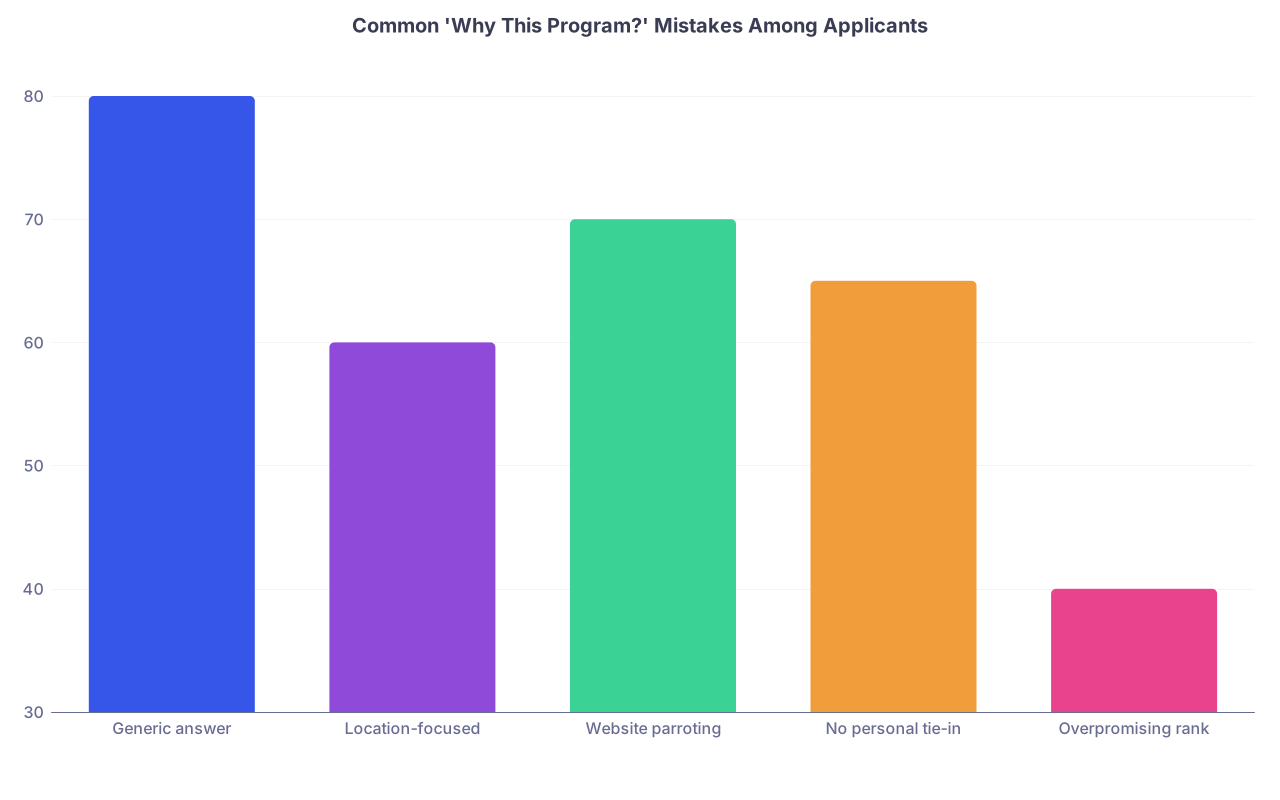
| Category | Value |
|---|---|
| Generic answer | 80 |
| Location-focused | 60 |
| Website parroting | 70 |
| No personal tie-in | 65 |
| Overpromising rank | 40 |
A Simple, Safe Structure You Can Reuse
Let me give you a template that won’t get you in trouble — if you actually customize it.
1. Start with your broad goal or what you’re looking for
- “I’m looking for a program where I can become a strong, independent clinician with good exposure to [X] and opportunities to [Y].”
2. Add 2–3 specific program features that match that goal
- “Your [specific rotation, track, patient population, schedule, mentorship structure] really stands out to me because [link to your experience or goal].”
3. Weave in something you observed or heard
- “Talking to the residents this morning / during my sub-I, I was struck by [concrete detail], which matches how I like to work/learn.”
4. Close with a clear statement of fit and interest (without lying)
- “So between the [feature A], [feature B], and the culture I’ve seen here, I think this would be an excellent fit for how I want to train, and I’d be very excited to match here.”
If you fill in that structure with real specifics for each place, you’ll be miles ahead of the average applicant who’s winging it.

| Step | Description |
|---|---|
| Step 1 | Research program |
| Step 2 | Identify 3 specific features |
| Step 3 | Link each feature to your goals/experience |
| Step 4 | Draft bullet outline |
| Step 5 | Practice out loud |
| Step 6 | Refine for clarity and authenticity |
| Level | Description | Program Reaction |
|---|---|---|
| Weak | Generic, location-focused, vague | "Not really interested in us" |
| Average | Some specifics, mostly brochure words | "Fine but forgettable" |
| Strong | Concrete details + personal tie-in | "Good fit, likely higher on list" |
| Outstanding | Deep understanding + clear goals + authentic interest | "Top of rank list candidate" |
FAQ (Exactly 3 Questions)
1. Is it OK to say a program is my top choice during the interview?
Yes, if it’s true and you mean it. But only say “top choice” or “number one” to one program. Everyone else should hear honest but slightly softer language (“ranked highly,” “very interested in matching here”). Lying about rank intentions is a fast way to lose credibility if word gets around. And no, you don’t get extra points for theatrics — programs mostly care about your fit and sincerity, not dramatic declarations.
2. How long should my “Why this program?” answer be?
Aim for about 60–90 seconds, with the ability to expand to 2–3 minutes if they keep the conversation going. Shorter than 30 seconds usually means you’re too generic. Longer than 3 minutes and you’re rambling. You want tight, specific, and conversational — not a monologue. If you can’t say it naturally in under 2 minutes, you haven’t trimmed enough.
3. What if I genuinely don’t know yet what I want long-term?
That’s fine. You don’t need a locked-in fellowship or career path. But you can’t use uncertainty as an excuse to be vague. Instead, be honest about your uncertainty and then describe what kind of training environment you know you do well in: high acuity vs. slower pace, heavy autonomy vs. more guidance, academic vs. community, specific patient populations you care about. Then tie those preferences to real features of their program. Clarity about how you learn and work is more important than a rigid 10-year plan.
Open your interview spreadsheet right now. Pick one program you care about and force yourself to write three specific, concrete reasons you’d want to train there — reasons that wouldn’t make sense at the program across town. If you can’t do that, that’s exactly where you need to start.