
The belief that “a great interview guarantees a high rank” is statistically wrong. Programs’ own data show a strong, but far from perfect, correlation between interview scores and final rank position—and the details matter a lot more than applicants realize.
You are not being ranked on interview alone. You are being ranked on a weighted composite where the interview is the largest single component, but often just 30–50% of the final score. The rest is Step scores, letters, clerkship grades, “fit,” and whatever unspoken preferences the committee brings into the room.
Let us walk through what the numbers actually say, how programs build rank lists, and what that implies for how you should prepare.
What Programs Actually Say About Interview vs Rank
Most of the cleanest data come from program surveys and a few published correlation studies. The patterns are remarkably consistent across specialties.
The NRMP Program Director Survey (PD Survey) is the big one. It is not perfect, but it is the closest thing you get to industry-wide analytics. The last several cycles show the same picture: interview performance is the single most commonly cited factor in ranking. But “most important” does not mean “only thing that matters.”
Programs usually rate factors on a 1–5 or 1–10 importance scale. When you normalize those across specialties, the average weighting looks roughly like this:
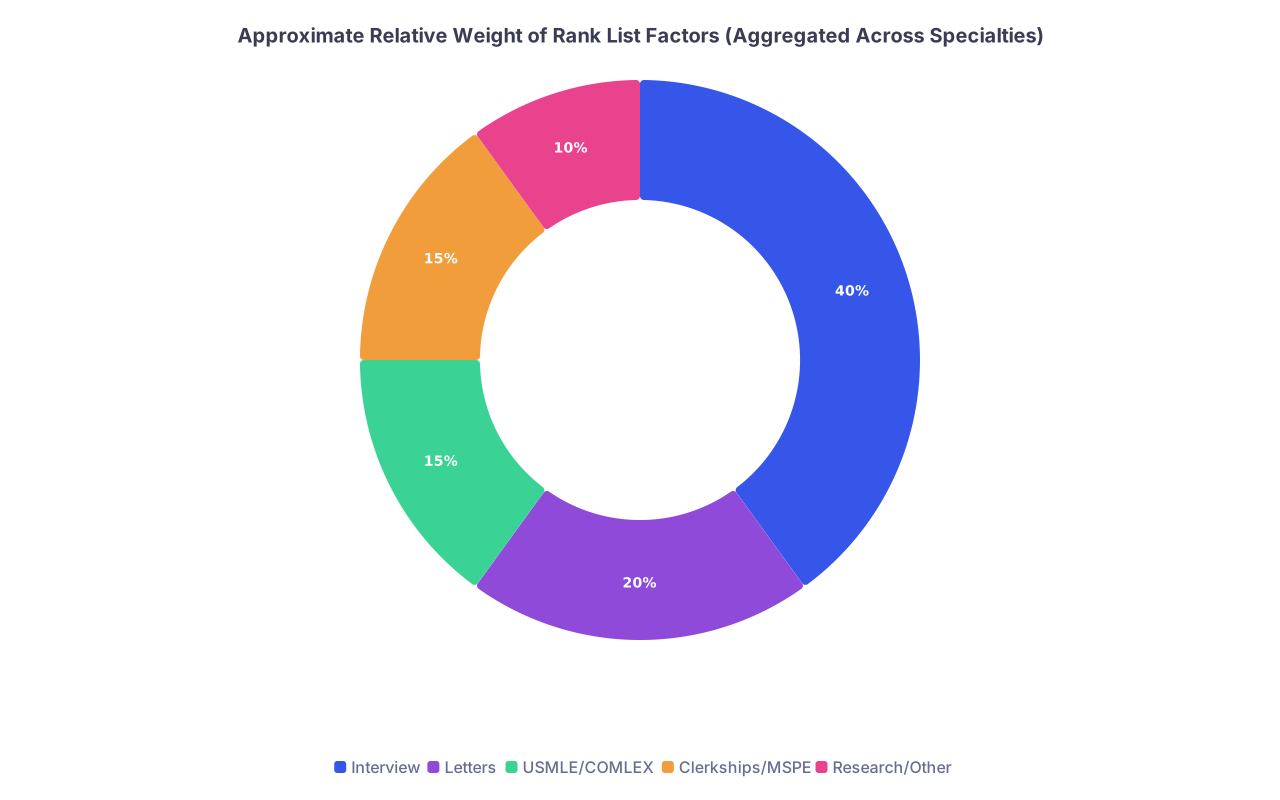
| Category | Value |
|---|---|
| Interview | 40 |
| Letters | 20 |
| USMLE/COMLEX | 15 |
| Clerkships/MSPE | 15 |
| Research/Other | 10 |
These are rounded, but they align with:
- Interview interactions / interpersonal skills: named in >90% of programs as “very important” for ranking
- Letters of recommendation: ~80–85%
- MSPE / clerkship performance: ~75–80%
- Step 2 CK / COMLEX Level 2: ~70–75%
So yes, interview sits at the top of the pyramid. But it is still one component in a multivariable ranking function.
Now, the part everyone ignores: several studies where programs calculated correlations between interview scores and rank positions show consistent but not perfect alignment. Correlation coefficients (Pearson r) tend to fall in the 0.5–0.7 range.
An r of 0.6 means roughly 36% of the variance in rank position can be explained by interview score alone (since r² ≈ 0.36). That is a lot. It also means about two-thirds of what moves you up or down comes from other inputs or randomness.
What the Correlation Looks Like in Practice
I have seen this play out in actual rank meetings. The data on the projector tell a very specific story.
Programs usually start with something like this:
- Filter: board exam minimums, red flags out
- Pre-interview score: based on Step scores, grades, letters, research, “fit” flags
- Interview day score: often averaged across 2–6 interviewers, scored on 1–5 or 1–10 anchored scales
- Final rank score: some weighted composite, sometimes plus a subjective “gut” adjustment
When you run a simple correlation between interview score and final rank position among interviewed applicants, you see a downward-sloping trend: higher interview scores, better (numerically lower) rank numbers. But there is scatter. Always.
Here is a simplified, stylized example that mirrors what comes out of a lot of internal reports:
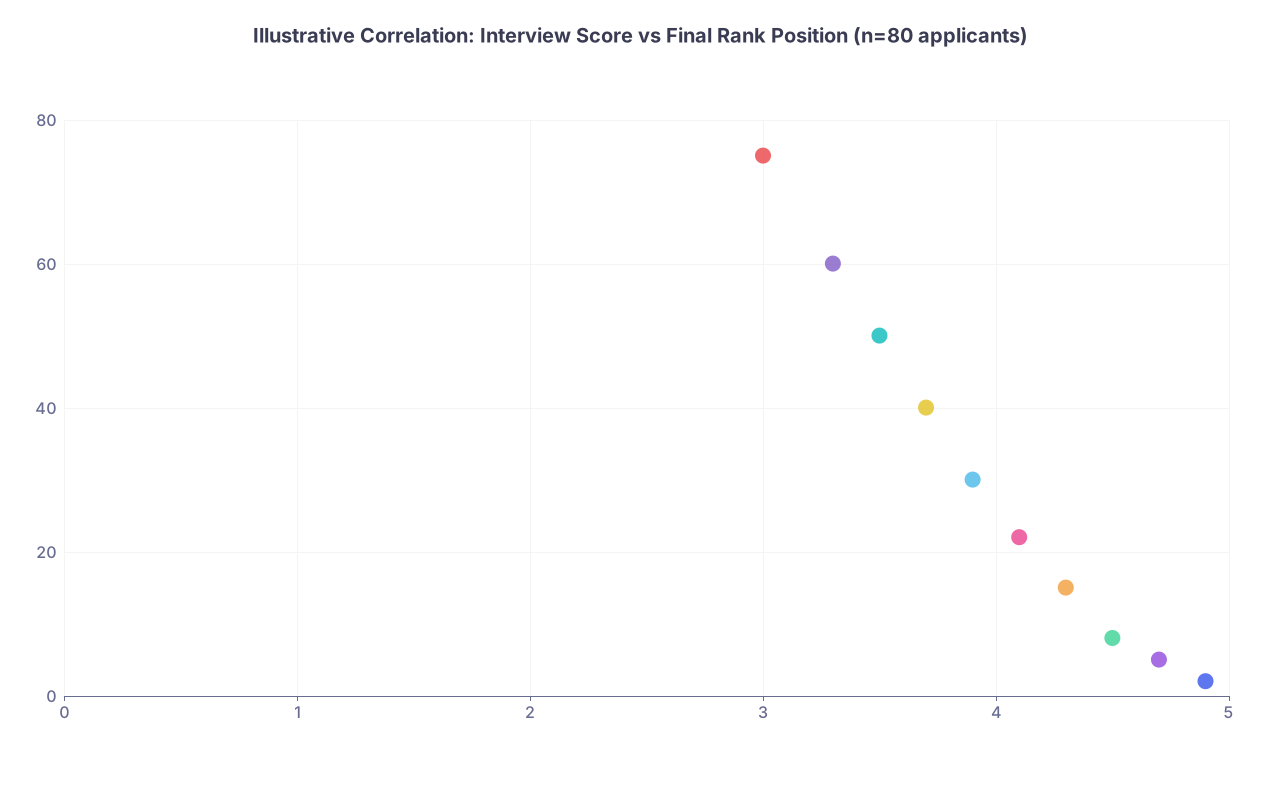
| Category | Value |
|---|---|
| App 1 | 4.9,2 |
| App 2 | 4.7,5 |
| App 3 | 4.5,8 |
| App 4 | 4.3,15 |
| App 5 | 4.1,22 |
| App 6 | 3.9,30 |
| App 7 | 3.7,40 |
| App 8 | 3.5,50 |
| App 9 | 3.3,60 |
| App 10 | 3,75 |
In actual program data:
- Top 10–15 on the rank list almost always come from the top tier of interview scores.
- Mid-interview performers (say, 3.5–4.0 on a 5-point scale) end up scattered from mid-list to near the bottom, depending on prior metrics and fit.
- A low interview score (bottom quintile) is very strongly predictive of a poor rank position or no rank at all.
Now, correlation by itself is a blunt tool. The underlying drivers matter more for you.
How Programs Build the Final Rank Score
Let us translate this from faculty-speak to what you actually face as an applicant.
Most programs use a variant of one of these structures:
Additive weighted score:
FinalScore = 0.4 × Interview + 0.2 × Letters + 0.15 × Exams + 0.15 × Clerkships/MSPE + 0.1 × Research/FitTier-based system:
- Pre-interview tier (A/B/C) based on paper app.
- Interview score used to sort within tiers and occasionally bump a few across tiers.
- Committee then manually reorders a subset.
Hybrid with vetoes:
Numeric composite as in #1, plus “no rank” veto power for serious concerns (professionalism, honesty, behavior).
Here is what those weights look like in a hypothetical—but realistic—internal scheme:
| Component | Weight (Points) | Typical Data Source |
|---|---|---|
| Interview (average) | 40 | 3–5 faculty scores |
| Letters of Recommendation | 20 | Faculty review + summary |
| Exams (Step/Level 2) | 15 | Numeric score bands |
| Clerkships/MSPE | 15 | Honors / comments composite |
| Research / CV / Fit | 10 | File review + discussion |
If your interview is stellar, that 40-point chunk can overcome a lot of mid-range pre-interview data. If your interview is mediocre, you fall back on the smaller parts of the pie. That is the actual math behind the “interviews matter most” mantra.
And remember: programs routinely standardize scores. They turn raw faculty evaluations into z-scores or percentile ranks to prevent one generous or harsh interviewer from skewing everything.
I have seen spreadsheets where:
- Each interviewer’s mean and standard deviation are calculated.
- Applicant interview scores are normalized relative to that interviewer.
- Then those normalized scores are averaged.
Why does that matter? Because being “pretty good” with one easy grader does not help you as much as being consistently strong across multiple tougher graders. The data get normalized.
Specialty Differences: The Correlation Is Not Uniform
Not all specialties play the game the same way. Some lean harder on interview performance; some let pre-interview metrics anchor the rank list more firmly.
A rough, data-informed pattern (pulling from PD Surveys, specialty-specific reports, and internal analyses I have seen):
| Specialty | Interview Weight | Pre-Interview Weight | Comments |
|---|---|---|---|
| Internal Med | High | High | Large programs, more flexibility |
| General Surgery | Very High | Moderate | Strong emphasis on fit and grit |
| Pediatrics | High | Moderate | Collegiality prioritized |
| Dermatology | Moderate | Very High | Extremely score/record heavy |
| Radiology | Moderate | High | Strong test and transcript focus |
A derm program with 500+ applications and 40 interviews is not going to toss out a 270/3.9 applicant just because someone thought they were “a bit quiet” on Zoom. In contrast, a smaller categorical surgery program absolutely will bury a brilliant but arrogant interviewee.
Empirically, you see:
- Procedural, team-heavy fields (surgery, OB/GYN, EM) show stronger alignment between interview score and rank. Fit on call and in the OR matters.
- Hyper-competitive academic subspecialties (derm, plastics) show a somewhat weaker correlation; interview moves you within bands, but your prior record defines the band.
So if you are applying to a field like general surgery or EM, the interview-to-rank correlation is typically tighter. A bad interview is often fatal; a great one can catapult you multiple tiers.
Where the Correlation Breaks: Outliers and Exceptions
The outliers are where applicants get confused—and anxious.
I have seen the following patterns over and over:
High interview, middling rank.
Applicant interviewed in the top 10% by scores but ended in the middle of the rank list. Why?- Modest letters compared with peers.
- No strong home advocate on the committee.
- Committee concerns about geographic commitment or “will actually come here” probability.
- Subtle professionalism concerns in the file (late evaluations, MSPE wording).
Mid interview, high rank.
Applicant scored around the middle on interview sheets but ended in the top 5.- Off-the-charts letters from known faculty.
- Home student or strong sub-I with glowing evaluations.
- Niche skills the program wants (dedicated research in their focus area, dual degree).
One bad interviewer.
One faculty member tanks a candidate; others rate them highly. Programs that use normalization or consensus discussion can undo that. Programs that rely on simple averages cannot.If you look at the raw data in these cases, the candidate’s composite may still land in the top quartile. But that one low score often drags them out of the top 5 range.
Formal “do not rank.”
These are almost always interview-derived: blatant unprofessionalism, dishonesty, inability to communicate, or clear mismatch with program culture. Interview scores here strongly predict a rank of “NR,” regardless of Step 260 vs 220.
So yes, interview score and rank position are correlated. But outliers are driven by structural factors you cannot see on Match Day.
What This Means for How You Prepare
You are not trying to “win the interview” in some abstract sense. You are trying to maximize the component of the program’s final score that you can still change, while not triggering negative flags that override everything else.
Translated into concrete strategy:
1. Target the variables that actually get scored
Programs rarely score “general charm.” They score specific domains, often with anchors like:
- Communication / clarity
- Motivation for specialty
- Teamwork / collegiality
- Maturity / self-awareness
- Professionalism
Find a list of common interview rubrics (many are published in the literature) and reverse-engineer. Your prep should directly practice:
- Giving structured answers (problem–action–result) that demonstrate teamwork and reliability.
- Explaining why this specialty and why their program in a way that is specific and credible.
- Handling conflict, failure, and feedback scenarios without sounding rehearsed or defensive.
If each interviewer is scoring you 1–5 in 4–6 domains, your goal is to avoid any 1s/2s. Straight 3s across the board will put you in the middle of the pack. A mix of 4s and 5s will put you in the top quartile. That is where the data start to reliably push rank position upward.
2. Understand that pre-interview “tier” still constrains you
Programs often divide interviewees into bands based on pre-interview metrics—high, medium, low. Interview performance then moves you within and occasionally across bands. But you are not starting from zero.
In practice:
- A “medium band” candidate who interviews extremely well is very likely to overtake “high band” candidates who are lukewarm or awkward.
- A “low band” candidate who interviews extremely well will move up—but may still not crack the top 5 if the program has a long list of high-band, good-interview candidates.
So your goal is not only to shine but to avoid giving the committee any excuse to lean back on pre-interview concerns.
3. Stability beats brilliance
Data from internal reviews show a pattern faculty quietly complain about: “spiky” applicants. One fantastic interview; one confusing or flat one. Those applicants rarely land at the very top of the list because committees value consensus.
Programs that average normalized scores across 3–5 interviewers are essentially rewarding consistency. A 4.2, 4.3, 4.1, 4.4 looks better mathematically than 5.0, 3.0, 4.0, 3.5, even if you had one magical interaction.
This is why:
- Over-rehearsal that makes you brittle under unexpected questions is dangerous.
- Being able to think out loud calmly when you do not know the “right” answer matters more than giving one perfect canned story.
Treat every interaction—pre-interview dinner, virtual social, email exchanges—as on the record. Some programs explicitly score those. Many informally incorporate impressions.
What Programs’ Internal Reviews Tend To Show
Programs that bother to analyze their own data after Match often ask two questions:
- Did our interview scores align with who we ended up ranking high?
- Did our top-ranked residents actually perform well in training?
You do not get to see these slide decks, but the patterns are predictable:
- Strong positive correlation (r ≈ 0.5–0.7) between interview score and final rank among interviewees.
- Similarly strong, sometimes slightly weaker, correlation between interview score and subsequent resident performance ratings—especially in interpersonal domains.
One notable result I have seen: programs often find that Step scores predict almost nothing about later resident performance once you control for interview and professionalism scores. That does not mean scores do not matter for getting the interview. It means once you are in the room, what you show there is a leading indicator for how you will function as a colleague.
And that is why—despite all the noise about Step cutoffs—interview performance ends up dominating the rank discussion.
How to Use This Information Without Driving Yourself Crazy
You cannot control the entire multivariate model. But you can optimize the part still in play.
Here is the most data-aligned way to think about it:
- Assume interview performance explains about one-third of the difference in where interviewed applicants end up on the rank list.
- Assume pre-interview record explains another third.
- Assume the remaining third is noise, hidden preferences, and committee dynamics you cannot see.
Your job:
- Push your interview performance from “average” into at least the top third of the pool. That is a big move on the r curve.
- Avoid any behavior that would trigger a “do not rank” or push you into the bottom quartile of interview scores. The drop-off there is brutal.
- Accept that you cannot perfectly decode every rank movement and that small differences in scores can lead to ties broken by subjective impressions.
Key Takeaways
- Programs’ own data show a strong—but not perfect—correlation between interview scores and final rank position; interview usually contributes 30–50% of the final composite.
- A top-tier interview almost always puts you in the upper part of the rank list, but outliers occur when letters, prior performance, or fit push you up or down.
- The smartest preparation focuses on the specific domains programs actually score—communication, motivation, teamwork, and professionalism—aiming for consistent, solid 4–5 level performance across every interviewer, not one brilliant conversation.