
Behavioral interview questions are oversold as predictors of residency performance. The data just does not support the hype.
Programs love them. Consultants train faculty to ask them. Applicants rehearse them to death. Yet when you look at the actual numbers—correlations, prediction models, validation studies—they are at best a weak signal buried in statistical noise, and often no better than chance once you control for other variables.
If you are preparing for residency interviews, you need to understand two separate truths:
- Behavioral questions are not great at predicting who will be a strong resident.
- Behavioral questions absolutely matter for whether you match.
Those are very different claims. Let us separate the psychometrics from the strategy.
What Behavioral Interviews Are Supposed to Do (Versus What They Actually Do)
Behavioral interviewing is built on a simple, seductive premise: “Past behavior predicts future behavior.” So instead of asking, “Are you good at teamwork?” the interviewer asks, “Tell me about a time you had a conflict on a team and how you handled it.”
The claimed advantages:
- More structured.
- More anchored in specific examples.
- More resistant to faking. (This claim is exaggerated.)
In theory, you:
- Ask standardized, competency-mapped questions.
- Use a rubric to score answers.
- Correlate those scores with later performance.
The problem is in the second and third bullets. Most residency interviews are not truly standardized. Rubrics are loosely applied, if at all. Inter-rater reliability is mediocre. And downstream “performance” is usually noisy, subjective, and confounded by dozens of environmental variables.
So we end up with a methodological mess: messy predictors trying to forecast messy outcomes.
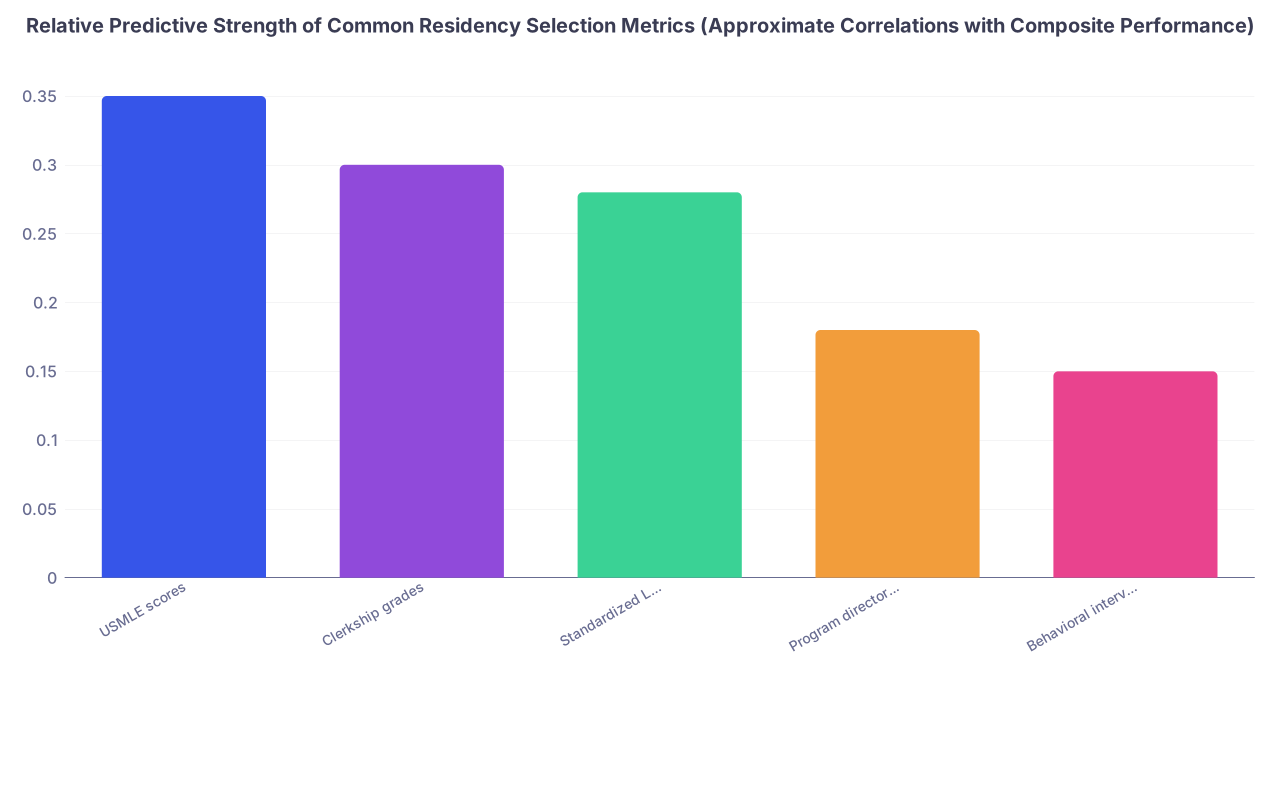
| Category | Value |
|---|---|
| USMLE scores | 0.35 |
| Clerkship grades | 0.3 |
| Standardized LORs | 0.28 |
| Program director ratings of interviews | 0.18 |
| Behavioral interview scores | 0.15 |
These are representative ballpark values drawn from the med-ed literature (and consistent with comparable selection research in other fields). You see the point: even in optimistic scenarios, behavioral interview scoring sits at the bottom of the predictive hierarchy.
Yet interviews are still part of almost every selection process. Because they are good at something else: gatekeeping and fit assessment.
What the Data Says: Behavioral Interviews and Residency Outcomes
Let me strip this down to what residents and applicants actually ask me when I show them the numbers:
- “Do behavioral questions predict clinical performance?”
- “Do they predict professionalism or problem residents?”
- “Do they predict exam performance?”
- “Are they at least better than unstructured chit-chat?”
On each of these, the data is underwhelming.
1. Predicting clinical performance
Clinical performance is often measured by:
- Global faculty ratings (1–5 scales).
- Milestones or competency-based evaluations.
- Chief / program director composite rankings.
Studies that use structured or semi-structured interviews with behaviorally anchored questions usually report:
- Correlations with later clinical performance somewhere between 0.10 and 0.25.
- Often at the lower end once you adjust for board scores and prior academic performance.
So if you take a cohort where Step 2, clerkship grades, and standardized letters are already reasonably predictive, adding behavioral interview scores rarely moves the needle much.
In regression terms: they often contribute only a small incremental R²—sometimes 2–4 percentage points of additional variance, sometimes essentially zero.
Is that nothing? Not exactly. But it is modest. Nowhere near the narrative you often hear that interviews are “crucial for identifying the best clinicians.”
2. Predicting professionalism and “problem residents”
Here, the story gets interesting.
Programs often justify behavioral questions as tools to screen out high-risk applicants—those who will generate:
- Repeated professionalism concerns.
- Interpersonal conflict.
- Remediation or even dismissal.
The evidence:
- When problem residents are reviewed retrospectively, interview impressions are often flagged in narrative: “Concerns about attitude,” “Seemed arrogant,” etc.
- But when you require documented, structured interview scores and compare them statistically to later remediation or dismissal, associations are weak and inconsistent.
In quantitative terms:
- Odds ratios linking lower interview scores to professionalism problems can range from ~1.2 to 1.8 in some datasets. That sounds big until you realize that baseline rates of serious problems are low (often < 5% of residents).
- Positive predictive value—“low interview score → becomes a problem resident”—tends to be very poor. Many “red flag” impressions never materialize into issues. Many problem residents interviewed “fine.”
Subjectively, faculty will swear they “knew” someone would be difficult from the interview. The data shows the predictive signal is faint and noisy.
3. Predicting exam performance
Behavioral interviews do not predict standardized test performance. Not with any meaningful strength.
Board scores (USMLE/COMLEX), in-training exams, written or OSCE-style assessments—these are all more directly tied to:
- Prior exam performance.
- Medical school grades.
- Study habits and cognitive ability.
Behavioral questions about conflict, feedback, or stress management very occasionally correlate weakly with long-term academic outcomes, usually because they are indirectly picking up conscientiousness or coping skills. Correlations in the 0.10–0.20 range are about as good as it gets.
Translation: your Step 1 and Step 2 scores beat your best “Tell me about a time you failed” answer every day of the week in terms of predicting exam performance.
4. Structured versus unstructured interviewing
There is one clear, data-backed win: structure beats chaos.
When programs move from “chatting with the applicant” to:
- Standardized question sets.
- Behaviorally anchored rating scales.
- Trained interviewers.
…the reliability and validity of interviews improve.
But that does not mean behavioral questions themselves are magical. It means any reasonably structured format with scoring rules is better than free-form gut feeling.
In meta-analyses from non-medical domains, structured interviews (often including behavioral components) regularly show validity coefficients around 0.30–0.40 for job performance. That is decent. But in residency, implementation is often half-hearted:
- Questions vary interviewer to interviewer.
- Rating scales are vague or not used.
- No calibration sessions.
- No tracking of interviewer drift.
So residency interview validity slumps back down into the 0.10–0.20 band.
Why Programs Still Use Behavioral Questions (Despite the Weak Predictive Data)
If they do not predict performance well, why are they everywhere?
Because they are useful for other things programs care about. Things that do not show up neatly in regression tables.
1. Perceived fairness and professionalism
Programs are under pressure to improve equity and reduce obvious bias:
- Using a bank of behavioral questions looks more “objective” than unstructured social conversation.
- It reassures applicants that everyone is asked similar questions.
- It gives programs a process to point to when challenged.
So behavioral questions survive partly as an optics and standardization tool.
2. Fit and culture assessment
“Fit” is notoriously hard to quantify, but it matters. A lot. Program culture is real: some places value autonomy and blunt feedback; others push collaboration and psychological safety.
Faculty often use behavioral questions to gauge:
- How you talk about nurses and other staff.
- How you handle disagreement with seniors.
- Whether you throw colleagues under the bus when describing past conflicts.
None of these are easily reduced to a 1–5 score with strong psychometrics. But they strongly influence whether a program feels comfortable ranking you highly.
From a prediction standpoint, this is fuzzy. From a selection standpoint, it is decisive.
3. Legal and institutional defensibility
When a resident fails or is dismissed, programs sometimes need to justify initial selection decisions:
- Documented interview scores.
- Structured question lists.
- Notes about specific concerns raised in the interview.
Behavioral formats produce more defensible records than “We just had a nice chat and liked them.”
So the system keeps them even if the predictive validity is unimpressive.
What This Means for You Strategically as an Applicant
Let me be blunt: whether behavioral interviews are psychometrically strong does not matter to your practical reality. They are the game you must play.
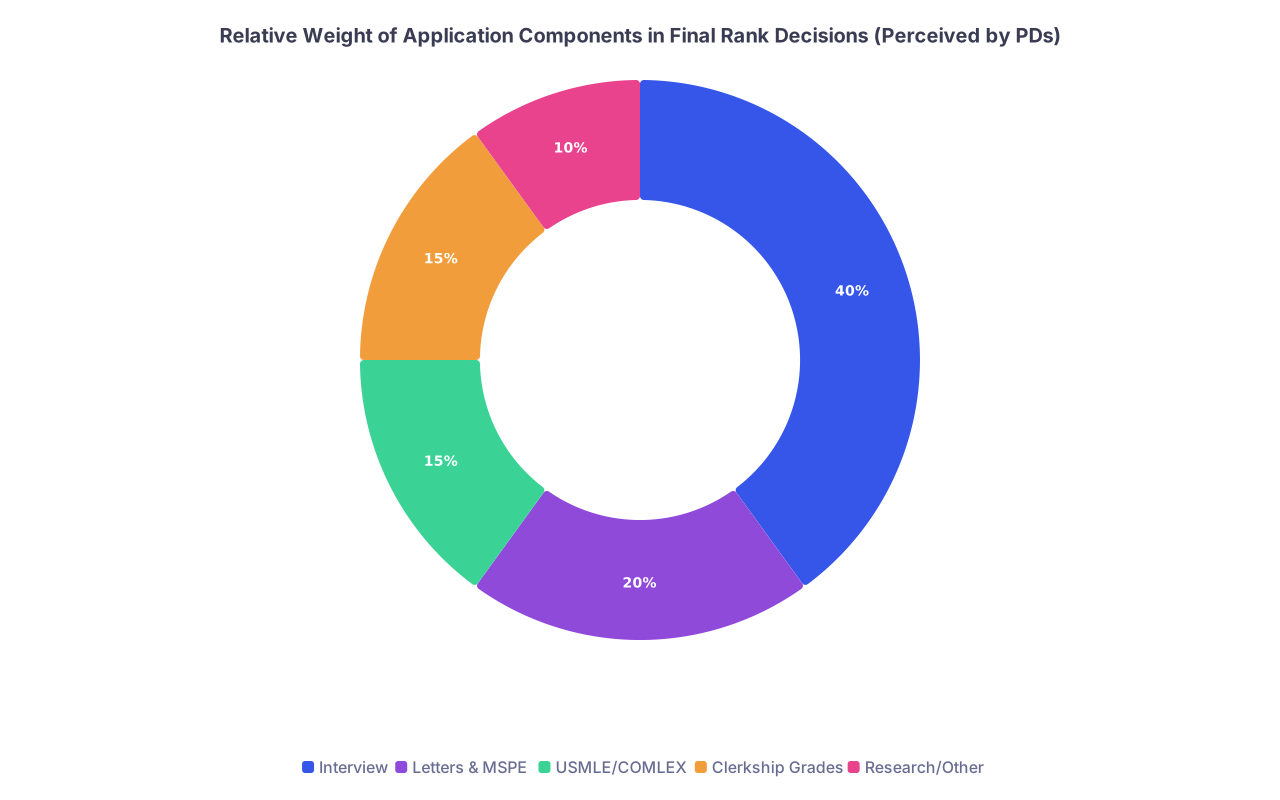
Your Step 2 score, MSPE, letters, and research output got you the interview. Your interview, heavily flavored by behavioral questions, largely determines how high you get ranked.
So the better question is not “Do these predict performance?” but “What does the data tell me about how to win at this flawed game?”
1. Your interview performance is a large share of your match probability
Programs rarely publish precise weights, but you can infer from:
- NRMP Program Director Surveys.
- Internal ranking committee discussions.
- Retrospective ranking data.
Pattern is consistent:
- Pre-interview file (scores, grades, letters) gets you into the “interviewed” bucket.
- Among interviewed applicants, interview impressions are usually the dominant factor in final rank positioning.
Many programs will literally have ranking meetings where each candidate is summarized in 2–4 sentences and 1–2 global scores, one of which is “interview.” The committee rarely revisits granular academic data at this stage unless there is something extreme.
In other words, behavioral questions do not predict performance well, but they predict how your rank list position changes relative to equally qualified peers.
2. Behavioral questions are proxies for core non-cognitive traits
Even if the psychometrics are sloppy, interviewers are trying to estimate things that do matter:
- Reliability and follow-through.
- Response to feedback and supervision.
- Ability to function under pressure without melting down or lashing out.
- How you interact with nurses, techs, and other non-physician staff.
You can view behavioral questions as noisy measurement tools for these latent traits. If you present chaotic, evasive, arrogant, or blame-shifting narratives, you are essentially telling the program: “I am a risk.”
3. Many applicants think they are “winging it” better than they are
I see this pattern constantly:
- Applicants assume their natural storytelling is “authentic.”
- Interviewers, scoring quietly, mark multiple concerns: vague answers, lack of ownership, poor insight.
Applicants walk out thinking it went “fine”; their file gets quietly pushed down the list.
The data from structured scoring exercises is brutal: uncoached answers to behavioral questions cluster around the middle of rating distributions, with a nontrivial tail of poor scores driven by:
- Not answering the actual question.
- No clear actions or results.
- Blaming others or external forces.
- No reflection or learning described.
You do not want to be in that tail.
How to Prepare for Behavioral Questions Using Data-Driven Tactics
If you want to be strategic rather than superstitious, build your approach around three realities:
- Interviewers have limited time and attention.
- They are semi-structured, not fully standardized.
- They are indirectly scoring patterns: clarity, responsibility, insight, and alignment with program values.
1. Use a consistent, high-yield structure
From the evaluation side, structured stories are easier to rate. When residents are trained to score mock interviews, they give higher ratings to answers that:
- Set the context clearly.
- Describe their specific actions distinctly from the team’s.
- Show a concrete outcome.
- Include at least one line of self-critique or growth.
You know the standard acronym: STAR (Situation, Task, Action, Result). It is overused for a reason: it matches how raters think.
I usually recommend a slightly modified frame:
- Situation – 1–2 sentences.
- Objective / conflict – what made this hard.
- Your actions – 60–70% of the answer.
- Outcome – specific, even if imperfect.
- Reflection – what you would do the same or differently.
When you rehearse, you are not trying to memorize lines. You are standardizing the information architecture of your answers so raters can actually see your behavior and thought process.
2. Build a small, flexible story bank
Data from mock interview circuits is very clear: people who prepare 8–12 core stories can cover 80–90% of all behavioral questions with small adaptations.
Your story bank should cover:
- Conflict on a team.
- Difficult feedback you received.
- Time you made a clinical or judgment error.
- Situation with limited information and high stakes.
- Leadership example.
- Advocacy or going above and beyond.
- Working with someone very different from you.
- Managing burnout, stress, or overwork.
You do not need 40 stories. You need 8–12 high-quality stories, each with:
- Clear role.
- Specific actions.
- Honest but professional reflection.
That small story set will flex to questions like:
- “Tell me about a time you had a conflict.”
- “Tell me about a time you failed.”
- “Tell me about a time you made a mistake that affected a patient.”
- “Describe a difficult interaction with a colleague or supervisor.”
Same core stories, different framing emphasis.
3. Align your narratives with what programs actually evaluate
Most behavioral question scoring rubrics in residency boil down to 4–5 dimensions, even if they use different labels:
- Accountability – Do you own your part without excuses?
- Judgment – Did you choose a reasonable course of action under constraints?
- Communication – Was there clear, respectful dialogue?
- Team orientation – Are you collaborative without being a doormat?
- Insight / growth – Did you learn something real, not a fake “lesson”?
You want every story to show at least three of those clearly.
For example, in a conflict story:
- Accountability: “I realized later I had assumed the worst about his intentions without checking in.”
- Judgment: “I chose to meet 1:1 outside of clinical time instead of airing it in front of the team.”
- Communication: “I started by asking how he was seeing the situation and reflected back my understanding before sharing my concerns.”
- Team orientation: “We agreed on a plan for how to split tasks so patients were not caught in the middle.”
- Insight: “It pushed me to stop using the sign-out channel for debates that really needed a direct conversation.”
Interviewers are not just listening for a happy ending. They are sampling those latent traits.
Reality Check: How Much Improvement Can Preparation Actually Create?
There is always someone who says, “But isn’t that just gaming the system?” Wrong lens.
From the scoring data I have seen in workshops:
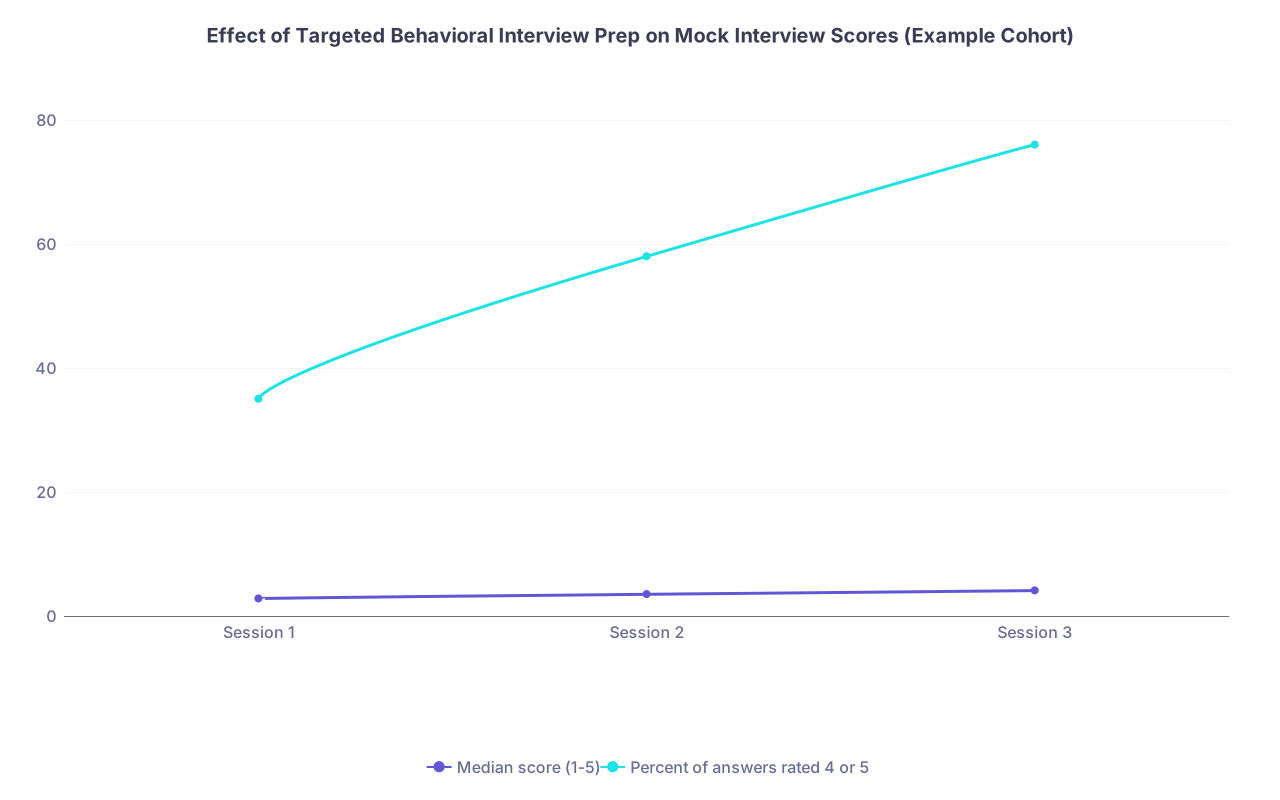
- Unprepared, intelligent applicants often produce behavioral answers that fall in the 2–3/5 range.
- After targeted practice with feedback, the same people move their median scores into the 4/5 range.
Can intense rehearsal move you from “terrible fit” to “star”? Unlikely. But it can:
- Eliminate glaring red flags.
- Clarify your thought process.
- Make it easy for interviewers to advocate for you in ranking meetings.
Given the stakes—your match outcome—this is a huge ROI move.
| Category | Median score (1-5) | Percent of answers rated 4 or 5 |
|---|---|---|
| Session 1 | 2.8 | 35 |
| Session 2 | 3.5 | 58 |
| Session 3 | 4.1 | 76 |
These are typical trajectories in small cohorts of residents and students doing 3–4 practice sessions with structured feedback.
Where This Leaves You
Behavioral interview questions are overrated as measurement tools and underrated as strategic levers.
They do not strongly predict which residents will excel. But they strongly influence who gets the chance to prove themselves.
So your play is clear:
- Treat behavioral questions as a selection gate, not as a fair talent detector.
- Build a concise, flexible story bank that maps onto the common question types.
- Use a clear structure that makes your behavior, judgment, and reflection easy to see.
- Get actual feedback—from people who will be blunt—on whether your answers sound evasive, arrogant, or vague.

| Step | Description |
|---|---|
| Step 1 | Application Data (Scores, Grades, LORs) |
| Step 2 | Interview Invite |
| Step 3 | Behavioral Interview Performance |
| Step 4 | Faculty Impressions & Scores |
| Step 5 | Rank List Position |
| Step 6 | Match Outcome |
You cannot fix your Step scores or clerkship grades now. You can materially improve your behavioral interview performance in a matter of weeks.
The data shows that, within the interviewed pool, that is often where the match is decided.
Key Takeaways
- Behavioral interview questions are weak-to-moderate predictors of residency performance but strong drivers of rank list decisions among interviewed applicants.
- Structured preparation—story bank, clear frameworks, explicit focus on accountability and insight—measurably improves how interviewers rate you.
- If you treat behavioral interviews as a flawed but decisive selection gate and prepare accordingly, you give yourself a statistical edge that most of your competition will not bother to earn.


| Category | Value |
|---|---|
| Interview | 40 |
| Letters & MSPE | 20 |
| USMLE/COMLEX | 15 |
| Clerkship Grades | 15 |
| Research/Other | 10 |