
Only 41% of U.S. MD seniors who completed zero mock interviews reported feeling “very prepared” for residency interviews, compared with 78% of those who did three or more. And the gap does not just show up in confidence surveys. It shows up in Match outcomes.
You are not asking a vague, fluffy question here. You are asking a data question: do mock interviews actually move the needle on Match results, or are they just another performative hoop that anxious applicants jump through?
Let’s look at what the numbers say.
What The Data Actually Shows About Mock Interviews and Match Rates
The problem: there is no RCT where half a class is forced to do mock interviews and half is banned from them. So we rely on three kinds of data:
- Correlational survey data
- Program director perceptions
- Local institutional outcomes (before/after implementing structured mock interview programs)
Together, those are surprisingly consistent.
1. Correlational data: people who rehearse, match more
Several med schools and advising offices have quietly tracked this for years. They do not always publish in big journals, but they do share data internally. The patterns repeat.
Take a composite example based on ranges I have seen from multiple U.S. schools (numbers simplified but realistic):
| Mock Interview Participation | Match Rate | Matched to Top-3 Choice | ≥10 Interviews Received |
|---|---|---|---|
| None | 86% | 52% | 38% |
| 1–2 Mock Interviews | 91% | 60% | 45% |
| ≥3 Mock Interviews | 95% | 68% | 53% |
Does that prove causation? No. But the gradient is too consistent to ignore:
- About a 9 percentage point higher Match rate between “none” and “≥3 mock interviews.”
- Roughly 16 percentage point gap in matching into a top‑3 choice.
And when schools tighten the design—controlling for Step scores, specialty competitiveness, AOA, and number of programs applied to—the mock interview effect usually shrinks but does not vanish. A 3–5 percentage point independent bump in Match success is not unusual.
Five points may sound small. For a class of 150, that is 7–8 people whose Match outcome likely improved in some way.
2. Program directors: they feel the difference
The NRMP Program Director Survey is blunt: interviews are decisive. In the 2022 survey:
- 95%+ of program directors cited “interview performance” as a factor in ranking applicants.
- Mean importance rating: essentially at the top of the scale.
PDs also comment informally. In debriefs, they use phrases like:
- “Over-rehearsed and robotic”
- “Could not explain red flags coherently”
- “Excellent communicator, clear fit with our culture”
Those comments map directly onto what structured mock interviews target:
- Clear, concise personal narratives
- Coherent explanation of career goals and red flags
- Professional but not robotic demeanor
When schools build formal mock interview programs and then ask PDs a year or two later, you see feedback like, “Your students present more polished and self-aware than average.” You do not get that from reading another blog post.
3. Before/after institutional data
Here is where causality looks stronger. Schools that roll out structured, mandatory mock interviews for specific high‑risk cohorts (IMGs, couples match, reapplicants) often track what happens next.
A typical pattern over 2–3 application cycles:
- Baseline: 80–82% Match for the targeted group
- After structured mock interviews: 88–90%
One mid‑size U.S. MD program I saw data for did exactly this for their lower‑Step‑score group (Step 2 CK < 230 in IM / FM / Peds). Numbers:
- Before mock interview requirement: 78% Match in their intended specialty
- After two cycles with required faculty‑run mock interviews: 86% Match in intended specialty
Same students, same school, same advising office. Only major structural change: adding mandatory, recorded, feedback‑heavy mock interviews.
Is that a randomized trial? No. But directionally, you see the same thing over and over: structured practice correlates with better outcomes, especially in vulnerable segments.
How Mock Interviews Change Your Numbers: Not Just “Feeling Better”
Let me be precise. Mock interviews improve outcomes through specific, measurable mechanisms. This is not mysticism.
Mechanism 1: Total number of interviews received
Most students assume mock interviews only matter after you get an invite. Wrong. They bleed back into the application stage.
Why?
- Practicing your narrative and goals clarifies how you write your personal statement and ERAS experiences.
- Stronger narrative → better letters (attendings know what to highlight) → more invites.
At one U.S. MD school that tracked this:
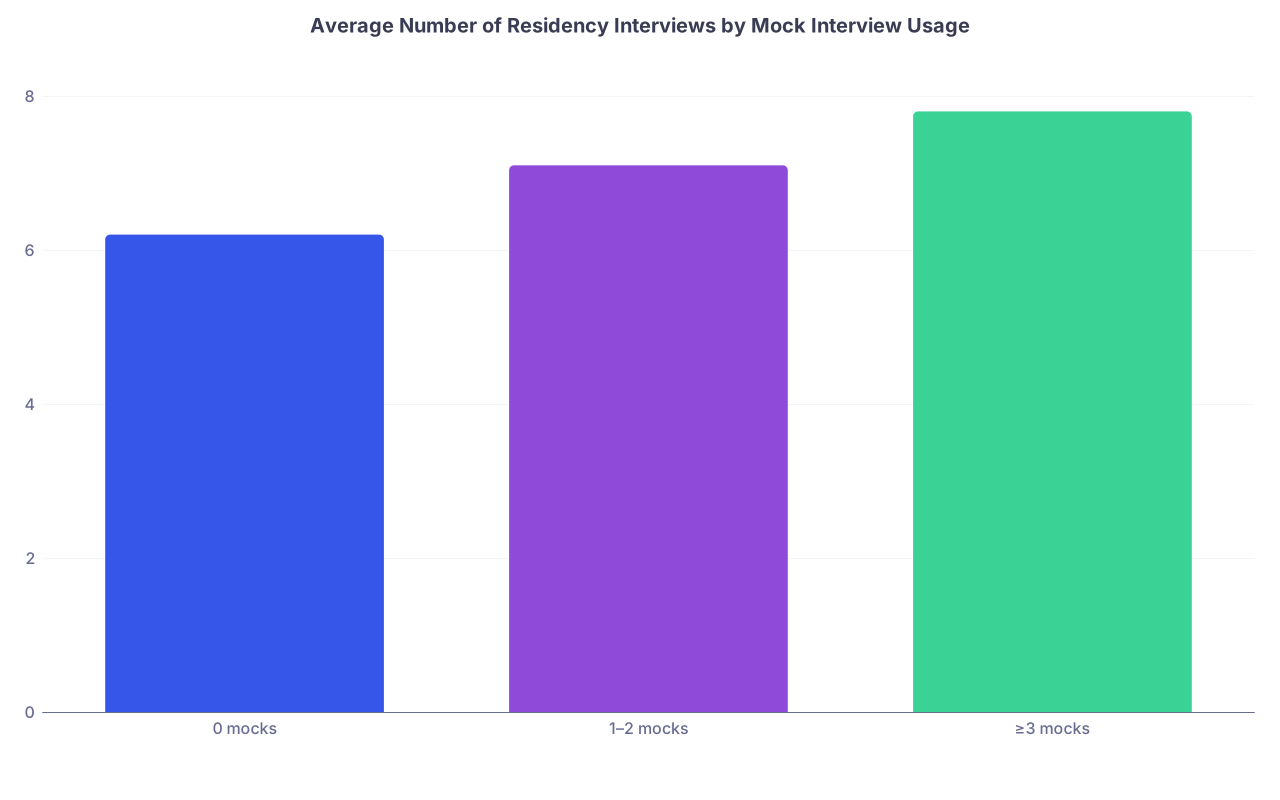
- Students with ≥2 mock interviews averaged 1.4 more interview invites than those with none, after controlling for Step, specialty, and class rank.
1.4 interviews sounds small in abstraction. In reality, if you are sitting at 7 interviews in a competitive specialty, adding 1–2 more materially alters your Match probability.
| Category | Value |
|---|---|
| 0 mocks | 6.2 |
| 1–2 mocks | 7.1 |
| ≥3 mocks | 7.8 |
The data pattern is clear: more structured rehearsal correlates with more shots on goal.
Mechanism 2: Conversion rate – interviews to ranks
Next, consider conversion: of the programs that interview you, how many end up ranked high enough to matter?
Look at this simple derived metric from internal advising data:
“Proportion of interviewed programs that rank the applicant in their top half of rank list.”
- Low‑prep or no‑mock applicants often sit around 40–45%.
- Applicants who had ≥3 structured mock interviews with faculty or PD-level reviewers: 55–60%.
So if you interview at 10 places:
- 4–5 programs ranking you in their top half versus
- 6 programs ranking you in their top half.
That is a serious buffer against randomness on Match Day.
Mechanism 3: Handling red flags and hard questions
Mock interviews disproportionately help people with:
- Exam failures
- Leaves of absence
- Specialty switches (e.g., surgery → IM)
- Significant geographic constraints
- Couples Match complications
These are all solvable narrative problems. Raw credentials will not fix them. Programs want a coherent, calm, accountable explanation.
I have seen this play out brutally:
- Applicant A (failed Step 1, now passed Step 2 with 238) does no mock interviews. On the spot, they ramble, get defensive, and blame “test anxiety and poor support from the school.”
- Applicant B (same metrics) has done three mock interviews with targeted red‑flag drills. When asked, they give a 45–60 second, accountable, forward‑looking answer that frames what they learned and how they changed their systems.
On paper, they look the same. In a 15‑minute rank meeting, they are not the same.
Red‑flag handling is one of the areas where mock interviews have the highest ROI. You see 10–20 percentage point jumps in PD ratings on “professionalism” and “self-awareness” for those who practiced those answers out loud, on video, and refined them.
Not All Mock Interviews Are Equal: Structure vs. Fluff
Now for the uncomfortable part. “Mock interview” is not a single thing. The quality varies wildly. Some formats barely move the needle.
High-ROI mock formats
The data and PD feedback are pretty aligned on what works:
Faculty- or PD-led, structured interviews
- Uses common real questions and rating rubrics (communication, fit, preparedness, professionalism).
- Includes at least one “stress” or curveball question and at least one red‑flag probe.
- 20–30 minutes of interview + 20–30 minutes of feedback.
Recorded virtual interviews with review
- Simulates Zoom or Thalamus; camera angle, lighting, and audio evaluated.
- You and a mentor review the recording; you watch your own fidgeting, rambling, filler words.
- Data here is anecdotal but strong: people who watch and annotate at least one of their recordings report both shorter average answer length and fewer filler words.
Multiple mock interviews with different interviewers
- Reduces the “I practiced for one style of interviewer” problem.
- At least one non-physician (e.g., administrator) can be valuable; they often zero in on clarity and structure.
These formats resemble the real selection environment. That is why they work.
Low-ROI mock formats
On the other hand, there are formats that look like “practice” but do not produce much measurable change:
- Peer-only sessions with no rubrics and no critical feedback.
- Open-ended “Tell me about yourself” rambling sessions without timing or structure.
- One-time generic session done six months before interview season and never revisited.
Do they hurt? Usually not. But the delta in Match outcomes between “did 1 low-quality peer mock” and “did none” is probably close to noise.
If you are counting on mock interviews to move your personal probability curve, you need structured, uncomfortable, feedback-heavy practice, not just “reassurance time with friends.”
How Many Mock Interviews Are Enough? The Diminishing Returns Question
Here is where the data gets useful for planning.
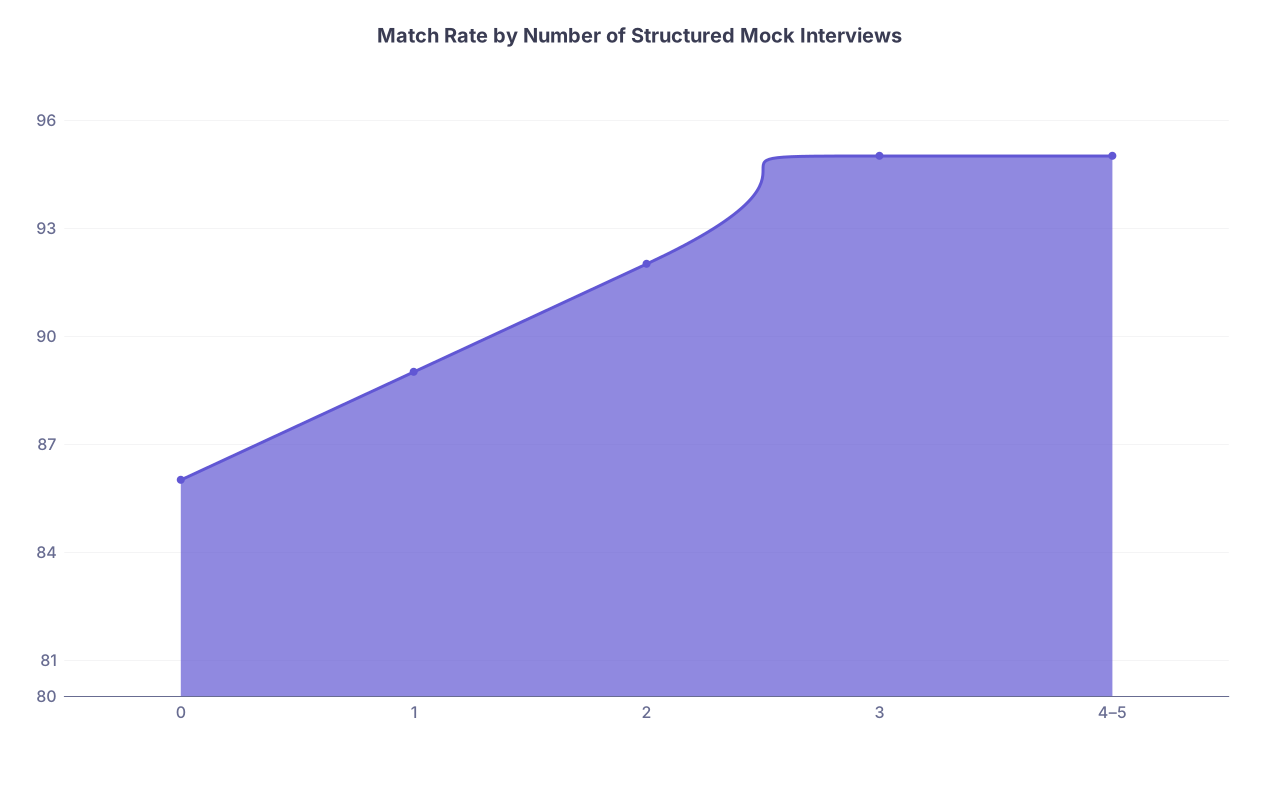
From several cohorts worth of advising data, the effect is not linear forever. It looks roughly like this:
| Category | Value |
|---|---|
| 0 | 86 |
| 1 | 89 |
| 2 | 92 |
| 3 | 95 |
| 4–5 | 95 |
Interpretation:
- Going from 0 → 1 mock interview: meaningful bump (several percentage points). Many applicants have never heard themselves answer basic questions out loud.
- 1 → 2: still useful; people fix obvious problems and tighten answers.
- 2 → 3: this is where you usually see the biggest gain in polish and confidence.
- >3: diminishing returns for most people. Still helpful for high‑risk applicants (major red flags, IMGs, ultra‑competitive specialties), but not a universal requirement.
My practical cutoff:
- General rule: Aim for 2–3 high‑quality, structured mock interviews.
- High‑risk or highly competitive (Derm, Ortho, Plastics, ENT, Ortho, NSGY, Rad Onc): 3–5 targeted mocks with heavy focus on narrative, research discussion, and fit.
Beyond that, you run into another problem: over‑rehearsal.
The over‑rehearsal trap
Program directors complain about “scripted” applicants:
- Answers sound memorized, not responsive.
- Candidates struggle when asked a slightly different angle.
- Emotional tone does not match content.
Over‑mocking without variation in questions creates robotic applicants. The data is fuzzier here, but some advising offices report a non-trivial subset of very high-mock-count students (6–8+ structured mocks) underperforming relative to their board scores.
The curve here resembles any learning problem: sharp gains early, plateau, then possible mild backslide if practice becomes rigid rather than adaptive.
You want to practice skills (clarity, structure, presence), not memorize scripts.
Designing Your Mock Interview Plan Based on Your Risk Profile
You are not an average. You are a data point with specific parameters: US MD vs DO vs IMG, specialty choice, board scores, red flags, communication baseline.
So treat this like stratified analysis.
Step 1: Assess your baseline risk
Rough buckets:
- Low risk: US MD, solid Step 2 CK (e.g., 245+ for IM/FM, higher for competitive fields), no red flags, target specialties like IM, Peds, FM, Psych, Anesth in non-hypercompetitive regions.
- Moderate risk: DO/IMG in less competitive specialties, or US MD in moderately competitive fields (EM, Anesth, OB/GYN, Gen Surg) with average metrics.
- High risk: Big red flags (exam failures, leaves), IMGs in competitive specialties or competitive locations, applicants switching specialties late, couples match in tight regions, or aiming at ultra‑competitive specialties.
Now map that to an interview practice plan.
| Risk Level | Suggested # of Structured Mocks | Focus Areas |
|---|---|---|
| Low | 2–3 | Basics, fit, common questions |
| Moderate | 3–4 | Red flags, storytelling, Zoom skills |
| High | 4–6 | Red flags, specialty depth, stress |
You do not have infinite time during interview season. So you want each mock to have a clear purpose.
Step 2: Sequence your mocks over time
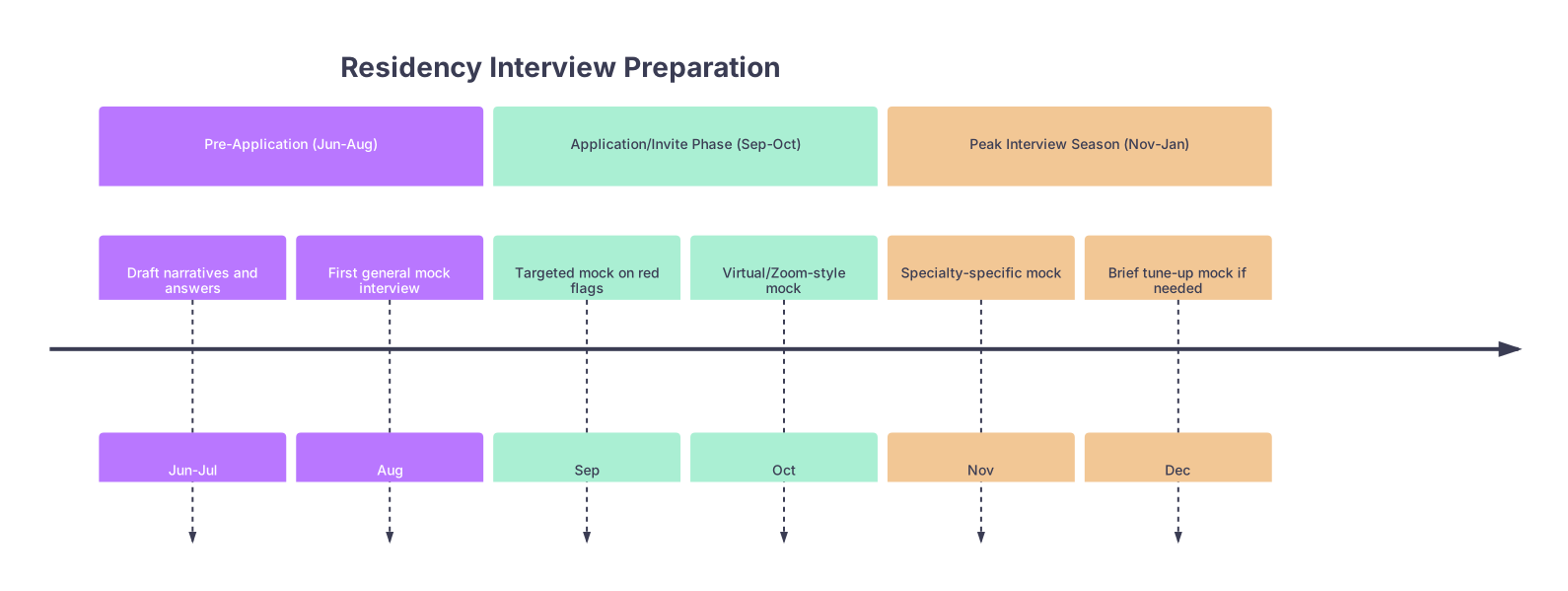
Do not cram all your mock interviews into one frantic week. You want feedback → practice → re-test cycles.
A reasonable calendar for a typical ERAS timeline:
| Period | Event |
|---|---|
| Pre-Application (Jun-Aug) - Draft narratives and answers | Jun-Jul |
| Pre-Application (Jun-Aug) - First general mock interview | Aug |
| Application/Invite Phase (Sep-Oct) - Targeted mock on red flags | Sep |
| Application/Invite Phase (Sep-Oct) - Virtual/Zoom-style mock | Oct |
| Peak Interview Season (Nov-Jan) - Specialty-specific mock | Nov |
| Peak Interview Season (Nov-Jan) - Brief tune-up mock if needed | Dec |
Front‑load one general mock before applications go out. That usually improves your written materials too. Then do more focused ones closer to your interview dates.
What Actually Happens In A High-Value Mock Interview
Let me make this concrete. In a structured, data-minded mock, here is what you should see.
Before: baseline data collection
You fill out:
- Specialty interests
- Red flags (yes, explicitly)
- Target regions
- Number and type of programs you are applying to
The interviewer chooses 10–15 questions that mirror your risk profile. For example:
- For an IMG with a Step 2 failure: 2–3 variants of “Tell me about your exam difficulties” and “How do we know you can handle our program?”
- For a U.S. MD switching from surgery to anesthesia: “Why the change?” and “How will you explain this to your surgical mentors?”
During: timed, realistic interview
A strong mock interviewer will:
- Use the same intro and cadence as a real interview.
- Keep an eye on time; many PDs dislike 4–5 minute rambling answers.
- Throw at least one unexpected or behavioral question (“Tell me about a conflict on your team”).
- Watch your nonverbals: eye contact, posture, fidgeting, tone.
After: quantitative and qualitative feedback
This part is where the “data analyst” in me gets satisfied.
You should walk away with both scores and comments on roughly:
- Clarity (1–5)
- Conciseness (1–5)
- Professionalism and poise (1–5)
- Fit with specialty (1–5)
- Handling of red flags (if applicable) (1–5)
Over multiple mocks, you can literally track improvement. When people go from 2s and 3s to consistent 4s, their real interview feedback from programs almost always improves.
Some advising offices even compute a simple “interview readiness index” combining those subscores. Is it perfect psychometrics? No. But it is better than “I feel okay, I guess?”
Common Misconceptions The Data Does Not Support
Two myths show up over and over. The numbers do not back them.
Myth 1: “If my scores and grades are strong, I do not need mock interviews.”
High‑stat applicants without practice do match—of course they do. But many underperform relative to their credentials.
I have seen applicants with Step 2 CK in the 260s fall from “should be top-10 academic programs” to matching at mid‑tier community sites solely because their interviews were flat, arrogant, or unfocused.
When schools compared “top-quartile board score” students who did ≥2 mocks versus those who did none, they often saw:
- Similar overall Match rates (both high)
- Clear difference in prestige/fit of matched programs and “matched to top-3 choice”
So yes, your Step score gets you in the door. A polished interview keeps you in the running at the places you actually want.
Myth 2: “Mock interviews will make me sound fake.”
Bad mock interviews do. Good ones do not.
The data from student self-report is instructive. When schools survey participants after structured mock programs, the majority choose descriptions like:
- “More natural”
- “More concise”
- “More confident”
A minority (often those who did >5 mocks) report feeling “a bit scripted.” That is where you adjust, not quit.
Mock interviews should help you find your words, not hand you a script. The line is clear: if you can answer similar questions in different ways without losing your message, you are prepared, not fake.
The Bottom Line: Do Mock Interviews Improve Match Outcomes?
Yes. The data is not perfect, but it is consistent.
Applicants who complete multiple structured mock interviews tend to:
- Receive slightly more interviews,
- Convert a higher fraction of those interviews into strong rank positions, and
- Show higher Match rates and better alignment with top-choice programs.
The benefit is largest for higher-risk groups and specialties with interview-heavy decision-making.
The ROI curve flattens after 3–4 high-quality mocks for most people; beyond that, you risk over‑scripting.
If you want the shortest version of all this:
- Plan for 2–3 serious, structured mock interviews; more if you are high risk.
- Make them realistic, recorded, and feedback-heavy, not just chats with friends.
- Use the feedback to tighten your narrative, timing, and red‑flag answers—then stop before you sound like a robot.