
8–12. That is the typical number of ranked programs where 80–90% of U.S. MD seniors successfully match in many but not all specialties. The problem is simple: a huge number of applicants ignore this, panic, and hoard 20–30+ interviews in competitive fields while others go unmatched with five or six.
Let me be blunt: you cannot treat “number of interviews” as a vague comfort metric. The data show very clear interview-to-match relationships by specialty. If you understand those ratios, you can:
- Gauge whether your current interview count is dangerous, adequate, or overkill.
- Decide when it is rational to cancel low-yield interviews.
- Know when you actually need to scramble for more invites or consider backup plans.
This is not about feelings. It is about probabilities.
I will focus on NRMP Charting Outcomes and Main Match data patterns you can actually apply while you are scheduling interviews and building your rank list.
1. The Core Concept: Interviews, Rank Length, and Match Probability
The NRMP does not publish “interviews per match” directly, but it does give you something even more actionable: probability of matching vs. number of programs ranked. The number of interviews is tightly linked to how many programs you can rank.
Rule of thumb that holds across specialties:
For most applicants, number of ranked programs ≈ number of interviews attended (minus 0–1 that you decide not to rank due to red flags).
So when you see “90% match probability at 12 ranked programs,” read that as “roughly 12 interviews attended for most people.”
To put structure on this, here’s a simplified comparison across broad specialty types. These numbers are pulled from patterns seen in recent NRMP data (exact year-to-year figures wiggle a bit, but the shape is stable).
| Specialty Type | Approx Ranked Programs for ~90% Match |
|---|---|
| Primary Care (FM, IM, Peds) | 10–12 |
| Mid-Competitiveness (EM, Psych, OB/Gyn) | 12–15 |
| Competitive (Anes, Rads, Ortho prelims backup, Gen Surg) | 14–18 |
| Hyper-Competitive (Derm, Plastics, ENT, Ortho, Neurosurg) | 18–25+ |
Translate that directly to interviews needed if you are an average U.S. MD applicant in that bucket.
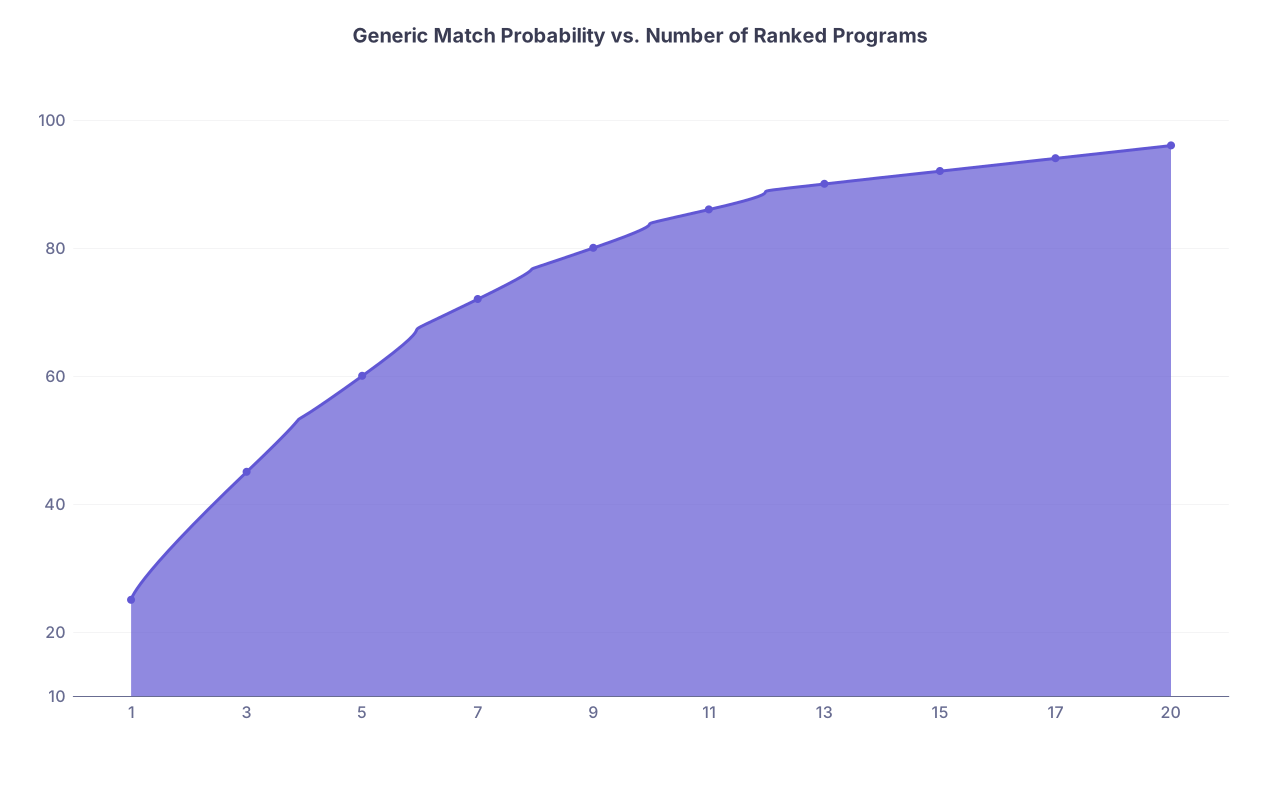
To visualize how the curve behaves, think S‑shaped:
- Huge risk drop going from 1 → 6 ranked programs.
- Diminishing returns above ~12–15 for most core specialties.
- For hyper-competitive fields, the curve shifts right; you need more interviews to get into that “safe-ish” zone.
| Category | Value |
|---|---|
| 1 | 25 |
| 3 | 45 |
| 5 | 60 |
| 7 | 72 |
| 9 | 80 |
| 11 | 86 |
| 13 | 90 |
| 15 | 92 |
| 17 | 94 |
| 20 | 96 |
You are trying to get yourself onto the steep part of the curve, then far enough onto the plateau that one bad interview day does not sink you.
2. Primary Care Fields: Family Med, Internal Med, Pediatrics
These fields absorb a large number of applicants and have relatively high match rates for U.S. MD seniors. That does not mean you can get lazy. Data still punishes anyone who thinks four interviews is “plenty.”
Internal Medicine (categorical)
For U.S. MD seniors:
- Rough pattern:
- ~3 ranked programs → match probability in the 70–80% range.
- ~6–8 ranked → often >90%.
- ~10–12 ranked → creeping into 95%+ territory.
A practical interpretation:
- If you have ≤4 IM interviews, you are in the danger zone unless you are extremely strong and regionally flexible.
- 6–8 interviews gives you a good shot; many applicants match comfortably here.
- 10–12 interviews is “statistically comfortable” for most traditional IM applicants.
Family Medicine
FM is often seen as the safe harbor, and the data mostly agree:
- Match probability rises very fast with the first 5–7 ranked programs.
- Many U.S. MDs with 8–10 FM programs ranked exceed 95% match probability.
Interview-to-match ratio:
- FM is often close to 1:1 or 1.2:1 for U.S. MDs.
- That means 8–10 interviews usually becomes 8–10 ranked programs and a very high chance of matching.
Pediatrics
Peds behaves similarly to FM, perhaps slightly more competitive in some regions:
- 7–9 interviews will put a typical U.S. MD in the solid zone.
- 10–12 is very comfortable unless you are limiting yourself to a hyper-specific region or only top-tier children’s hospitals.
If you are applying to one of these three as your only specialty and you are a U.S. MD with a reasonably clean application, you can read the data this way:
- 1–4 interviews: high risk.
- 5–7: borderline but can be enough if you are not geographically picky.
- 8–10: good.
- 10–12: excellent.
For DOs and IMGs, the curve shifts right. You often need more interviews for the same match probability, especially at university programs.
3. Mid-Competitive Fields: EM, Psych, OB/Gyn, Categorical Surgery
These specialties punish overconfidence. Not as brutal as derm or plastics, but far from guaranteed.
Emergency Medicine
EM used to have a very predictable pattern: 10–12 contiguous ranks → ~95%+ match for U.S. MDs. The recent shifts in EM competitiveness have mangled things in some cycles, but the underlying logic still holds.
For a U.S. MD with average metrics and no major red flags:
- 8–10 EM interviews: decent but not bulletproof.
- 10–12: typically strong match probability.
- 12–15: very safe for a normal applicant, especially with geographic spread.
Once you cross 15 EM interviews, marginal benefit drops sharply. At that point, most people start wasting travel money.
Psychiatry
Psych has become more competitive than students expect:
- For U.S. MDs:
- ~8 ranks: solid probability but some risk.
- ~10–12 ranks: commonly ~90–95% match probability.
- 14+ ranks: very strong likelihood.
So a sane strategy:
- Aim for 10–14 psych interviews if it is your only specialty.
- Below 8? You should be nervous unless the programs are very broad in geography and tier.
OB/Gyn
OB/Gyn sits in that awkward middle: modest number of spots, rising interest.
- U.S. MD seniors often need 12–15 ranked programs for high match probabilities.
- 8–10 ranked → still real risk, especially for below-average applicants.
Interview reading:
- ≤8 interviews: not comfortable.
- 10–12: moderate comfort if you are average or above.
- 12–15: closer to the plateau of the probability curve.
Categorical General Surgery
General surgery is tricky because the applicant pool self-selects with fairly strong metrics:
- Many U.S. MD seniors reach ~90% match probability around 12–14 ranked programs.
- Fewer than ~8 ranked → the curve drops sharply.
I have seen excellent applicants match with 6–8 surgery interviews, but the variance is high. From the data side, a conservative line is:
- Aim for 12+ categorical surgery interviews if you want a high-confidence path.
- If you are sitting at 6–7 in December, you should probably broaden to prelims or a backup specialty.
4. Hyper-Competitive Specialties: Derm, Plastics, ENT, Ortho, Neurosurgery
Here is where the interview-to-match ratio goes from “helpful” to “brutal.” The short version: the same number of interviews buys you less security.
Dermatology
Derm has:
- High proportion of research-heavy, top-of-class applicants.
- Relatively low number of positions.
Patterns from NRMP:
- Even at 12–15 ranked dermatology programs, there are still meaningful unmatched rates for U.S. MDs.
- Match probability climbs more slowly because programs all want the same tiny core of “hyper-strong” applicants.
Practically:
- 10 derm interviews is not “safe” the way 10 IM interviews are.
- For many derm applicants, 15–20 interviews is where match probability feels reasonably comfortable, but the floor never reaches “FM safe.”
And yes, hyper-competitive applicants stockpile 20+ interviews; that hoarding distorts the market.
Plastic Surgery (Integrated)
Integrated plastics might be the most unforgiving. Very few positions, very concentrated competition:
- Even at double-digit ranks, unmatched rates remain notable.
- The yield per interview is low compared to primary care.
If you are in this game:
- 10 plastics interviews is not enough for many applicants.
- People who match comfortably often hold 15–20+ invites.
- Below ~8, you are absolutely not in safe territory.
ENT, Orthopedics, Neurosurgery
These cluster near the derm/plastics profile, with some differences:
ENT and ortho:
- Many U.S. MDs still unmatched despite high numbers of ranks.
- It is common to see 12–15 interviews and still significant risk.
Neurosurgery:
- Small match pool, known for not forgiving red flags.
- You want as many interviews as possible; 12+ is where some comfort begins, not where it ends.
Data summary: the interview-to-match ratio here might be closer to 1.5–2 interviews per “confident” match probability step, compared to almost 1:1 in primary care.
If your heart is set on one of these, you cannot treat “10 interviews” as a safety threshold. For some, 10 is the bare minimum to stay in contention.
5. Combined / Parallel Plans: Advanced + Preliminary, Dual Applications
The interview calculus gets more complicated when you are splitting across specialties or track types.
Advanced Specialties + Preliminary Year (e.g., Radiology, Anesthesia, PM&R)
For things like integrated Radiology or Anesthesia, many positions are categorical now, but advanced-only programs still exist, which require:
- Matching the advanced (e.g., R1 anesthesia) AND
- Matching a prelim or transitional year.
The NRMP data show that:
- Having 8–12 interviews in an advanced specialty like radiology or anesthesia usually gives decent odds for a U.S. MD, similar to mid-competitive fields.
- But your overall match security depends on also having enough prelim/TY interviews.
You need to think in pairs:
- If you have 10 anesthesia interviews but only 2 prelim interviews, your global risk is very high.
- For most applicants, you want on the order of 6–8+ prelim/TY interviews to give yourself multiple combinations that can work.

| Step | Description |
|---|---|
| Step 1 | Count Advanced Interviews |
| Step 2 | Try to add more advanced or add backup specialty |
| Step 3 | Count Prelim/TY Interviews |
| Step 4 | Add more prelim/TY programs |
| Step 5 | Reasonable combined safety |
| Step 6 | >= 8? |
| Step 7 | >= 6? |
If you are weak on Step scores or have red flags, push both numbers higher. The data for weaker applicants require more interviews for the same outcome probability.
Dual Applying (e.g., Ortho + General Surgery, Derm + IM)
Dual applicants often completely misread their numbers. A common disaster pattern:
- 6 ortho interviews.
- 4 gen surg interviews.
- Applicant feels “10 interviews total, I am fine.”
That is not how the data work.
You must evaluate each specialty independently:
- Six ortho interviews is low and risky.
- Four general surgery interviews is also low and risky.
- Combined, that is not “10 safe interviews;” it is “two risky portfolios stitched together.”
From an analytics standpoint:
- Treat each specialty as if it were your only one.
- Ask: “Would I feel safe if these were my only interviews?”
- If the answer is “no” for both, you have a problem.
6. Specialty-by-Specialty Interview Targets (Data-Driven Ranges)
Let us put this into concrete interview count targets for U.S. MD seniors with average-ish competitiveness and no major red flags. These are not guarantees; they are evidence-based guardrails.
| Specialty Group | Rough Interview Target Range |
|---|---|
| Family Med, Internal Med, Pediatrics | 8–12 |
| Psych, EM, OB/Gyn | 10–14 |
| Categorical Surgery, Anesthesia, Rads | 12–16 |
| Derm, ENT, Ortho, Neurosurg, Plastics | 15–20+ |
| Prelim/TY (when needed) | 6–10 |
How does this translate into interview‑to‑match expectations?
- Primary care: often close to 1 interview → 1 strong shot.
- Mid-competitive: more like 1.1–1.3 interviews per high-probability outcome.
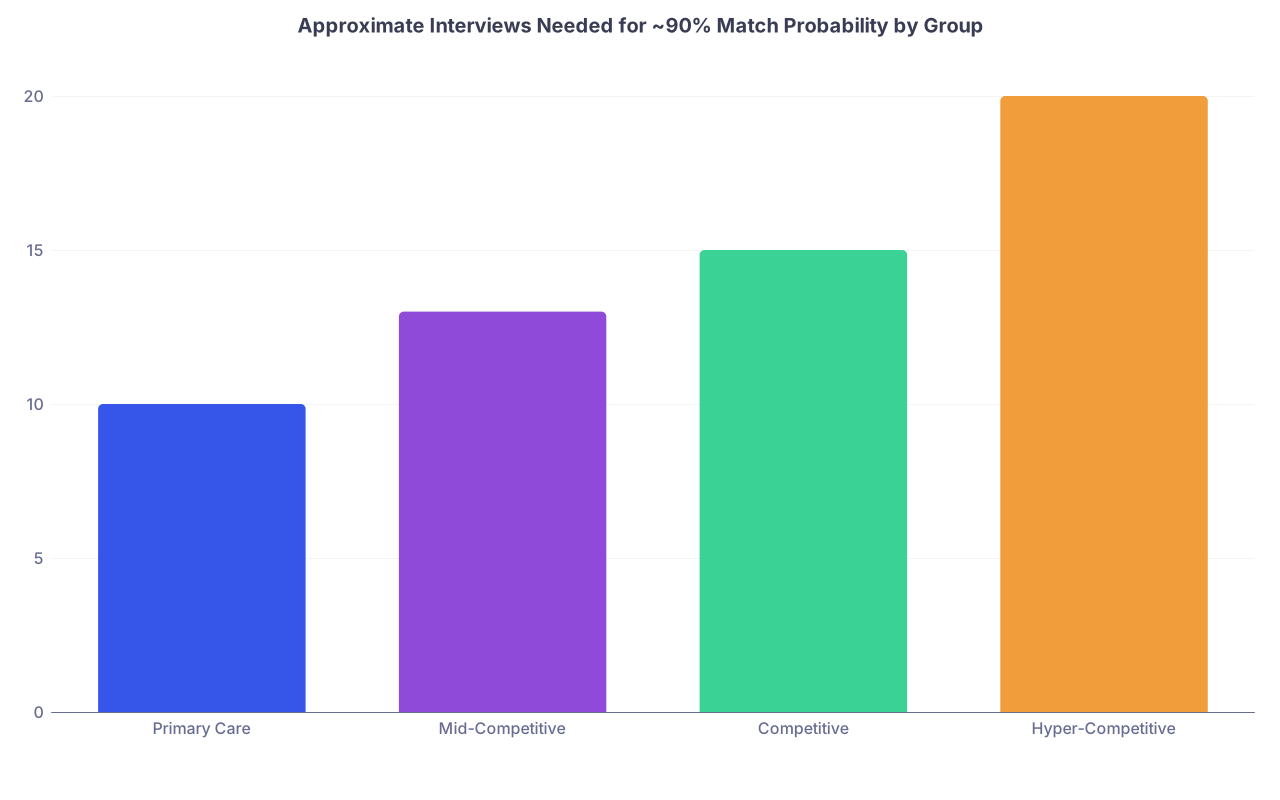
- Hyper-competitive: 1.5–2 interviews per high-probability outcome, with no true “safe zone.”
To make the relative steepness visual:
| Category | Value |
|---|---|
| Primary Care | 10 |
| Mid-Competitive | 13 |
| Competitive | 15 |
| Hyper-Competitive | 20 |
7. When Can You Safely Cancel Interviews?
The data can also tell you when you are over-interviewing.
Let’s say you are U.S. MD, applying IM only, pretty average. By mid-December you have:
- 16 IM invitations, accept all, and you like the geographic spread.
From a probability standpoint:
- Your match likelihood is already extremely high after about 10–12 attended.
- The next 4–6 add tiny increments of safety while costing money, time, and energy.
This is where I have zero sympathy for “but what if…” thinking. The match algorithm favors the applicant. If you rank 12 programs you would actually attend, you have extremely robust odds in IM.
Reasonable decision-making:
- Keep the programs you are genuinely interested in.
- Consider cancelling the very bottom ones that add almost no value, especially if they conflict with stronger programs or severely impact your schedule.
On the other hand:
- If you are in derm with 18 interviews, cancelling down to 12 because “12 was enough for IM” is statistically foolish. You are not in IM. The curve is different.
8. Risk Factors That Shift Your Needed Interview Count
The ranges I gave assume a generic U.S. MD in the middle of the pack. Reality is messier.
You need more interviews than those baselines if:
- You are a DO or IMG applying to historically MD-heavy specialties or university-heavy fields.
- Your Step 2 score is below the mean for the specialty.
- You failed or barely passed a board exam.
- You have chronological gaps, leaves, professionalism flags, or a very regionally constrained list.
- You switched specialties late and your application signal is mixed.
For example:
- A DO student applying EM in a crowded cycle might want 15+ EM interviews for comfort, not 10.
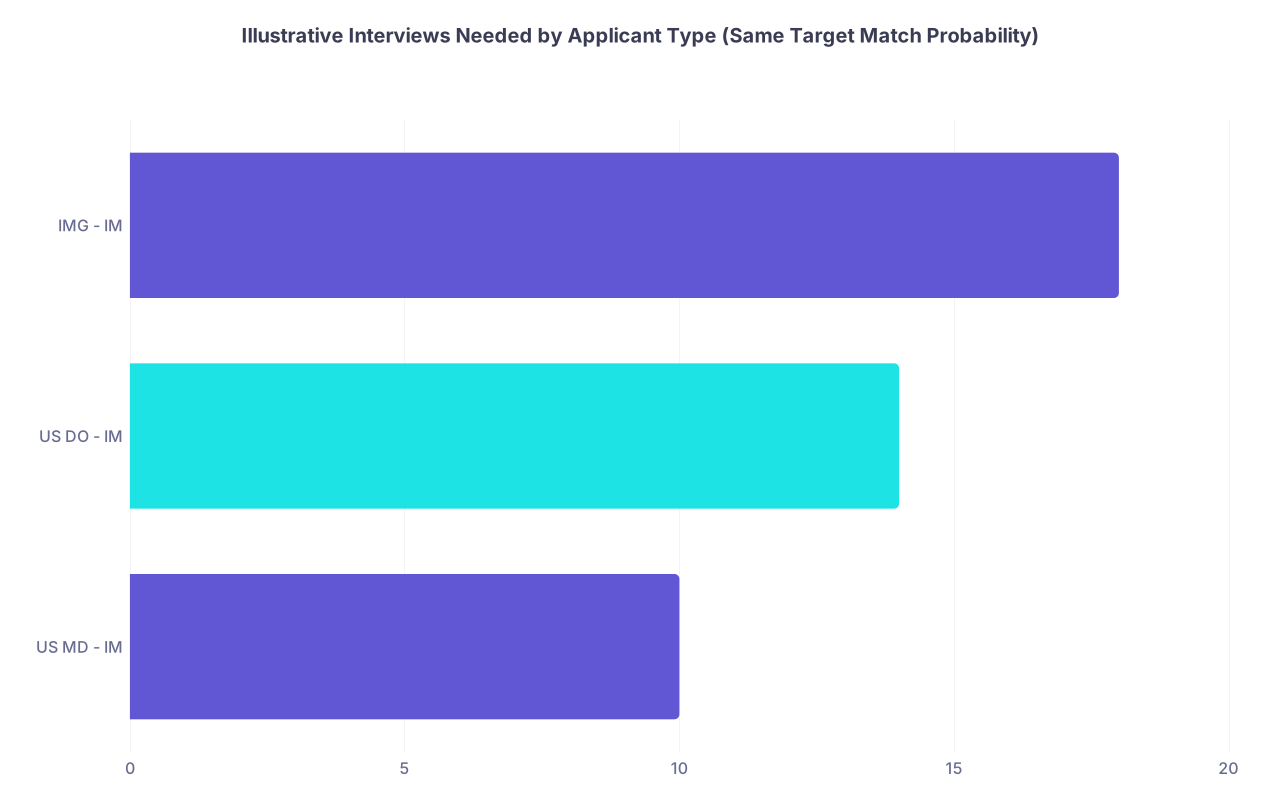
- An IMG applying IM might need 15–20+ interviews to reach the same match probability that a U.S. MD gets with 10.
| Category | Value |
|---|---|
| US MD - IM | 10 |
| US DO - IM | 14 |
| IMG - IM | 18 |
This is not “fair” or “unfair.” It is just how selection patterns behave in the published data.
9. How to Use This Data While You Are in the Thick of Interview Season
Let me walk through a realistic scenario, numbers-first.
You are an average U.S. MD applying to psychiatry only. By December 1:
- You have 7 psych interviews scheduled.
- You have 4 more invites pending response.
What does the data say?
- 7 interviews (~7 ranked programs) puts you well above a coin flip but not remotely at a 95% plateau.
- If you can push that number to 11–12, your probability curve gets much friendlier.
So:
- You should accept those additional 4 psych interviews if they are geographically and logistically feasible.
- You probably should not cancel any existing ones unless a new invite is clearly higher yield and the conflict is unavoidable.
Alternative scenario: Ortho + Backup IM
You have:
- 5 ortho interviews.
- 9 categorical IM interviews.
Interpreting this:
- 5 ortho: borderline. Some excellent applicants match with that, many do not.
- 9 IM: decent but not quite at the high-safety zone; 10–12 would be more comfortable.
Your rational strategy:
- Treat ortho as a lottery ticket, not your safety.
- Add another 2–3 IM programs if you can.
- Prioritize attending as many IM interviews as possible rather than desperately chasing one more ortho at the cost of skipping an IM day.
This is how you let the numbers, not your ego, steer the ship.
10. Final Thoughts: Turning Ratios into Strategy
You do not control whether a specific program ranks you highly. You do control how many shots you take and how spread out they are.
The data across specialties point toward a few hard truths:
- There is a real, quantifiable interview-to-match curve for every field.
- Primary care lets you reach a safe plateau with fewer interviews; hyper-competitive fields never really hit a risk-free plateau.
- Dual applicants and advanced+prelim candidates must treat each component as its own probability problem, not lump the interview counts together.
- Being under the “reasonable target range” for your specialty is not a mindset problem. It is a statistical problem that demands concrete action: add programs, broaden geography, consider backup plans.
Use these ranges as a dashboard, not dogma. As you collect or lose interviews, compare your situation to the curves I described for your specialty and applicant type. Ask yourself, without emotional fog: “Given the data, would someone with my profile feel confident with this number?”
If the honest answer is no, you still have time to adjust.
With interview-to-match ratios in your head, you are better equipped to decide which invitations to accept, which to cancel, and when to push for backup options. The next step is converting those interviews into actual ranks with strong, data-aware performance on interview day. But that is another analysis for another phase of your journey.