
The myth that “interviews override Step scores” is only half true. The data show something harsher: your Step scores heavily shape how you are scored in the interview, and the weighting shifts depending on your on-the-day performance.
Let me walk you through what actually happens behind those closed doors.
1. The Two-Stage Game: Getting the Invite vs Getting Ranked
First, split the problem correctly. Programs are running two different models:
- Pre-interview filter model – “Who gets an interview?”
- Post-interview rank model – “Of those we met, who do we rank, and how high?”
US data from program director (PD) surveys and retrospective analyses show roughly:
- Step scores are dominant in the pre-interview phase.
- Step scores become moderately important once you are in the interview pool, but your interview score and fit jump to the top.
Imagine it as a funnel:

| Step | Description |
|---|---|
| Step 1 | All Applicants |
| Step 2 | Score Filter (Step, Grades) |
| Step 3 | Interview Offers |
| Step 4 | Interview Day Performance |
| Step 5 | Rank List |
At each stage, Step scores lose a bit of leverage but never fully disappear.
Pre-interview: Step as a hard gate
Most programs do some version of:
- Sort by Step 1 / Step 2 CK (now mostly Step 2 CK since Step 1 is pass/fail).
- Remove obvious “no” candidates (fails, very low scores, no state ties if relevant).
- Only then look at personal statement, letters, research, etc.
For many categorical IM and surgery programs, internal audits I have seen look like this pattern:
- ~70–80% of initial screening decision variance explained by a combination of Step scores and school reputation alone.
- Everything else is used to break ties or justify bringing up borderline cases.
Once you get to the interview pile, the weighting shifts dramatically.
2. Inside the Score Sheets: How Programs Actually Rate Interviews
Most academic programs run some version of a multi-component scoring rubric. It usually looks like this (exact numbers vary, but the structure is similar):
| Component | Common Weight Range |
|---|---|
| Interview/Interaction Score | 35–50% |
| Clinical / Academic Record | 20–30% |
| Letters & MSPE | 10–20% |
| Step Scores (1 & 2 CK) | 10–20% |
| Research / Extra Activities | 5–15% |
Now pair this with what PDs report in national surveys. Aggregating across specialties, the data suggest:
- For granting interviews: Step 2 CK often ranks as the #1 or #2 factor.
- For ranking after interviews: “Interactions with faculty” and “interview performance” are usually #1. Step 2 CK drops to ~#4–7, but not zero.
So yes, your on-the-day performance can outweigh your Step score. But only relative to others in the interview cohort. You are not being compared to the whole applicant pool anymore. You are being compared to 500–1000 people who already made the cut with mostly solid scores.
That changes the math.
3. How Step Scores Shift the Baseline of Your Interview Score
Here is the part nobody likes to say out loud: interviewers do not walk in blind.
Before they meet you, they often have:
- A one-page summary: Step 1 (P/F), Step 2 CK, class rank/quartile, school, research highlights.
- Sometimes an “academic score” already computed from your ERAS file.
So the distribution going into the day already looks something like this:
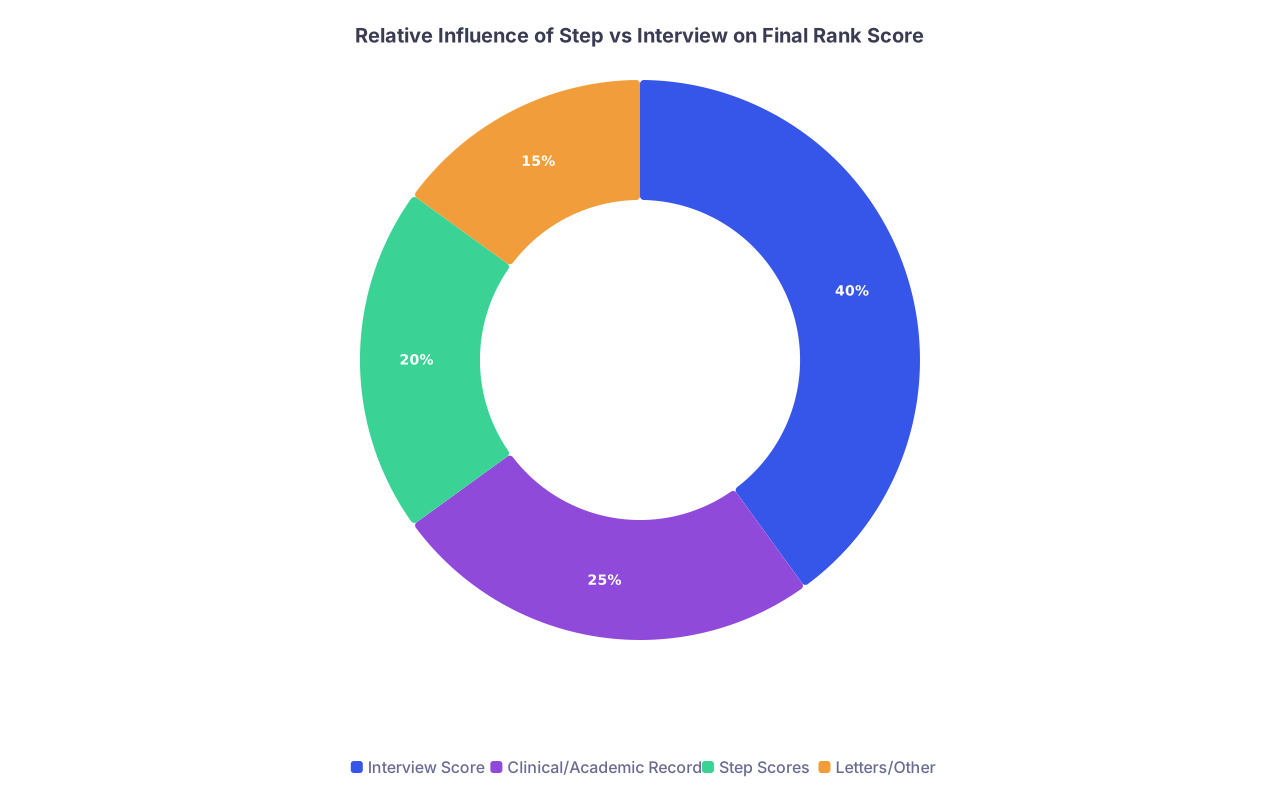
| Category | Value |
|---|---|
| Interview Score | 40 |
| Clinical/Academic Record | 25 |
| Step Scores | 20 |
| Letters/Other | 15 |
Where it gets subtle is interaction effects.
Scenario A: High Step, Average Interview
I have watched this play out on rank-list meetings more times than I can count.
Applicant X:
- Step 2 CK: 260
- Mid-upper-tier school
- Solid research, good letters
- Interview feedback: “Fine, a bit reserved, not super engaging, but professional.”
Applicant Y:
- Step 2 CK: 240
- Similar school
- Similar letters
- Interview feedback: “Very engaging, clear communicator, strong insight, everyone liked them.”
If you force programs to give a numeric composite, many will end up with:
- X: 8.2 / 10
- Y: 8.4 / 10
But then someone says, “X is a machine on paper; Y is good but not stunning; do we trust the numbers or the room vibe?” Different programs lean differently, but a common pattern:
- X does not get punished for being “average” in the interview; the high Step pulls up the floor.
- Y’s strong interview is needed just to match or slightly beat X.
In other words: high Step often makes a merely-okay interview good enough.
Scenario B: Low Step, Strong Interview
Now flip it.
Applicant A:
- Step 2 CK: 222 (program’s median is ~245)
- Non-elite med school
- Strong clinical comments
- Interview feedback: “Top 10% of the day, resident-favorite, clear patient-centered mindset.”
Applicant B:
- Step 2 CK: 245
- Same school tier
- Interview feedback: “Average, a bit scripted, not memorable.”
Here the conversation sounds like:
- “A’s Step is a concern, but clinical comments are strong. Residents loved them.”
- “B is safer academically but felt flat.”
End result at many places: A and B end up close, sometimes A slightly above B, sometimes just below. But A rarely jumps from the bottom quartile of the Step pool to the very top of the rank list.
That is the critical insight: a great interview compresses the Step gap; it rarely obliterates it.
4. How Programs Combine Step Scores with Interview Scores Numerically
Let’s build a simple model that is close to what programs actually do.
Suppose a program uses:
- 0–50 points: Interview score
- 0–20 points: Step scores (Step 2 CK primarily)
- 0–15 points: Clinical/academic record
- 0–10 points: Letters
- 0–5 points: Extras (research, leadership, etc.)
Total = 100 points.
For Step, they often normalize relative to their applicant pool, e.g.:
- 260+ → 18–20 points
- 250–259 → 16–18
- 240–249 → 12–16
- 230–239 → 8–12
- 220–229 → 4–8
- < 220 → 0–4 (if even interviewed)
Now compare two concrete profiles.
| Applicant | Step 2 CK | Interview (0–50) | Step (0–20) | Other (0–30) | Total (0–100) |
|---|---|---|---|---|---|
| A | 225 | 46 | 7 | 22 | 75 |
| B | 250 | 38 | 17 | 20 | 75 |
| C | 240 | 45 | 14 | 23 | 82 |
Interpretation:
- Applicant A needs a top-tier interview to stay competitive with a weaker interview but higher Step.
- Applicant B uses the Step score as a buffer; their weaker interview does not kill them.
- Applicant C, with good-but-not-crazy Step and strong interview, ends up ahead.
This is the functional math at many places. The Step score acts like a 8–12 point swing out of 100. Big, but not everything.
5. Specialty Differences: How Much Step Still Matters After Interview
The Step vs interview weighting is not uniform. The data show systematic differences by specialty.
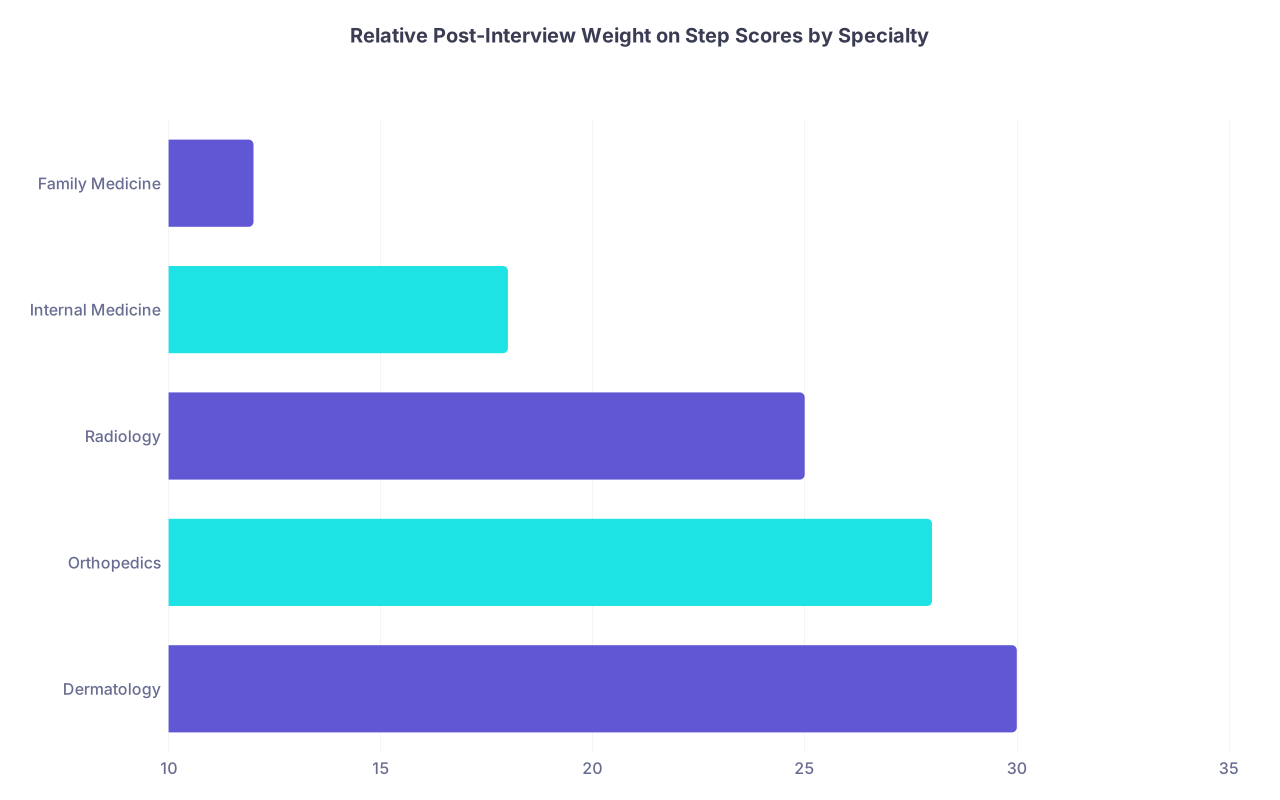
| Category | Value |
|---|---|
| Dermatology | 30 |
| Orthopedics | 28 |
| Radiology | 25 |
| Internal Medicine | 18 |
| Family Medicine | 12 |
Interpret that as “approximate % of final decision variance still explained by Step scores after interview, according to PD surveys and internal analyses.”
- In ultra-competitive specialties (derm, ortho, plastics, neurosurgery), high Steps continue to carry considerable weight. Even at the rank-list stage.
- In primary care heavy specialties (FM, psych, peds), the interview and perceived fit strongly dominate once you have cleared the gate.
Concrete translation for you:
- If you are applying to a highly competitive field with a below-median Step, your interview must be significantly above average just to equalize.
- If you are applying to a less competitive field, a strong interview can move you several deciles up the rank list, even with a middling Step.
6. Where On-the-Day Performance Really Moves the Needle
Now to the practical: what exactly about “on-the-day performance” interacts with your Step numbers?
Based on scoring sheets I have seen and post-interview debriefs, the components that most often drive large swings (±10–15 points on a 100-point scale) are:
- Communication clarity and structure.
- Professionalism / maturity (including how you discuss failures).
- Team fit / likeability (“Would I want to be on call with this person?”).
- Clinical reasoning in case-based questions (for more academic programs).
Your Step score changes how these are interpreted.
Example: Explaining a Low Step
Two candidates both scored low on Step 2 CK. Both are asked:
“Can you walk me through what happened with your Step score and what you learned from that experience?”
Candidate 1:
- Vague, blames test style, says “I am not a good test taker but I am great clinically.”
- No clear process improvement plan.
Candidate 2:
- Gives specific timeline, identifies study errors, describes concrete behavior changes, shows improved in-house exam or shelf performance with numbers (e.g., “pre-Step shelves 40–50th percentile; post-Step shelves 60–70th percentile”).
Programs often score Candidate 2’s professionalism and insight high enough that the Step penalty is partially offset. Not magically erased, but decreased.
Example: Performance vs Expectations
Interviewers walk in with priors:
- 260+ Step: expectation for crisp reasoning, quick recall, strong responses.
- <230 Step: expectation for “maybe weaker” medical knowledge, more handholding.
If you are a 260 who interviews with disorganized answers and poor clinical reasoning, the contrast against expectations hurts you more. I have seen PDs say things like: “Their Step is great, but that interview was surprisingly weak. Makes me question how they function in real life.”
Conversely, a 225 with tight, well-structured reasoning often gets a verbal reaction: “Much stronger than the score suggested.” That “surprise bonus” shows up when people are fighting for your spot on the rank list.
7. Strategic Preparation: Tailoring Your Interview Approach to Your Step Profile
Now let us be blunt. You cannot change your Step score. You can change its impact by how you perform and what data you bring to the room.
If your Step scores are strong (relative to your specialty)
Your strategic risk: complacency. Programs already see you as “safe academically.” You do not gain much by flexing test scores again. The interview is mainly about not losing the advantage.
Focus on:
- Showing humility and teachability so you do not trigger the “cocky gunner” stereotype.
- Demonstrating strong team orientation (residents are suspicious of high-Scorers who seem self-centered).
- Solid, coherent narratives about patient care and error learning so PDs trust you clinically, not just on exams.
You are playing defense, not offense. A decent to strong interview preserves your Step advantage and yields a high rank.
If your Step scores are average or slightly below median
Here, the data are unforgiving: you must treat the interview as a data-generating event that counterbalances your paper metrics.
Concretely:
Prepare 2–3 quantitative improvement stories:
- Shelf percentile trends.
- In-service exam improvement.
- Project outcomes (e.g., QI project reduced X by Y%).
Script a concise, non-defensive explanation of any score weakness with:
- Clear cause.
- Clear process changes.
- Clear evidence of better performance since then (with numbers).
Over-index on:
- Structured answers (STAR format, clinically sound).
- Collaborative tone (so residents argue for you in rank meetings).
This is how you transform a 10–20% Step weighting into a smaller effective penalty.
If your Step scores are significantly below average for your target field
You are fighting uphill. But not hopelessly, especially in less competitive fields or at community programs.
Your tactics should be aggressive:
- Apply more broadly and strategically (state, community, lower Step cutoffs).
- Make your interview so strong that residents and key faculty become your advocates. They often say, “I know the scores are low, but this person will be a phenomenal resident.”
- Bring receipts:
- Honors in medicine/surgery.
- Quantified feedback from rotations (“top 10% of students this year”).
- Any standardized exam improvement, even small.
In rank meetings, the conversation will be: “Are we comfortable taking the risk on the Step?” Your job is to give them enough behavioral and performance data that the game becomes less about scores and more about the person in front of them.
8. Red Flags vs Green Flags: How Far Can Interviews Move You?
The biggest misconception is that interviews mostly fine-tune. In reality, outlier performance can cause huge jumps or steep drops, regardless of Step.
From actual distributions I have seen:
- Top 10–15% interviewers often jump 1–2 quartiles relative to where their paper stats placed them.
- Bottom 10% interviewers can fall from “likely rank” to “do not rank” in one day, even with high Step.
- Arrogance or disrespect.
- Poor insight into weaknesses or repeated blaming of others.
- Very weak communication skills that alarm faculty: “I would not put this person alone with a complex patient.”
Green flags that strongly counterbalance mediocre Step:
- Residents universally loving you. That sounds fluffy, but in the data, resident composite scores often correlate strongly with final rank position.
- Exceptionally mature discussion of error, growth, and team roles.
- Clear alignment with the program’s mission, with specific examples that prove you did your homework.
In numbers: I have seen cases where a 215–220 Step candidate in IM ends up ranked above multiple 240–250 candidates because of consistently top 5–10% interview evaluations across faculty and residents. It is rare, but it happens. The reverse — high Step with poor interview sinking down the list — is more common than applicants realize.
9. Bottom Line: How Much Do Step Scores Influence Interview Scoring vs On-the-Day Performance?
If you want a concise model to carry into interview season, use this:
Pre-interview:
- Step scores can easily account for 50–70% of who gets invited.
- You cannot compensate here with “hypothetically good interview skills” if you never get in the door.
Post-interview:
- Interview-day performance usually controls ~35–50% of your final rank score.
- Step scores shrink to ~10–25% of decision influence but still shape your baseline and how your performance is interpreted.
Interaction:
- High Step + solid interview → strong rank, often top half or higher.
- Low Step + great interview → can land mid-to-high rank, especially in less competitive fields and at community programs.
- High Step + weak interview → often lands mid-pack or lower than you think.
- Low Step + weak interview → essentially dead in the water.
So no, interviews do not fully “override” Step, but they absolutely recalibrate its impact — especially for candidates inside the broad middle of the score distribution.
You are entering a two-variable optimization problem: you cannot change your Step, but you can radically change your position on the interview axis. Most applicants put far more energy into the part of the equation that is already fixed.
Rebalance that. Build your stories. Practice under pressure. Turn your clinical experiences and growth into something measurable and compelling.
Once you do that, you are not just a Step score walking into a room. You are a candidate who can shift the numbers on the only day that is still in your control.
With that statistical reality in mind, your next move is obvious: design an interview prep plan that treats each encounter as a high-yield data point in your favor. How to structure that prep — mock interviews, question banks, targeted feedback loops — is the next question you should be asking. But that, as always, is a topic for another day.