
The data shows that most applicants are optimizing for the wrong parts of interview day.
Programs are not ranking you primarily on how “polished” your PowerPoint-style answers sound. They are ranking you on a small set of components that repeatedly show up at the top of survey data: your interactions with residents, the overall program “fit” impression, and your performance in formal faculty interviews. Everything else is background noise by comparison.
Let me walk through this like a data problem instead of a vibes problem.
What Actually Drives Rank Lists: The Big Picture
Multiple large surveys of program directors and residents paint the same pattern. Different years, different specialties, same hierarchy.
Across NRMP Program Director Surveys (2016–2022) and specialty-specific data:
- Resident interaction and resident opinions sit consistently at or near the top.
- Faculty interview assessments and perceived “fit” are right behind.
- Pre-interview metrics (scores, research, LORs) matter mainly for securing the interview, not for rank order once you are in the room.
To make this concrete, here is an approximate synthesis of weighting (comparable to Likert “importance” averages and ranking frequency) for rank-list decisions, focusing purely on interview-day components:
| Component | Relative Weight (Approx %) |
|---|---|
| Resident interactions / feedback | 25 |
| Faculty interviews (formal) | 20 |
| Overall perceived “fit” | 20 |
| Program director impression | 10 |
| Informal events (dinner, socials) | 10 |
| Facilities / resources impression | 5 |
Is this exact for every specialty? No. But the order and rough magnitudes are surprisingly stable. Resident input and interpersonal fit dominate; physical tours and slide decks do not.
Let us visualize how top factors stack against the secondary ones.
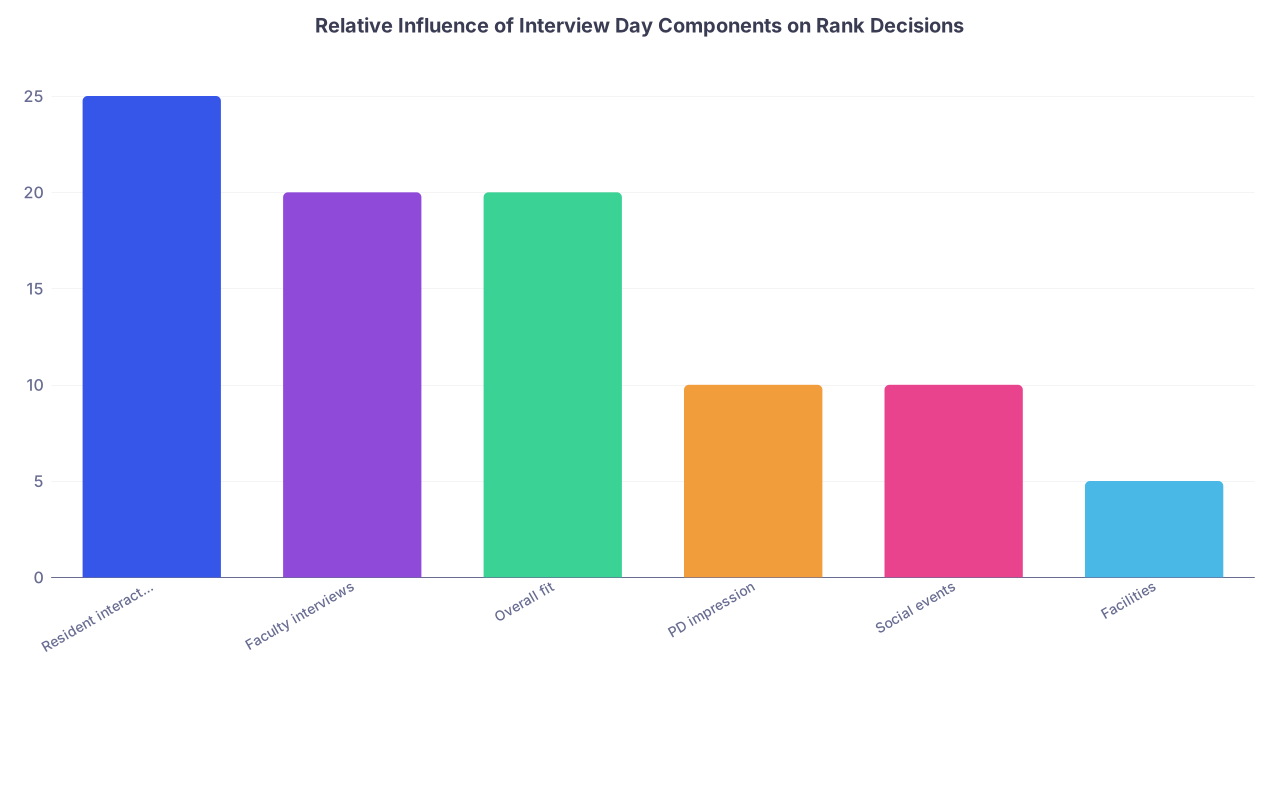
| Category | Value |
|---|---|
| Resident interactions | 25 |
| Faculty interviews | 20 |
| Overall fit | 20 |
| PD impression | 10 |
| Social events | 10 |
| Facilities | 5 |
If you are allocating prep time proportional to importance, you should be spending roughly two-thirds of your energy on three things:
- How you interact with residents (both scheduled and informal).
- How you structure and deliver answers in faculty interviews.
- How consistently you project being a good “fit” for that specific program’s culture and workload.
The rest is marginal returns.
1. Resident Interactions: The Hidden Primary Endpoint
Program directors keep saying the quiet part out loud: “If my residents don’t like you, you are not going on our rank list.”
Survey after survey backs this up. In the NRMP Program Director Survey (e.g., 2018, 2020, 2022 editions):
- “Feedback from residents” is cited by 80–90% of PDs as a factor in rank decisions.
- Among those who use it, resident feedback is often ranked top 3 in importance.
You can think of this as a binary filter rather than a fine-grained scoring metric. Residents usually do not hand in a 1–10 rating sheet with multivariate regression. They give you:
- Clear yes
- Weak yes
- Neutral / “seemed fine”
- Red flag / no
Programs behave accordingly. I have watched PDs move an applicant 10–15 spots down because 1–2 seniors said, “Felt arrogant, would not want to be on call with them.”
Where resident data actually comes from
It is not just the formal Q&A. Residents are sampling you all day:
- Pre-interview chit-chat (the “waiting room” vibe check)
- Breakout room conversations
- Noon conference or teaching sessions
- Pre-dinner or post-dinner hanging around (for in-person seasons)
- Post-interview social hours on Zoom
Residents talk to each other afterwards. The summary that gets to the PD is something like:
- “Very enthusiastic, asked good questions, seemed like they will work hard.”
- “Quiet but thoughtful, seems reliable.”
- “Talked over others, kept steering conversation back to their research.”
You are not being graded on being extroverted. You are being graded on being someone they can spend 14 hours with without wanting to leave medicine.
How to optimize for this component
You do not “perform” here; you calibrate behavior. A data-minded approach:
Objective: Avoid negative outliers
Residents are usually more sensitive to red flags than to mild positives. The distribution is asymmetric. One bad moment weighs more than three good ones. So the floor matters more than the ceiling.Observable behaviors residents frequently mention (positively):
- Asking specific, grounded questions: “How are nights structured for interns?” beats “What is the culture like?”
- Listening more than speaking when they talk about their experience.
- Respecting non-physician staff in any story you tell. Residents notice subtle signals of hierarchy and ego.
Behaviors that residents often flag as negative:
- Monologuing about yourself when others are present.
- Complaining about prior programs, med schools, or applicants.
- Flexing metrics (Step, publications, name-dropping institutions).
If you want a tactical rule: aim to talk 30–40% of the time in group resident settings. Ask, respond, then shut up.
2. Faculty Interviews: Structured Signals Programs Actually Record
Faculty interviews produce some of the only semi-quantitative data points on interview day. Most programs have a form, explicit or not:
- 5-point or 7-point scale on “clinical readiness,” “interpersonal skills,” “fit,” “professionalism.”
- Free-text comments that carry disproportionate weight if strongly positive or negative.
Program directors will often look at average interview score, min / max, and any outlier comments. They know the scores are noisy—but they still use them.
How much does this matter?
In composite rank algorithms used at many academic centers, interview scores often carry something like 30–40% of the total composite (the rest split across application file strength, letters, etc.). But remember: this is among the pool already invited to interview. At that stage, your interview performance can move you significantly up or down relative to peers with similar paper stats.
You can visualize it as:
- Pre-interview file: gets you into the top ~2–4× more applicants than spots.
- Interview performance + resident feedback: determines the final ordering within that group.
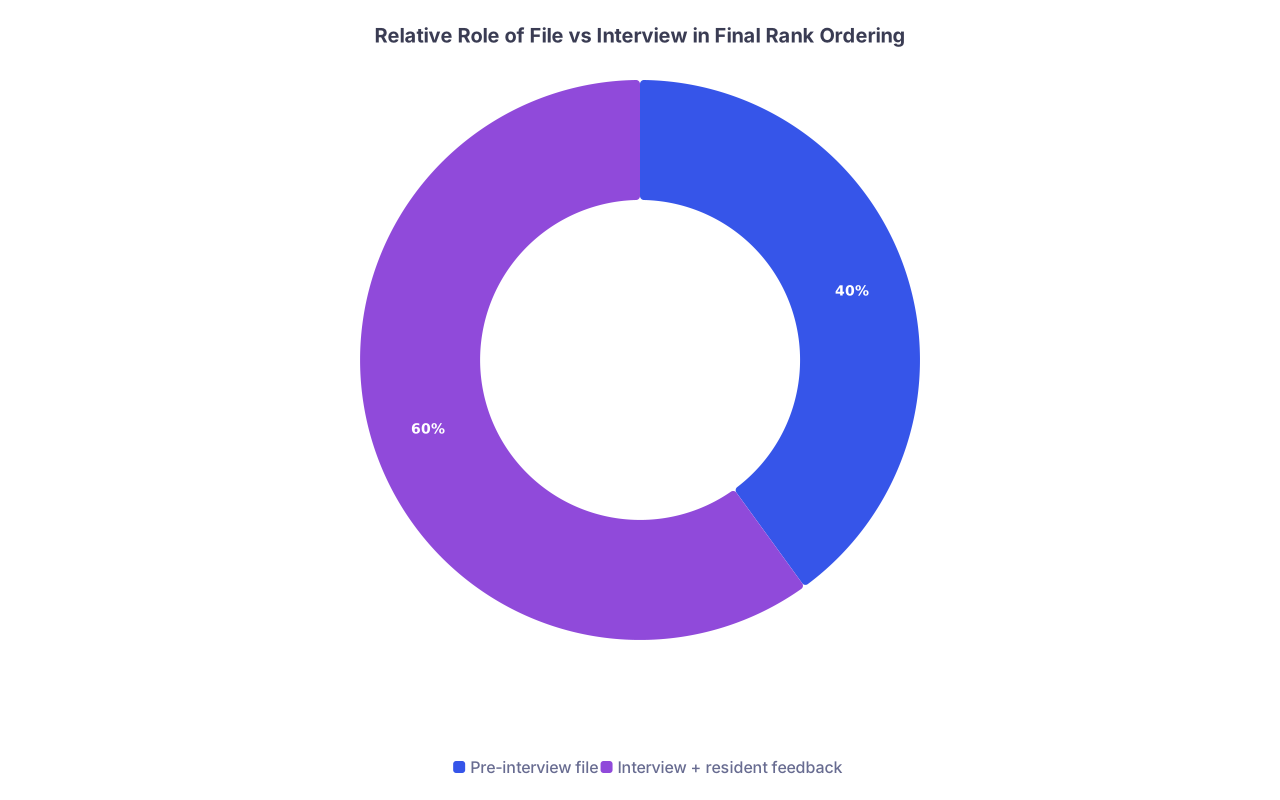
| Category | Value |
|---|---|
| Pre-interview file | 40 |
| Interview + resident feedback | 60 |
How interview scoring actually behaves
In practice, interview scores have:
- High ceiling compression: many applicants cluster at “4” or “5” out of 5.
- Long negative tail: a few people get “2” or “1,” and those are almost always knocked way down the list.
So the realistic goal is:
- Do not end up in the negative tail.
- Create at least one strong, memorable positive hook.
Programs will often remember you as:
- “The applicant who had clear, specific reasons for wanting our patient population.”
- “The applicant who handled the ‘tell me about a conflict’ scenario with mature reflection, not blame.”
How to prep like an analyst, not an actor
You do not need 50 canned answers. You need 6–8 story “data points” that map across common dimensions:
- Teamwork / conflict
- Failure / resilience
- Clinical ownership
- Ethical tension
- Teaching or leadership
- Curiosity / improvement
Anchor each to a specific, detailed scenario with numbers when possible:
- “I was cross-covering 20 patients on nights when we had a 30% no-show rate for labs…”
- “Over a 4-week rotation, I tracked that our discharge summaries were consistently delayed >24 hours…”
Program faculty are accustomed to vague generalities. When an applicant talks in concrete terms, they stand out.
3. Perceived “Fit”: The Fuzzy Metric That Isn’t Actually Fuzzy
“Fit” sounds like useless jargon. It is not. It is shorthand for a multivariate mental model faculty and residents build during the day:
- Do your interests match what the program actually offers?
- Will you tolerate (or thrive in) their workload style?
- Do your communication patterns match the team’s usual culture?
Surveys consistently rank “perceived interest in program” and “fit” among the top contributors to rank decisions. Some PDs explicitly admit they will rank a slightly weaker file higher if the applicant “clearly wants to be here and will stay all 3–5 years.”
Where fit signals are generated
Fit does not come from you saying “I feel I would be a great fit.” That phrase is noise. Fit comes from:
- Specificity of your questions: Asking about their exact ICU structure, EMR, clinic model.
- Referencing something unique to that program: Safety-net mission, underserved population, research niche, community feel.
- Internal consistency: The things you say in different rooms align. Residents hate hearing applicants give totally different “why this program” answers to different people.
I have seen rank meetings where someone says, “Applicant X said they love working with underserved communities, but their whole trajectory is high-income private systems,” and that alone drops them a tier.
Intent vs outcome mismatch
A common error: applicants broadcast “I love research” in a program that barely supports it. Or they gush about subspecialty fellowships at a community program that admits one fellow a year, if that.
Programs hear: “They will be unhappy here, and we will be an interim stop.”
Fit is about conditional probability:
Given we match this person here, what is the probability they:
- Stay for the full training duration?
- Function well with existing residents?
- Represent the program well to patients, students, and fellowship programs?
Your job is to show that those probabilities look high.
4. Social Events and Dinners: High Signal, High Noise
Applicant dinners (or virtual socials) are messy but influential. From data and from being in debrief rooms, here is the pattern:
- For 60–70% of applicants: socials provide mild positive or neutral reinforcement.
- For ~10–20%: socials reveal very strong positives (“everyone loved them”) or serious red flags.
The key is that the extreme ends matter much more than the middle.
Residents will often say:
- “Quiet but nice” → neutral, little effect.
- “Asked thoughtful questions and stayed engaged the whole time” → modest positive.
- “Got weirdly competitive, talked down about other programs” → strong negative.
What the data says about skipping socials
Programs vary, but many track attendance at optional events informally. Does skipping automatically hurt you? Not always. However, in some competitive specialties where nearly everyone attends, absence becomes a negative signal of interest.
Think of it like this:
- If 90% of applicants attend: not showing up looks like low interest unless you have a clear reason.
- If 50–60% attend: absence is usually interpreted as neutral.
You cannot change the specialty norms, but you can be consistent. If you miss, mention briefly to the coordinator or on interview day that you were on a shift, had a required lecture, or a genuine conflict. You are managing how the missing data point is interpreted.
5. Physical Facilities, Tours, and “Shiny Object” Bias
Applicants overestimate this. Programs know it.
Survey data consistently ranks “facility quality” and “call rooms / perks” low in PD decision-making. For residents, those factors matter more for their personal satisfaction than for rank discussions.
But there is a subtle bias: strong or weak facilities do influence your own rank list, and your attitude about them influences how residents perceive your priorities.
If you seem overly fixated on:
- Parking, lounges, food, housing stipend,
- Gym access, call room TVs,
residents sometimes infer: “This person is looking for comfort first, not workload tolerance.”
You should absolutely care about these things for your own ranking decisions. Just understand they are not moving you up their rank list. At best, they are tiebreakers.
6. How to Allocate Your Prep Time Based on the Data
If you treat interview day like studying for a test, you need a clear time allocation model. Something like:
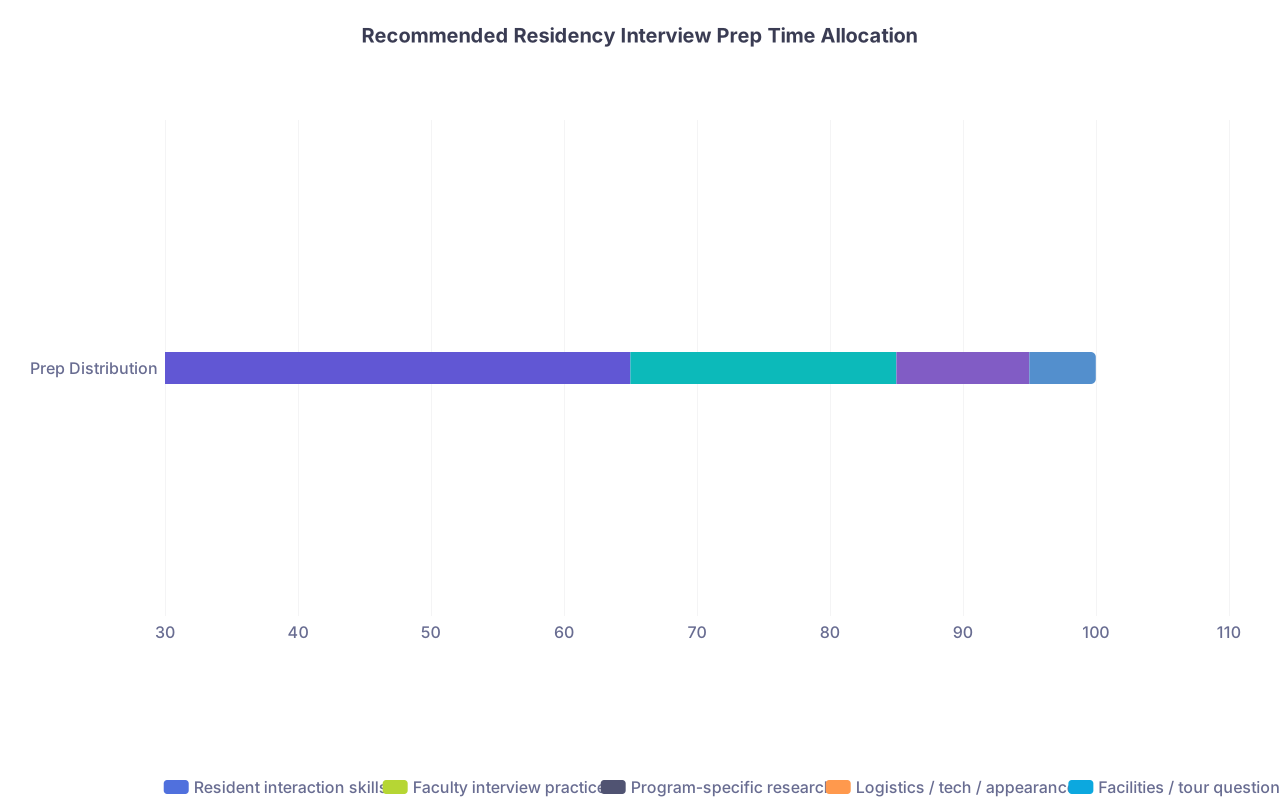
| Category | Resident interaction skills | Faculty interview practice | Program-specific research | Logistics / tech / appearance | Facilities / tour questions |
|---|---|---|---|---|---|
| Prep Distribution | 30 | 35 | 20 | 10 | 5 |
Translated into actions:
30–35%: Practice structured answers for faculty-style questions
Focus on 6–8 strong stories, each with clear beginning, conflict, resolution, reflection. Time yourself. Remove filler.25–30%: Work on resident-interaction skills
Do small-group mock sessions. Practice asking concrete, genuine questions. Get feedback on whether you accidentally sound competitive, dismissive, or bored.20%: Program-specific preparation
Know 3–4 specific, non-generic reasons you are interested in each program. These should be actually true based on websites, resident bios, or published outcomes.10–15%: Logistics and tech
Especially for virtual: test your lighting, audio, background, logins, jacket / shirt combination. You do not want the PD’s primary memory to be “their connection was unstable.”5%: Facilities / location questions for your own decision-making
This will not raise your rank at the program, but it will prevent you from matching somewhere you cannot stand.

| Step | Description |
|---|---|
| Step 1 | Identify target programs |
| Step 2 | Program-specific research |
| Step 3 | Prepare 6-8 core stories |
| Step 4 | Mock faculty interviews |
| Step 5 | Mock resident group sessions |
| Step 6 | Refine answers & timing |
| Step 7 | Tech & logistics check |
| Step 8 | Interview day |
7. How Programs Combine the Signals on Rank Day
Here is the part applicants rarely see. On rank meeting day, the data on you tends to look like this:
- Composite file score: Step scores, grades, research, letters.
- Interview score: Average from X faculty, maybe weighted by seniority.
- Resident feedback: A categorical summary (“strong yes / yes / neutral / no”).
- PD / APD subjective impressions.
Some programs literally run a weighted formula; others do a modified version adjusted in a group meeting.
A very typical structure (formal or informal):
| Component | Weight (%) |
|---|---|
| Pre-interview file | 35 |
| Faculty interview scores | 30 |
| Resident feedback | 20 |
| PD / APD subjective input | 15 |
Two key implications:
- A strong file cannot fully rescue disastrous interview or resident impressions.
- A moderately strong file plus excellent interview day performance can outrank candidates with better test scores but mediocre on-site performance.
I have seen this exact move: Applicant with “weaker” board scores moved into the top 5 because three residents and two faculty independently said, “This is exactly the kind of intern we want.”
Summary: What the Data Really Tells You
Strip away the noise and you get three main conclusions:
- Resident interactions and faculty interviews are the dominant interview-day components affecting your rank position. Avoid red flags there and create a small number of strong, specific, consistent signals.
- “Fit” is not fluff. It is the composite of your demonstrated interests, communication style, and alignment with what the program actually is. You influence it by being specific, consistent, and realistic.
- Shiny factors—facilities, tours, perks—matter far more to your comfort than to your ranking. Allocate prep time accordingly: prioritize human interactions over cosmetic variables.
FAQ (Exactly 5 Questions)
1. If I have an average interview but outstanding scores and research, can I still rank highly?
Yes, but with a ceiling. Data and experience show that a strong file plus “fine” interviews usually lands you in the upper-middle of a list, not at the very top. Top tiers tend to be reserved for applicants who are both strong on paper and clearly excellent to work with based on resident and faculty impressions.
2. How much does being quiet or introverted hurt me in resident interactions?
Less than you think, as long as you are engaged. Residents rarely punish quiet applicants; they punish disengaged, arrogant, or dismissive ones. If you listen actively, ask a few targeted questions, and show interest, your introversion is not a problem. Trying to overcompensate and dominate the conversation usually backfires.
3. Do programs really care if I skip the pre-interview dinner or social?
It depends on the specialty and the program norm. In fields where nearly everyone attends, absence can be interpreted as low interest unless you explain a legitimate conflict. Where attendance is mixed, skipping is usually neutral. What matters more is that if you attend, you avoid negative impressions.
4. Are virtual interviews disadvantaged compared with in-person for showing “fit”?
The mode is less important than your behavior. Programs have shifted their expectations; many now conduct the majority of interviews virtually. Fit is still assessed through your questions, consistency, tone, and interactions with residents. Tech issues and distractions can hurt you more online, so tightly control those variables.
5. Should I tailor my answers differently for residents vs faculty?
The core stories should be the same, but the emphasis differs. With faculty, lean a bit more into clinical reasoning, teaching, quality improvement, and long-term goals. With residents, emphasize day-to-day teamwork, workload, support, and how you handle the grind. They compare notes; if your persona looks radically different between groups, your “fit” score drops.