
The belief that “research gets you interviews but does not change how they’re scored” is only half true. The data shows that once you are in the room, your research productivity can still shift how your interview is interpreted, weighted, and ultimately ranked—especially at academic-heavy programs and in competitive specialties.
Most applicants underestimate this. Or misunderstand how it actually plays out.
Let us walk through this the way a program director looking at spreadsheets would: by numbers, distributions, and risk management, not by vibes.
1. What Programs Actually Weigh Before And During Interviews
Start with what we know from large datasets.
The NRMP Program Director Survey (2021, 2023 cycles) is blunt about priorities. For Step 2, class rank, AOA, etc., directors list “Importance when deciding whom to interview” and “Importance when ranking candidates.” Research falls in both lists, but at different strengths depending on specialty.
At a global level (all specialties combined), research productivity and scholarly output tend to show up like this:
- Modest weight for offering an interview.
- Higher weight for ranking, especially at university and physician–scientist–oriented programs.
- Stronger effect in a few specialties; weaker in others.
To keep this concrete, here is a simplified summary across specialties:
| Specialty | Research for Interview | Research for Rank | Interview Score Weight vs Application* |
|---|---|---|---|
| Internal Medicine | Medium | Medium-High | Interview ~50–60%, Application ~40–50% |
| General Surgery | Medium-High | High | Interview ~55–65%, Application ~35–45% |
| Dermatology | High | Very High | Interview ~50–60%, Application ~40–50% |
| Neurology | Medium | Medium-High | Interview ~50–60%, Application ~40–50% |
| Family Medicine | Low-Medium | Low-Medium | Interview ~60–70%, Application ~30–40% |
| Radiation Onc | Very High | Very High | Interview ~45–55%, Application ~45–55% |
*These interview vs application weights are composite estimates from PD surveys, not fixed formulas.
The pattern is obvious:
- In community-heavy, primary care specialties, the interview itself dominates and research only modestly shifts anything.
- In research-oriented or competitive fields (derm, rad onc, some IM tracks, neurosurgery), research is a structural variable. Not decorative.
But your question is narrower: once you are in the interview room, does prior research productivity change how that interview is weighted?
Short answer: not always in the literal math of the score sheet, but very often in:
- How they assign interviewers to you.
- What “good” or “excellent” means on a research-heavy program’s rubric.
- Tie-breakers and rank committee discussions when candidates look similar on paper.
2. How Research Productivity Alters The Interview Context
Programs rarely publish their exact formulas, but after seeing enough internal scoring sheets, patterns repeat.
Most programs use some variant of this structure:
- Pre-interview application score: exam scores, grades, class rank, research, letters.
- Interview score: 2–5 faculty interviewers, each giving 1–10 or 1–5 scores across domains (communication, fit, professionalism, academic potential, etc.).
- Final rank score = f(application composite, interview composite, “intangibles” / committee discussion).
So where does research change the weighting?
2.1. Interviewer Assignment: Who You Talk To Changes Your Odds
Many academic departments quietly stratify interviewers:
- “Research-heavy” faculty: R01s, labs, lots of fellows.
- “Clinician-educators”: more focused on teaching and clinical volume.
- Leadership: PD, APD, chair, division chiefs.
If your ERAS shows:
- 8–12 PubMed-indexed papers,
- multiple first-author abstracts at national meetings,
- maybe a master’s or PhD,
you are far more likely to be slotted with faculty who care a lot about research.
That changes the effective weighting of your research because:
- Those interviewers see research potential as core to “fit.”
- They may explicitly have a “scholarly potential” line item on their form.
- They push harder in rank meetings for candidates who match their research priorities.
I have seen spreadsheets where:
- All applicants get a base “research score” from ERAS (0–5).
- Research-focused interviewers then essentially overwrite or amplify that number based on the interview discussion.
So even if the official rubric says:
- Application 40%, Interview 60%,
what actually happens is:
- Your research history determines which interviewers you get.
- Those interviewers use research performance during the interview to upgrade or downgrade your “academic potential” component.
- That academic potential component can be the main reason someone jumps 20–30 spots on a rank list.
That is not theoretical. That is exactly how several IM and neurology academic programs operate.
3. The Data: How Much Research Signals You Are “That Person”
We need to quantify “high” research productivity. Otherwise, all this is vague.
Let us look at distributions, not anecdotes.
Across NRMP’s Charting Outcomes and specialty-specific reports, you see something like this for U.S. MD seniors (numbers approximate, and vary by cycle):
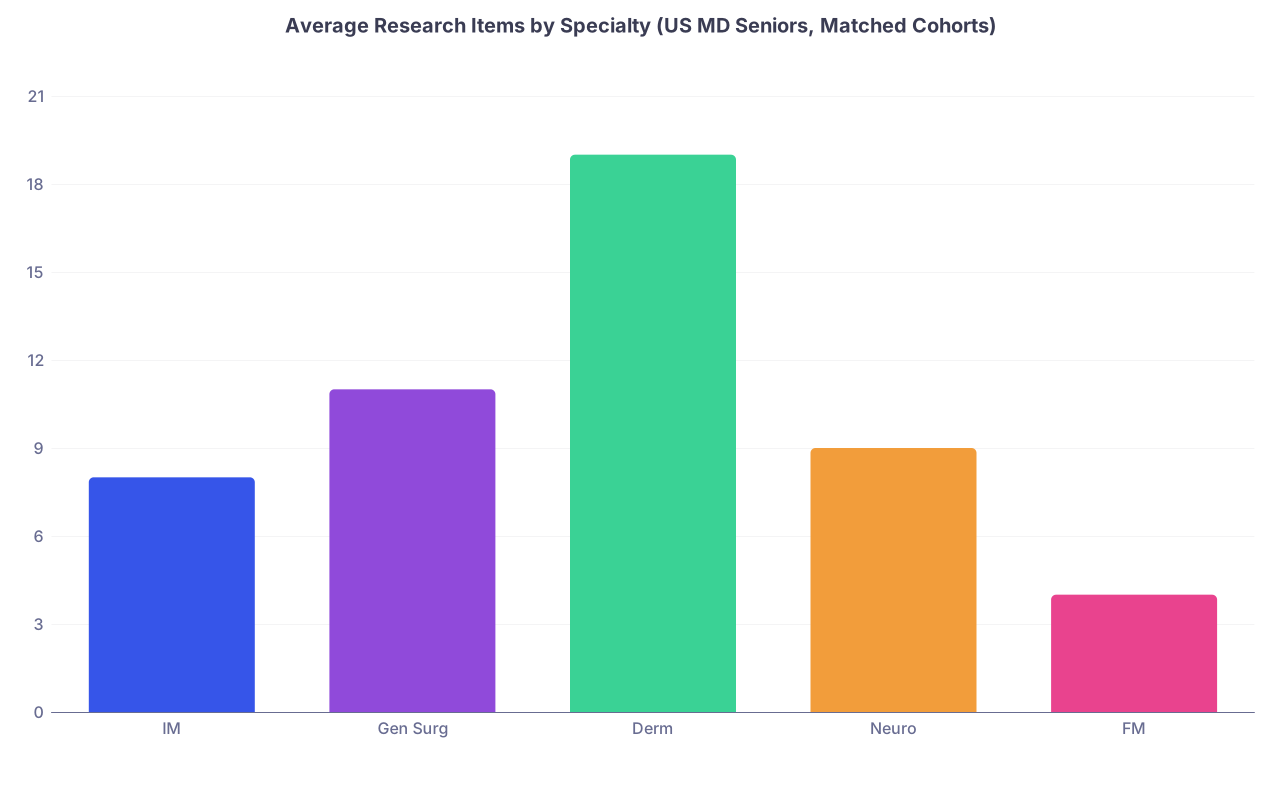
| Category | Value |
|---|---|
| IM | 8 |
| Gen Surg | 11 |
| Derm | 19 |
| Neuro | 9 |
| FM | 4 |
Those numbers are “research experiences + abstracts + posters + publications.” They inflate everything. A poster and a paper are not the same, but the raw count still matters as a screening tool.
Where things actually start to change how your interview is treated:
Internal Medicine (academic-heavy programs):
- Below ~5 items: you are not “research-oriented” on paper.
- 5–12 items: you look solid; enough for most university programs.
- 13+ items or multiple first-authors: you are flagged as “research-strong,” which can influence interviewer assignment and rank discussions.
Dermatology:
- Sub-10 items is often below the median.
- 15–25 items with clear dermatology focus makes you the classic “research resident” archetype.
General Surgery:
- 8–10+ items, especially at high-volume academic centers, triggers interest for academic tracks and lab years.
This bridges into interviews in a concrete way: programs know their own historical patterns.
At one large IM program I worked with, PDs had a simple heuristic:
- Applicant with >2 first-author clinical research publications in respected journals + good letters = “probable future fellow / academic.”
- That tag alone got them discussed more seriously during rank meeting, often irrespective of a minor Step 2 deficit (like 4–5 points below their median).
Is that formal weighting? Sometimes yes. Often it is behavioral weighting: who gets advocated for, and how strongly.
4. Inside The Interview Room: How Research Changes The Questions – And The Scoring
Once you sit down, you do not get a separate “research interview score” at every program. But the content of your conversation changes what “fit” and “potential” mean.
4.1. Academic Programs: Research As A Modifier Of “Fit”
At a research-heavy medicine or neurology department, the implicit formula is closer to:
- Clinical competence = must meet a threshold.
- Professionalism = must be solid.
- Then: does this person align with our research and academic mission?
Here is how that plays out in practice:
You and another applicant both:
- Have 250-ish Step 2 scores.
- Have strong letters.
- Interview well, no red flags.
You have:
- 10 research items, 3 first-author publications (two in the program’s disease area of strength).
They have:
- 2 posters and a local abstract.
On the interview scoring sheet, both might get:
- 4/5 for communication.
- 4/5 for clinical reasoning.
But when faculty are forced to differentiate, your research portfolio gives them a rationale to assign:
- “Potential for academic career”: 5/5 vs 3/5.
- “Fit with our program’s mission”: 5/5 vs 4/5.
On a 25-point scale, that is a 3–4 point spread. That is the difference between top third vs mid-list.
Programs will insist their rubric treats everyone the same. Yet committee discussions often sound like:
- “This is the candidate who worked with Dr. X on heart failure phenotyping. They would plug right into our lab.”
- “We could get at least a couple of publications and maybe line them up for our T32.”
That conversation is weighting. Your research history dictated how they interpreted your interview performance.
4.2. Community-Focused Programs: Diminishing Marginal Returns
Contrast that with a community internal medicine or family medicine program.
You show up with:
- 20+ research items, two RCTs, a statistics background.
Their priorities:
- Bread-and-butter clinical work.
- Longevity in the community.
- Language skills, patient rapport.
Your research helps you look impressive, but once you clear an “interesting enough” threshold, the regression line flattens. Their rubric may not have “academic potential” as a major axis. In some cases, heavy research experience can actually make them nervous:
- “Are you just going to leave us for a fellowship immediately?”
- “Will you be frustrated by our lack of research infrastructure?”
At those programs, how is your interview weighted?
- Communication, humility, and genuine interest in community work overwhelmingly dominate.
- Whether you have 3 vs 18 publications only modestly adjusts anything.
So yes, research can change the perceived weighting. But direction and magnitude depend heavily on program type.
5. The Subtle Part: Research As A Risk-Offsetter
Directors make risk-adjusted decisions.
If you have a borderline feature—slightly low Step 2, average grades, gap in training—strong research can partially derisk you at academic centers. Because it suggests:
- Discipline over years (not weeks).
- Ability to follow through on complex projects.
- Comfort with data, which is increasingly important in QI-heavy environments.
I have seen cases where:
- Applicant A: Step 2 = 262, minimal research, generic letters.
- Applicant B: Step 2 = 252, 2 clinical first-author pubs, glowing letter from a known investigator, strong subspecialty interest.
On paper, A “wins” by test score. In the interview + rank discussion, B frequently outranks A at academic programs.
Why? Because when you model future outcomes:
- Probability B becomes a successful fellow, produces papers under your faculty, and strengthens your program’s reputation is higher.
- A is “safer” clinically, but less upside for academic branding.
Directors are not robots; they are portfolio managers. They want a class blend. A few “workhorses,” a few “future chiefs,” a few “R01-track,” etc.
Your research background changes which “bucket” you fall into and how strongly someone pushes you in that bucket.
6. How To Leverage Research In The Interview Without Overplaying It
You cannot change your publication count 4 weeks before interview season. But you can absolutely change how much your existing research moves your interview score.
The data points you can influence:
- Clarity of your research narrative.
- Alignment between your work and the program’s strengths.
- Your perceived role in each project (first-author vs “extra pair of hands”).
- How well you handle basic statistics and methodology questions.
Here is what shifts outcomes:
6.1. Know Your Own Work Cold
At high-research programs, interviewers often ask pointed questions:
- “Walk me through the primary endpoint and how you chose it.”
- “What was your sample size calculation based on?”
- “What would you change if you re-ran the study?”
If you stumble here, your research hurts you. I have watched faculty downgrade a candidate’s “integrity” and “reliability” because they could not explain a paper they were first author on. Their reasoning: “The CV may be inflated.”
From a data standpoint, that one negative impression can drop your composite by 10–20 percentile points in a stack of otherwise similar applicants.
6.2. Convert Raw Productivity Into A Coherent Trajectory
Random scatter:
- One cardiology case report.
- One ortho QI poster.
- One psych chart review.
Better than nothing. But not compelling.
What moves the needle in interviews is when you can connect the dots:
- “I started with a QI project in heart failure readmissions, then transitioned to an outcomes study on SGLT2 inhibitors. That led to my current interest in advanced heart failure and transplant.”
Now your research does three jobs:
- Signals discipline and follow-through.
- Demonstrates you understand clinical context, not just p-values.
- Creates a believable future fellowship path that aligns with programs’ available mentors.
Directors like trajectories. They allocate limited research mentors and protected time. If you sound like a candidate who will actually use those resources, your score in “fit with program strengths” rises.
7. Does More Research Make The Interview Less Important?
No. In fact, for high-research candidates, the interview can be more make-or-break.
Here is why:
- Application stage: your research got you into the “academically promising” pool.
- Interview stage: they are testing if the person matches the CV.
Consider two groups in a research-heavy program’s rank spreadsheet:
Group 1: Low–moderate research (0–4 items)
Group 2: High research (10+ items, multiple first-author)
What happens:
- Group 1: Interview performance has huge relative weight, but baseline expectations are mostly about clinical fit and professionalism.
- Group 2: Interview performance and research credibility are both scrutinized. A strong performance can rocket you near the top. A weak or inauthentic performance can drop you below many less-research-heavy candidates.
A simplified mental model some PDs use (not formal, but real):
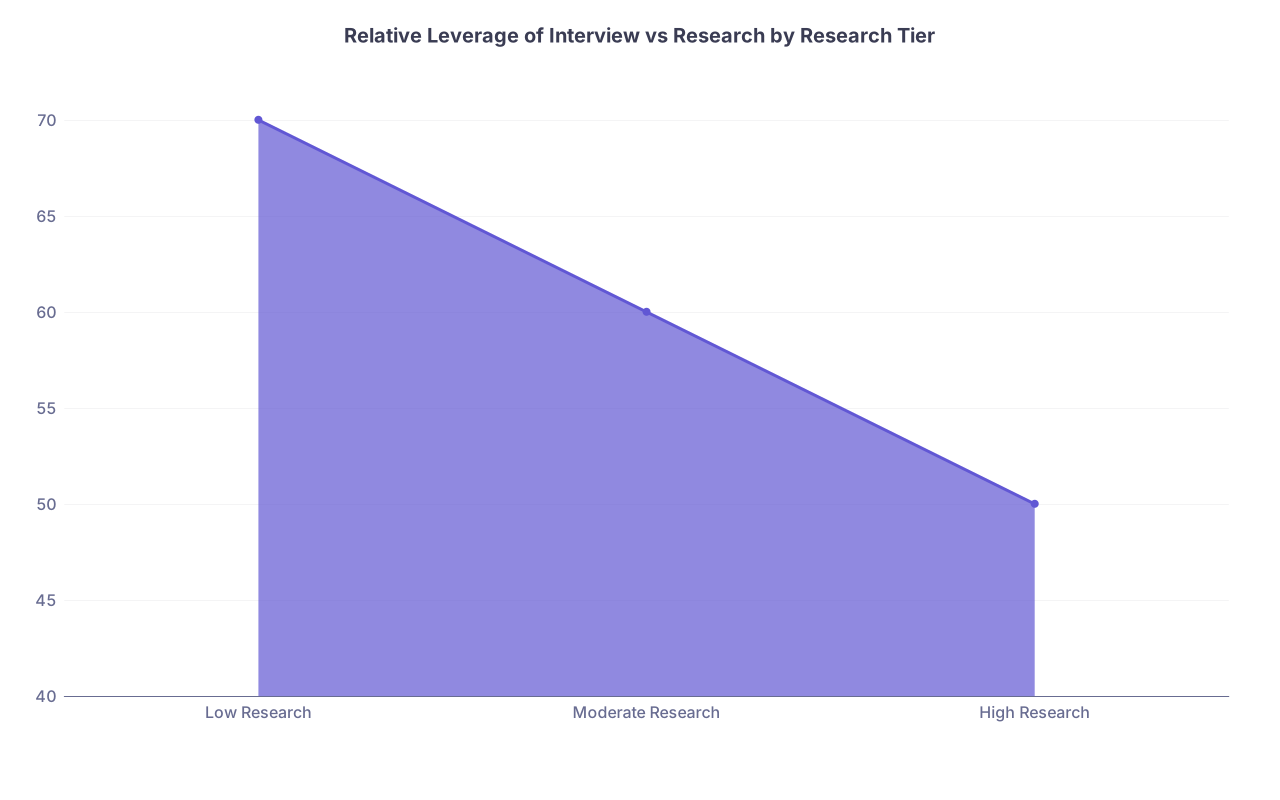
| Category | Value |
|---|---|
| Low Research | 70 |
| Moderate Research | 60 |
| High Research | 50 |
Interpretation:
- Horizontal axis = research productivity tier.
- Vertical axis = relative percent weight of interview behavior alone in shaping final impression.
As research rises, the pure interview behavior weight shrinks slightly because research potential is now blended into how the interview is judged. But your total leverage in the room goes up, because strong research lets you convert one good conversation into a narrative the committee can easily support.
8. Specialty-Specific Patterns You Should Not Ignore
Different fields use research differently as a signal.
8.1. Internal Medicine (especially academic tracks)
- Research can compensate partially for slightly lower Step scores.
- Interviewers will look for serious engagement with a disease area or methodology.
- Physician–scientist tracks often have explicit interview slots with PIs. Those interactions can outweigh a generic faculty interview.
8.2. General Surgery
- Programs value grit and OR performance first, but major research can flag you for lab years and academic careers.
- A candidate with a 240–245 Step 2 and 2–3 serious surgical outcomes papers may outrank a 250+ candidate with zero research at academic centers.
8.3. Dermatology, Radiation Oncology, Neurosurgery
- Research is almost a second transcript.
- The interview is used to test authenticity and confirm that your CV is not just you “standing near a lab.”
- Genuine ownership of projects can hugely amplify your interview impact.
8.4. Family Medicine, Community EM, Community IM
- Once you clear a basic hurdle (some scholarly or QI engagement), marginal returns on extra abstracts are small.
- The interview reverts to the classic triad: likeability, reliability, and fit with patient population.
9. How To Prepare, Given Your Current Research Profile
You cannot retroactively redo your last 3 years, but you can change how your data is interpreted.
If you have high research productivity (10+ items, clear focus):
- Prepare a crisp 60–90 second “research elevator pitch” that ties into your subspecialty interest.
- Anticipate one or two deep-dive questions on methods and limitations for each major project.
- Explicitly articulate how you plan to engage with that program’s research infrastructure (T32, labs, specific PIs).
Your goal: convert research from “impressive list” into “strategic asset” that PDs can visualize within their system.
If you have moderate research (3–9 items, some coherence):
- Emphasize what you learned: teamwork, critical thinking, statistics.
- Be transparent about your role. Do not pretend a minor contribution was central; faculty can tell.
- Link your projects to concrete interests (hospitalist medicine with QI, cardiology, heme/onc, etc.).
Your goal: signal you are research-literate and coachable, even if you are not trying to become an R01-level investigator.
If you have minimal or no research:
- Do not oversell. It backfires fast.
- Lean on clinical experiences, leadership, and QI or teaching instead.
- For research-heavy programs, acknowledge that you are interested in developing this skillset and give one or two concrete ideas you would like to explore.
Your goal: avoid being perceived as anti-academic. Neutral is better than fake.
10. The Bottom Line: Does Research Change How Your Interview Is Weighted?
Quantitatively, your interview score is not usually “multiplied” by your research productivity in an explicit formula.
Qualitatively—and in actual committee behavior—your research:
- Influences which interviewers you meet.
- Shapes the dimensions on which you are judged: “future academic,” “fellowship-bound,” “community workhorse,” etc.
- Becomes a lever in tie-breaker debates when applications look similar.
- Can offset moderate weaknesses or, if mishandled in conversation, create new doubts.
So the real answer is this:
Research productivity does not make the interview optional. It changes the stakes and the story of the interview.
If you treat your research as a list of buzzwords rather than as evidence of how you think, you waste one of the few levers you still control late in the application cycle. If you understand how program directors read your CV and what they are optimizing for, you can turn the same publications into a much stronger rank position.
You have already done the hard part: years of work to produce the data on your ERAS. Now the question becomes whether you can present that data—in 20 strained minutes across a Zoom window—in a way that makes a committee quietly move your name up a spreadsheet.
With that framing in place, you are ready for the next hard problem: structuring your actual interview answers so they sound like a future colleague, not just an accomplished student. But that is a separate analysis.