
Last October, I watched a resident applicant walk out of an interview room beaming. He thought he’d nailed it—smooth answers, lots of smiles, everyone “so nice.” Two hours later, I overheard the same interviewers call him “generic,” “not a fit,” and place him near the bottom of their rank list.
He didn’t do anything obviously wrong. But he got quietly killed on the evaluation grid. That’s what you need to understand: you are being scored on things no one explains to you, in a process you don’t see and would probably hate if you did.
Let me walk you through what actually happens behind those closed doors.
What Really Happens Right After You Log Off (or Leave the Room)
You think the interview is over when you say “Thank you for your time.” It isn’t. The real game starts about five seconds after you disappear from the Zoom screen or step into the hallway.
Here’s the unglamorous truth. At most programs, each faculty interviewer has some combination of:
- A numerical form (1–5 or 1–9 scale)
- A few mandatory categories they must score
- A free-text box for “comments,” which are taken more seriously than you think
And they’re filling it out fast. While your face is still fresh in their mind but fading with every ping of their inbox.
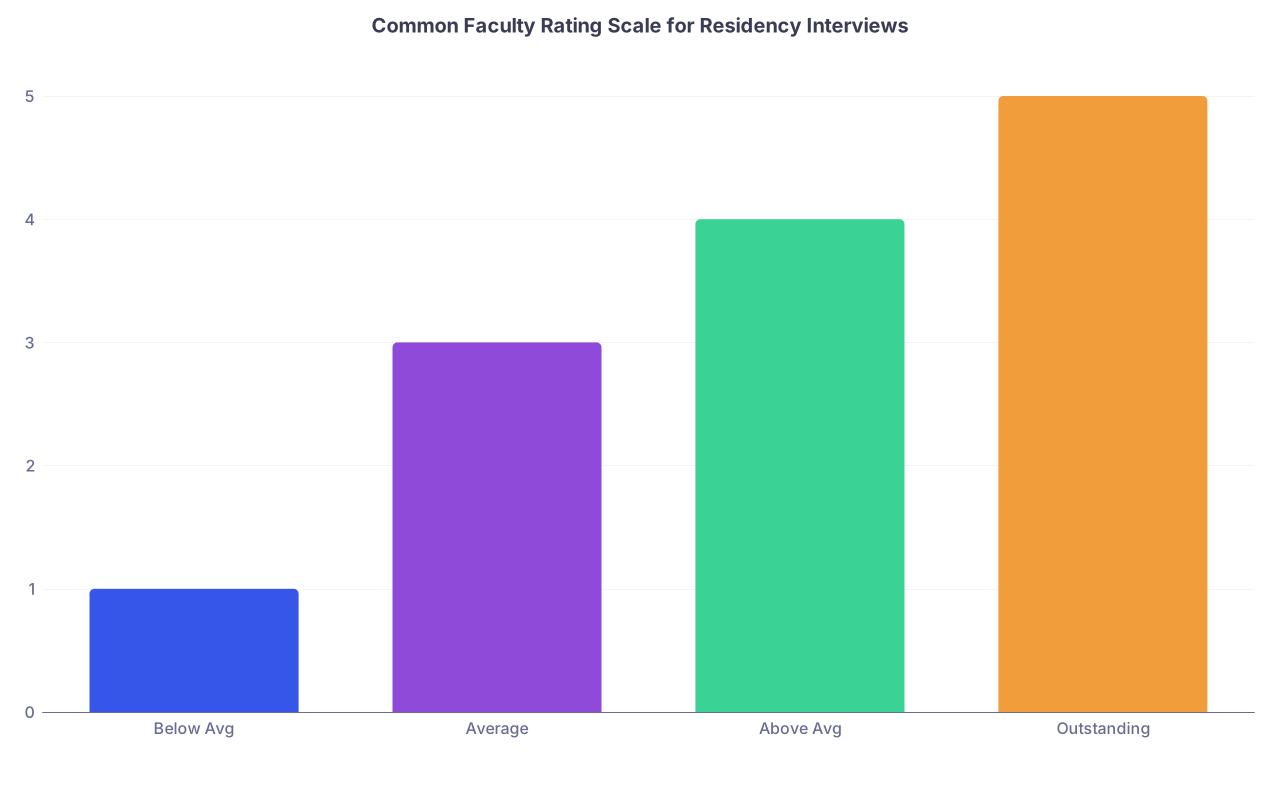
| Category | Value |
|---|---|
| Below Avg | 1 |
| Average | 3 |
| Above Avg | 4 |
| Outstanding | 5 |
Most programs use some version of this kind of scale. The numbers look meaningless—until you realize that one faculty member’s “3 – average” is another’s “this person should not match here.”
Programs pretend this is all very objective. It isn’t. It’s human, rushed, inconsistent, and biased in ways you can actually prepare for.
Let me show you the levers they quietly use to rank you.
The Hidden Scoring Categories You’re Being Judged On
No, they’re not just asking “Did I like them?” That’s too obvious. They’ll feel that, but they’ll record it using categories that sound much more professional.
Here are the buckets that show up over and over again on actual evaluation sheets I’ve seen and used.
1. “Fit with Program Culture”
This is the big one. The catch-all. The polite way to say “Do I want to work with this person at 2 a.m.?”
On the form it might be labeled:
- “Overall Fit”
- “Program Fit”
- “Team Compatibility”
- “Interpersonal Skills / Collegiality”
Faculty will dock you on this if:
- You come off as overly transactional (“I chose your program because your fellowship match list is strong, your case volume is high, and your research is prolific…” and nothing about people or environment).
- You sound like you want a very different culture than what they actually are. For example:
- Telling a smaller community IM program you’re “very interested in NIH-level outcomes research and plan to become R01-funded” when they barely have a research office.
- Or telling a hardcore academic surgery program you’re really looking for “good work–life balance and a calm environment.”
What you do not see is the discussion later:
- “They were fine, but felt more like a better fit for a big research place.”
- “They’re going to hate our call schedule.”
- “High maintenance vibe. Pass.”
When you get that label, your numeric score might not tank. But you quietly slide down the rank list. A “fit concern” is hard to recover from.
2. “Maturity / Professionalism”
This one is brutal because it gets weaponized by attendings who don’t like your style. But it’s also where some applicants shoot themselves in the foot.
They’re rating:
- How you handled slightly uncomfortable questions
- Whether you talked trash about your school, other programs, or colleagues
- Your ability to take responsibility instead of blame-shifting
Red flags that immediately get written down:
- Blaming other residents, administration, or “bad attendings” for every negative story
- Over-sharing about conflicts and drama
- Telling stories where you’re always the hero and never at fault
Strong professionalism looks like:
- “We had differing expectations; here’s what I learned and how I adjusted.”
- “We had a challenging attending, but I tried to focus on what I could control and what skills I could still take from the rotation.”
- Owning your weaknesses in a matter-of-fact way, without overselling or self-flagellating.
3. “Communication Skills”
No, this is not just “Did you speak clearly?” It’s whether you can:
- Answer the damn question directly
- Structure a thought
- Tell a concise story without spiraling into chaos
Faculty especially hate:
- 4-minute rambling answers that never land
- Buzzword salads: “I’m passionate about interdisciplinary collaboration within a systems-based framework…”
- Overly rehearsed speeches that sound like Step 1 recall, but for your life
You get big points for:
- Concrete examples
- Simple sentences
- Admitting “Let me think about that for a second” instead of babbling
I’ve seen applicants saved on the rank list because three different people wrote: “Excellent communicator. Clear. Organized. Great with patients.”
Nobody tells you this, but clear communicators get more benefit of the doubt across every other category.
4. “Clinical Reasoning / Academic Potential”
Even in “fit-heavy” programs, they’re subconsciously ranking you on how smart and trainable you seem.
What they look for:
- How you describe your clinical experiences: do you think like a clerk or like a budding resident?
- Do your answers show pattern recognition, priority setting, and basic judgment?
- When you talk about a case, do you show you understand what the point was?
The smartest thing you can do: when they ask about a meaningful clinical experience, do not just tell an emotional story. Add one or two lines showing what you learned clinically. For example:
“Taking care of that patient forced me to think through why we were choosing one anticoagulation strategy over another given his renal function and cancer. It was the first time I really felt responsible for understanding the whole picture instead of just executing orders.”
That’s the kind of throwaway line that makes an attending quietly check “strong” instead of “average.”
5. “Motivation for Specialty / Program”
On the sheet this might say:
- “Commitment to specialty”
- “Interest in this program”
- “Career goals alignment”
They’re asking:
- Are you going to leave?
- Are you using this specialty as a backup?
- Are you going to be miserable here because what you want and what we offer are miles apart?
Things that hurt you:
- Generic reasons for the specialty (“I like medicine, I like procedures, I like continuity…” everyone says this)
- Telling five different versions of your “future career” depending on who you’re talking to
- Overly specific fellowship goals that don’t exist at that program
Things that help you:
- Very specific, believable reasons for the specialty—anchored in stories, not slogans
- A path that can actually be supported by their program
- Dropping a detail about their program that only someone who actually looked it up would know
The Subjective Stuff That Outsizes Its Role
There’s a whole layer of evaluation that no program will write on paper, but that absolutely affects where you fall on a rank list.
“Would I Want Them Covering My Patients?”
I’ve heard this sentence countless times after a group interview day: “I wouldn’t mind if they were the resident on my service.”
That’s the informal gold standard. It’s an instinctive judgment about:
- Calmness under pressure
- Reliability
- Ego size
- How much hand-holding they’ll need in July
How you project this:
- You take ownership in your stories: “I made sure,” “I followed up,” “I realized I’d missed X and corrected it”
- You don’t dramatize everything
- You sound like someone who shows up, does the work, and doesn’t melt down
On the flip side, if you sound fragile, easily overwhelmed, or chaos-prone, faculty imagine you on night float. And they get nervous.
Emotional Tone: Desperate vs Composed
There’s a line between enthusiastic and desperate. Cross it, and your ranking drops.
Desperate looks like:
- Overselling: “This is my absolute number one, dream program, I love everything about it, I would be so honored…” said identically at six different places
- Too many emails, too effusive “thank you” notes
- Apologizing constantly
Composed looks like:
- Confident but grounded: “I’d be very excited to train here. The X, Y, Z align really well with what I’m looking for.”
- One clear, specific thank you, not a love letter
- Letting silence breathe in the interview instead of filling every space
Attendings are suspicious of extremes. Over-eagerness reads as unstable. Overly chill reads as disinterested. You want that middle band: engaged, thoughtful, steady.
How the Numbers Get Turned Into a Rank List
Here’s the part they almost never explain to you: how your individual interview scores become your fate on Match Day.
Every program has its own version, but it usually looks like some combination of this:
| Component | Typical Weight |
|---|---|
| Interview Score | 40–60% |
| Application (Scores, Grades, CV) | 20–40% |
| Letters of Recommendation | 10–20% |
| Institutional / “Gut Feel” Factors | 10–20% |
Step 1: Individual Evaluations
Each interviewer scores you separately. They might see:
- Only your ERAS
- Your ERAS plus some summary sheet
- Or, in some places, almost nothing but your name and photo
They submit:
- Numeric ratings for several categories
- A global recommendation: “Do not rank,” “Rank lower,” “Rank middle,” “Rank to match”
- One or two lines of text
Those one or two lines? They get read at the ranking meeting. In full. Months later. Choose your words carefully during the interview; they end up feeding these comments.
Step 2: The Spreadsheet
Someone—often the program coordinator or an APD—builds a consolidated spreadsheet:
ERAS data, scores, interview averages, red flags, home student status, etc.
You might have:
- Interview Avg: 4.2/5
- Application: 3.8/5
- LORs: 4.0/5
- “Fit” comment: “Great communicator, good team player”
Or:
- Interview Avg: 3.0/5
- Application: 4.7/5 (stellar scores, AOA, research monster)
- “Fit” comment: “Very strong on paper, but rigid and slightly arrogant.”
Now guess which one often gets ranked higher in fields like IM, peds, EM. It’s not always the “4.7 on paper.”
Step 3: The Ranking Meeting
This is where the real decisions happen.
Picture a conference room or Zoom call with:
- Program Director
- Associate/Assistant Program Directors
- Chief residents
- Sometimes a few faculty reps
They scroll. They argue. They move names up and down.
The phrases that actually move your number:
- “I’d be happy if they matched here” → bump up
- “I don’t remember them at all” → they stay in the middle or drift down
- “I had serious concerns” → big drop, sometimes “do not rank”
- “Felt generic; nothing stood out” → death by mediocrity
This is why being memorably solid is better than being “flawless but forgettable.” In a list of 300 names, bland doesn’t survive.
How to Interview in a Way That Scores Well on Their Hidden Rubric
You cannot control every factor, but you can absolutely shape how you land in those categories.
1. Answer Like a Resident, Not a Medical Student
On clinical or behavioral questions, frame your answers with ownership and systems-thinking.
Instead of: “We had a patient with DKA, and the team decided to…”
Use: “We had a patient with DKA. Initially we did X. I realized later that I hadn’t considered Y, and now when I see similar patients, I make sure to…”
You’re signaling:
- Insight
- Growth
- Responsibility
That’s exactly what they’re trying to score under “maturity,” “clinical reasoning,” and “trainability.”
2. Build a Coherent Narrative About Who You Are
Faculty cross-check your answers across multiple interviews, sometimes unconsciously.
If one interviewer hears you say: “I’m very interested in academic cardiology and research,”
…and another hears: “I don’t really see myself doing much research,”
…your file gets the “inconsistent / not sure what they want” energy. That hurts your “fit” and “motivation” score.
You need a stable spine to your story:
- Why this specialty
- What kind of physician you want to be
- Broad direction of your career (community vs academic, procedural vs cognitive-heavy, etc.)
Details can flex. Spine stays the same.
3. Make It Easy for Them to Write a Positive Comment
They will remember one or two things about you. Max. Feed them those things.
Give them:
- One memorable story that clearly shows resilience, ownership, or leadership
- One specific, genuine reason you like their program
- One trait you explicitly name about yourself that they can echo
For example: “I tend to be the person who quietly keeps the team organized—making sure nothing falls through the cracks on busy days. That’s something I really leaned into on my ICU month.”
Later, in the comment box, that attending writes: “Very organized, reliable, would be good on busy services.”
You basically wrote your own evaluation line.
4. Avoid the Subtle Red Flags
You don’t need to be perfect. You just need to avoid tripping major alarms.
Things that quietly tank people:
- Complaining about call, hours, or “work–life balance” in a way that sounds like you don’t understand residency reality
- Bringing up money or moonlighting repeatedly
- Sounding like you’re above certain kinds of work (“I really hope I don’t have to do much scut”)
- Name-dropping prestige constantly, especially if their program isn’t a prestige beast
Programs want to believe you’ll show up and do the work without constant drama. Do not make them doubt that.
What You Never See: Post-Match Regret (And How It Shapes Ranking Next Year)
One more insider detail. Programs remember their mistakes.
- The “amazing on paper” resident who turned out to be toxic
- The “borderline” applicant who became a star
- The intern who quit in November
Those experiences change how PDs weight the pieces of the application.
If they got burned by a resident with 270s and 10 first-author papers who was a nightmare to work with, they’ll shift more weight to “fit” and “professionalism” the next year. I’ve heard PDs say flat-out: “I’d rather take a 220 with great teamwork than another 260 who makes everyone miserable.”
This is why the interview—and the quiet ranking that follows—matters more than your Step score once you’re in the room.

| Step | Description |
|---|---|
| Step 1 | Interview Day |
| Step 2 | Faculty Score Forms |
| Step 3 | Comments & Ratings Logged |
| Step 4 | Scores Combined in Spreadsheet |
| Step 5 | Ranking Meeting Discussion |
| Step 6 | Preliminary Rank List |
| Step 7 | Final Adjustments |
| Step 8 | Submitted Rank Order List |
FAQs
1. If I feel like an interview went “average,” does that mean I’m dead at that program?
No. Remember, the majority of applicants are “average” in the moment. What matters more is whether you triggered any big positives or negatives in the comments. An “average” conversation with one small, memorable strength (“great communicator,” “very thoughtful,” “good fit for our culture”) can still land you solidly in the match range. Disasters and red flags kill you more than lack of brilliance.
2. How much do thank-you emails actually impact how they rank me?
Most of the time, they don’t move your numeric score at all. But they can reinforce a positive impression or mildly repair a slightly awkward interview—if they’re specific, short, and authentic. What does hurt you is overdoing it: multiple follow-ups, effusive flattery, or sounding like you’re trying to manipulate your position. Think of thank-you notes as a nudge, not a lever.
3. Do faculty see my entire application during the interview, or are they “blinded”?
It varies. Some programs give interviewers your full ERAS plus letters. Others give a summary sheet. A few “blind” interviewers to scores and grades. In practice, assume they know your basic academic profile and at least a rough idea of your background. Don’t contradict your own application, and don’t re-read your CV line by line in the room. Use the time to bring your file to life, not recite it.
4. If one interview went badly but the others felt strong, how screwed am I?
Not necessarily at all. Programs expect variability between interviewers. One lukewarm or even negative eval can be diluted if two others loved you. Where you get hurt is when multiple people independently flag the same concern (e.g., “arrogant,” “disorganized,” “not sure they really want this specialty”). Focus on consistency across interviews and controlling the themes they’re likely to write in their comments.
Key points to walk away with: you’re not being judged on vibes alone; you’re being funneled through a quiet scoring system built around fit, professionalism, communication, reasoning, and believable motivation. The numbers are messy, but the impressions are real. Your job is to make it easy for them to write, “Good fit, solid resident, I’d be happy if they matched here”—because that single line can pull you up the list more than another line on your CV ever will.