
The dirty secret of residency interviews is this: one bad answer rarely kills you. What kills you is what happens in the five minutes after you leave the room.
I’ve sat in those rooms. I’ve watched program directors, associate PDs, and crusty senior faculty argue over whether to forgive a truly awful response. I’ve seen an applicant go from “no way” to “still rankable” because one person at the table fought for them, and because the rest of the application gave them ammunition to do it.
You’re scared of giving a bad answer. You should be more interested in how bad answers get rescued.
Let me walk you through what really happens.
What Counts as a “Bad Answer” in Faculty Eyes
Not every shaky response is bad. Faculty distinguish between three types of problems, even if they don’t say it out loud.
1. The Harmlessly Clumsy Answer
This is the “I’m nervous and over-talking” category. You ramble a bit about research. You lose your train of thought in a “tell me about yourself” monologue. You give a generic weakness like “I care too much.”
Behind closed doors, this usually sounds like:
“He was a little nervous, but that’s fine.”
“She talked a lot, but content was decent.”
This almost never hurts you long term, as long as the rest of the interview is solid. It might even disappear from memory by the time they score you.
2. The Concerning but Salvageable Answer
Now we’re talking about answers that raise real eyebrows but don’t automatically eject you.
Examples I’ve actually heard:
- “I don’t really like working nights; I’m more of a daytime person.”
- “I’m not sure what I’d do if an attending told me to do something I strongly disagreed with. I’d probably just follow their orders.”
- “Honestly, I haven’t really had any conflicts with team members. Everyone’s usually fine.”
These get flagged.
In the room afterward, they become:
“I’m worried about how she’ll handle hierarchy.”
“He doesn’t seem to really get what residency hours are like.”
“That answer about conflict felt immature.”
But here’s the key: these can still be rescued. Faculty start searching your file for contrary evidence. That’s where the salvage operation begins.
3. The Red-Flag Answer
This is the stuff that makes someone in the room literally write “NO” in capital letters on the score sheet.
- Big professionalism problem (“I skipped some clinics because the attending never showed up on time anyway.”)
- Bad attitude toward patients (“Sometimes these noncompliant patients just don’t want to be helped.”)
- Blaming everyone else for failures (“The evaluation was unfair; the resident just didn’t like me.”)
- Disrespect for other fields/team members (“Nurses at my last hospital weren’t very competent; we had to double-check everything.”)
Those answers can still be talked about. But you’ve just walked into a different category: “Do we want this person at all?” rather than “How highly should we rank them?”
There too, some people get rescued. Not most. Some.
What Actually Happens After You Leave the Room
You walk out. The door closes. Now the real interview begins.
Every program has its own process, but most mid-to-large academic programs follow some version of this pattern.

| Step | Description |
|---|---|
| Step 1 | Applicant Leaves Room |
| Step 2 | Immediate Impressions |
| Step 3 | Score Assigned |
| Step 4 | File Re-Reviewed |
| Step 5 | Specific Answers Revisited |
| Step 6 | Score Modified or Flagged |
| Step 7 | Rank Meeting Later |
| Step 8 | Consensus? |
Here’s what that actually feels like in real life.
The moment you leave, at least one interviewer says something like, “So, what’d you think?” or “Okay… thoughts?”
Then:
- One person leads with a gut reaction. “I liked her a lot,” or “He made me a little nervous.”
- The others either quickly agree or cautiously disagree.
- Any obviously bad answer is brought up within the first 60 seconds. Always.
This is where your bad answer lives or dies. In the context of that first conversation.
If your interviewer liked you overall, they may preemptively defend you:
“Yeah that answer about conflict resolution wasn’t great, but the rest of the interview was solid. I think it was nerves.”
If they didn’t care much for you, they sharpen the knife:
“That answer about not liking nights — that bothered me. I don’t think he understands the reality of intern year.”
That first speaker has more power than you realize. You never meet them again, but they’re in the room defining your narrative.
How Faculty Decide Whether to Forgive a Bad Answer
This is the part nobody explains to applicants, because it’s messy and very human.
Faculty don’t “grade” every answer in isolation. They run your bad answer through three filters:
Filter 1: Does This Fit With the Rest of the Application?
They pull up your ERAS file. Your letters. Your MSPE comments. Your personal statement.
They’re looking for something very specific: is this bad answer a pattern or an outlier?
I’ve seen this play out like this:
- Applicant botches a question about dealing with feedback, sounds a bit defensive.
- Faculty checks the MSPE. Sees: “Responds well to feedback, implemented suggestions between shifts.”
- Sees a letter that says, “She actively sought out feedback and integrated it quickly.”
- Result: “Okay, I think that answer was just poorly worded. I’m not worried.”
The opposite also happens:
- Applicant shrugs off a professionalism issue with a “Yeah, that was just a misunderstanding.”
- MSPE: “Had a professionalism lapse requiring discussion with the clerkship director.”
- Letter: “Needed redirection early in the rotation regarding punctuality but improved.”
- Result: “This is a pattern. I’m very concerned.”
Your file either arms your advocate or arms your critic. It rarely does nothing.
Filter 2: Do I Believe This Was Nerves or Character?
Faculty absolutely distinguish nerves from values. They’re surprisingly forgiving of nerves.
Nervous answers look like:
- Talking too fast, but content is logically okay.
- Starting one sentence, then correcting yourself to something more appropriate.
- Overqualifying everything: “I mean, in most cases… I think… I’d probably…”
Character-driven problems look different:
- Calm, confident delivery of a problematic opinion.
- Doubling down when gently challenged.
- Lack of awareness that what you said might be problematic.
If someone says something troubling but their whole posture screams, “I’m trying to get this right and I’m anxious,” faculty at decent programs will push to forgive it — especially if another part of the interview showed maturity.
If you confidently state something that sounds arrogant, dismissive, or unprofessional? Much harder to walk back in that room.
Filter 3: Did This Applicant Show Enough Strength Elsewhere to Earn a Second Chance?
This is brutal, but honest: strong applicants get more grace.
If you have:
- Strong letters with phrases like “top 10% of students I’ve worked with”
- Concrete examples of leadership or hardship well-handled
- A track record that makes you desirable (good scores, good school, strong research for competitive fields)
Then when you give a bad answer, someone at the table is usually motivated to say, “I think we can coach that out of them.”
If you’re a borderline applicant and give the same bad answer? Someone says, “I’m not sure it’s worth the risk.”
That’s the part of “holistic review” people don’t put in brochures.
The Specific Ways One Faculty Member Can Rescue You
Let’s talk about the actual mechanics of rescue. How, precisely, does one bad answer get neutralized?
It usually requires one person in the room doing at least one of the following:
Reframing your answer in the most generous possible way.
“I think what she was trying to say is that she anticipates nights will be hard but she’s prepared to work through it.”Pulling in evidence from your file.
“His sub-I evaluation repeatedly mentions he stayed late to help, even on call days. That doesn’t match someone trying to avoid hard work.”Arguing for coachability.
“She clearly reflects well on experiences. I think with some mentorship, that way of framing her answer will change.”Comparing you to other applicants.
“We’ve had people say way worse about work-life balance and still become solid residents. He’s nowhere near that.”Explicitly labeling the bad answer as nerves.
“She was visibly anxious during that question. Her other answers were much more composed and thoughtful.”
When you hear about candidates who “didn’t interview perfectly but still matched high,” this is what happened. Someone with credibility in the room decided you were salvageable and convinced the others.
The Answers That Faculty Quietly Salvage All the Time
You’d be surprised how often candidates think they destroyed themselves with an answer that faculty barely noticed or easily forgave.
These are the “bad” answers that get rescued constantly:
Too honest about burnout:
“There were times I felt really burned out and doubted medicine.”
If you followed it with growth, reflection, or changes you made, faculty usually spin this as maturity, not weakness.Clumsy diversity/equity language from good intent:
You’re clearly trying to say you value diverse patients but fumble the phrasing.
If your behavior (experiences, work, rotations) backs up good intent, they let it go.Overly self-deprecating leadership answers:
“I’m not a natural leader, I’m more of a quiet person.”
If your examples still show you functioning well on teams, someone will say, “We need quiet leaders too.”Generic “why this specialty” that sounds cliché:
Almost everyone does this. Faculty are numb to it. They don’t downgrade you much for being unoriginal as long as you’re not bizarre.
You walk out replaying these, convinced you blew it. Meanwhile, they’ve already moved on or rationalized it.
The Answers That Are Hard to Save (But Sometimes Still Are)
There’s a middle ground that worries faculty: answers that don’t scream “do not rank” but that suggest trouble down the road.
A few recurring problem areas:
Rigid attitudes toward work-life balance as an intern.
“I think we should strictly limit work hours; I’ll need time for my hobbies most days.”
Nobody hates work-life balance. But interns who think residency will regularly accommodate their hobbies raise alarms. To salvage this, someone has to argue, “I think he just hasn’t seen a full residency schedule yet.”Blame-shifting on past conflicts.
“The attending was just unfair” with no self-reflection.
This can sometimes be reframed if there’s at least one sentence of “I could have done X better.”Subtle contempt for certain patient populations.
Anything that sounds like you’re “above” certain patients.
To rescue that, a faculty member basically has to bet that you were speaking clumsily and that your experiences show real compassion elsewhere.
These are the gray-zone applicants. Often what happens is: you don’t get eliminated, but you get pushed down the rank list. Salvaged enough to be “okay,” not enough to be “top.”
What You Can Do During the Interview to Make Salvage Possible
You can’t control what happens after the door closes. But you can absolutely control how salvageable you are when you do mess up.
A few very practical, “I’ve watched this happen” moves:
1. When You Feel an Answer Going Sideways, Self-Correct Out Loud
Faculty love self-awareness. If you give a shaky answer, catch it.
Example:
“I’m realizing I didn’t phrase that as well as I’d like. Let me try that again more clearly.”
That line can single-handedly shift the room’s interpretation from “character issue” to “nerves plus insight.”
2. Add One Line of Reflection at the End of Any Weak Answer
You botch a question about conflict? End with:
“That situation really taught me the cost of not speaking up early, and since then I’ve tried to address concerns much sooner, even if it’s uncomfortable.”
That one line gives your future defender exactly what they need: something to point to as growth.
3. Avoid Doubling Down on a Question You’re Unsure About
If you see a faculty member’s face tighten or you sense discomfort, don’t keep going in the same direction. You can soften in real time.
“I want to clarify that I don’t mean I avoid nights; I just mean I anticipate they’ll be a big adjustment, and I’m preparing myself for that.”
You’re editing your own narrative before it’s locked into their memory.
4. Don’t Let One Bad Moment Poison the Rest of the Interview
This is the part most students mishandle. You say something dumb, then spend the next 15 minutes mentally flogging yourself. Your affect drops. You get short. You stop connecting.
Faculty don’t only remember the bad answer; they remember the shift after it. I’ve heard, “After that question, he kind of shut down.”
If you keep your energy steady, let one bad answer go, and keep engaging, the impression is: “Normal interview with one weaker response.” Much easier to salvage.
How Rank Meetings Cement — or Erase — Your Bad Answer
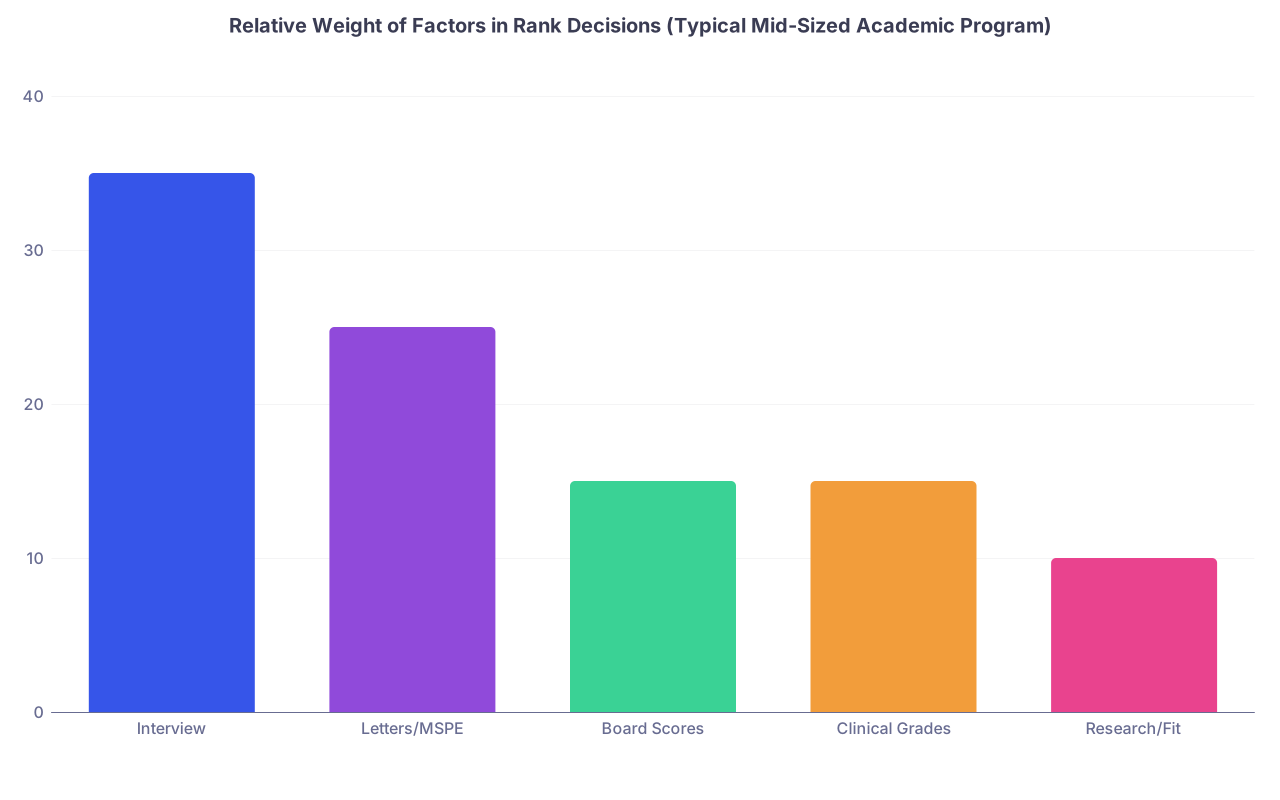
One more insider piece: your fate is usually not sealed on interview day. It’s sealed at the rank meeting.
| Category | Value |
|---|---|
| Interview | 35 |
| Letters/MSPE | 25 |
| Board Scores | 15 |
| Clinical Grades | 15 |
| Research/Fit | 10 |
Those percentages aren’t official, but they’re not far off at many places. Here’s why that matters.
By the time the rank meeting happens:
- People have half-forgotten the specifics of your bad answer.
- They remember their overall gut feeling and any strong positives or strong negatives.
- Your written comments might say: “Good overall. One concerning answer about X, but likely nerves.”
If your bad answer has been reframed that way in the written record, you’re going to be okay. Not top 5, but not dead.
But if the note says: “Concerning judgment. Would not want as intern,” that lives forever. It will override a lot of otherwise strong data.
At that meeting, someone still can — and sometimes does — say, “I think we were too harsh in the moment; overall he seemed teachable.” That kind of late rescue happens more than you’d think.
A Quick Mental Model to Carry Into Every Interview
Think of every answer as raw material for someone in that room to build one of two stories:
- Story A: “This person is solid, honest, and teachable. Even their weaker answers show growth potential.”
- Story B: “This person might be a headache. The risk isn’t worth it.”
A bad answer doesn’t automatically put you in Story B — unless it shows arrogance, lack of insight, or disrespect.
Your job isn’t to be perfect. It’s to make it easy for a reasonable faculty member to say, “I know that one answer wasn’t great, but overall I believe in this applicant.”
If you can give them that, most “bad” answers will quietly die in that room. And you’ll never hear about it.

FAQs
1. If I realize hours later that I gave a terrible answer, should I email the program to clarify?
Generally, no. I’ve watched those emails land. At best, they get politely ignored. At worst, they highlight something no one was that worried about. The only time I’ve seen a follow-up help is when it was about a factual error (misstated dates, wrong publication, etc.), and even then it was neutral more than helpful. Fix it by being excellent in your next interview, not by trying to retroactively rewrite one.
2. Do programs ever discuss specific bad answers across faculty who interviewed me separately?
Yes. In fact, this is common when there’s disagreement. You might have one faculty member saying, “I really liked her,” and another asking, “Did she say anything to you about not liking night shifts? Because she said that to me.” If more than one person heard a similar concerning theme, the chance of salvage drops dramatically. If only one person heard it and others had good experiences, you’re much more likely to be rescued.

3. How much does one really good answer offset one really bad answer?
A truly outstanding answer — especially to a question about hardship, professionalism, or insight — can absolutely tilt things in your favor. Faculty love evidence of depth. I’ve seen applicants keep high positions on the rank list despite clumsy responses elsewhere because they gave one or two answers that showed unusual maturity or self-awareness. Think: “This person will grow fast with the right environment.” That narrative can survive a clunker.
4. Are certain specialties less forgiving of bad answers?
Yes. Surgical subspecialties and some high-intensity fields (like EM at busy county hospitals) tend to be less forgiving about anything that hints at low work ethic, low resilience, or difficulty taking feedback. Pediatrics and family medicine often show more grace for anxiety and awkwardness but are unforgiving about attitudes toward vulnerable patients or interprofessional respect. But across specialties, the core rule holds: arrogance and lack of insight are much harder to rescue than inexperience or nerves.
Years from now, you won’t remember the exact wording of the answer you regret. You’ll remember whether you trusted yourself enough to move past it, kept showing who you really are, and gave the right people in that room a reason to fight for you.