
What Happens in the Post-Interview Meeting: How You’re Discussed
It’s 5:45 pm. Your last interview just ended. You’re walking to your car replaying every answer, every smile, every awkward pause. You’re thinking: “Did they like me? Did I say the right thing?”
Inside the program? They’ve already started ranking you.
Let me pull back the curtain on what actually happens in that room once you leave the Zoom call or walk out of the conference center. Because the post‑interview meeting is where your entire application gets boiled down to a few sentences, a couple numbers, and one bottom-line decision:
Do we fight for this person, or do we let them go?
You’re not in that room. But I have been. So let me tell you how it really works.
The First 10 Seconds: Your Fate in a Single Sentence
The most brutal truth: for most programs, your “summary” as an applicant gets spoken in about 10–20 seconds.
It sounds like one of these:
- “IMG, strong Step 2, super nice, a bit quiet, but would be solid.”
- “Very smart, 260+, but came off arrogant; I’m nervous about team fit.”
- “Average scores, but absolutely stellar on interview—top third for me.”
- “Research beast, not sure they’ll actually be happy here.”
That’s what you become. A reduction. And the person who controls that reduction is usually your “advocate” on the committee—often your faculty interviewer, sometimes your resident interviewer, occasionally the PD themselves.
If your advocate is lukewarm or sloppy in how they describe you, you’re done before debate even starts. If they’re energized and specific, your stock rises.
Your goal on interview day is to make that person’s 10–20 second summary so compelling and easy that they can’t help but sell you.
Who’s Actually in the Room (and Who Matters)
You picture some shadowy committee of mysterious faculty. Reality is messier.
Here’s what the typical post‑interview meeting looks like at a mid‑to‑large program:
- Program Director (PD) – runs the meeting, sets the tone, often has veto power.
- Associate/Assistant PDs – do a lot of the real evaluation work.
- Core faculty – usually 3–10 who interview regularly.
- Chief residents – often the most honest voices in the room.
- Resident representatives – 1–3 current residents, usually interviewers.
- Program coordinator – not voting, but do not underestimate their influence.
At smaller community programs it might be just PD + APDs + coordinator and a couple residents. At big-name academics it can feel like a small town hall.
Who drives the discussion? Three groups:
- PD/APDs – their opinion can rescue or bury you.
- Your main faculty interviewer – they frame your narrative.
- Chiefs/residents – they are the primary filter for “will this person survive nights and not make our lives hell?”
If the residents do not like you, you will almost never end up near the top. I’ve watched PDs back away from stellar Step scores because multiple residents said some version of: “I would not want to be on nights with this person.”
The Scoring System: How You Get Turned into a Number
Most applicants assume it’s vibes. It is not. It’s structured vibes.
Every program has some version of a scoring system. It looks something like this:
| Category | Typical Weight | Source |
|---|---|---|
| Interview Score | 30–50% | Faculty + resident interviewers |
| Academic Metrics | 20–30% | USMLE/COMLEX, grades, class rank |
| LORs & MSPE | 10–20% | PD/APD review |
| Fit/Professionalism | 20–30% | Global sense in meeting |
Some programs use 1–5 scales. Others 1–9. Some split into “interview,” “application,” and “global rank.” But the pattern is the same: they convert messy human impressions into something they can sort in Excel.
Here is the unspoken hierarchy:
If your interview score is low, your board scores almost never save you. If your interview score is high, they will stretch to excuse mediocre metrics. Interview performance is not just another box; it’s the multiplier on everything else.
One surgery PD put it bluntly:
“By the time they get here, we know they can pass exams. I’m ranking who I want in my trauma bay at 3 am. That’s what the post‑interview meeting is for.”
How the Meeting Actually Flows
Let me walk you through the real sequence. Strip away the official language and it goes like this.
Step 1: The Pre-Meeting Sort
Before anyone sits down, the coordinator or APD has already created preliminary lists:
- “Auto-accept” tier: glittering scores, strong home letters, good interview comments.
- Middle mass: most of you.
- Problem pile: red flags, bad comments, weird vibes, professionalism concerns.
If you think the evaluation “starts” at the meeting, you’re behind. The meeting is more correction than creation. If someone loved you or hated you, that’s already embedded in how your name appears on the list.
Step 2: Quick Warm-Up Cases
They often start with obvious ones:
- The absolute superstar everyone loved.
- The disaster everyone hated.
Why? To establish calibration. Someone will say, “Okay, is Applicant X a top‑5? Top‑10? Above or below Y?” You’re watching the culture of the program show itself there: do they prioritize research, grit, likeability, or raw IQ?
This matters because once they set anchors at the top and bottom, everyone else is “above/below” relative to those early examples.
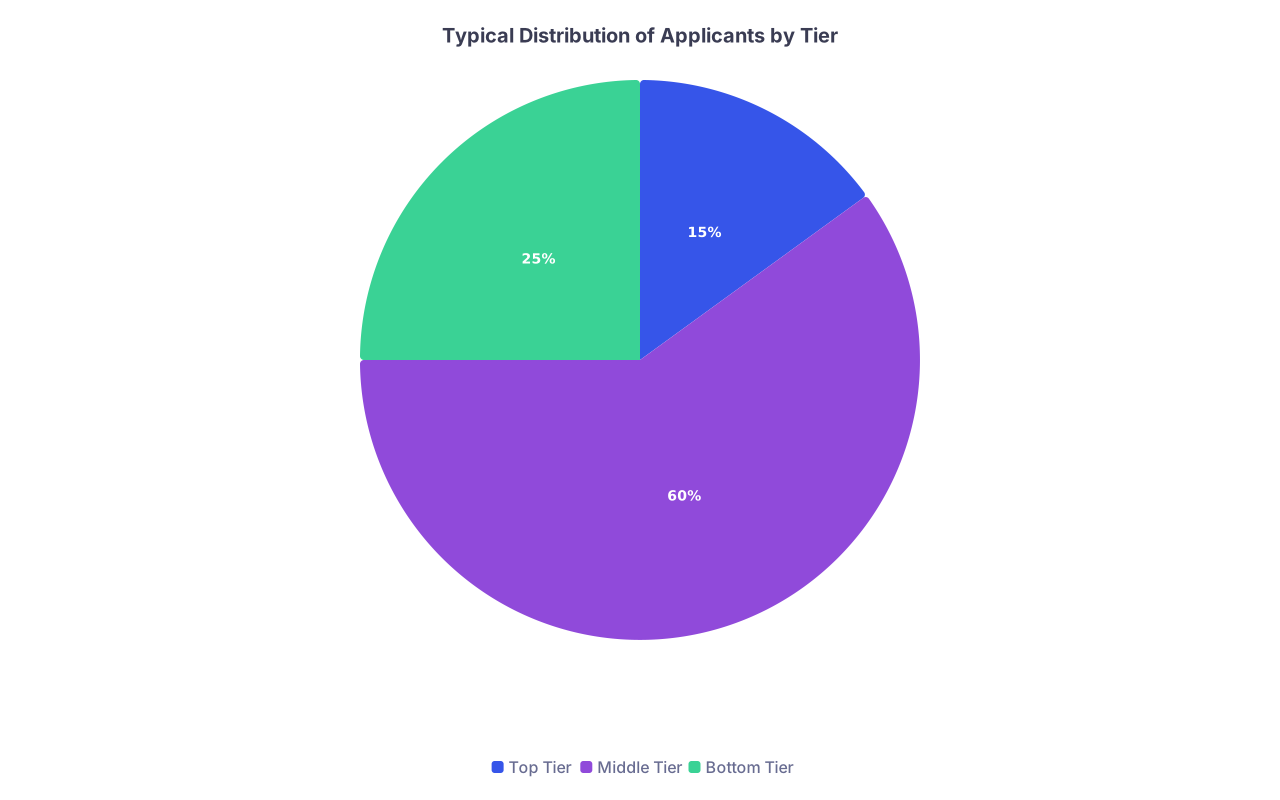
| Category | Value |
|---|---|
| Top Tier | 15 |
| Middle Tier | 60 |
| Bottom Tier | 25 |
At a typical mid-sized categorical program, maybe 10–20% end up in that genuine “fight for them” top tier. Everyone else gets mapped against them.
Step 3: Your Case Presentation
Now it’s your turn. You come up on the spreadsheet or board.
Your file isn’t read out loud line‑by‑line. Nobody is rereading your personal statement in the room. They’re looking at a compressed view: numbers, school, maybe a quick summary line.
Then your interviewer gives their impression. This is the moment you were interviewing for.
A strong advocate sounds like this:
“This is the IMG from Jordan. Step 2 is 251. She did 2 years as a hospitalist before coming here. She was one of the few who asked very specific questions about our ICU curriculum. Residents loved her. I would absolutely want her on my team. I’d rank her in my top 10.”
Notice the details:
- Specific anchor (“IMG from Jordan, 251”).
- Concrete behaviors (“asked specific questions about ICU curriculum”).
- Resident validation.
- Clear placement (“top 10”).
A weak advocate sounds like this:
“Yeah, he was nice. Good scores. Nothing concerning. I thought he’d be fine here.”
You feel the difference immediately. The second one doesn’t move anyone. It gets you stuck in the anonymous middle.
Your job on interview day is to feed your interviewer the first kind of summary, not the second. You do that by making your story easy to remember and repeating a few key themes:
- Who you are.
- What you want.
- Why this program matches that.
If they can’t remember you clearly 5 hours later, you’re just another “seemed fine.”
The Real Criteria: What They Argue About
On paper, programs claim they score on professionalism, academic achievement, and potential. In the room, the debates focus on a brutal handful of questions. I’ve heard these exact lines:
“Are they safe?”
Translation: Are we comfortable putting this person on nights with a pager and real patients?“Are they going to quit?”
Massive issue now. Burnout, specialty changes, people leaving mid‑intern year. Anything that suggests low resilience or ambivalence gets discussed.“Will they make our lives easier or harder?”
This is where likeability, humility, and work ethic show up. If residents think you’ll complain constantly, weaponize wellness, or vanish when it’s busy, you get buried.“Are we going to regret not keeping them?”
For very strong applicants. Programs don’t want to be the one that let the future star get away.
What They Look for Without Saying It Out Loud
Some patterns I’ve seen repeatedly:
- Overly polished, “perfect” applicants with zero vulnerability often read as fake.
- Applicants who blame others (school, PD, system) for every challenge raise red flags.
- People who talk more about “prestige,” “brand,” or “big-name fellowship” than patients trigger insecurity—programs assume you’ll be constantly dissatisfied.
If you talked sincerely about hard rotations, failures, or growth without self-pity, you stick in their mind as mature. That counts more than you think.
The Hidden Influence of Residents and the Coordinator
You know who gets listened to more than their official title suggests? Two groups.
Residents
Residents are the BS-detectors. They’re also closest to the real day-to-day.
Common resident lines in meetings:
- “They were nice, but they interrupted a lot.”
- “I asked about a time they were wrong, and they gave a non-answer.”
- “Honestly, I would not want to be on nights with them.”
The PD hears that last sentence and your ceiling drops by 50 spots. Instantly.
If residents love you, they say things like:
- “She felt like one of us.”
- “He asked really thoughtful questions about how we actually spend our time.”
- “They were very honest about their weaknesses but had plans to fix them.”
That’s gold. You move up tiers on the strength of that language.
Program Coordinator
Officially, they’re “non-voting” in most places. Unofficially, I’ve seen this play out:
PD: “Anyone have concerns about this person?”
Coordinator: “They no‑showed the second look without emailing. And they were pretty rude when we asked them to reschedule their interview time.”
Room: silent
Your rank position just dropped. You might not drop off the list, but you’re no longer in the top group.
Respect emails. Respect logistics. The coordinator is often the first and last person the PD asks if there were any “issues” with you.
How the List Gets Built: Tiers, Not Perfection
Nobody is micro-sorting 120 applicants in perfect order debating whether #47 should be #45. It does not work like that.
Most programs build ranks in tiers.
Roughly:
- Tier 1: “Must-haves” – people they’d genuinely celebrate matching.
- Tier 2: “Strong fits” – would be happy to see on Match Day.
- Tier 3: “Safe bets” – fine, solid residents, not exciting.
- Tier 4: “Only if the world ends” – they’d rather go unfilled than dip too far here.
Within tiers, people move around a bit: slight boosts for couples match, diversity of background, research niche the PD wants, or home students.
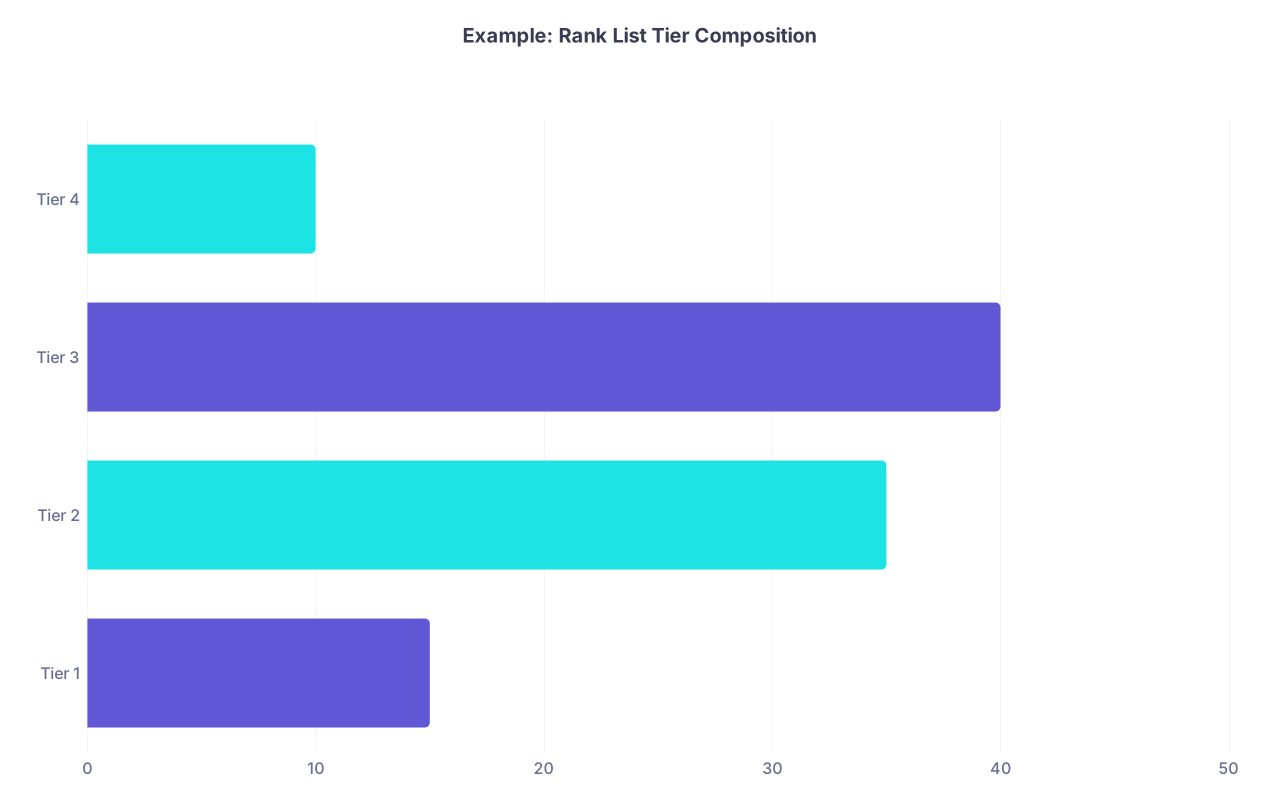
| Category | Value |
|---|---|
| Tier 1 | 15 |
| Tier 2 | 35 |
| Tier 3 | 40 |
| Tier 4 | 10 |
Your practical goal? Force your way into Tier 1 or high Tier 2. Because when the match algorithm does its dance, that’s the pool that actually has leverage.
Here’s the twist: one great advocate can push you up a tier. One persistent concern—“I just don’t trust their judgment”—can bump you down a tier or two, no matter how shiny your CV.
The Things That Get You Quietly Downgraded
Nobody writes “this person was annoying” in the official scoring fields. But they say it out loud in the room in more professional language.
Common silent rank killers:
- Inconsistent story. You say you love underserved patients but only applied to the most elite coastal programs. People notice.
- Too focused on hours and call. If half your questions are schedule, vacation, moonlighting, you look like you’re trying to escape work.
- Subtle arrogance. Correcting faculty unnecessarily, dismissing other specialties, flexing your school every third sentence.
- Defensiveness. If every weakness is spun into a humblebrag, they assume you’re impossible to coach.
- No curiosity. You asked generic questions a quick website visit could answer. That reads as laziness or real disinterest.
A lot of these aren’t “bad” in isolation. It’s the pattern they care about. Programs aren’t terrified of low knowledge; they’re terrified of bad attitude.
What You Can Control Before That Meeting
You can’t sit in the room. But you can very deliberately script what is likely to be said about you.
Here’s how.
1. Give Them a Memorable Hook
You want your advocate to have an easy handle:
- “The former teacher who worked in Appalachia and wants to keep doing rural primary care.”
- “The engineer-turned-EM applicant who built his own simulation cases.”
- “The IMG peds applicant who started a longitudinal clinic back home.”
If you’re just “third year from X school with decent scores,” you drown in the middle.
You build that hook in:
- Your “tell me about yourself” answer.
- The way you frame your past work.
- The questions you ask about the program that link to your story.
2. Make “Top-Third” a No-Brainer
Interviewers sometimes get asked directly: “Where would you put them? Top third, middle, or bottom of today’s group?”
You want them to say “top third” without hesitation.
You get there by:
- Being prepared but not scripted.
- Answering hard questions honestly but with insight.
- Showing you know the program—not just the brand name or city.
- Being easy to talk to. Seriously, don’t underestimate this.
If you walk out thinking, “That felt like a good conversation, not an interrogation,” you’re usually in good shape.
3. Leave Residency-Appropriate Impressions
They are constantly translating everything you say into: “What does this look like as a PGY‑1?”
If you:
- Show up on time, well-dressed → “They’ll probably be reliable on call.”
- Own mistakes in your answers → “They’ll tell us when they mess up on nights.”
- Ask about feedback and improvement → “They’ll grow quickly.”
That’s what gets said in your favor in that room.
What Happens After the Meeting (and Why You Should Stop Obsessing)
After everyone argues, adjusts tiers, and assigns their final scores, your fate is functionally sealed.
The official “rank list” often gets tweaked later:
- Couples match tweaks.
- Internal candidates.
- A PD trying to balance class personalities or backgrounds.
But your personal narrative does not get rewritten. Nobody is having a second emotional meeting about you in February. Unless you send a genuine update (new Step 2, major award, significant life change) or there was uncertainty, you stay roughly where they put you.
That’s why all the mental replay you do after the interview is wasted time. They’ve moved on. You should too—into preparing for the next interview and, later, building a smart rank list.
FAQs: What You’re Afraid to Ask Out Loud
1. Can a thank-you email actually change my rank?
Very rarely. A generic “thank you for your time” does nothing. Everyone sends that.
Where I have seen movement:
When an applicant sends a concise, specific note that clarifies confusion or deepens a point from the interview. For example, following up with a short paragraph about a project you only mentioned briefly, or articulating clearly why their ICU track matches your long-term goals—if your interviewer was already on the fence in a good way, it can push them into being a stronger advocate.
But no one moves from Tier 3 to Tier 1 because of a thank you email.
2. Do programs really remember if I was nervous?
They don’t care that you were nervous. They care how you functioned while nervous.
If you were visibly anxious but still thoughtful, kind, and engaged, people often say, “They were a bit nervous at first, but once they warmed up, they were great.” That doesn’t hurt you.
Where it does hurt: if the nerves made you shut down, give one-word answers, or seem uninterested. That gets translated as “hard to read” or “not sure about their communication skills.” Practice enough that your baseline still shows through the adrenaline.
3. How much do board scores still matter once I’ve interviewed?
They matter, but differently. Before interview, scores decide if you get in the door. After interview, they’re more of a tie-breaker.
When comparing two similarly liked applicants, I’ve seen people say, “Okay, same vibe, similar fit, one has a 260 and one has a 230—fine, bump the 260 a bit.” But I’ve also seen a 230 with an outstanding interview ranked far above a 260 who got bad comments from residents.
If your interview is strong, scores become a detail, not your identity.
4. Does being a “reach” applicant hurt me in the room?
Sometimes. Not always.
If you’re clearly above the usual academic level of the program—huge scores, big-name research, elite home institution—some programs will quietly assume you won’t rank them highly. The phrase you might hear is, “We’re just a backup for them.” Those applicants often get ranked lower than their “objective” strength justifies.
You can counter that by making a very specific case during the interview for why you’d actually be happy there: family, geography, particular patient population, or training style. If they believe you’d realistically rank them high, they’ll usually rank you closer to your true strength.
5. Can one bad comment from a single interviewer destroy my chances?
It depends who said it and what they said.
One mildly negative comment (“a little quiet”) blended with several positive ones won’t kill you. Committees know interviews are snapshots. But a serious concern—“I don’t trust their judgment” or “I felt they were dishonest about X”—especially from a respected faculty member or chief, can absolutely tank your position.
This is why consistency matters. If everyone else’s notes are glowing and one outlier trashes you, people sometimes challenge it: “That doesn’t match what the rest of us saw.” In those cases, you often land in the middle, not the bottom. But you’re no longer in contention for the very top.
You walk out of an interview day thinking it’s over. For the program, that’s when the real decision-making begins. In a closed room, your whole professional identity gets compressed into a narrative and a number.
Your job—before you ever sit in that chair—is to shape a story that’s easy to remember, hard to dismiss, and impossible not to advocate for.
With that understanding, you’re not just “hoping they liked you.” You’re walking into each interview aiming to script what your advocate will say when you are not there to defend yourself. Get that part right, and you’ll give yourself a real shot on Match Day.
The next step, once you understand this game behind the curtain, is learning how to answer those high-yield interview questions in a way that feeds your advocate exactly the ammunition they need. But that’s a conversation for another day.