
It’s 7:12 p.m. You’re sitting at a long table in a noisy restaurant, name tag half-twisted, water glass sweating in front of you. Three residents are scattered around you—one chief, one PGY-2, one intern who looks only slightly less terrified than you. The formal interviews are “over,” and someone just said the line every resident says:
“Tonight’s totally informal, this won’t affect how we rank you.”
Let me tell you what really happens.
That dinner? It absolutely affects how they rank you. For some borderline cases, it is the tiebreaker. I’ve watched candidates rise or die based only on what residents wrote after that meal.
You’re about to see how residents actually evaluate you at interview dinners—what they pay attention to, what gets quietly documented, and what you can do to control a process that everyone pretends doesn’t exist.
What Residents Have Been Told About You Before Dinner
Residents don’t come to these dinners blind.
Here’s what they typically already know walking in:
- Your name and photo
- Your med school and home region
- Rough idea of your Step scores or at least “strong / average / weak”
- Any “flags” the program director mentioned: leave of absence, prior career, couples match, big gap, strange personal statement
- Occasionally, “This person is high on the PD’s list—do not let them get weird vibes and run.”
In some programs, before they leave clinic to meet you, the chief gets a brief rundown from the coordinator or PD: “We like this group; be welcoming,” or “We’re screening heavy this year; let us know if anyone seems odd / arrogant / not a team player.”
So when you sit down, they’re not thinking, “Who’s this stranger?” They’re thinking, “Is this applicant who they looked like on paper, or is there a mismatch?”
That’s the first frame: confirmation vs disconfirmation. They’re checking if the paper version of you holds up in a real-world, unstructured environment.
The Real Rubric Residents Use (That Nobody Shows You)
No one hands residents a formal scoring sheet at dinner. But mentally? Almost all of them are running the same silent checklist.
Let me translate what’s actually going through their heads.
1. “Would I want to do a 28‑hour call with this person?”
This is question #1. It’s crude, but it’s real.
When the residents walk back to the hospital afterward and the PD or APD asks, “So, what’d you think?”, this is exactly how they phrase it:
“Yeah, I’d do a call with them.”
or
“Honestly, I wouldn’t want to be stuck on nights with that guy.”
They’re watching:
- Do you dominate conversations or share space?
- Can you banter, or are you painfully rigid?
- Do you ask basic things about the program without having read the website?
- Do you show any signs of being a complainer, know‑it‑all, or emotional black hole?
You don’t have to be hilarious or the life of the party. You just have to be someone they can imagine stuck in a workroom at 3 a.m. while the hospital is on fire, without wanting to scream.
2. “Are you normal?”
That sounds insulting, but that’s truly how it’s phrased in resident debriefs.
I’ve literally heard:
“She’s really smart, but she’s… not normal.”
“He’s totally normal, I liked him.”
“Normal” to them means:
- You can hold a basic conversation without making it weird.
- You’re not performing a persona.
- You understand basic social cues, don’t overshare, don’t trauma-dump.
- You’re not obviously bitter, angry, or carrying unresolved baggage.
If they walk away thinking, “Something felt off,” you’re in trouble. Residents don’t always articulate it well, but those vague bad vibes have killed a lot of applications.
3. Humility vs. Insecurity vs. Arrogance
Residents are ruthless about this one.
The internal triage goes like this:
- Confident and humble → gold.
- Quiet but clearly competent → good, especially in surgical and procedure-heavy fields.
- Self-deprecating but solid → generally liked.
- Overly self-effacing, constantly minimizing yourself → red flag for burning out or collapsing under pressure.
- Bragging, one-upping, casually flexing scores or research in conversation → hard no at many programs, even if you’re brilliant.
They’re not impressed by your Step 2 or your 17 publications at dinner. Faculty already know that. Residents are deciding whether your personality matches the pressure cooker.
4. “Are you going to be a problem?”
This is ugly but true: residents are scanning for risk.
They’re overworked, underpaid, and they don’t want to babysit a co-resident with chronic drama. So they are subconsciously screening for:
- People who sound litigious (“At my last institution I filed a complaint…” used carelessly is a land mine)
- People who seem rigid, easily offended by banter, or intensely high-maintenance
- People who already look exhausted and cynical as MS4s
- People who give off strong “I’m better than this program” energy
If a resident even somewhat suspects you’ll be a problem, they’ll mention it. Programs are risk-averse. You’re done.
What They Watch Moment-To-Moment At The Table
You think they’re asking you about hobbies. What they’re actually doing is running pattern recognition on your behavior.
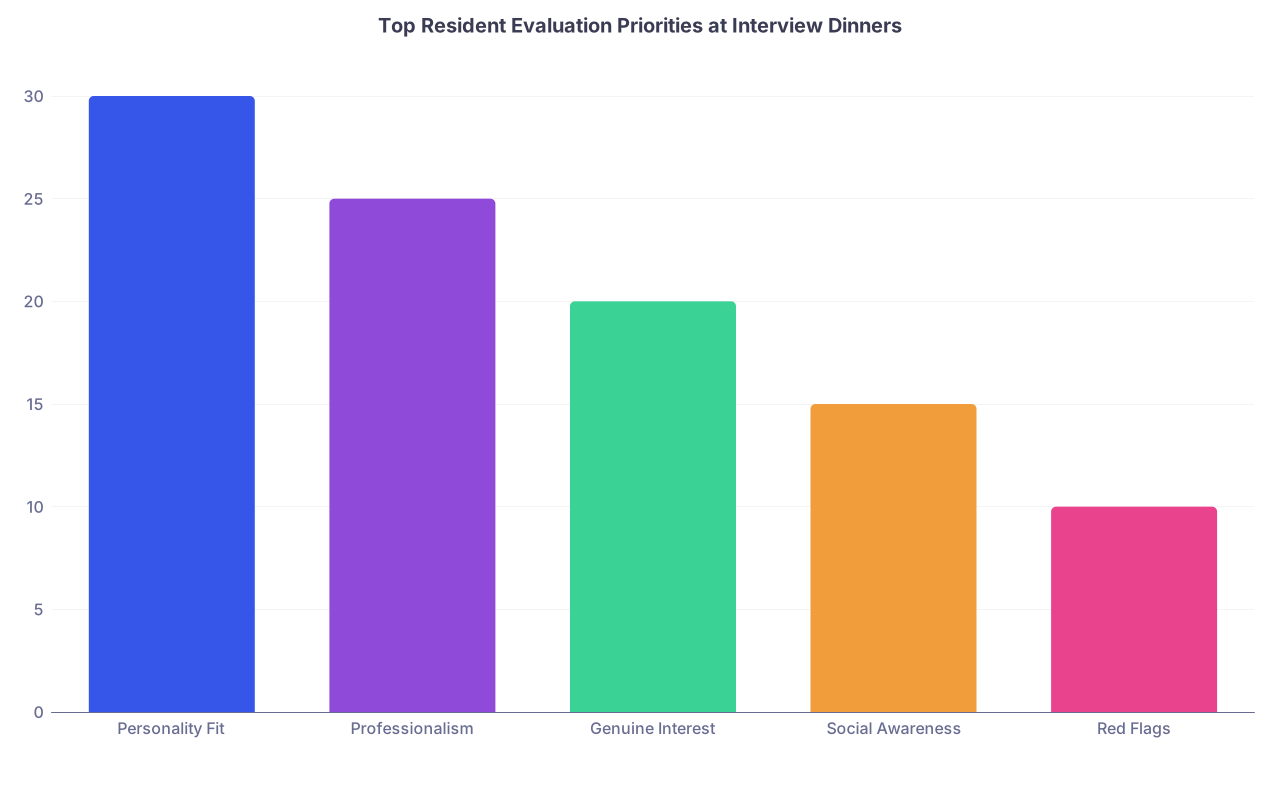
| Category | Value |
|---|---|
| Personality Fit | 30 |
| Professionalism | 25 |
| Genuine Interest | 20 |
| Social Awareness | 15 |
| Red Flags | 10 |
Let’s get specific.
Who You Talk To And How
If you only talk to attendings or senior residents and ignore the intern? We notice. And we write that down.
I’ve seen this in debriefs:
“He only cared what Dr. X thought; barely interacted with us.”
“Didn’t even ask the intern anything.”
Residents pay special attention to how you treat:
- The intern
- The quiet PGY-2 at the end of the table
- The coordinator, if they pop in
- Waitstaff (yes, that’s a real thing people comment on)
You do not need to perform kindness. But if you’re overly selective about who’s “worth” your attention, it leaks your character.
How You Handle Group Conversations
You’re not being graded on how many questions you ask. They’re looking at how you fit into a group of peers.
Things that quietly hurt you:
- Talking over other applicants repeatedly
- Turning every question into a story about yourself
- Repeatedly correcting minor details (“Actually, it’s pronounced…”)
- Name-dropping famous institutions or mentors in casual conversation
- Monologuing. Residents hate monologuing.
They like applicants who:
- Ask residents about their lives and share a bit about their own, without overselling
- Help pull quieter applicants into convos: “Hey, what about you, where are you from?”
- Listen more than they talk, but don’t sit there mute and stiff
Residents are essentially asking: Are you the asshole in sign-out who talks for ten minutes about nothing, or are you the colleague who reads the room?
What You Choose To Complain About
You have more freedom at dinner than in formal interviews, but complaining is dangerous.
Residents will often fish: “Yeah, our EMR is awful,” or “We work a ton of hours.” They want to see how you react.
Bad answer:
“Oh good, I hated my last hospital’s EMR, it was so stupid, my attending was useless with it…”
Better answer:
“Yeah, I’m used to clunky EMRs. I care more about having good support from seniors when it’s busy than what the interface looks like.”
They are gauging whether you handle frustration with maturity or turn every annoyance into an indictment of your environment.
If you’re trashing your med school, your classmates, or your home program at dinner, assume someone will repeat that quote, with your name attached.
The Shadow Documentation: How Your Dinner Performance Gets Recorded
Here’s the piece most applicants never see.
Residents go home. Group chat lights up. Then, either that night or within a couple days, there’s some version of this process:
- Chief or senior sends: “Thoughts on yesterday’s group? Anything stand out good or bad?”
- Residents who were there drop one-liners:
- “Loved [FirstName], super chill, would fit well.”
- “[FirstName LastInitial] was strange, kind of intense.”
- “Didn’t get a good read on [Name], quiet but seemed nice.”
- “Hard no on [Name], arrogant and talked over everyone.”
Those comments get transcribed into the applicant’s file in some form, especially at mid-size and large academic programs. Sometimes it’s structured (“Resident feedback: strong/neutral/negative”). Sometimes it’s literally pasted from emails or noted in the ranking meeting.
| Program Type | Resident Feedback Weight | Typical Use Case |
|---|---|---|
| Big academic | Moderate–High | Tie-breakers, flagging red flags |
| Mid-size university | High | Major factor in ranking discussions |
| Community | Moderate | Fit assessment, culture protection |
| Malignant-ish | Very High | Used to screen out “too soft” folks |
If there’s a serious negative comment from multiple residents, your file essentially gets a soft stamp: UNLIKELY TO FIT. You’ll survive only if the PD is absolutely obsessed with your metrics or your letter writers.
On the other hand, if residents all liked you—and your paper app was already strong—you go onto the internal “we want them” list, which absolutely influences how far down the list you land.
Alcohol, Boundaries, And The Subtle Self-Destruct Buttons
You already know “don’t get drunk.” Let’s raise the bar a little. Because I’ve seen people ruin strong applications with one careless night.
Alcohol
Programs often say, “Get whatever you want; it’s on us.” That’s not actually a blank check.
Unspoken rule from residents: your max is 1–2 drinks, slowly, with water in between. Many PDs now explicitly ask for observed behavior around alcohol.
Residents notice:
- Who goes for three cocktails while everyone else has beer or one glass of wine
- How people’s personalities shift with alcohol (louder, sloppier, flirty, angry)
- Whether you can still hold a coherent conversation after drink #1
If anyone writes, “Got pretty drunk at dinner,” that follows you.
Inappropriate Jokes And Flirting
You are being evaluated for professionalism in a semi-social environment. Mystic line, but it’s there.
Things that absolutely get repeated:
- Sexual jokes, even “as a joke”
- Flirty comments to residents
- Any comment about how residents look that feels even slightly objectifying
- Overly personal questions about residents’ relationships, money, or politics
I’ve seen an applicant completely tank because he got too comfortable with one of the women residents and made a “joke” about how he’d “need help surviving nights” with a grin. She told the chief. Chief told PD. PD: “We’re done here.”
Oversharing And Trauma Dumping
Dinner is not therapy.
Talking briefly about why you went into medicine, a meaningful experience, or how you grew from something hard? Fine.
But if you’re unloading family trauma, mental health struggles in graphic detail, or deep resentments about prior mistreatment—residents will mark you as emotionally unstable or a potential HR problem. Unfair? Maybe. Real? Absolutely.
Use the dinner to show that you have depth, but also that you have boundaries.
How To Show Up The Right Way (Without Being Fake)
You’re not an actor. You’re a human with limited energy. Still, you can stack the deck in your favor.
Calibrate Your Energy
The goal is “warm, engaged, and curious,” not “overcaffeinated TED Talk host.”
If you’re naturally introverted, you don’t need to become extroverted for three hours. But you do need to engage enough that residents can see you.
That means:
- Ask a few residents specific questions about their experience.
- Share at least a couple concrete stories: a case you liked, a rotation that shaped you, something you’re looking forward to in residency.
- Don’t park yourself silently in the corner scrolling your phone between courses.
Introverted but engaged reads as thoughtful. Silent and withdrawn reads as “we have no idea who this person is.”
Show You Actually Want Them, Not Just Any Program
Residents are allergic to generic interest.
They can tell when you’re running the same script you used last night in another city. You need a few program-specific references ready:
- “I heard your PGY-2s get early autonomy in the ICU—that’s unusual and really appealing to me because…”
- “I noticed you all do X rotation at [outside site]; how has that been in practice?”
- “Your call schedule structure seems different from [similar program]; how does it feel day-to-day?”
This doesn’t have to be fancy. But it has to sound like you’ve spent more than three seconds on their website.
Drop In Evidence Of Being Low-Drama, High-Resilience
Residents love people who sound durable.
You don’t need to say, “I’m very resilient.” That’s meaningless. Instead, show it in how you talk:
- Describe a tough rotation and what you learned or how your team handled it together
- Mention that you value good co-residents more than fancy prestige
- When they complain about something, you respond with perspective, not a rant
What they’re hearing: “We can put this person on a heavy service and they won’t melt or poison the team dynamic.”
A Quick Reality Check On Power: Who Actually Moves Your Rank?
Here’s the part you’re probably underestimating.
Residents have more power in ranking than you think—but it’s not always obvious on paper.
In many programs, there’s an official line: “Residents have advisory input.” The unofficial truth: a strong resident consensus, positive or negative, heavily shapes where you go.

| Step | Description |
|---|---|
| Step 1 | Interview Dinner |
| Step 2 | Resident Group Chat |
| Step 3 | Chief/Resident Rep Summary |
| Step 4 | Program Director Meeting |
| Step 5 | Push Up On Rank List |
| Step 6 | Rank = Application Strength |
| Step 7 | Drop or Remove From List |
| Step 8 | Resident Consensus? |
The usual pattern:
- If you’re academically strong and residents like you → you drift upward on the rank list.
- If you’re academically average but residents love you → you can jump above candidates with better scores.
- If you’re academically strong but residents have serious concerns → you quietly slide down or off the list.
- If everyone is “meh” → the faculty’s original impression stands.
I’ve been in ranking meetings where the PD said:
“I really liked their application, but you all clearly did not click with them at all. I don’t want to ignore that.”
Translation: dinner sank them.
FAQs
1. If residents say “this dinner doesn’t affect rankings,” are they lying?
Yes and no. There’s usually no formal “dinner score.” But residents are absolutely forming opinions, and those opinions feed into the narrative about you. They won’t say, “We rejected them because they ordered three margaritas,” but someone will say, “We got weird vibes at dinner,” and that’s enough for you to slide downward when there are 200 other competent applicants.
2. How much should I talk versus listen?
Aim for roughly a 60/40 split where you’re listening more than you talk, but not by a massive margin. If you realize you’ve been quiet for 20 minutes, jump in with a question or short story. If you’ve been talking for more than a few minutes straight, hand it back: “What was that like for you all?” Residents are measuring your ability to be part of a team conversation, not deliver a monologue.
3. What if one resident clearly dislikes me—am I doomed?
Not automatically. Everyone knows personalities clash. What kills you is consensus negative feedback. If one resident doesn’t like you but two others say, “Actually I thought they were great,” you’re safe. Your goal is to give multiple people a chance to see you positively—by engaging with different residents, not clinging to just one person all night.
Key points? The dinner is not casual, no matter what they say. Residents are asking, “Would I trust this person on my worst call?” And what you show in a noisy restaurant—your judgment, your ego, your ability to be a decent human when no one’s formally scoring you—often weighs more than another publication or two.