
The fastest way to tank a residency interview is to open your mouth about rank lists before Match Day.
People do not get this. Every year, strong applicants walk into perfectly good interviews and casually sabotage themselves with one or two “ranking talk” comments they think sound savvy or flattering. Programs hear those comments very differently. As risk. As gamesmanship. As unprofessional.
You are in the Residency Match. That means there are rules. And beyond the official NRMP rules, there is unwritten etiquette that program directors expect you to understand. If you miss it, you will look naive at best and manipulative at worst.
Let us go through the dangerous ranking comments and behaviors that will hurt you, why they are a problem, and what to say instead.
The Big Rule: Stop Talking About Ranking During Interviews
Before we get into specific mistakes, you need the governing principle:
If it sounds like:
- “I will rank you…”
- “Where are you ranking me?”
- “Are you ranking me to match?”
- “You’re my number one…”
Then you should not say it in the interview. Period.
There are two layers here:
NRMP rules (Match Participation Agreement)
Programs and applicants must not solicit or disclose ranking information in a way that violates policy. Program staff sit through trainings about what they can and cannot say. They are on alert.Professional judgment
Even if a comment does not technically violate a rule, it can still make you appear immature, presumptuous, or untrustworthy.
Programs care deeply about integrity. The minute you sound like you are trying to game the system, you raise red flags.
Mistake #1: Asking Programs How They Will Rank You
This is the most obvious landmine, and still, I hear about applicants stepping on it every year.
Variations include:
- “Do you think I’ll be ranked to match here?”
- “Historically, where would a candidate like me fall on your list?”
- “Can you tell me how competitive I am for your program?”
- “What are the chances I’ll match here if I rank you high?”
To you, it sounds like gathering information. To them, it sounds like pressure and a violation risk.
Programs cannot and will not give you that information. If they are ethical, they are intentionally vague. If they are not ethical and overshare, that is a problem too. Either way, you lose:
- You put interviewers in an uncomfortable position.
- You signal you do not understand Match rules.
- You look like you want guarantees instead of trusting the algorithm and your own rank list.
What to do instead:
- Ask about fit, training, and opportunities, not ranking.
- If you want to know if you are a reasonable candidate, the time for that was before ERAS, with advisors, not mid-interview with the PD.
Better question:
“Given my interests in X and Y, how do residents with that profile typically thrive in this program?”
That gets you information about fit without touching rank lists.
Mistake #2: Telling Multiple Programs They Are Your “Number One”
This one is deadly because it seems so harmless in the moment and so obvious in hindsight.
On the trail, you will be tempted to say things like:
- “You’re my top choice.”
- “I am planning to rank you number one.”
- “I see myself only here; this is my first choice.”
Here is the problem:
Unless that program truly is your final number one and you are prepared to stand by that, you are lying or at least misleading. And programs talk. PDs text each other. Coordinators gossip at national meetings. I have seen exact applicant quotes forwarded between programs.
The damage:
- If two program directors both think you “committed” to ranking them first, you have just branded yourself as untrustworthy.
- Even one burned PD will remember you and share your name when colleagues ask about that year’s applicants.
- You put yourself in conflict with the spirit of the Match, which assumes independent, honest rank lists.
There is also a subtle downside even if you mean it sincerely and only say it to one place: you are forcing a level of commitment in the middle of interview season that you may regret when you see other programs.
Better approach:
- During interviews: Do not make rank promises. Ever.
- After interviews: If you want to send a post-interview communication later in the season stating that a program is your clear first choice, that is a separate strategic decision. And even then, you say it once, to one place, and you do it carefully and honestly.
Safer phrases during the interview:
- “I am very impressed with this program.”
- “I could see myself being very happy training here.”
- “This program will be ranked highly on my list.”
Those are enthusiastic, honest, and do not box you into a corner.

Mistake #3: Fishing for Hints About Your Position on Their List
This is the sneakier version of Mistake #1. You know you should not directly ask, so you try to “read between the lines” or push them into telling you.
Common offenders:
- “Are there any concerns that would keep you from ranking me highly?”
- “Based on past applicants, does my profile fit those who matched here?”
- “Will I be a competitive candidate for your top spots?”
Even if it is framed as “feedback,” interviewers hear this as:
“Please tell me if I have a shot here.”
They are trained not to answer that.
The other trap is reading too much into vague positivity:
- “We think you’d be a great fit.”
- “We’d love to see you here.”
- “You’d do very well in this program.”
You then treat those comments as promises. They are not. Programs may say that to multiple applicants. Or to almost everyone they rank.
Do not circle back with:
- “Since you said you’d love to have me here, does that mean I’m ranked highly?”
That makes you look anxious and miscalibrated.
What to do instead:
- Ask: “Are there any aspects of my application or experiences that you feel I should strengthen going forward in my training?”
That is genuine feedback, not ranking talk. - Focus on whether you want them. The algorithm works in your favor if you rank honestly based on preference, not on guessing how they feel about you.
Mistake #4: Quizzing Programs About Their Rank Strategy
You might think you sound sophisticated asking about how a program ranks applicants. You do not. You sound like you do not trust the process or you are trying to reverse-engineer an edge.
Problem questions:
- “How do you rank research versus clinical performance?”
- “Do you rank audition rotators higher than others?”
- “How much weight do you give to Step scores when ranking?”
- “Do you prioritize home students on your rank list?”
From the PD’s perspective, this is dangerous territory. They want to be consistent and fair. They also do not want their internal decision process endlessly litigated by applicants.
It is fine to ask what they value. It is not fine to press for ranking algorithms.
Better version:
- “What qualities do you value most in residents here?”
- “What do your strongest residents have in common?”
- “How do you describe the kind of trainee who thrives in this program?”
These questions give you insight into culture and expectations, not rank mechanics.
Mistake #5: Oversharing Your Own Rank Strategy
Talking too much about how you are ranking programs makes you look transactional. Programs want to believe you care about training, mentorship, and patient population, not just prestige calculus.
Examples that backfire:
- “I’m mostly focused on name recognition, so I’ll probably rank all the big university programs above community ones.”
- “I want to stay in this region unless a top-10 program takes me.”
- “I’m only ranking programs with strong fellowships in [insert competitive subspecialty]; that’s my priority.”
- “I probably won’t rank any place without strong research funding.”
You just told them:
- You care about status more than fit.
- If they are not in your exact filtered box, you are not committed.
- You might be miserable if reality does not match your fantasy.
Even if the interviewer personally agrees with some of what you said, they will see you as a risk: someone who could be unhappy, entitled, or constantly trying to leave.
Keep your personal ranking logic private. You can discuss priorities like geography, patient population, or mentoring style in a balanced way, without sounding like you are building a rigid spreadsheet.
An acceptable version:
- “I have family in this region, so staying nearby is a meaningful factor for me.”
- “I am interested in a program where residents get early operative or procedural experience.”
Stop short of “If you do not meet X, you are lower on my list.”
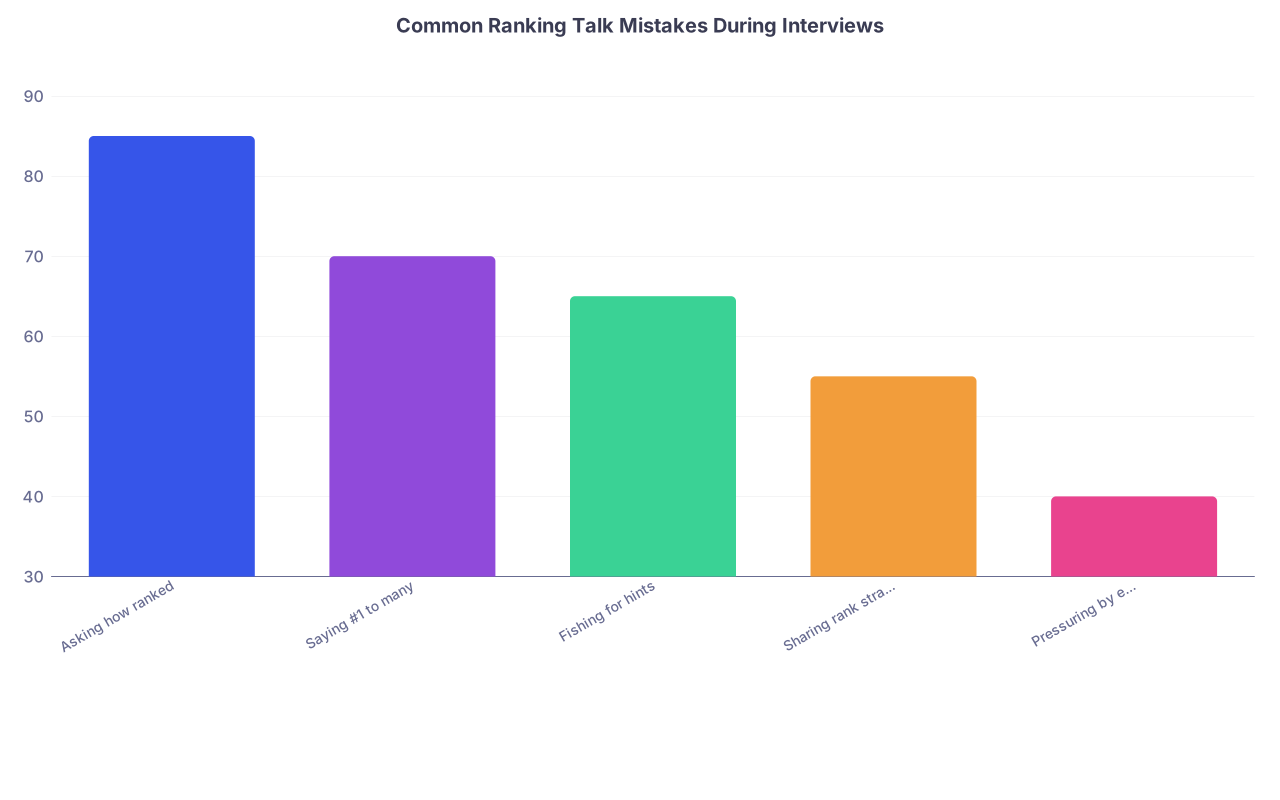
| Category | Value |
|---|---|
| Asking how ranked | 85 |
| Saying #1 to many | 70 |
| Fishing for hints | 65 |
| Sharing rank strategy | 55 |
| Pressuring by email | 40 |
Mistake #6: Violating the Spirit of the NRMP Rules
The NRMP does not just care about literal statements like “You will be ranked at X position.” It cares about patterns of behavior that pressure or mislead.
Common applicant missteps:
- Asking: “If I rank you first, will that help my chances?”
- Saying: “I’ll only rank you first if you can tell me I’ll match here.”
- Suggesting: “If you hint that I’m high on your list, I’ll rank you higher.”
That is bargaining. And it is exactly what the Match Agreement is designed to prevent.
Do not try clever workarounds:
- “Off the record, can you tell me how likely I am to match here?”
- “Informally, between us, where do I stand compared to other applicants?”
- “I know you cannot say it officially, but can you give me a wink if I’m safe here?”
This does two things:
- It makes you look ethically flexible.
- It pushes faculty to choose between rules and candor. They will remember that.
The algorithm is built so that you should rank programs in your true order of preference, without trying to outsmart anyone. The more you chase “inside information,” the more likely you are to mis-rank and hurt yourself.
Mistake #7: Desperate or Pushy Post‑Interview Messages About Rankings
Yes, this is after the interview day, but it is still part of “interview impression.” Many programs explicitly tell you they add post-interview communication to your file. You are still being evaluated.
Red‑flag messages look like:
- “If you tell me I’ll be ranked to match, I will rank you #1.”
- “I need to know if I have a real chance at your program before I rank you high.”
- “If I rank you first, can you confirm I’ll match there?”
- Sending repeated emails asking: “Where do I stand on your list?”
Programs hate this. You become “that applicant” in the office. The anxious one. The one trying to strong-arm a guarantee.
Even more subtle versions can hurt you:
- “I’m trying to decide between your program and [competitor]. Could you tell me anything that might help me decide which place would rank me higher?”
- “I really want to match at your program; is there anything I can do to improve my chances on your rank list now?”
What you can do:
- One thoughtful, concise thank-you email is fine.
- A single, honest “this program is a top choice / my first choice” message late in the season can be appropriate. But you must mean it. And you must not send the same statement to multiple programs.
Safe template:
- “Thank you again for the opportunity to interview. After reflecting on my interviews and goals, your program remains one of my top choices. I would be very excited to train there.”
Stop there. No barter. No questions about where they will rank you.
Mistake #8: Careless Comments to Residents That Sound Like Ranking Talk
You will have “informal” interactions: resident dinners, pre‑interview meet-and-greets, hallway chats. Do not be fooled. Residents talk to faculty. What you say there will get back to the committee.
Examples that backfire:
- At dinner: “Honestly, I am only here because I wanted to see the city; I am probably not ranking this place high.”
- To a resident: “I already know this is my backup if I do not match at [prestigious program].”
- In a social: “You guys seem great, but I really prefer university programs.”
Residents will absolutely quote you. They are protective of their program. They do not want someone who clearly does not want to be there.
You do not need to fake over-the-top enthusiasm, but do not insult the program or telegraph that they are your safety net.
Reasonable approach:
- Be curious, engaged, and respectful at every program, even if you think it is lower on your list.
- Keep your internal ranking thoughts internal. You gain nothing by broadcasting them.

| Step | Description |
|---|---|
| Step 1 | Interview Day |
| Step 2 | About training, culture, fit |
| Step 3 | About ranking, lists, guarantees |
| Step 4 | Safe. Professional. |
| Step 5 | Risky. Avoid. |
| Step 6 | Question or Comment |
Mistake #9: Misinterpreting Program Comments As Contracts
Programs also make mistakes. Some say too much. Some try to “recruit” with language that is way too strong.
You might hear:
- “We’ll rank you highly.”
- “You’d be at the top of our list.”
- “We’re very interested in you.”
- “We hope to see you here in July.”
Do not turn those phrases into ironclad promises in your mind. They are not binding. They may not even be accurate. A PD can tell ten people they will be ranked highly and still not match some of them.
What you must not do is:
- Quote those comments to other programs.
- Use them to justify probing for similar promises elsewhere.
- Write angry emails later: “You told me I’d be at the top of your list and I did not match.”
That only hurts you down the line (especially if you end up applying for fellowship and the same faculty recognize your name).
Internal rule:
Assume no one can promise you a spot. Rank based on genuine preference, and let the algorithm do its job.
Mistake #10: Letting Anxiety Drive Your Mouth
At the root of almost all ranking talk errors is anxiety. Fear of not matching. Fear of making the wrong choice. Fear of being “just another applicant.”
Under that fear, people start oversharing, probing, bargaining. They forget they are being evaluated the entire time.
You need a simple mental script:
- “My job: assess fit and show my best self.
Their job: assess me and build a rank list.
The algorithm: handle the rest.”
Every time you feel the urge to ask something about ranking, pause and reframe:
- Can I ask this as a question about training, culture, or expectations?
- Or do I actually not need to ask this at all?
If the real goal is reassurance, you will not get it from programs. You get it from understanding the Match rules, building a realistic rank list, and having a backup plan if needed.
Quick Reference: Safe vs Dangerous Phrases
| Situation | Dangerous Phrase | Safer Alternative |
|---|---|---|
| Expressing enthusiasm | "You are my #1 no matter what." | "I could be very happy training here." |
| Asking about chances | "Will I be ranked to match?" | "What qualities do your successful residents share?" |
| Post-interview email | "If you rank me high, I’ll rank you first." | "Your program remains one of my top choices." |
| Comparing programs | "You are my backup if X does not happen." | "I am considering several strong options, including yours." |
| Asking about strategy | "Who do you rank higher, rotators or not?" | "How do rotators typically integrate into your program?" |
Memorize the pattern:
Any phrase that uses “rank,” “list,” “number one,” “top spot,” “match guarantee” in a direct, transactional way is dangerous.
Final Thoughts: What Actually Matters
You are not being evaluated on how well you “play the Match game.” You are being evaluated on:
- How you think.
- How you communicate.
- How you fit the culture.
- Whether you seem like someone they can trust at 2 a.m. with a sick patient.
Ranking talk—a craving for certainty, for advantage—pulls you away from that.
If you remember nothing else:
- Do not ask or bargain about how programs will rank you. It makes you look naive and unprofessional.
- Do not promise multiple programs they are your “number one,” and do not let your anxiety push you into manipulative post-interview emails.
- Talk about fit, training, and culture. Keep your actual rank list in your own head—and let the algorithm do what it was built to do.