
Most applicants have no idea what their interview answers are actually being graded on.
They obsess over “perfect” wording, buzzwords, and memorized stories. Meanwhile, in the conference room after you leave, the conversation is about something very different: “Would I trust this person at 2 a.m. with my sickest patient?” and “Are they going to be a pain in the ass to work with?”
Let me walk you through what is really going on in the heads of program directors and faculty when you talk. Not the brochure version. The closed-door, ranking-meeting version.
The Real Goal of Your Interview Answers
You’re not being tested on eloquence. You’re being tested on risk.
Residency interviews are fundamentally risk assessments. By the time they invite you, your scores and CV already say you’re “good enough.” The questions now are:
- Are you safe?
- Are you reliable at 3 a.m.?
- Are you a culture fit or a culture problem?
- Are you trainable?
That’s it. Everything else is noise.
Here’s the mental checklist many program directors (PDs) actually use as they listen to your answers:
| Dimension | What They’re Really Asking Themselves |
|---|---|
| Clinical judgment | Will this person freak out or freeze under pressure? |
| Work ethic | Will they show up, follow through, and not dump work on others? |
| Integrity | Will they be honest when they screw up? |
| Team fit | Will my residents like working with them? |
| Self-awareness | Do they know their weaknesses without crumbling? |
If your beautifully polished story doesn’t answer those questions, it doesn’t matter how nice it sounds.
How They Actually Score Your Answers Behind Closed Doors
Most programs use some kind of scoring rubric, even if it’s poorly enforced. You rarely see it, but I’ve sat in those meetings and read the sheets.
There’s usually a 1–5 score for things like:
- Communication skills
- Professionalism
- Maturity/judgment
- Motivation for this specialty
- “Fit” (the vaguest but most powerful category)
The trick: they’re not scoring your vocabulary. They’re scoring the signal your answers send.
Let me break it down by the questions you’re guaranteed to get and what’s really being evaluated.
“Tell Me About Yourself” – The Hidden First Filter
This is not a warm-up question. This is a trap door.
Directors use this question to answer one fast question: “Does this person know who they are and why they’re here, or are they just recycling their personal statement?”
Here’s what strong “Tell me about yourself” answers do from the PD’s perspective:
- Show you can summarize yourself like a professional, not like a nervous student.
- Give a coherent story connecting your past to this specialty and this program.
- Reveal whether you’re going to be interesting enough to teach and work with for three or more years.
The worst answers I see:
- The Recitation: basically reading your ERAS back to me. “I went to X undergrad, then Y med school, I did research in Z…” I already know this. It tells me nothing about who you are.
- The Chaos Dump: starting with childhood, then random volunteer work, then jumping to Step scores. No spine, no through-line. That signals poor organization and weak insight—huge red flag.
What PDs secretly like:
A concise, 60–90 second answer with:
- 1–2 sentences on who you are (background/context)
- 2–3 sentences on how you got into this specialty (motivation + credibility)
- 1–2 sentences on what you’re looking for in residency (to see if it matches what we offer)
What they’re thinking while you answer:
“Could I put this person in front of a patient or consultant and feel confident they can introduce themselves and represent the program?” If the answer is no, your day is already uphill.
“Why This Specialty?” – What They Listen For (And What They Don’t Believe)
The official purpose: explore your motivation.
The real purpose: figure out if you’ll burn out, regret your choice, or bail for a different specialty.
PDs are tired of hearing:
- “I like the mix of medicine and procedures.” (Surgery, EM, OB, almost everyone says this.)
- “I love continuity of care.” (IM, FM, Peds boilerplate.)
- “I like thinking on my feet.” (EM cliché.)
They don’t care what you like in the abstract. They want evidence you’ve seen the real, unglamorous version of the job and still want it.
What impresses them:
- Concrete stories from actual rotations, preferably tough moments.
- Clear exposure to the ugly parts: the bureaucracy, the 3 a.m. calls, the social work nightmares.
- A specific angle of the specialty that shows you understand its depth, not just the shadowing highlight reel.
For example, a PD’s internal reaction:
You say: “I love procedures and fast-paced environments; that’s why I want EM.”
They think: “So does every M3 during their first trauma code. Will you still like it when you’re seeing your 8th drunk patient of the night?”You say: “On my EM sub-I, by week three, the part I minded least at 3 a.m. was still the complicated undifferentiated chest pain workup. I like that mix of detective work and decisive action, even when it’s exhausting.”
They think: “Okay. They know what the grind feels like at least a little.”
Your answer should prove: I have seen enough of the real day-to-day that my choice is unlikely to be fantasy.
“Why Our Program?” – Where Most People Expose They Didn’t Prepare
This question is not about flattery. It’s about laziness.
Everyone thinks PDs love hearing: “Your program is outstanding with diverse pathology, great training, and strong research.” No. That’s a low-effort copy-paste.
Here’s the internal PD scale I’ve watched play out:
Level 1 (Generic): “You see a wide range of pathologies and have strong teaching.”
Translation: You didn’t bother looking at our website for more than 30 seconds. Red flag for effort.Level 2 (Website regurgitation): “I’m excited by your X track, your weekly Y conference, and the Z clinic.”
Translation: Okay, you at least read the homepage. Minimal but acceptable.Level 3 (Connected + Specific): “On my sub-I here, I noticed your seniors took real ownership on the wards while still being supported in morning rounds. That balance of autonomy and backing is exactly how I learn best.”
Or: “I’ve talked with Dr. A and Dr. B residents; both said this is a place where it’s okay to ask for help at 2 a.m. That’s the culture I want in my training.”
Translation: You did real homework. You tested our culture through actual humans. You’re serious.
What PDs are really filtering for:
- Are you going to rank us high enough to be worth our energy?
- Do you understand what is unique about us—or did you apply because of geography only?
- Will you leave after PGY-1 if you realize this wasn’t what you wanted?
If your answer could be said at 20 other programs, it’s garbage.
“Tell Me About a Time You Failed” – The Integrity Question
This is where directors test your honesty and your capacity to grow. And this is where many otherwise strong applicants get quietly downgraded.
Here’s the calculus in the PD’s head:
- Does this person pick a real failure or a dressed-up humblebrag?
- Do they blame others or own their part?
- Can they describe what they learned without sounding like they read a self-help blog?
Classic weak answers:
- “I studied very hard but still got a B instead of an A.” – That’s not failure for residency-level stakes. That’s just mildly disappointing.
- Stories where the “failure” is entirely someone else’s fault – You’re telling them you can’t self-reflect.
Strong answers usually have 3 elements:
- A real setback (failed an exam, messed up a handoff, misjudged a situation with a patient/family).
- Clear ownership: “Here’s what I did wrong. Here’s what I missed.”
- Concrete behavior change: specific steps you took afterward that changed how you function.
What directors are thinking:
“Residents will screw up. That’s a given. Do I trust this person to tell me when they do? Or are they going to hide things until it becomes a safety issue?”
You are not being punished for failure. You are being evaluated on how you fail.
“Tell Me About a Conflict/Working on a Team” – The Toxicity Detector
This is where programs are trying to avoid one thing: bringing in poison.
Behind closed doors, I’ve heard variations of this many times:
“I’d rather take someone with lower scores who won’t blow up the team than a rockstar who’ll ruin the culture.”
When they ask about conflict, they’re listening for:
- Whether you always cast yourself as the hero and others as the problem
- Whether you can see the other side even a little
- Whether your “solution” is avoidance, passive-aggression, or actual communication
If every conflict in your stories somehow ends with you being the only reasonable person in the room, that’s a bright red flag.
They’re trying to figure out:
- Are you going to implode at 4 a.m. when the nurse pushes back on your order?
- Are you going to escalate every minor frustration to an attending?
- Are the current residents going to hate working with you?
One PD I know literally wrote “NO” in capital letters on the score sheet after a candidate described three different “conflict” situations and was the righteous victim in each one.
Your answer should quietly prove you can do three things:
- Recognize that reasonable people can disagree.
- Communicate directly and professionally.
- Move on without holding a grudge.
Clinical/Scenario Questions – They’re Not Testing Knowledge The Way You Think
When they throw you a clinical scenario, especially in EM, IM, surgery, or OB, remember: this isn’t Step 3.
They’re not expecting you to manage a crashing patient like a PGY-3. They want to see:
- Do you think in a structured way under pressure?
- Do you recognize when you’re out of your depth and need help?
- Do you remember core safety moves: ABCs, calling for backup, not leaving the patient?
The internal grading is more like:
- 5: Safe, structured, knows their limits, good priorities.
- 3: Some knowledge gaps but safe, knows when to ask for help.
- 1: Dangerous overconfidence, no insight into limitations.
The one thing that tanks you: confidently giving a dangerous plan and not recognizing that it’s dangerous.
If you’re unsure, the safest move actually impresses them more:
“I’d want to first stabilize airway and breathing, get IV access, call my senior/attending early, then start X and Y while reassessing vitals.”
Shows humility and framework. That’s gold.
Behavioral Questions – The Pattern Hunt
All those “Tell me about a time when…” questions? They’re not random.
PDs are doing pattern recognition:
- Every answer that blames others: one more tick in the “victim mindset” box.
- Every answer where you overestimate your role: one more tick in the “ego” column.
- Every answer showing reflection: one more tick in the “teachable” column.
They’re asking themselves:
- Would this person listen to feedback… or argue?
- Will this person spiral when criticized?
- Are they going to be high-maintenance emotionally?
If your answers consistently show:
- Ownership of your decisions
- Respect for other team members
- Real examples instead of vague generalities
You quietly climb that unspoken “fit” score.
The Intangibles: Delivery, Not Just Content
Let me be blunt: content is maybe 60% of your interview answers. The rest is delivery and presence.
Program directors notice things you don’t think they do:
- Do you actually make eye contact or stare at the table?
- Are you rambling? If they have to cut you off repeatedly, that’s a problem.
- Do you sound like a human, or do you sound like you’re reading from an internal teleprompter?
What interviewers often say about strong candidates afterwards:
- “They’re easy to talk to.”
- “They seemed grounded.”
- “I could see them on nights with us.”
Almost nobody says, “What a perfectly structured STAR-format behavioral answer.”
They care that:
- You can communicate clearly with patients and colleagues.
- You aren’t so anxious you shut down under moderate stress.
- You aren’t so rehearsed you come off inauthentic.
You don’t have to be charismatic. You have to be real and coherent.
What Actually Moves You Up Or Down the Rank List
Here’s the part no one tells you.
When the whole committee sits down to build the rank list, they don’t re-listen to every word you said. They operate off shorthand impressions and a handful of vivid moments.
Comments I’ve seen on score sheets:
- “Super solid. Would trust on nights.”
- “Very smart but something off socially.”
- “Residents loved them.”
- “Talked in circles. Didn’t answer questions.”
- “Open about past failure, seems very coachable.”
That’s what your answers create: impressions they can remember at 11 p.m. three months later when they’re arguing about slots 18–27 on the list.
To give you a sense of weight:
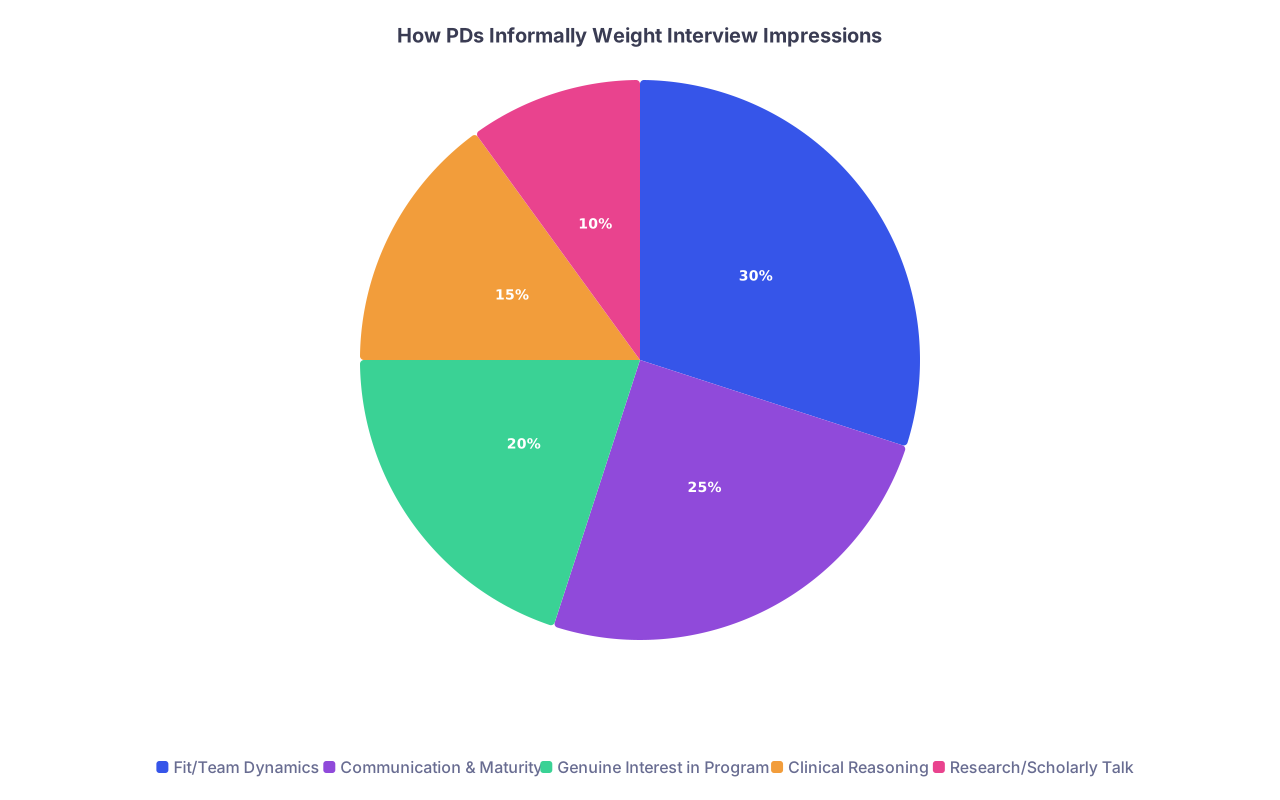
| Category | Value |
|---|---|
| Fit/Team Dynamics | 30 |
| Communication & Maturity | 25 |
| Genuine Interest in Program | 20 |
| Clinical Reasoning | 15 |
| Research/Scholarly Talk | 10 |
None of that is printed. But it’s how the room talks.
So your job in every answer is not to show off everything you’ve done. Your job is to quietly answer the real questions behind the question:
- Are you safe?
- Are you honest?
- Will you work hard without burning bridges?
- Do you actually want to be here?
If your answers hit those chords consistently, you do better than a slick talker who misses them.
How to Practice the Right Way (Not Like Everyone Else)
Most people “practice” interviews by memorizing paragraphs. That’s exactly how you become stiff and forgettable.
Insiders practice differently:
- They define 6–8 core stories (patient encounter, failure, conflict, leadership, learning moment, why specialty, why program, resilience).
- They know the point of each story: what quality it proves (teamwork, honesty, growth, etc.).
- Then they practice telling them in different lengths (30, 60, 120 seconds) so they can adapt naturally.
You want your stories to feel like real conversation, not recitations. The content stays; the exact wording can flex.
And for the love of God, record yourself at least once. Every PD I know agrees: many candidates have no idea they ramble or never actually answer the question.

| Step | Description |
|---|---|
| Step 1 | Interview Question |
| Step 2 | Use Why specialty/program stories |
| Step 3 | Use real failure/conflict story |
| Step 4 | Highlight collaboration & humility |
| Step 5 | Walk through structured reasoning |
| Step 6 | Answer with 1-2 clear points |
| Step 7 | End with brief reflection or takeaway |
| Step 8 | What are they really testing? |
This is how you think like a resident, not a test-taker.