It’s 7:58 a.m. You’re sitting outside the conference room, clutching your folder, trying not to sweat through your suit. The coordinator calls your name. You walk in, shake a few hands, sit down.
By 8:03 a.m., the program director has already decided whether you’re safe… or a problem.
Let me tell you what really happens in those first five minutes. Because decisions are getting made faster than anyone admits publicly, and they’re not about your Step score or your research pub count. Those are already known. What they’re judging now is: “Do I want this person on my team at 3 a.m. when things are on fire?”
That’s what this is really about.
How Fast PDs Actually Judge You
Here’s the truth faculty won’t put on their website: most of the meaningful “rank” impressions are formed in the first 5–10 minutes. The rest of the interview just confirms or occasionally overturns that gut decision.
I’ve watched PDs lean back in their chair after the first question, tilt their head, and quietly write a single word on the eval sheet: “Nope.” The interview still goes on for 20–30 minutes. The small talk continues. But the door is already closed unless you do something extraordinary to change it.
Those first 5 minutes are about red flags. They’re not trying to see if you’re perfect. They’re scanning for problems. Risk. Headaches.
Most of you think red flags are big, obvious things: failing Step, gaps in training, a professionalism note in your file. Sure, those matter. But the PD already knows all that before you sit down. What they’re catching in the first 5 minutes are the subtle red flags you don’t even realize you’re broadcasting.
Let’s go through them one by one.
Red Flag #1: Your Body Walks In Before Your Brain Does
The door opens. You step in. For the next 10 seconds, you’re not being judged on content. You’re being judged on presence.
Here’s what PDs and attendings actually notice, even if they don’t articulate it:
- You shuffle in vs. you walk in with purpose
- Your eyes are on the floor vs. you scan the room and make contact
- Your shoulders are rounded, backpack-kid posture vs. upright, “I belong here”
- Your handshake is a limp, two-finger mess vs. firm, brief, confident
- Your voice comes out as a mumble vs. clear, steady, audible
Nobody tells you this in “official” prep sessions, but I’ve heard PDs say this verbatim once the door closes:
“That one looked terrified. I don’t want them falling apart on Night Float.”
Or worse:
“He couldn’t even look me in the eye. How’s he going to talk to angry families?”
They’re not looking for a motivational speaker. They’re looking for basic functional confidence. Residents teach students. Residents talk to consultants. Residents lead codes. If you seem like you can’t anchor a simple human interaction, that’s a red flag.
What to fix:
You don’t need to become charismatic. You need to become steady.
Practice walking into a room, sitting down, greeting 2–3 people, and saying, “Hi, I’m [Name]. Thank you for having me today,” in a calm, audible voice. Record it. You’ll hate the first few. Repeat until you don’t look like you’re hoping to disappear.
This isn’t about being extroverted. It’s about communicating: “I can function under pressure without crumbling.”
Red Flag #2: You Can’t Give a Clean, Coherent “Tell Me About Yourself”
The first question in 80% of interviews is some version of: “So, tell me about yourself” or “Walk me through your story.”
PDs listen to your structure more than your biography.
What they flag in the first 60–90 seconds:
- You ramble in circles
- You give your entire CV chronologically from birth
- You dive into a 3-minute dissertation about your undergrad honors thesis
- You never mention why this specialty, why this program, or what you are like as a resident
Behind the scenes, this is how they interpret it:
If you can’t summarize your own life in 60–90 seconds, how are you going to present a new patient in morning report without spiraling?
I’ve sat in debriefs where attendings literally say: “Their answer to ‘Tell me about yourself’ was all over the place. They’re going to be a 15-minute presenter for a 5-minute case.”
You need a tight, rehearsed—but not robotic—TMAY.
A clean answer does three things:
- Gives a quick anchor of who you are (background in one sentence, not three paragraphs).
- Connects your path to the specialty in a believable, non-cheesy way.
- Punches out with where you are now and what kind of resident you want to be.
If your TMAY is running beyond 90 seconds, that’s a problem. If you hear yourself using filler words (“um, like, sort of, kind of”) every third word, that’s a problem. Those are red flags of disorganization and insecurity.
Record it. Time it. Then sharpen it until it’s clean.
Red Flag #3: Your Energy Is Off – Either Flat or Performative
This one is subtle, but it kills more interviews than you’d think.
Within five minutes, most PDs have categorized your “energy” into one of three buckets:
- Solid: Engaged, calm, present.
- Concerningly flat: Low affect, monotone, hard to read, seems disengaged.
- Performative and fake: Overly enthusiastic, forced laughter, “used car salesperson” vibes.
Guess which two categories trigger red flags.
Flat energy gets interpreted as burnout, depression risk, or someone who will disappear on the team. I’ve heard:
“Nice enough, but they seemed dead inside. We don’t need another ghost on wards.”
Over-performative energy feels like you’re acting. Overly polished, every answer a slogan, constant smiling even when discussing serious topics. The thought process: “What are they hiding? What happens when the act drops?”
Programs don’t need cheerleaders. They need stable human beings who can show up and stay the course. First 5 minutes tell them a lot about that.
Quick self-checks:
- If people in your life have said you seem “hard to read” or “low energy,” you need to consciously turn the dial up one notch in interviews: more eye contact, a bit more inflection, slightly more expressive facial responses.
- If people say you’re “a lot” or “always on,” you need to slow your speech down, drop the volume 10%, shorten your sentences, and leave space after questions.
Not fake. Controlled.
Red Flag #4: You Don’t Know the Program – At All
This one is unforgivable in PD land.
Within minutes, they will test whether you’ve done any real homework on their program. Sometimes it’s direct: “So, why our program?” Sometimes it’s more concealed: “What kind of training environment are you looking for?” and then they watch to see if what you describe matches anything they actually offer.
The red flag version looks like this:
- You give a generic answer that could apply to any program in the country.
- You mention features they don’t have (trauma center status, fellowships, specific tracks).
- You clearly confuse them with another program in the same city.
I watched a PD at a solid mid-tier IM program in the Midwest literally scribble a big X next to an applicant’s name after this:
Applicant: “I love how strong your cardiology fellowship is.”
PD: “We don’t have a cardiology fellowship.”
Applicant: “Oh, right—I mean, just the strong fellowship opportunities in general.”
PD (later, outside): “Lazy. Didn’t even click the website.”
That was it. Done.
You don’t need a 10-page dossier on every program. But you must be able to, in the first few minutes, show that you:
- Know their basic structure (community vs academic, major tracks or features).
- Understand something specific that attracted you (e.g., X clinic, Y rotation, Z format).
- Can connect that to your goals or personality.
If you can’t do that, they assume you spam-applied and do not care. Which means you’re a flight risk if they rank you.
Red Flag #5: You Give Off “Blame Vibes” Immediately
Here’s something I rarely see students prepare for: attitude toward adversity in those early questions.
Within five minutes, you’ll often get something like:
- “Tell me about a challenge you faced.”
- “Tell me about a time something didn’t go as planned.”
- “Walk me through that leave of absence / failed exam / low clerkship grade.”
This is where PDs look for the “blame vector.”
Red flag responses:
- You spend most of your answer talking about how unfair someone else was.
- You name names and dump on specific attendings, schools, or systems.
- You never use the phrase “I could have done X differently” or “I learned Y.”
- You describe yourself as a victim of circumstance, full stop.
After one of these answers, I heard an APD say:
“She’s going to be the resident who emails me at 2 a.m. about how the nurse was mean instead of figuring out how to solve the actual problem.”
You’re allowed to acknowledge unfairness. Medicine is full of it. But if there’s no hint of ownership or growth, that’s a red flag.
Safer pattern:
- Briefly name the situation.
- Acknowledge what made it hard.
- Explicitly state what you learned and how you changed your behavior since.
If PDs don’t hear that last part in the first few minutes, you’re going into the “potential problem child” mental folder.
Red Flag #6: Poor Hygiene, Scent, or Distracting Appearance
Nobody likes to say this out loud, but it absolutely matters in the first minute.
A few things they notice immediately:
- Strong cologne/perfume that fills the room
- Body odor, stale sweat smell, unwashed hair
- Stained or wrinkled clothes, scuffed shoes that look neglected
- Facial piercings that violate hospital policy, unprofessional nail art in conservative fields
- Extremely unkempt facial hair
Is this “fair”? No. Does it happen? Yes. Constantly.
PD thought process is brutally simple: “If you can’t pull it together for the one day that decides where you train for 3+ years, what are you going to look like on rounds? With patients? With families?”
You don’t need a bespoke suit. You need clean, well-fitted, neutral clothing, minimal scent, and clear evidence you understand basic professional appearance.
I’ve seen borderline applicants get bumped up because they looked composed, neat, and “put together” compared to others with similar applications who looked like they changed in the car.
Red Flag #7: Social Blind Spots in Small Talk
You think the interview starts with the first formal question. It doesn’t. It starts in the hallway. In the Zoom waiting room. In the two minutes while they’re waiting for another interviewer to join.
The PD is watching how you handle “nothing” time.
Red flags show up as:
- You stare at the floor or your hands, offer one-word answers to casual questions.
- You interrupt stories or jump in to top someone else’s anecdote with your own.
- You ignore non-physician staff in the room (coordinators, admin, other residents).
- You visibly check the clock or your phone (yes, even a quick glance) when someone else is talking.
One PD I know has a line item on the evaluation sheet: “Is this someone I’d want to sit next to at 6 a.m. sign-out every day?” That score is often decided before the “real” questions even begin.
Residents are worse than attendings about this. They will absolutely tank your eval if you come off as rude, cold, or socially tone-deaf.
During those first informal minutes, your job is simple: be a normal human. Make basic conversation. Show interest. Don’t hijack the room. Don’t flex. Don’t correct people. Just… be someone who can exist with others.
Red Flag #8: Zero Insight Into Your Own Application
Within five minutes, some interviewer will reference a piece of your application: research, a gap, a unique hobby, a leadership role. They’re checking if your file matches the person in front of them.
Red flags here:
- You can’t clearly explain what you actually did in your research.
- Your story about your “passion for underserved care” sounds like you’ve never actually thought about it beyond the essay.
- You’re surprised or defensive when they ask about a weak spot in your file.
- You seem to be hearing your own narrative for the first time.
PDs have a good nose for scripted vs. owned stories. When you sound like you’re reading your personal statement back to them, they mark you as shallow or coached. When you can’t defend or contextualize your own choices, they mark you as lacking insight.
The behind-the-scenes judgment:
“Smart, but no self-awareness. High maintenance. Probably won’t handle feedback well.”
You need to have a mental map of your own file:
- Every oddity, gap, leave, low grade—have a clear, honest, brief explanation and a learning point.
- Every “big thing” you highlight—be ready with 1–2 specific examples or stories behind it.
PDs assume: If you haven’t reflected on your own path, you’re not going to reflect on your mistakes in residency either.
Red Flag #9: Disrespect or Disinterest Toward Other Specialties & Teams
This one burns people without them realizing it.
Very early on, PDs will pick up whether you see medicine as a team sport or as you versus the world. They listen carefully when you talk about:
- Rotations you liked and disliked
- Difficult attendings
- Other specialties
- Nurses, social workers, consultants
Red flags in the first few comments:
- Joking about “dumping on medicine” or “calling consults just to get rid of work.”
- Calling certain specialties “useless” or “annoying.”
- Talking about nurses as obstacles rather than partners.
- Mocking other programs, schools, or systems.
I sat through a debrief where a PD said:
“He’s going to be that surgical resident who screams at the nurse for calling a rapid response. I’m not bringing that into my program.”
They have seen enough toxic residents. They’re allergic to even a whiff of that energy.
You don’t need to be saintly. You just need to show basic respect and understanding that everyone is overloaded and trying to do their job. If sarcasm is your default mode, you need to dial it way back on interview day.
Red Flag #10: You Overplay or Underplay Your Interest
Within the first five minutes, PDs are also thinking about one cold reality: yield. Who’s actually going to come if we rank them highly?
So they watch how you signal interest. Two opposite red flags:
Needy and desperate:
- You mention repeatedly how this is your “absolute top choice” to everyone you meet, day isn’t even halfway through.
- You push for reassurance (“Do you think I’d be a good fit?” “What are my chances?”).
- Your questions feel like a plea for validation, not genuine curiosity.
This reads as anxious, unstable, and frankly a little manipulative. PDs don’t like being cornered.
Too aloof:
- You give off the vibe that you’re above the program.
- You visibly compare them to “higher tier” places you’ve interviewed.
- Your answers and body language say, “I’m here because I have to be, not because I care.”
That triggers “flight risk” alarms. They’ll rank someone slightly “weaker on paper” who actually looks like they might come.
Healthy middle ground: you show that you’ve done your homework, you can concretely state what you like about them, and you treat the opportunity as real. You don’t have to lie and say they’re number one. You just have to show they’re not an afterthought.
| Red Flag Area | What PDs Infer About You |
|---|---|
| Body language & presence | Will you function under pressure? |
| TMAY / first answers | Can you think and communicate clearly? |
| Energy & affect | Burnout risk, stability, authenticity |
| Program knowledge | Actual interest vs spam applying |
| Challenge/weakness talk | Ownership vs blame, coachability |
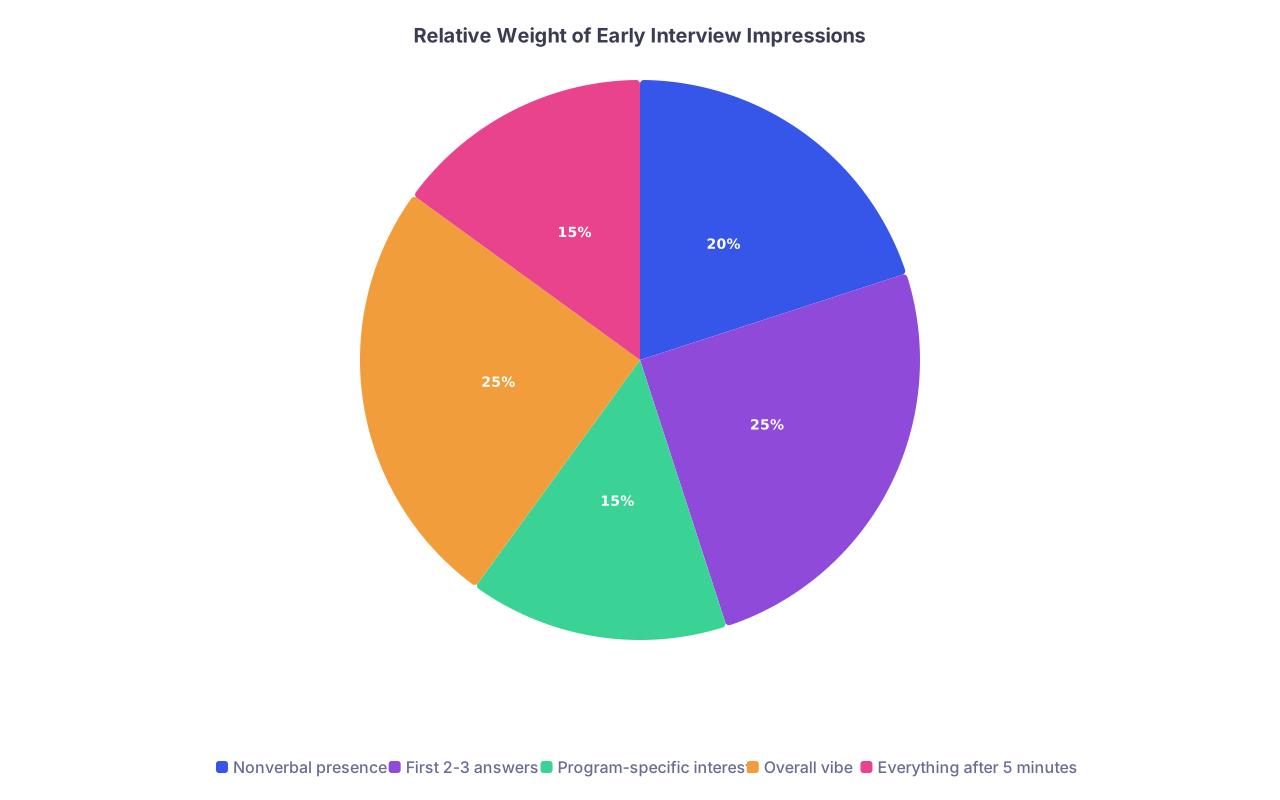
| Category | Value |
|---|---|
| Nonverbal presence | 20 |
| First 2-3 answers | 25 |
| Program-specific interest | 15 |
| Overall vibe | 25 |
| Everything after 5 minutes | 15 |
How to Actually Prepare for Those First 5 Minutes
You don’t fix these red flags by reading another generic list of interview questions. You fix them the way programs evaluate you: by watching yourself.
Here’s what I’ve seen work for applicants who transformed from shaky to solid:
Record a 5-minute “mock entrance + first questions” session. Not a full hour-long interview. Just:
- You walk into a room
- Shake hands / greet
- Sit down
- Answer: “Tell me about yourself,” “Why this specialty?” and one “challenge” question
Then watch it without the sound first. Just body language. Do you look grounded or scattered? Engaged or shut down?
Then listen with audio only. How’s your pace? Filler words? Tone? Do you sound like you believe what you’re saying?
Finally, watch the whole thing with video + sound. That’s how they’re seeing you.
Do this two or three times. Adjust. You don’t need to become perfect. You just need to eliminate the obvious red flags so programs can actually hear your strengths.

| Step | Description |
|---|---|
| Step 1 | Enter Room |
| Step 2 | Greeting & Handshake |
| Step 3 | Small Talk / Settling In |
| Step 4 | Tell Me About Yourself |
| Step 5 | Why This Specialty / Why Our Program |
| Step 6 | First Follow-up Question |
| Step 7 | Early Overall Impression Formed |
The Bottom Line: What PDs Decide in 5 Minutes
Let me strip it down to what’s really happening in those first few minutes.
They’re not deciding if you’re brilliant. They already know you can learn medicine or you wouldn’t be there. They’re deciding:
- Are you going to make my life easier or harder?
- Can I trust you at 3 a.m. with a sick patient and an overwhelmed team?
- Are you going to poison the culture we’ve spent years protecting?
The red flags we just went through—disorganized presence, blame-heavy stories, ignorance about the program, poor social awareness—are shortcuts to those deeper questions.
You don’t have to be perfect. You just have to be non-problematic enough that your actual strengths can get a fair hearing.
If you remember nothing else, remember this:
- The interview starts before the first question.
- Your first 2–3 answers matter more than you want to believe.
- They’re not looking for genius. They’re screening out risk.
Prepare for those first five minutes like your rank list depends on it. Because at most programs, it does.