
Relentless thank-you calls and emails have hurt more residency applicants than they have ever helped.
I am not exaggerating. I have watched well-qualified candidates drop from “strong consider” to “do not rank” because they turned post-interview communication into a nuisance. Not because they were rude or unprofessional. Because they were persistent, anxious, and oblivious to how programs actually operate.
You are not competing on who sends the most thank-you notes. You are competing on who is easiest to work with.
If your behavior after the interview makes people think, “This person will be high-maintenance and exhausting on call,” you are done.
Let’s make sure you do not become that story.
The Core Reality: You Are Taking Time from People Who Have None
Here is the first mistake: forgetting that every email and call you send is an interruption.
Program coordinators are juggling:
- 800–2,000 applications
- 100–200 interview days / slots
- Faculty who cannot remember their Zoom links
- Residents who no-show for interview dinners
- GME deadlines, ACGME paperwork, and a constantly ringing phone
Now add: “Applicant sent 6 follow-up emails asking to confirm that we received their thank-you.”
That is how you get a quiet eye-roll and a mental note: “Neediness. Not a good sign.”
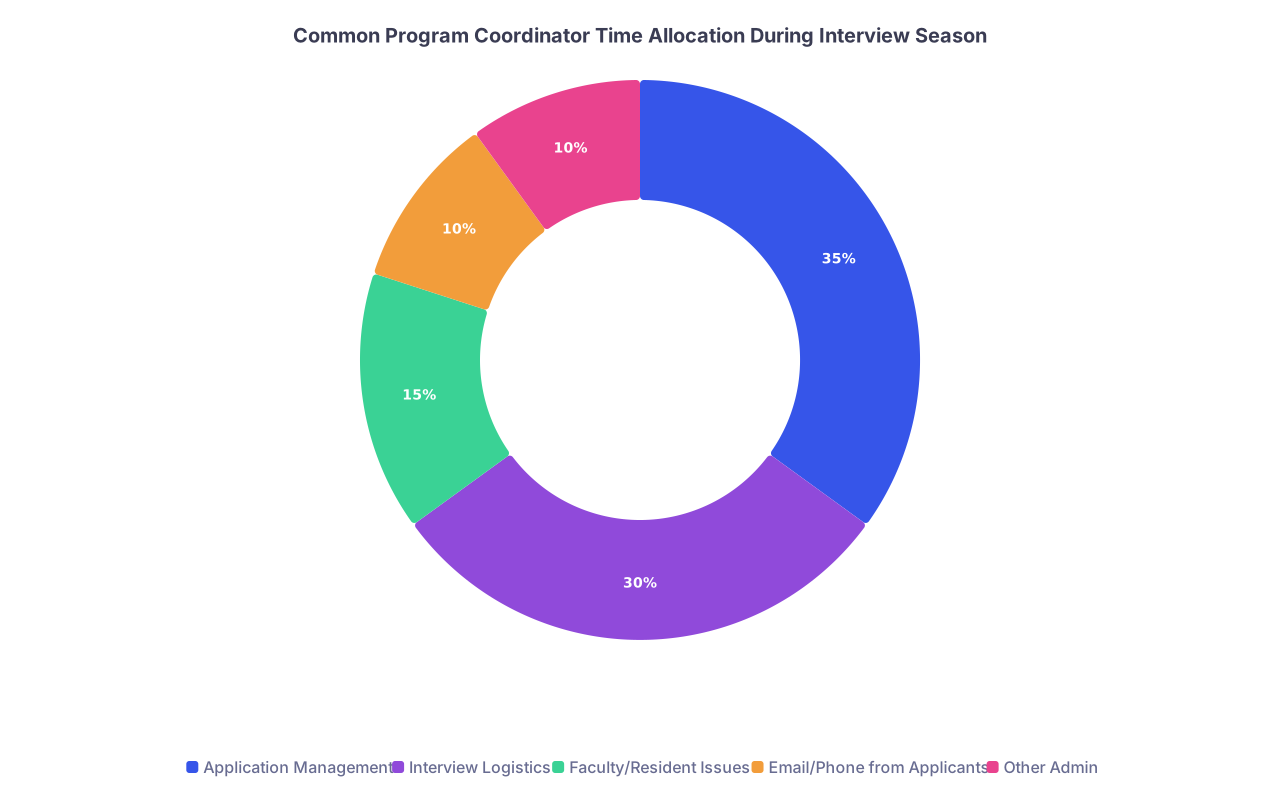
| Category | Value |
|---|---|
| Application Management | 35 |
| Interview Logistics | 30 |
| Faculty/Resident Issues | 15 |
| Email/Phone from Applicants | 10 |
| Other Admin | 10 |
You are not seeing the whole board. You see your single message. They see your message as 1 of 100 that morning.
Your job is not to stand out by sheer volume of communication. Your job is to leave such a calm, competent impression that they barely notice the logistics around you.
Mistake #1: Treating Thank-You Notes Like a Graded Assignment
Programs are not scoring your thank-you note.
Read that again. Internal medicine at a big academic center. Surgery at a community program. Pediatrics at a children’s hospital. The sentiment is the same: “We do not rank based on thank-you emails.”
Yet applicants act like this is a secret bonus section on an exam.
Here is what programs actually do with thank-you notes:
- Some skim them and move on.
- Some do not read them at all.
- A few attach them to your file, but they already made a preliminary ranking impression from the interview itself.
What does hurt you:
- No thank-you at all when the culture expects basic politeness (some programs notice; a few care).
- A thank-you that is oddly intense, manipulative, or clearly copy-pasted.
- Multiple “thank-you” messages that turn into a running thread of anxiety.
Signs your thank-you email is crossing the line
If your email:
- Is longer than 2 short paragraphs.
- Mentions “this program is my top choice” when it clearly is not (they can often tell).
- Tries to clarify or “fix” multiple interview answers.
- Feels like an essay instead of a simple expression of gratitude.
…then you are overdoing it.
What most faculty remember fondly:
- A short, specific, gracious note.
- Personalized enough to show you were actually paying attention.
- Sent once. Within a week. And then silence.
If you are spending 45 minutes per thank-you email and doing 15 interviews, you are making a bad trade. That mental energy belongs with your rank list, your well-being, or actually reading about the specialty you claim to love.
Mistake #2: The “Did You Get My Email?” Spiral
This one gets people in trouble fast.
Pattern I have seen more times than I like:
- Interview Monday.
- Applicant sends thank-you Tuesday morning.
- No reply by Thursday. Anxiety spikes.
- Applicant sends follow-up: “Just wanted to confirm you received my earlier email.”
- No reply again. Applicant calls the coordinator.
- Coordinator writes in notes: “Multiple contacts about email. A bit intense.”
Here is what you are missing: faculty often do not reply to thank-you emails. At all. By design. They are not being rude. They are being realistic.
Many programs explicitly tell interviewers:
“Feel free not to reply to thank-you emails. Do not promise anything. Do not indicate rank status.”
So if your brain is interpreting silence as “they hate me” or “they must not have seen it,” you are inventing a problem and then broadcasting your anxiety to the program.
You send one email. That is it. No confirmation message. No follow-up. No “just bumping this to the top of your inbox.”
Your thank-you email is a courtesy, not a conversation starter.
Mistake #3: Calling Programs “To Say Thank You”
Phone calls to “personally express my appreciation” almost always backfire.
Coordinators do not have time for unscheduled gratitude calls. They especially do not have time for calls that turn into:
- “While I have you, I had just a few quick questions…”
- “Do you know when the rank list meeting is?”
- “I wanted to reiterate how interested I am in your program.”
You think you sound enthusiastic. On their end, it sounds like:
- Needy
- Time-consuming
- Potentially boundary-challenging as a future resident
Phone calls are appropriate for:
- Canceling or rescheduling an interview when email is too slow.
- Clarifying an urgent technical issue (Zoom link not working, etc.).
- Responding to an explicit invitation to call.
They are not appropriate for thank-you messages in 2026. That era is over.
If you are thinking, “But a phone call is more personal,” stop. You are not trying to become their friend. You are trying not to be the applicant whose name they say with a sigh.
Mistake #4: Over-Personal Disclosure in Thank-You Messages
Here is a quiet red flag that makes people very nervous: too much personal detail in a short email.
Examples I have actually seen variations of:
- “I felt such a strong connection with you; I have never felt this way about any program director before.”
- “I was really depressed after my last few rejections, but your interview gave me hope again.”
- “Talking with you reminded me of my late father and I got emotional afterward.”
This makes faculty uncomfortable. Not because they lack empathy. Because they are imagining you as an intern in a crisis, and they are already wondering: “Will this person blur boundaries? Will emotions regularly override professionalism?”
Keep your thank-you note:
- Professional
- Warm but not intimate
- Focused on the program and what you learned, not your emotional journey
If you would hesitate to say it in a room with three attendings and two residents, it does not belong in an email either.
Mistake #5: Using Thank-You Emails as a Backdoor for Updates and Negotiation
This one is sneaky. People pretend they are “just saying thanks” but really they are trying to:
- Add an extra LOR after the fact
- Report a minor “update” (poster accepted, small teaching award)
- Ask if the program is “still strongly considering” them
- Hint they will rank the program highly if they get some sign of interest
Programs see through this instantly.
Here is how it feels on their end:
- You are trying to reopen evaluation after the interview day is done.
- You are turning a polite convention into a power play.
- Worst case, you are fishing for illegal disclosures about rank status.
If you have a major update (new Step 2 score, couples match change, significant publication), that can justify one concise update email to the coordinator or the general program email — not hidden inside a thank-you to every interviewer.
And you do not ask, “How will this affect my rank?” You already know the answer: it might help a little, or it might not matter. They are not going to tell you either way.
| Scenario | Appropriate Action | Annoying Action |
|---|---|---|
| Routine thanks | 1 short email per interviewer | Multiple follow-ups, calls |
| Major update (Step 2 score) | 1 concise email to coordinator | Sending to every faculty you met |
| New publication | Add in ERAS if possible, 1 email if truly significant | “Just wanted to share all my new achievements since interview” |
| Clarifying logistics | Email coordinator once | CCing PD and associate PD on minor questions |
Mistake #6: Overdoing “You’re My #1” and Love Letters
Ranking language is a minefield. Misuse it and you upset programs, violate NRMP expectations, and risk being seen as manipulative.
Programs generally dislike:
- Exact rank statements from applicants (“I will rank you #1”).
- Over-the-top affection for multiple programs (yes, word gets around).
- Anything that sounds like pressuring them to reciprocate.
They hate:
- Applicants later discovered to have told multiple programs “You are my #1.”
- Messages that sound like: “If you rank me highly, I will rank you highly.” (This edges toward match violation territory.)
If you want to express strong interest without sounding desperate or unethical:
- Use one short “interest” email for your true top program (and mean it).
- Phrase it as “I plan to rank your program very highly” or “Your program is my top choice” only if it is actually true.
- Do not send this kind of message to more than one or two places. You may think you are being clever. You are not.
And do not bury this inside a second or third thank-you email. That just compounds the annoyance.
Mistake #7: Bad Timing — Last-Minute Bursts and Rank Week Chaos
There is a pattern that makes coordinators twitch: the “Rank List Panic Blast.”
Timeline looks like this:
- November–January: normal interview flow, some thank-you emails. Fine.
- Late February / early March: suddenly, a flood of “I just wanted to check in and reaffirm my interest” messages.
- Rank order list certification week: a few desperate “Have you finalized your rank list? Am I still under consideration?” emails.
This behavior does not change rank lists. At all.
What it does:
- Confirms that the applicant struggles with anxiety management under pressure.
- Creates extra work right when the program is trying to finalize complex decisions.
- Annoys people enough that, if you were borderline, you may slide down rather than up.
Send your thank-you note within 3–7 days of the interview.
If you choose to send one genuine “this is my top choice” message, send it once, around mid-season or when you finalize your own thinking.
Then stop. No radio check-ins. No rank-week flailing.
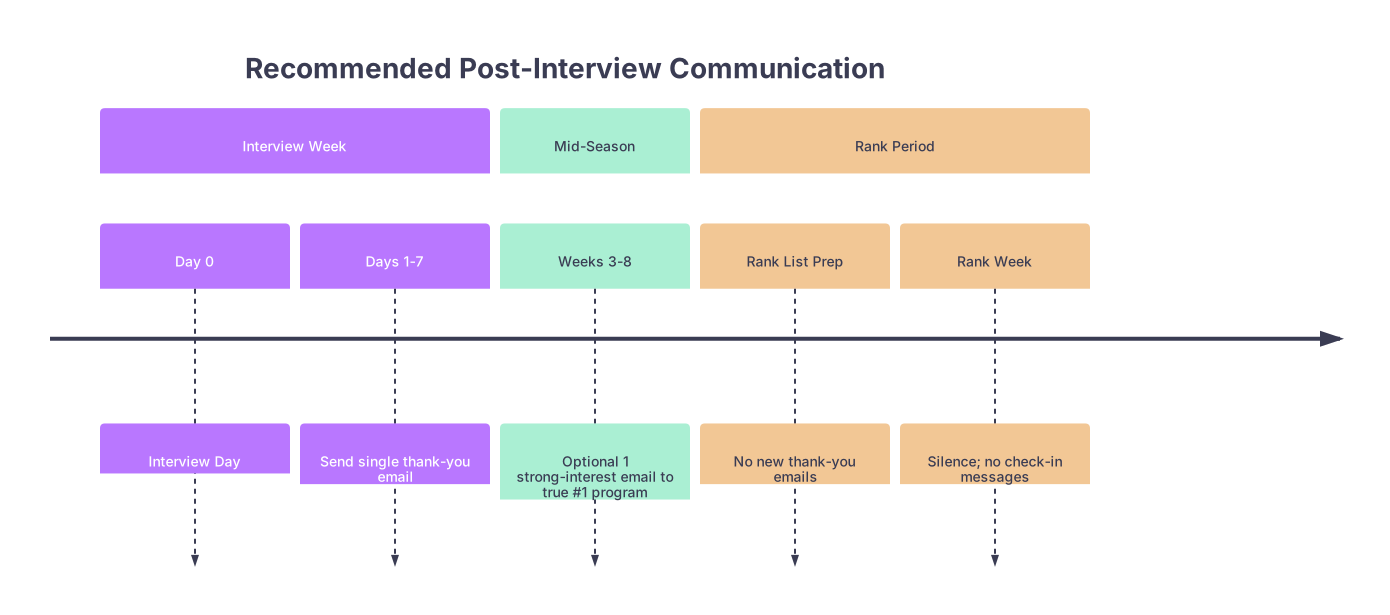
| Period | Event |
|---|---|
| Interview Week - Day 0 | Interview Day |
| Interview Week - Days 1-7 | Send single thank-you email |
| Mid-Season - Weeks 3-8 | Optional 1 strong-interest email to true #1 program |
| Rank Period - Rank List Prep | No new thank-you emails |
| Rank Period - Rank Week | Silence; no check-in messages |
Mistake #8: Copy-Paste Sloppiness and Obvious Templates
Programs will forgive a generic thank-you. They will not forgive blatant carelessness.
Real examples I have seen:
- “Thank you, Dr. [Insert Last Name Here]” — brackets included.
- Email addressed to the wrong program.
- Mentioning a conversation that happened with a different interviewer.
- “I really enjoyed learning about your neurosurgery program” — sent to family medicine.
This does not make you look busy. It makes you look sloppy. Which is exactly what PDs do not want in someone managing orders, meds, and consults at 3 a.m.
If you are using templates (and that is fine), your rules:
- Edit the salutation and at least one sentence that is specifically true for that person.
- Double-check program name, specialty, city, and gendered titles if used.
- Never trust autocomplete when addressing faculty — it will burn you.
You do not get bonus points for literary flourish. You do get penalized for sending “Dear Program” to Dr. Singh.
Mistake #9: Turning Residents into Message Relays
Post-interview dinners and socials are informal. That does not make residents your personal backchannel.
Red flags when messaging residents afterwards:
- DM’ing residents on Instagram or WhatsApp with long thank-yous and rank questions.
- Asking, “Do you think the PD liked me?” or “What are my chances?”
- Asking residents to “put in a good word” after the interview.
You put residents in a bad position:
- They are not supposed to discuss rank deliberations.
- They are not your agents.
- Many will quietly report concerning interactions to the chief or PD.
A simple, one-line “Thanks again for chatting with me during the social, I appreciated your honesty about call schedule” message is fine if you already exchanged emails. But this is optional. Not required. And it stops there.
No follow-ups asking for inside information. That looks desperate and unprofessional.

Mistake #10: Ignoring Program-Specific Instructions
Some programs now explicitly say in their interview materials:
- “Thank-you notes are not necessary and will not impact ranking.”
- “Please direct all post-interview communication to the program coordinator only.”
- “Faculty are unable to respond to applicant emails due to volume.”
And yet. Applicants still:
- Email every interviewer individually.
- CC the PD on routine questions the coordinator could answer.
- Apologize for “ignoring the policy” but send the email anyway.
You think you are the exception. The one charming, earnest candidate they will secretly appreciate.
You are not. You are the person who showed they either do not read or do not respect clear directions.
If they say “no thank-you necessary,” you can:
- Obey and send none. That is perfectly acceptable.
- Or send one concise email to the general program address, addressed to the team.
Both are fine. What is not fine is pretending you did not read what they wrote.
What a Non-Annoying Thank-You Email Actually Looks Like
Keep it boring. Boring is safe. Safe is good.
Example:
Subject: Thank you for the opportunity to interview
Dear Dr. Lopez,
Thank you for taking the time to speak with me during my interview with the [Program Name] internal medicine residency on January 8. I appreciated our discussion about the program’s emphasis on resident autonomy in the ICU and your description of how senior residents are supported when taking on that responsibility.
My conversations with you and the residents reinforced my strong interest in your program’s combination of rigorous clinical training and supportive culture. I am grateful for the opportunity to have interviewed.
Sincerely,
[Your Name]
AAMC ID: #######
Notice what it is not doing:
- Not asking any questions.
- Not asking for confirmation.
- Not hinting about rank list.
- Not oversharing.
- Not more than 2 short paragraphs.
You send something like this once. Then you leave them alone.
The Bottom Line: Behave Like Someone They Want on the Team at 3 A.M.
Programs are not looking for the most effusive or persistent communicator. They are looking for:
- Low-drama.
- Respectful of time and boundaries.
- Competent, organized, and not emotionally volatile.
Your thank-you and follow-up behavior is a free preview of how you will handle:
- Pages from nurses
- Messages from attendings
- Emails from GME
- Stress when communication is imperfect
Do not give them any reason to wonder if you will be the resident sending three “just following up again” messages to radiology overnight.
Three Things To Remember
- One short, specific thank-you email per interviewer (or per program, if they prefer) is enough. No follow-ups. No calls.
- Never use thank-you messages to fish for rank information, push updates aggressively, or manage your anxiety. That burden belongs to you, not the program.
- The less work you create for busy coordinators and faculty, the better you will quietly look when they sit down to rank.