
Oversharing personal struggles in residency interviews is one of the fastest ways to sink an otherwise strong application.
Not because programs do not care about your story. They do.
Because your judgment under pressure is exactly what they are evaluating—and oversharing screams poor judgment.
I have watched excellent applicants walk into interviews with solid Step scores, strong letters, and great rotations… and then talk themselves straight onto the “do not rank” list because they treated the residency interview like trauma therapy.
You are not going to make that mistake.
Let us go through the specific ways oversharing personal struggles can hurt you, what interviewers are actually listening for, and how to talk about adversity without sabotaging your rank list.
The Core Problem: You Think “Vulnerable” Means “Tell Them Everything”
The residency advice industrial complex has sold you a half-truth: “Be authentic. Be vulnerable. Share your struggles.”
Unqualified, that advice is dangerous.
You are not talking to a therapist, a best friend, or a supportive mentor who knows you well. You are talking to:
- Program directors who must staff a hospital safely.
- Faculty who will have to trust you on night float at 2 a.m.
- Residents who want to know if you will be a stable, reliable teammate.
When you overshare, here is what they start quietly asking themselves:
- Will this person be able to handle the stress of residency?
- Will they bring chaos or drama into the program?
- Will they need constant emotional support we cannot realistically provide?
- Will this blow up into a professionalism or impairment issue down the line?
They are not heartless. They are risk-averse. Their primary job is patient safety and team stability, not your personal healing arc.
You must talk about hardship like a physician, not like a patient.
The Most Common Oversharing Disasters
If you recognize yourself in any of these, you are exactly who I am talking to.
1. Unfiltered Mental Health Disclosures
I am not saying “never mention mental health.” I am saying most applicants do it badly.
The dangerous pattern looks like this:
- You describe severe, recent episodes of depression, panic attacks, suicidal ideation, or self-harm.
- You make it sound ongoing, unstable, or poorly managed.
- You do not clearly show treatment, follow-up, and sustained recovery.
- You spend more time on the pain than on the resolution.
What interviewers hear:
- “I might not be safe alone with patients, call schedules, and stress.”
- “I might have major disruptions in residency with leave, impaired performance, or burnout.”
- “I want support more than I want to show readiness.”
If you cannot confidently say your condition is well treated, stable, and has not compromised your recent performance, you should not be leading with it—if mentioning it at all.
2. Graphic Family Trauma and Chaos
I have heard applicants go into extended detail about:
- Domestic violence in their home growing up.
- A parent’s severe addiction with vivid episodes.
- Being disowned, abandoned, or embroiled in ongoing family conflict.
- Ongoing legal battles, restraining orders, or custody disputes.
Do those experiences shape who you are? Of course.
Do they belong in a 20–30 minute professional assessment of your readiness to be a physician? Only if you are extraordinarily careful.
What interviewers worry about:
- Is this person still in the middle of this chaos?
- Are they bringing unresolved trauma into a high-stress training environment?
- Will they be consumed by personal crises during residency?
Residency programs want resilient applicants, not actively destabilized ones.
3. Using the Interview as Confessional
This one is obvious to everyone in the room except the applicant.
Interviewers hear:
- “I have never talked about this before, but…”
- “I do not usually share this…”
- Tears begin. Long pauses. The room feels like a therapy session.
Let me be blunt: breaking down in an interview over an unprocessed issue will terrify most committees.
Not because they lack compassion. Because they are mentally projecting you into:
- A code situation.
- A dying patient’s room.
- A 28-hour call with 16 patients to pre-round on.
If you cannot stay functional in a low-stakes conversation, they doubt you will hold up in high-stakes care.
4. Adversity With No Clear Recovery Arc
This is where many personal struggle stories die.
You talk about:
- Failing Step 1.
- Failing a course or OSCE.
- Taking a leave of absence.
- Struggling with substance use.
- A major relationship or marriage meltdown during clerkships.
But you do not provide three key things:
- Concrete actions taken to address the problem.
- Sustained evidence of improvement.
- A clear, calm, matter-of-fact tone.
Instead, you sound:
- Defensive.
- Guilty or ashamed.
- Vague about timelines.
- Unsure it will not happen again.
Programs do not reject you for having problems. They reject you for looking like an ongoing problem.
5. Trauma as Personality Brand
Some applicants have been taught to make their trauma their “hook.”
They assume: “Everyone has scores and research. I have this unique tragic story. That will make me memorable.”
Yes. It will make you memorable. For the wrong reasons.
- “This person is centering their identity around being damaged, not being effective.”
- “They have turned their suffering into their main selling point.”
- “Where is the competent, grounded physician in this story?”
You want to be remembered as “that thoughtful, solid candidate who handled a tough situation well,” not “the applicant with the horrifying story.”
What Interviewers Are Actually Trying to Assess
Let us strip away the noise. On adversity questions, they are probing four things:
Judgment
Do you know what is appropriate to share in a professional setting?
Do you show discretion? Boundaries? Self-awareness?Stability
Are you emotionally and psychologically stable enough for residency?
Can you handle high volume, high acuity, and long hours without falling apart?Reliability
When things get stressful, do you become more focused and organized, or more chaotic and needy?Growth
Do you extract lessons from hardship that make you better to work with?
Or do you stay stuck in the narrative of what happened to you?
Oversharing personal struggles usually fails points 1 and 2 first. Interviewers may not say that out loud in feedback sessions, but I have heard the coded phrases over and over:
- “Might need more support than we can provide.”
- “Not sure about resilience.”
- “Story is still too raw.”
- “Boundary issues.”
Safe vs. Risky Topics: A Quick Comparison
Not all adversity is equally radioactive. Some is straightforward to discuss. Some is a minefield.
| Topic Type | Safer to Discuss | High-Risk to Discuss |
|---|---|---|
| Academic Issues | Single failed exam, remediated | Multiple failures, vague remediation |
| Health / Mental Health | Past, well-treated, stable | Recent, unstable, ongoing crisis |
| Family / Personal | Bereavement, caretaking roles | Graphic trauma, active conflict |
| Professional Conflict | Resolved team disagreement | Ongoing legal or HR disputes |
| Leaves of Absence | Single, clearly explained | Multiple, poorly explained |
If you are drifting into the right-hand column, your margin of error shrinks dramatically. One sloppy sentence can tank you.
How Oversharing Actually Hurts You (Mechanics Behind the Scenes)
I want you to understand how this plays out on the back end, after you leave the room.
1. Your “Global Impression” Score Drops
Most programs have some version of:
- Clinical competency
- Academic potential
- Interpersonal skills
- Overall impression / rank
You can ace three and still blow the last one. Oversharing usually torpedoes “overall impression” with comments like:
- “Strong candidate but concern about stability.”
- “Would rank cautiously.”
- “Avoid if other options available.”
You never see these notes, but they exist.
2. You Trigger Risk-Avoidance Mode
Every applicant is competing not just to be liked, but to not be seen as risky.
Programs have been burned before by:
- Residents needing emergency leaves.
- Professionalism complaints.
- Impairment issues.
- Unpredictable behavior under stress.
When you overshare, you remind them of those headaches. They default to safety. Which means choosing the equally qualified but lower-risk candidate.
3. You Get Pigeonholed By Your Story
If your personal struggles dominate your answers, you become “that story,” not “that resident.”
So when they sit down with 100 applicants and 15 spots, they are not remembering your procedural experience, your leadership, or your strong evaluations. They remember:
- “The student with intense family trauma.”
- “The one who broke down talking about depression.”
- “The one who went into detail about substance use.”
And they ask: “Do we really want to take this on?” Often, the answer is no.
How To Talk About Adversity Without Oversharing
You do not need to turn into a robot. You do need discipline.
Step 1: Choose the Right Story
Pick challenges that:
- Are fully resolved or clearly stabilized.
- Do not require graphic detail to be compelling.
- Show specific, measurable growth (grades improved, responsibilities increased, people trusted you more afterward).
Good examples:
- Failing an exam and then remediating successfully, with improved later performance.
- Caring for a sick family member while maintaining academic responsibilities.
- Handling a tough team dynamic on a rotation and resolving it professionally.
Dangerous examples:
- Recent psychiatric hospitalization.
- Graphic accounts of abuse.
- Ongoing custody battles or restraining order situations.
- Recent relapse of substance use.
If you insist on using a high-risk story, you had better be able to discuss it with the calm, contained tone of someone reading last year’s labs, not reliving yesterday’s crash.
Step 2: Strip Out Unnecessary Detail
You do not owe them your entire history to make a point. Short, clean, professional is the target.
Weak version (oversharing):
“I grew up in a home with constant screaming and physical abuse. My father was an alcoholic who would disappear for days. One night he…”
Stop. This is not a forensic report.
Stronger version (contained):
“I grew up in a very unstable home environment with significant conflict and inconsistency. That experience made me seek out stable mentors and taught me to be very deliberate about how I communicate under stress.”
Same life. Better filter. Less risk.
Step 3: Focus on What You Did, Not What Happened To You
Programs are hiring doers.
Your adversity answer should be 20% context, 80% actions, insights, and outcomes.
Bad ratio:
80% detailed scene setting, 20% vague “I learned resilience.”
Better ratio:
Brief context → specific steps you took → what changed → how that shows up in your work today.
Example structure:
- “During my second year, I failed the shelf for [rotation] and had to remediate.”
- “I met with faculty, identified that my issue was application of knowledge under time pressure, and created a structured practice schedule.”
- “On the repeat exam, I passed comfortably, and on later rotations my evaluations specifically noted improved clinical reasoning.”
- “Now, when I face a setback, my instinct is to get specific about the problem, seek feedback early, and put a concrete plan in place. That is how I approached [recent challenge].”
No drama. Just competence.
Step 4: Keep Your Emotions Under Control
Crying in an interview is not an automatic death sentence, but it does raise questions.
You need to rehearse any high-stakes story enough that you can:
- Say it calmly.
- Pause without falling apart.
- Answer follow-up questions without spiraling.
If you cannot get through your own story in a mock interview without getting overwhelmed, do not test it live with a program director.
Use a different example. Or shorten it drastically.
Step 5: Show Present Stability Clearly
For any serious past issue—academic, personal, or health-related—you must answer the silent question: “Why should we trust that this will not interfere with residency?”
That means you include:
- Timeline: “This occurred three years ago…”
- Concrete resolution: “Since then, I have…”
- Evidence: “My recent clerkship evaluations / Step 2 score / current schedule show that…”
If you cannot demonstrate sustained stability, do not push the story. You are not obligated to disclose every scar in your history.
Quick Frameworks You Can Use Safely
If you need structure, use it—but do not turn into a cliché robot.
A simple version that works:
- Brief Context – 1–2 sentences, no graphic detail.
- Your Response – What you did, who you involved, what plan you made.
- Outcome – How things improved, with at least one concrete indicator.
- Takeaway – What you do differently now as a result.
Keep the whole answer under 2 minutes. If you go past that, you are likely oversharing or rambling.
Practice: Red-Flag Statements To Eliminate
If these phrases are in your drafts or practice answers, cut or rewrite them:
- “I have never told anyone this before, but…”
- “This is hard to talk about…” (followed by long pauses and visible distress)
- “My whole world was shattered when…” (then a long dramatic monologue)
- “I still struggle with this a lot…” (with no clear stability plan)
- “I had a nervous breakdown…” (without medical framing or resolution)
Residency interviews are about readiness, not rawness.
A Visual Reality Check
Many applicants are tempted to overshare because they overestimate how much “story” weight programs want compared to basic competence and fit.
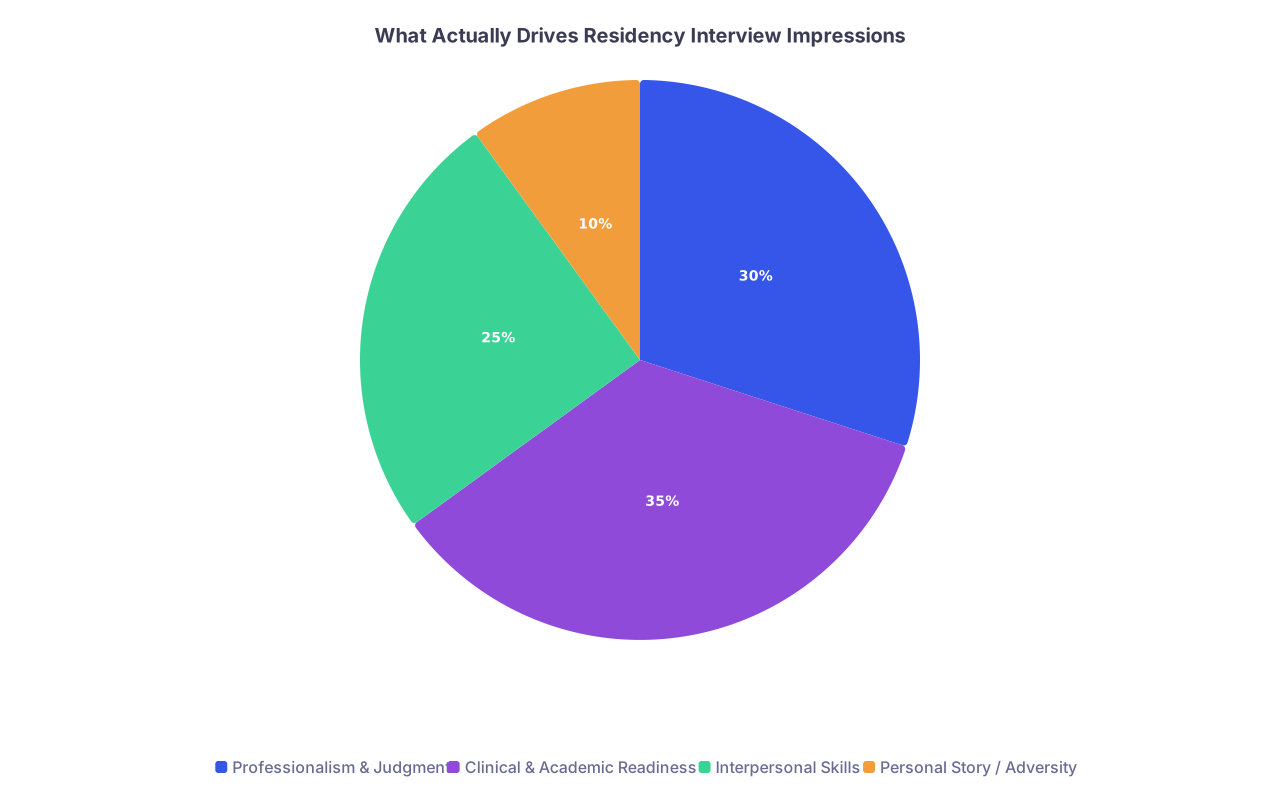
| Category | Value |
|---|---|
| Professionalism & Judgment | 30 |
| Clinical & Academic Readiness | 35 |
| Interpersonal Skills | 25 |
| Personal Story / Adversity | 10 |
Your personal story matters, but it is not the main act. If it starts to dominate, you look unbalanced.
What To Do If You Already Overshared in One Interview
You cannot undo it. But you can avoid repeating the error.
- Debrief honestly with someone experienced (advisor, trusted faculty, resident).
- Identify exactly where you crossed the line: too much detail, too recent, too emotional.
- Rewrite that answer into a tighter, more professional version—or pick a different story entirely.
- Practice out loud until you can deliver it calmly in under 90 seconds.
Do not double down because “it is my truth.” Your truth can exist without being poured unfiltered into every residency interview.
You are not betraying yourself by exercising discretion. You are showing maturity.

| Step | Description |
|---|---|
| Step 1 | Adversity Story Idea |
| Step 2 | Do NOT use this story |
| Step 3 | Frame with brief context |
| Step 4 | Focus on actions and outcomes |
| Step 5 | Show evidence of growth and stability |
| Step 6 | Safe to use carefully |
| Step 7 | Is it resolved and stable? |
| Step 8 | Needs graphic or intense detail to explain? |
| Step 9 | Can you tell it calmly in < 2 min? |
Key Takeaways
Do not confuse vulnerability with emotional exhibitionism. Programs want resilient, self-aware physicians, not open emotional wounds.
Do not make your trauma your brand. Use adversity only to demonstrate judgment, stability, and growth—never to shock or impress.
Do not improvise these answers. Script, refine, and practice them until they are clean, contained, and clearly show why you are safe to trust with patients and a pager.