
“Fit” is the most abused, least honest word in residency selection.
When a committee says, “We’re not sure about the fit,” what they really mean is: we do not want to tell you the real reasons you’re not rising to the top of our list. And those reasons are rarely what applicants think.
Let me walk you through what actually happens behind closed doors when programs talk about “fit” – and how you can prepare for residency interviews with those hidden criteria in mind.
What “Fit” Really Means When The Door Closes
Every program director will tell you some version of: “Fit is about values, mission, and alignment.” It sounds nice. It’s half true.
Behind the scenes, “fit” is shorthand for a messy bundle of questions:
- Will this person make our lives easier or harder?
- Will they function on our specific wards, with our culture, right now?
- Will they get along with our personalities and power structures?
- Will they embarrass us or make us look good?
- Will they stay, not quit, not blow up?
Nobody writes that in a handbook. But I’ve heard versions of it in almost every rank meeting.
Here’s the uncomfortable truth: once you’ve cleared the basic competence bar (scores, letters, red flags), the discussion is rarely about whether you’re good enough clinically. It’s about whether you’re the type of person they can see on rounds at 5:30 AM, in the workroom at 2 AM, and in the PD’s office when something inevitably goes wrong.
“Fit” is them trying to predict your behavior in their ecosystem.
And each ecosystem has its own unwritten rules.
The Real Levers Committees Use When They Say “Fit”
Let me break down what committees actually evaluate under the “fit” umbrella. These are the conversations that never make it to your feedback email.
1. Workhorse vs. Flight Risk
Programs are obsessed with one thing more than they admit: who’s going to keep the machine running?
At rank meetings, you’ll hear:
- “Will they tolerate our workload?”
- “Are they going to melt down halfway through intern year?”
- “They seem very ‘work-life balance’ oriented… are they going to hate our call schedule?”
Translation: they’re looking for workhorse signals without obvious signs of burnout risk or entitlement.
Signals you’re a workhorse:
- Longitudinal, sustained commitments (not 10 random 3-month things).
- Real experience with tough services and still positive about medicine.
- The way you talk about “hard work” versus “being exploited.”
The kiss of death is when someone says: “I’m not sure they understand how demanding this program is.” That’s code for: we’re not sure this person will put their head down and grind when it’s ugly.
You need to telegraph in your answers that you’ve been in the trenches and you didn’t crumble or grow bitter.
2. Culture of the Workroom
There is no universal “good personality.” There is only “good for this room.”
Some programs are sarcastic, dark-humor heavy, and fast-paced. Others are conflict-avoidant, ultra-polite, and hypersensitive to hierarchy. Some are nurse-dominated environments where diplomacy is king. Others are fellow-heavy shops where residents compete for scraps of autonomy.
Committee discussion sounds like:
- “They’re a bit intense. Would they rub our nurses the wrong way?”
- “Very quiet… will they disappear on nights and not speak up?”
- “Feels like they’d do better at a cushier/less malignant place.”
Programs are running a social simulation in their heads: put you in their current intern class, drop you on their busiest service, and ask: would this blow up?
The problem for you is you don’t see that culture fully on interview day. But you can read it.

| Step | Description |
|---|---|
| Step 1 | Application Reviewed |
| Step 2 | Interview Granted |
| Step 3 | Faculty & Resident Interviews |
| Step 4 | Post-Interview Debrief |
| Step 5 | Work Ethic Signals |
| Step 6 | Personality & Culture Match |
| Step 7 | Career & Program Alignment |
| Step 8 | Risk of Problems |
| Step 9 | Rank List Discussion |
| Step 10 | Final Rank Position |
| Step 11 | Score/Red Flag Screen |
| Step 12 | Discuss Fit |
3. Internal vs. External Candidate Dynamics
This one you will never see on a brochure.
If a program has strong internal candidates (home students, prelims, TYs, rotators who crushed it), the standard for “fit” for everyone else goes up. Not officially, but practically.
In meetings you hear:
- “Our students know how we work and they’re low-risk.”
- “This external looks strong, but is she better than [our own student]?”
- “We already know [rotator] can survive our ICU month.”
Home/rotator candidates come pre-vetted on the exact “fit” dimension: they’ve already functioned inside the system. Committees don’t have to guess.
For you, as an outsider, that means you need to reduce the guesswork. You do that by:
- Showing you’ve trained or rotated in similar environments (high-volume county, academic tertiary, community heavy).
- Speaking concretely about working with complex systems, EMRs, and interprofessional teams.
- Making it really easy for them to imagine your on-the-ground behavior.
If you are a home/rotator candidate and still don’t match there? Often the unspoken verdict is: “We’ve seen the real thing and the fit wasn’t good enough.” That’s painful, but honest.
4. Alignment With the Program’s “Self-Image”
Programs have egos. Strong ones.
Every program tells itself a story:
- “We’re the powerhouse research place.”
- “We’re the gritty safety-net, we serve the underserved.”
- “We’re the lifestyle, happy, no-malignancy program.”
- “We’re the procedural, hands-on, old-school medicine shop.”
Whether or not that story is fully true doesn’t matter. What matters is: they defend that identity when ranking.
I’ve listened to PDs say:
- “He seems very prestige-oriented. He’ll be unhappy if he doesn’t get constant research support.”
- “She sounds like she wants a cushy lifestyle; this place will eat her alive.”
- “He says rural primary care is his passion—this is a subspecialty funnel program, he’ll be frustrated.”
So when you walk into that room and say, “I want X,” they immediately compare that X to their internal self-image.
If you clash with it, even subtly, you become “bad fit.”
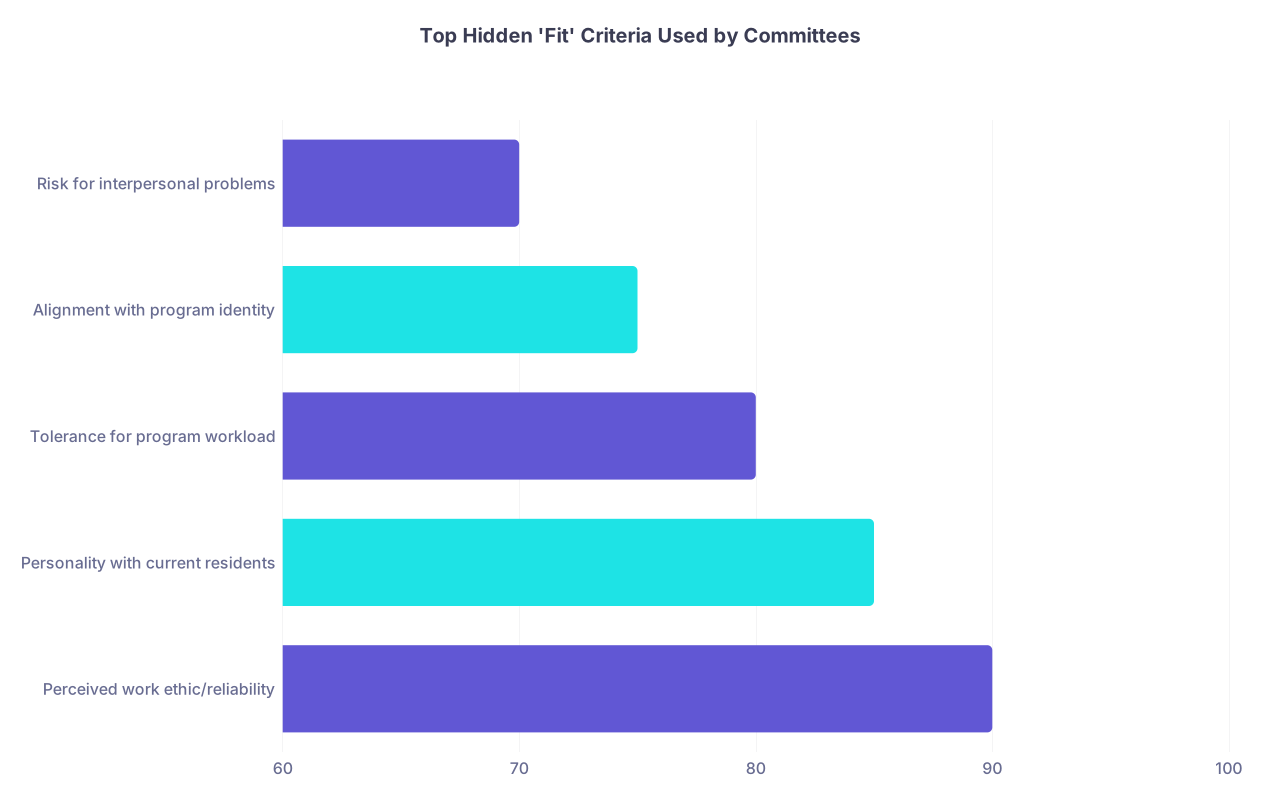
| Category | Value |
|---|---|
| Perceived work ethic/reliability | 90 |
| Personality with current residents | 85 |
| Tolerance for program workload | 80 |
| Alignment with program identity | 75 |
| Risk for interpersonal problems | 70 |
How They Decide You’re A “Good Fit” In 15 Minutes
You think you’re being judged on the sum total of your CV. You are not. You are being judged on:
- A few stories you choose to tell.
- Your vibe with residents.
- What interviewers say about you in two sentences.
Let me translate how that works.
1. The Two-Sentence Summary That Decides Your Fate
After you leave, each interviewer gets reduced to a soundbite. I’ve heard versions like:
- “Smart, a little intense, but would work well here.”
- “Great on paper, but something felt off. Very transactional.”
- “Nice, but I couldn’t get a read on them. Bland.”
- “You’d want this person on nights. Calm, no drama.”
Those 1–2 sentences shape your rank more than your 8-page ERAS printout.
What they’re actually encoding in those summaries:
- Emotional stability
- Ego size vs. humility
- Drama potential
- Coachability
- Social ease
If your answers are too canned, too perfect, or too generic, you end up as: “I couldn’t get a read.” That usually means you slide down the list. Not because anyone hates you, but because committees avoid uncertainty when they can.
2. Resident Vibe: The Shadow Interview
Residents have more power in “fit” discussions than you realize. PDs will pretend it’s all balanced. It’s not.
Off the record, I’ve heard:
- “The residents did not like him. They said he interrupted a lot.”
- “The residents loved her. Said she was the kind of person they’d want on call.”
- “Residents felt he talked down to them. Big red flag.”
A resident dinner can tank or boost you. And the comments are often vague: “Seemed chill.” “Seemed arrogant.” Those adjectives get repeated in the meeting like facts.
You prepare for this not by performing, but by dropping your guard just enough to be a normal human. Ask residents real questions. Don’t treat them like obstacles. Don’t obviously network up while ignoring them.
If residents feel disrespected or ignored, your “fit” score quietly dies.
3. Micro-Behaviors That Get Exaggerated
Interviewers read a lot into tiny things:
- How you react when your Zoom glitches.
- Whether you laugh at a joke or look terrified.
- If you can say “I don’t know” without panicking.
- How you describe your worst rotation or most difficult colleague.
They’re asking one core question: Is this someone I trust under stress?
When you talk about challenges, they’re not judging the story as much as your tone. Blaming, bitterness, martyrdom? Bad fit. Owning mistakes, staying grounded, not throwing others under the bus? Good fit.

How To Present As “Good Fit” Without Selling Your Soul
You can’t change who you are between now and interview season. You can change how visible and interpretable your best traits are.
Here’s how to thread that needle.
1. Show You Understand Their Reality
Programs are wary of applicants who seem naïve about their day-to-day.
On interviews, you should demonstrate:
- That you’ve looked seriously at their call schedule, patient volume, and clinic demands.
- That you’ve survived something comparable, even if not identical.
- That you’re not idealizing residency as three years of “learning” without grinding service.
Good lines sound like:
- “On my sub-I at [high volume place], I got a good sense of what it feels like to carry a heavy list and still show up for teaching. I actually liked the intensity.”
- “I function best in teams that are direct and fast-paced, where people communicate clearly even when it’s busy.”
You’re preemptively answering their fear: “Will this person break when we put them on our busiest service?”
2. Align Your Story With Their Identity (Without Faking It)
If you go to a safety-net program and spend 80% of the time talking about NIH grants you hope to snag, they’ll rank you, but low. They assume you’ll jump ship the first chance you get.
Flip that. Do your homework.
You want to be able to say, with specifics:
- For a community-heavy program: “I like being the primary doctor for my patients, not just a cog handing them to subspecialists. My continuity clinic during third year was the best part of my week.”
- For a research-heavy academic place: “I’m energized when I’m around people who are pushing the field forward. I’d want to plug into X or Y lab and continue my work on Z.”
They’re not looking for a perfect script. They’re looking for clear, believable alignment.
| Program Type | What They Privately Mean by “Fit” |
|---|---|
| Research-heavy academic | Will publish, not complain about service |
| Safety-net/county | Will handle chaos, mission-driven |
| Community-focused | Will stay local, not chase prestige |
| Lifestyle-reputation | Won’t abuse flexibility, low-drama |
| Procedural-heavy | Assertive, hands-on, quick learner |
3. Polish Three Core Stories: Grit, Conflict, Growth
Interview committees use your stories as templates for your future behavior. Three story types matter more than anything else:
- Grit story – A time things were objectively hard and you didn’t fold.
- Conflict story – A time you disagreed with someone in power and handled it like an adult.
- Growth story – A real mistake or shortcoming you improved on.
If your stories are vague (“I worked hard and it was challenging but I learned a lot”) you sound like wallpaper. If they’re sharp, concrete, and show backbone without ego, you become a “safe bet.”
Do not sanitize these to perfection. Leave some edges. Committees trust slightly messy but honest more than flawless and generic.
4. Signal You’re Low-Drama, High-Communication
Programs are traumatized by one type of resident above all: the quiet powder keg who doesn’t say anything until they implode, file complaints everywhere, or ghost mid-year.
So they look for:
- Do you name issues early and directly in your stories, or silently stew?
- Can you ask for help without shame?
- Do you take feedback without getting defensive?
You can subtly emphasize this in answers:
- “I realized I was getting overwhelmed, so I sat down with my senior and mapped out a new system.”
- “I’ve learned I do best when I check in early, rather than wait for things to get too big.”
That’s “fit” gold. It translates to: low risk of hidden explosions.
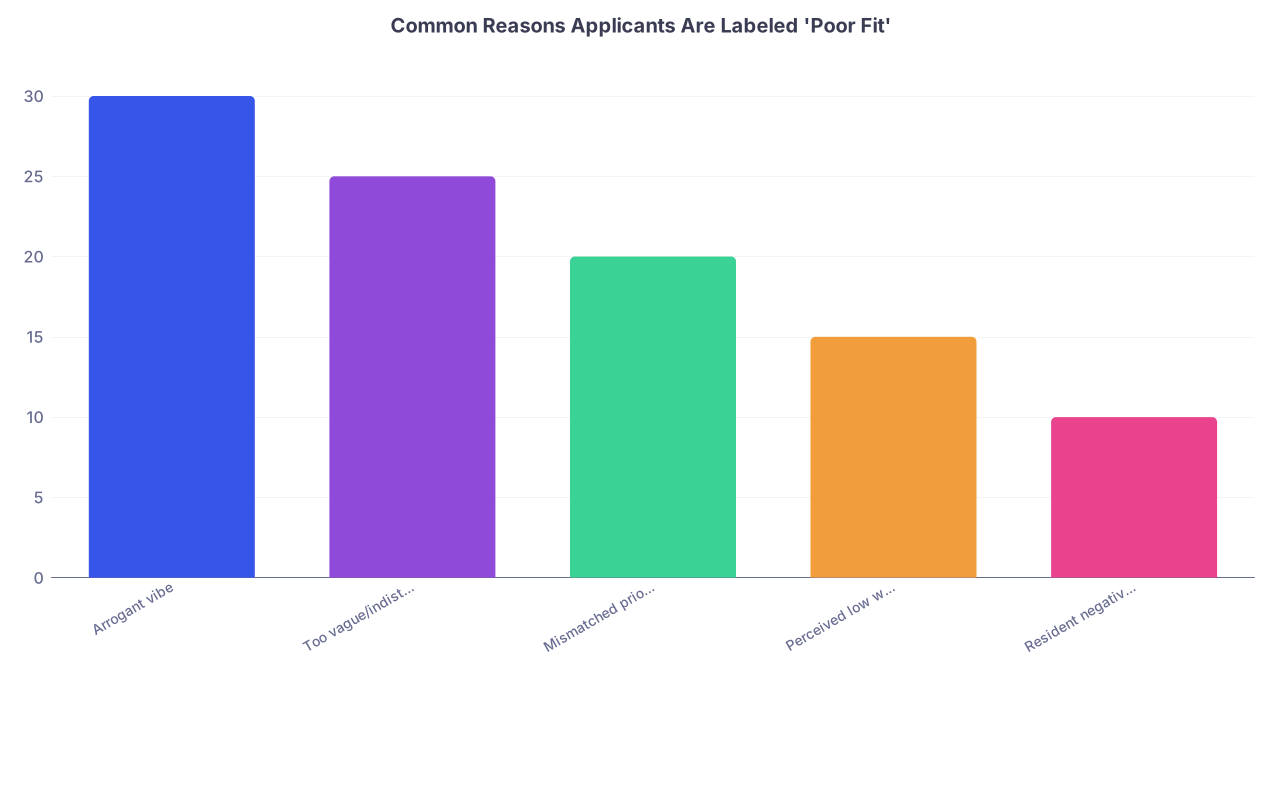
| Category | Value |
|---|---|
| Arrogant vibe | 30 |
| Too vague/indistinct | 25 |
| Mismatched priorities | 20 |
| Perceived low work ethic | 15 |
| Resident negative feedback | 10 |
What Committees Will Never Tell You Directly
There are a few brutal truths you deserve to hear.
1. “Not a Fit” Often Means “We Liked You, But Liked Others More”
Sometimes “fit” is used lazily. Instead of saying, “You were fine, but we had 40 great candidates and only 12 spots,” programs fall back on, “We did not feel you were the best fit.” It’s vague and non-actionable, which is why they like it.
Your takeaway: do not over-interpret one program’s judgment. “Fit” is highly context-dependent. A place with the opposite culture might rank you very high.
2. Your File Creates a Persona Before You Walk In
By the time you interview, half the room has already decided your “type” from your personal statement, letters, and CV.
- Heavy research, Ivy background? They expect cerebral, maybe aloof.
- DO or IMG from a busy community program? They expect gritty, maybe less academic.
- Tons of advocacy and humanities? They expect warm, maybe less procedural.
If you sharply contradict their expectation, they’ll either be impressed or unsettled. You can use that to your advantage, but you need to be aware of it.
3. One Lukewarm Voice Can Sink You Quietly
Rank meetings go like this: Most people barely remember each applicant. A strong positive or negative comment can carry disproportionate weight.
I’ve watched an applicant slide 20–30 spots on the list because one respected faculty said, “Something about him didn’t sit right with me. I can’t put my finger on it.” Nobody wants to fight that.
You can’t control all of it, but you can reduce ambiguity. Specific, grounded answers; open body language; a bit of real personality. Ambiguity is where vague negativity grows.

How To Prep For “Fit” Like An Insider
You’re not going to game every nuance. But you can walk in positioned very differently from the average applicant who thinks this is just about Step scores and “Tell me about yourself.”
Here’s how to prepare strategically.
Step 1: Build a One-Sentence “Fit Thesis” For Each Program
Before every interview, write one sentence:
“For [Program X], I fit because I’m [A, B, C] and they are [Y, Z].”
Example: “For County General IM, I fit because I like high-volume, underserved care and I’ve already thrived in chaotic settings with limited resources.”
That sentence becomes the spine of how you answer “Why this program?”, how you talk about your past, and what you emphasize.
Step 2: Script and Rehearse Your Three Core Stories
Not word-for-word scripts. But clear beats:
- Situation
- What was actually hard
- What you did (not just “we”)
- What you learned
- How you’ve applied it since
If a faculty member is half-distracted and hears only 60% of your story, they should still walk away thinking: “They’ve seen real difficulty, handled conflict maturely, and grew from it.”
Step 3: Decide Your “Workroom Persona” And Stick To It
On interview day, you’re signaling who you’ll be in the workroom.
Are you the calm anchor? The energetic motivator? The meticulous organizer? Pick a lane and let your answers, tone, and examples reinforce it.
Scattered persona = “I couldn’t get a read on them” = bad fit.
Consistent persona (even if not flashy) = safe, usable resident.
Step 4: Treat Resident Interactions As Part Of The Interview (Because They Are)
Don’t relax so much with residents that you start trashing other programs, oversharing, or posturing. They notice.
What residents usually report is not your content, but your energy:
- “Fun, normal, easy to talk to.”
- “Seemed fake and trying too hard.”
- “Complained about their med school a lot.”
You want to land in the first category. It’s not about being an extrovert. It’s about being grounded, curious, and respectful.
FAQs About “Fit” In Residency Interviews
1. How much does “fit” actually matter compared to scores and letters?
Once you’re in the interview pool, “fit” is easily 50–70% of your final rank at many programs. Scores and letters get you in the door and protect you from being screened out for risk. But at rank meetings, discussions almost always revolve around: “Would they work here?” rather than, “Their Step 2 is 8 points higher.”
2. I’m introverted. Does that automatically hurt my “fit”?
No. Programs don’t all want high-energy extroverts. They want reliable teammates. An introvert who is steady, communicative, and comfortable in their skin often ranks higher than an overcaffeinated charmer who feels fake. You do need to show you can speak up, advocate for patients, and function in a team. Quiet is fine. Withdrawing and giving one-word answers is not.
3. What if my genuine goals don’t fully match a program’s identity? Should I lie?
Do not lie. But calibrate. If you’re at a community program and ultimately want a niche academic career, you can frame it as: “I want to be an excellent generalist first, and later bring that experience into a more focused role.” Emphasize the overlap between your goals and what they offer, rather than centering what they don’t have.
4. How can I tell if a program thinks I’m a good fit during the interview?
You can’t trust one enthusiastic interviewer. But patterns help. If multiple interviewers say things like, “You’d do really well here,” or residents say, “You seem like our people,” that’s a signal. Cool, distant interviews where no one shares much about the program, or you feel like you’re pulling teeth, often correlate with a weaker fit on their side too. Still, do not over-read any single day; committees are unpredictable.
5. Can I recover if I sense I said something that hurt my perceived fit?
Yes, but you have to be deliberate. If you notice you framed something poorly—maybe sounding dismissive of a patient population or a prior program—you can circle back: “I’ve been thinking about how I phrased something earlier. I want to clarify what I meant…” Committees respect self-awareness and course-correction. What ruins “fit” is doubling down or pretending nothing happened while the interviewer is clearly uneasy.
You will never fully control how any one committee defines “fit.” The game is rigged by personalities, histories, egos, and unseen politics.
But now you know the levers they’re actually pulling. You understand how your stories and behavior get compressed into a two-sentence verdict in a rank meeting.
With that insight, you can walk into residency interviews not just hoping to impress, but deliberately showing them the version of you that truly belongs at the right program.
The next move is yours: sharpen your stories, study your target programs’ identities, and start practicing how you show up in the room. Once you’ve done that, you’ll be ready for the real battlefield—rank list strategy. But that’s a story for another day.