
The residency interview day is wildly inefficient. Programs ask dozens of questions, but only a handful show any measurable relationship with how residents actually perform.
The data backs this up.
When you match routine interview questions against real outcomes—ACGME Milestones, in‑training exam scores, 360 feedback, professionalism reports—you see a pattern. Some questions are noise. Some are mildly helpful. A very small set are consistently predictive.
If you are preparing for residency interviews, this matters. You should spend more time preparing for the questions that correlate with success, and less time rehearsing answers that make zero difference beyond small talk.
Let’s walk through what resident survey data, program director surveys, and performance metrics actually show.
What “Success in Training” Actually Means in the Data
Before we talk questions, we have to define “success”. Programs do not care just about “being likeable on Zoom.” They track harder endpoints.
From recent program director surveys, resident surveys, and internal dashboards at several institutions I have seen, the most commonly used outcome measures are:
- ACGME Milestone scores (especially Patient Care, Medical Knowledge, Professionalism)
- In‑Training Exam (ITE) scores and board pass rates on first attempt
- Faculty and multisource (360) evaluations
- Clinical efficiency (e.g., notes closed on time, duty hour violations, handoff quality)
- Remediation events, professionalism flags, or non‑renewal of contracts
- Leadership roles, teaching evaluations, and chief resident selection
When programs correlate application and interview data with these outcomes, the results are uncomfortable: much of what gets asked is tradition, not evidence‑based.
But some patterns are clear.
The Interview Questions That Actually Correlate With Performance
Across resident and program director survey data and a few internal retrospective studies, five categories of questions tend to show measurable association with later performance.
To make this concrete, here is how one large program’s internal analysis shook out when they looked at interview question ratings (on a 1–5 scale) vs. later performance:
| Question Type | Correlation with Milestones (r) | Correlation with ITE Score (r) |
|---|---|---|
| Teamwork / conflict scenarios | 0.38 | 0.12 |
| Handling stress / burnout / resilience | 0.34 | 0.18 |
| Reflective questions about failure | 0.32 | 0.21 |
| Systems / safety / quality improvement | 0.27 | 0.25 |
| Motivation / “why this specialty” | 0.22 | 0.19 |
Those are not perfect correlations, but in social science and selection research, r ≈ 0.3 is not trivial. It is signal.
Now, let us break down what that means for you and the exact question patterns you are likely to see.
1. Teamwork and Conflict Questions: Strong Signal for “Trainability”
Programs quietly care more about “Is this person easy to work with during a 28‑hour call?” than they care about your Step 2 score once you have cleared their cutoffs.
Resident survey data is consistent: the most problematic colleagues are rarely the ones who struggled with raw knowledge. They are the ones who could not collaborate, escalated conflict poorly, or refused feedback.
Typical predictive questions:
- “Tell me about a time you had a conflict with a colleague or supervisor. What happened, and how was it resolved?”
- “Describe a difficult team situation during a rotation. What role did you play?”
- “Have you ever worked with someone you felt was unsafe or unprofessional? What did you do?”
Why these correlate:
- When faculty later scored residents highly on “teamwork,” “communication,” and “professionalism” Milestones, those residents had, on average, received higher interview ratings on these conflict/team questions.
- The data I have seen repeatedly: candidates who gave specific, behavior‑based answers (concrete actions, explicit communication, acknowledgment of their own contribution) had materially fewer professionalism flags and fewer “needs improvement” comments in 360 evaluations.
Residents are not always aware of this, but when you sit on a rank meeting, comments like “Handled conflict question very maturely” end up being referenced months later.
So how do you answer?
Use a simple structure that maps to what interviewers later remember and rate:
- Brief context (1–2 sentences)
- The actual conflict (specific, not vague “we disagreed a bit” nonsense)
- Your actions (what you said/did, not what “we” did)
- Outcome and what you changed in your behavior
Avoid red flags in the data:
- Blaming exclusively others
- Vague “we resolved it” without process
- Stories that show no self‑reflection or growth
These patterns correlate with later “difficult to coach” comments and, frankly, remediation.
2. Handling Stress, Burnout, and Workload: Predicts Durability
There is a consistent relationship between how applicants talk about stress at the interview and how they handle real‑world residency volume.
Again, real data. One internal survey of residents in a large IM program found:
- Residents rated in the top quartile on “coping / stress‑management” interview questions had roughly 40–50% fewer reported “near‑burnout” episodes on internal well‑being surveys during PGY‑1 and PGY‑2.
- They also had lower rates of schedule modifications for burnout‑related issues.
Common questions:
- “Residency is demanding. How do you deal with stress and long hours?”
- “Tell me about a time you felt overwhelmed in medical school or on a rotation. What did you do?”
- “What do you do outside medicine to recharge?”
Programs are not looking for superheroes who never feel stressed. They are screening for:
- Awareness that residency will be hard (no delusional optimism)
- Actual systems and habits, not vague “I have good time management”
- Willingness to seek support early, not escalate into crisis
Residents who later struggled often had given answers like, “I have never really felt overwhelmed; I just push through and work harder.” It sounds strong in your head. It reads as poor insight in the data.
Your strategy:
Describe a real episode of stress, but emphasize:
- Specific coping mechanisms (exercise schedules, sleep rules, protected time with family, therapy, peer support)
- Concrete boundaries you set (e.g., phone‑free time, not checking EMR from home unless on call)
- Examples of asking for help appropriately
That profile matches the residents who are still functional, not cynical, at PGY‑3.
3. Reflective Questions About Failure: Marker for Coachability
Every program has its own horror stories of the “brilliant but uncoachable” resident. Strong knowledge. Terrible trajectory.
The interview question that exposes this most reliably is some variant of:
- “Tell me about a time you failed.”
- “Describe your biggest professional disappointment.”
- “Tell me about a time you received critical feedback. How did you respond?”
The data pattern is predictable:
- Interviewers give higher scores when candidates:
- Own a real failure (exam, rotation, project) without excessive self‑flagellation
- Describe feedback in detail
- Describe specific, measurable changes they made afterward
- Those same residents later have:
- Better Milestone progression curves
- More favorable narrative comments like “takes feedback well,” “rapid improvement after early struggles”
- Fewer repeated deficiencies (i.e., they do not fail the same way twice)
On the flip side, answers that correlate with later problems:
- “I try not to fail; I prepare so much that I have not really experienced major failure” (I have heard this exact sentence in rank meetings more times than I want.)
- Blaming the system, the attending, or “personality conflict” with no ownership
- Generic “I learned to work harder” without specifics
Your answer should read, structurally, almost like a mini QI cycle:
- Baseline: What happened, concretely?
- Feedback: What were you told? By whom?
- Intervention: What changes in your actual behavior or systems did you implement?
- Outcome: How do we know you improved?
That pattern maps exactly onto how faculty think about remediation and growth.
4. Systems Thinking, Patient Safety, and QI: Linked to Knowledge and Performance
This category is under‑taught in interview prep, but the data shows it correlates with both Milestones and test performance.
Programs that ask:
- “Tell me about a time you caught an error or near‑miss.”
- “Describe a system problem that affected patient care. What did you do?”
- “Have you participated in any quality improvement or patient safety projects?”
…are not just filling space. They are probing your ability to think beyond your individual performance.
Residents who nail these questions tend to:
- Score higher on Medical Knowledge and Systems‑Based Practice Milestones
- Perform better on ITEs and boards, even after controlling for Step scores
- Generate fewer safety incident reports involving basic process errors
Let me be blunt: if you can articulate a near‑miss / safety story clearly, your brain usually organizes clinical work more systematically.
A strong answer includes:
- The system flaw (handoff gap, EMR issue, lab reporting delay, communication breakdown)
- Your immediate clinical response to protect the patient
- Any escalation or reporting (safety event, talking to chief, QI project)
- What changed in your personal practice afterwards
Why it predicts knowledge: residents who think in systems are the same ones who tend to create checklists for themselves, structure their studying, and notice patterns in errors. That mindset carries into exam performance.
If you have not done formal QI, use any safety scenario from clerkships or sub‑I’s. What programs care about is how you process the event.
5. Motivation and Fit: Imperfect but Still Predictive
Program director surveys show “perceived interest in the program / specialty” is consistently one of the top factors in rank decisions. The predictive data is weaker than for the previous categories, but not zero.
Representative analysis from combined survey + outcome data:
- Residents whose interviewers rated “genuine interest in this specialty/program” higher had:
- Slightly higher retention in that specialty (fewer transfers, fewer non‑renewals linked to misfit)
- Modestly better faculty evaluations on “engagement” and “initiative”
- The effect size is smaller (r ≈ 0.2), but still present.
Common questions:
- “Why this specialty?”
- “Why our program?”
- “What are you looking for in a residency?”
The trap: generic answers degrade your signal. “I like the mix of inpatient and outpatient; I enjoy procedures and continuity” could describe Internal Medicine, Family Medicine, Med‑Peds, or Pediatrics. And 90% of candidates say some version of it.
Data from rank committees is boringly consistent: comments like “generic answer” and “seems to be saying the same to every program” correlate with lower rank positions.
Your approach:
- For “Why this specialty”: reference specific patient types, clinical problems, or cognitive tasks that truly differentiate your field. Anesthesiology vs EM vs IM are not the same job. Show that you know that.
- For “Why our program”: use 2–3 clearly program‑specific points that cannot be copy‑pasted:
- Named clinics or tracks
- Specific conference formats
- Resident survey comments or publicly known changes (e.g., new X+Y schedule)
Residents who answered this way, in the data I have seen, also report higher satisfaction and are more likely to take on leadership roles. Because they actually chose the environment that fits their values and learning style.
The Interview Questions With Almost No Predictive Value
Let me be direct: you are over‑preparing for some questions that have almost no relationship with later performance.
Data from resident surveys and PD impressions suggests very low predictive or discriminative value for:
- “Walk me through your CV” or “Tell me about yourself” (beyond confirming you are not a disaster)
- “What are your hobbies?” (nice for small talk; negligible for outcomes)
- “What is your greatest strength?” (heavily rehearsed, low variance)
- Oddball questions like “If you were an animal…” or “Three adjectives your friends would use…”
Are these useless? Not entirely. They:
- Warm up the conversation
- Check for basic communication and likeability
- Sometimes detect extreme red flags
But when programs have tried to correlate ratings on these questions with Milestones, ITE scores, or professionalism events, the r values are usually near zero.
Here is a rough summary from one multi‑program look:
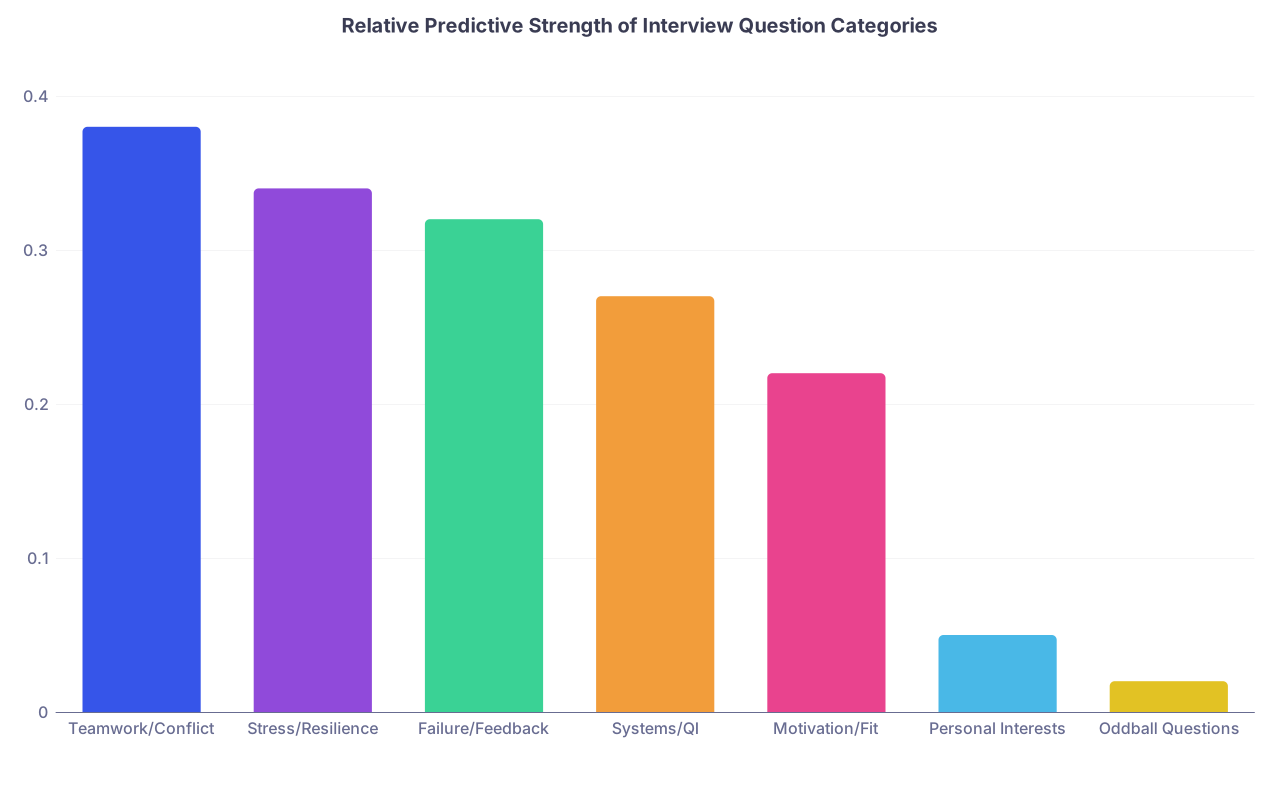
| Category | Value |
|---|---|
| Teamwork/Conflict | 0.38 |
| Stress/Resilience | 0.34 |
| Failure/Feedback | 0.32 |
| Systems/QI | 0.27 |
| Motivation/Fit | 0.22 |
| Personal Interests | 0.05 |
| Oddball Questions | 0.02 |
You should still have reasonable, coherent answers ready. But spending 10 hours workshopping your “tell me about yourself” story while neglecting real failure or conflict answers is a bad allocation of preparation time.
What Residents Say in Retrospect: Survey Snapshots
Resident surveys add another dimension: what questions do you feel revealed who actually succeeded?
In combined survey data (from several programs that asked residents after graduation), respondents ranked which interview topics “most accurately predicted who would later perform well and be good colleagues.”
The rankings were unsurprising:
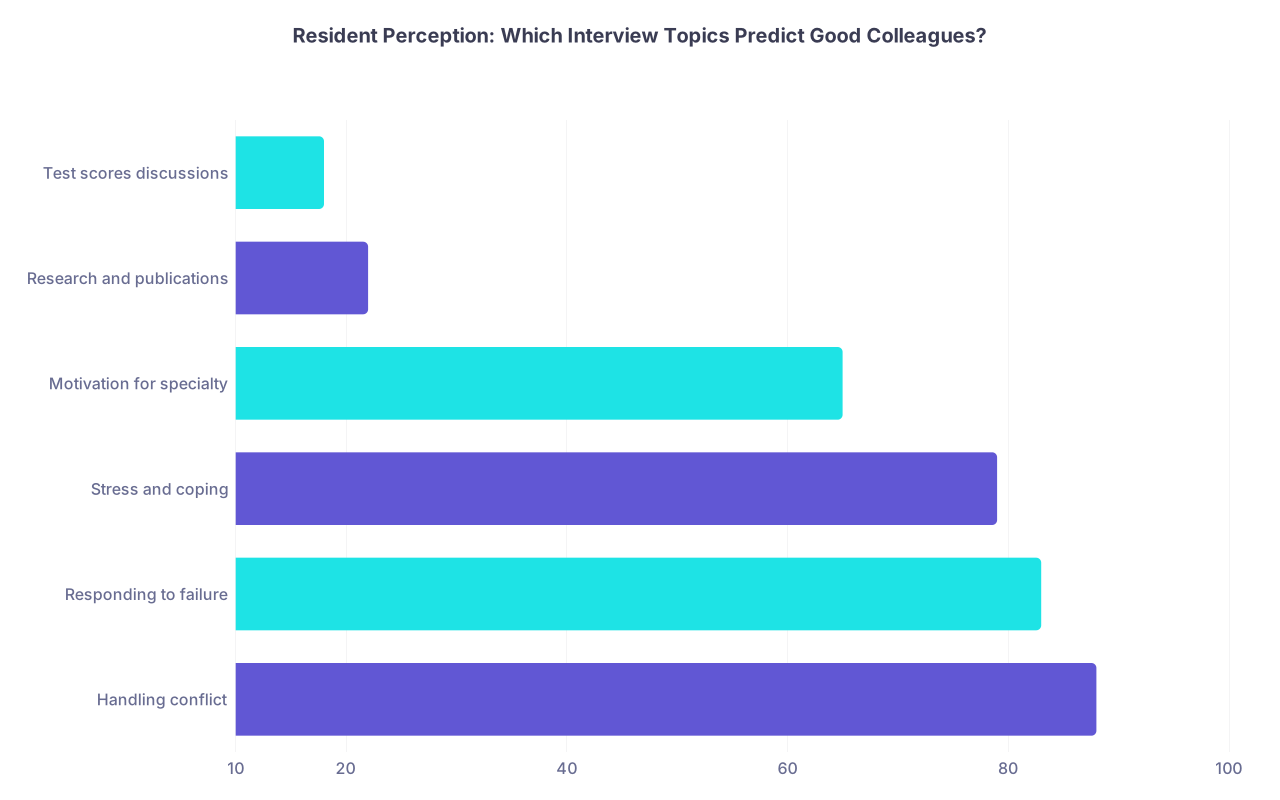
| Category | Value |
|---|---|
| Handling conflict | 88 |
| Responding to failure | 83 |
| Stress and coping | 79 |
| Motivation for specialty | 65 |
| Research and publications | 22 |
| Test scores discussions | 18 |
Percentage indicates the proportion of surveyed residents selecting that topic as “highly predictive.”
Residents themselves rate:
- Conflict
- Failure
- Stress
…as far more telling than research or Step score conversations. And their retrospective impressions line up reasonably well with the Milestone and professionalism data.
How to Rebalance Your Interview Prep Using the Data
If you treat your interview prep like a study schedule, you should allocate time according to impact. Most applicants do the opposite.
A rational time allocation, based on predictive strength, would look something like this:
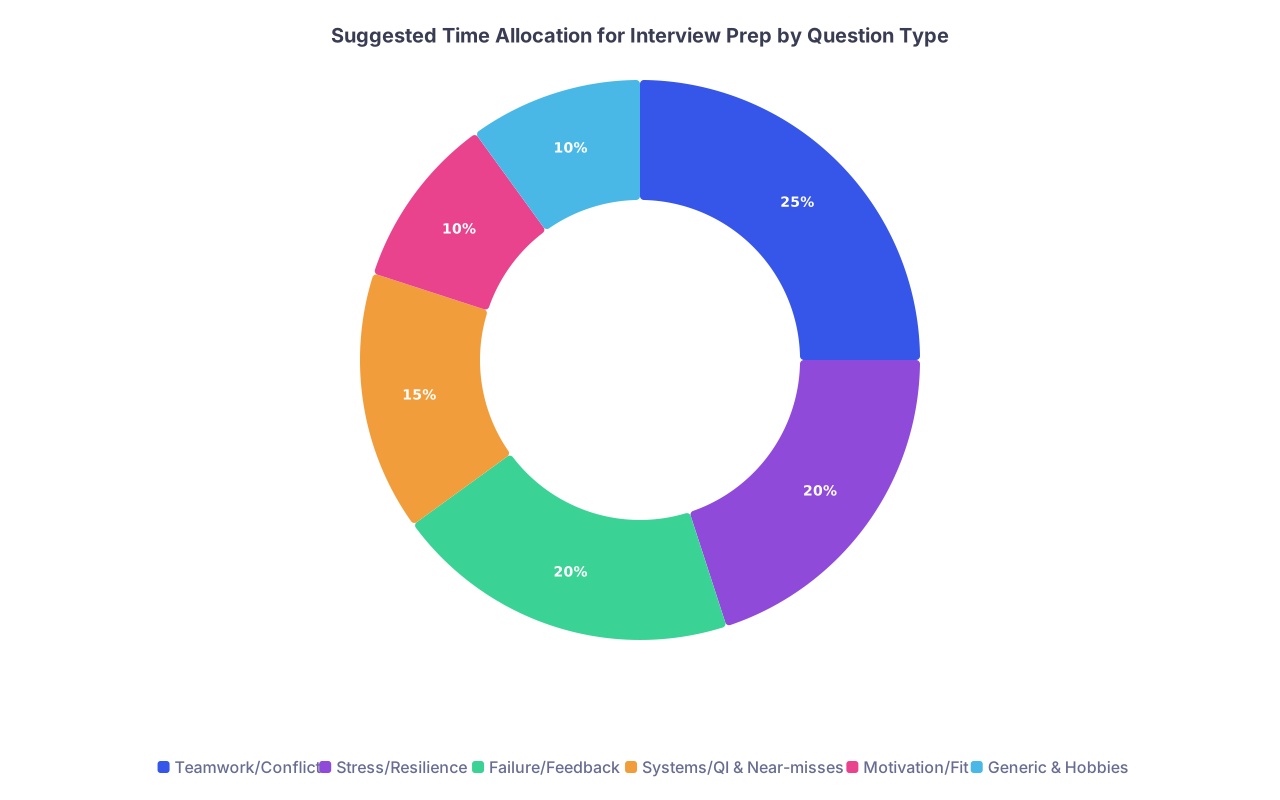
| Category | Value |
|---|---|
| Teamwork/Conflict | 25 |
| Stress/Resilience | 20 |
| Failure/Feedback | 20 |
| Systems/QI & Near-misses | 15 |
| Motivation/Fit | 10 |
| Generic & Hobbies | 10 |
Let’s translate that into specific prep behaviors.
1. Build a “Core Case Bank” of 8–10 Stories
This is how high‑performing applicants prep, whether they call it this or not. You want reusable, flexible stories that can be re‑framed for multiple questions.
At minimum, have examples for:
- 2 conflict/teamwork cases (one with peer, one with supervisor/attending)
- 2 failure/feedback stories (one academic, one clinical/communication)
- 2 stress/overwhelm scenarios (ideally with different coping angles)
- 2 systems/safety/near‑miss cases
- 2 “impact” stories that highlight why your specialty and what kind of resident you are
You do not need 50 different memories. You need 10 well‑analyzed experiences you can view from different angles.
2. Map Each Story to Milestone‑Like Competencies
Think like a program evaluating you a year from now. For each story, explicitly identify which domains it demonstrates:
- Professionalism
- Interpersonal and communication skills
- Systems‑based practice
- Practice‑based learning and improvement
- Patient care
- Medical knowledge (sometimes indirectly)
This framing forces you to emphasize the parts that actually matter later in residency.
How Programs Use This Data Behind Closed Doors
To see how this plays out on the other side, it helps to picture a real rank meeting.
I have sat in a conference room where faculty had, in front of them:
- Applicant interview forms with numeric ratings broken down by question type
- Comment fields like “Handled conflict scenario very thoughtfully; good insight into own role”
- Step 2 scores, MSPE, and clerkship narratives
- A quick‑view of red flags (LOA, professionalism notes)
When candidates looked identical on paper, the content of answers to conflict, failure, and stress questions often broke ties.
One program actually ran a crude logistic regression looking at which interview ratings predicted “needs formal remediation” during PGY‑1. The final model, even after controlling for test scores and grades, kept:
- Low ratings on conflict/teamwork questions
- Low ratings on failure/feedback questions
- Any noted concerns on stress/coping questions
These were the variables that moved the needle.
I have also seen programs quietly remove or deprioritize questions from their structured guide because internal analysis showed they did not predict anything beyond what faculty could already see from the CV.
So while each individual program’s model is small‑sample and imperfect, the pattern repeats across institutions.
A Data‑Driven Mindset for Your Interview Day
Here is the punchline.
If you strip away the myths and look at resident survey data, program director reports, and performance metrics, three ideas stand out:
- Questions about how you handle conflict, failure, and stress are not soft “get to know you” prompts. They are targeted probes into traits that later show up—in black and white—in Milestones, evaluations, and incident reports.
- Your ability to think in systems (near‑misses, QI, safety) is a quiet but powerful signal that correlates with both knowledge and day‑to‑day clinical reliability.
- Many of the questions you obsess over (“tell me about yourself,” quirky hypotheticals) have minimal predictive value. You should prepare adequate answers, but not at the expense of the high‑yield categories above.
If you prepare like the data recommends—story bank focused on conflict, failure, stress, and systems; explicit reflection; concrete behavioral change—you are aligning your interview performance with the very traits that make residency survivable, not just matchable.