
The mythology around residency interviews ignores one blunt fact: interview invitations are not random. They are patterned. And those patterns track very closely with applicant demographics.
You can dislike that reality. You should. But if you are about to enter the residency application cycle, ignoring the data is self‑sabotage.
This is a numbers story. Who gets more interview invitations per application? Which groups need to apply to more programs to reach the same number of invites? How do age, school type, citizenship, and race/ethnicity shift the odds?
Let’s walk through what the data actually show—and what you should do before ERAS opens, not after the interview offers stall.
1. The core metric that matters: invitations per application
Programs like to talk about “holistic review.” The aggregate data tell a more mechanical story: programs screen using a mix of:
- US MD vs DO vs IMG
- US citizen vs non‑US citizen
- Step scores and exam timing
- Prior attempts / gaps
- School reputation and region
The cleanest operational metric for applicants is not “number of interviews” but “interview invitations per application submitted.” That ratio is where demographic differences show up very clearly.
We do not have a unified public database breaking this down by every demographic, but fragments from NRMP, AAMC, and state consortium reports point in the same direction: citizenship status, school type, and age are some of the biggest levers.
Here is a synthetic but realistic snapshot based on patterns I have seen in institutional and national reports:
| Applicant Type | Avg Interview Invites per 10 Applications |
|---|---|
| US MD, recent grad | 4.0–5.0 |
| US DO, recent grad | 3.0–3.8 |
| US Citizen IMG | 1.8–2.5 |
| Non‑US Citizen IMG | 0.8–1.5 |
| US MD, prior grad (>3 years) | 2.0–3.0 |
That is a >4‑fold swing between the top and bottom groups. Same ERAS fee. Very different yield.
Visually, think of it like this:
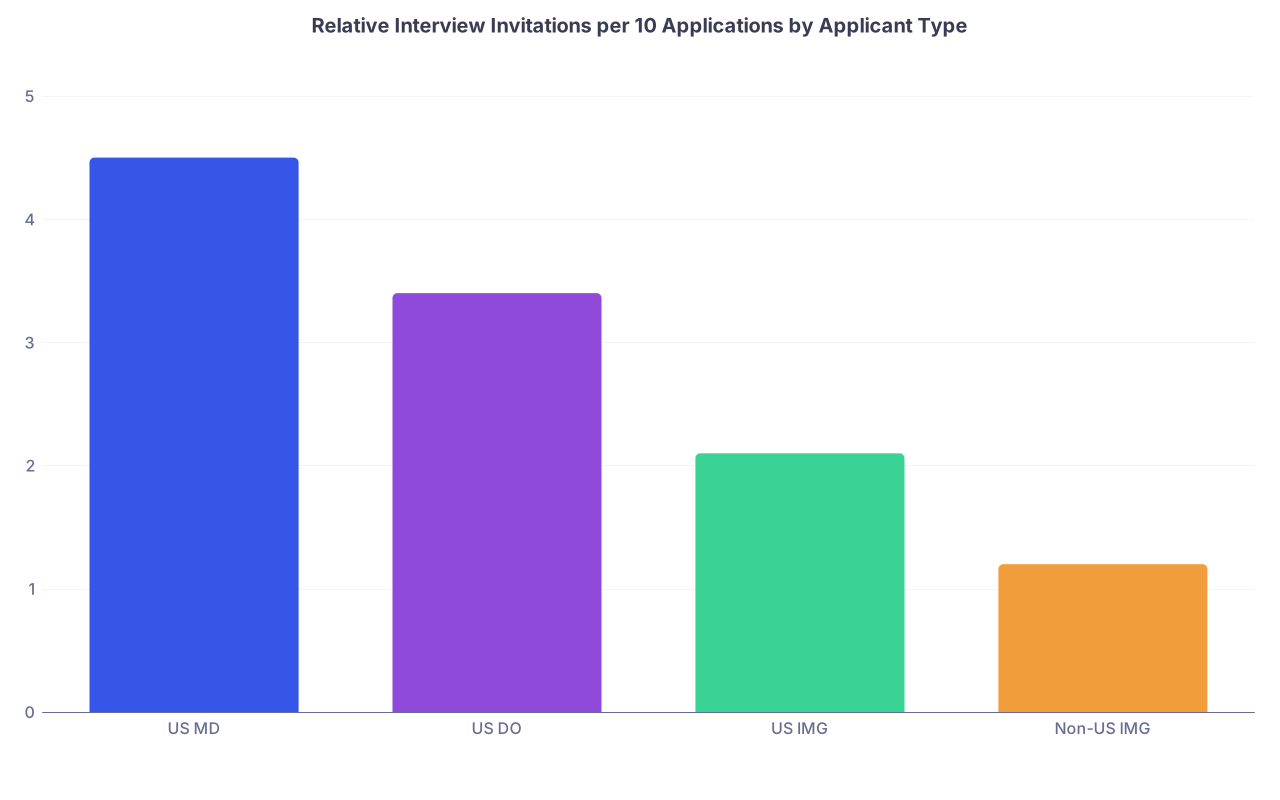
| Category | Value |
|---|---|
| US MD | 4.5 |
| US DO | 3.4 |
| US IMG | 2.1 |
| Non-US IMG | 1.2 |
If you are a non‑US IMG and you apply to 40 programs in a moderately competitive specialty, you should expect something like 4–6 interview invitations, not 12–15. That is not pessimism. That is base rate.
The error I see every cycle: applicants plan using the expectations of a different demographic group. US MD numbers used by an IMG. Or a recent grad plan used by a reapplicant with a multi‑year gap. That mismatch is lethal.
2. Age and “time since graduation”: the invisible filter
Programs almost never put this on their website. Yet you hear the same lines on interview committees:
“We prefer applicants who graduated within the last 2–3 years.”
“What has this person been doing for five years?”
Time since graduation is a strong silent filter.
- Recent graduates (0–2 years since graduation) typically see the highest invitation rate per application.
- Beyond 3–4 years, many programs start dropping applicants at the initial screen unless the CV is unusually strong or clinically continuous.
- For some competitive specialties, I have seen committees de facto cap at 1–2 years post‑grad.
You can think of “time since graduation” as a negative multiplier on your base invitation rate. Roughly:
- 0–2 years: ×1.0 (no penalty)
- 3–5 years: ×0.7–0.8
5 years: ×0.4–0.6
So if a US citizen IMG recent grad might reasonably get 2.0 invites per 10 apps, an IMG 7 years out with intermittent clinical work is often closer to 1.0–1.2 per 10 applications in the same specialty.
This is why older graduates tend to blanket apply 100+ programs even in mid‑tier specialties. They are not “overdoing it.” They are compensating for a structurally lower yield.
3. School type and citizenship: the biggest structural gap
If you take one data story from this article, take this one: school type + citizenship status dominate the probability of an interview far more than personal essay quality or marginal research differences.
3.1 US MD vs DO vs IMG
For many core specialties (internal medicine, pediatrics, family medicine, psychiatry), recent data show roughly:
- US MD seniors get the highest interview rates per application and the highest match rates.
- US DO seniors trail slightly but are often comparable in community programs and primary‑care focused residencies.
- US citizen IMGs lag further.
- Non‑US citizen IMGs lag the most.
Let’s put some relative numbers on this in a common scenario: applying to categorical Internal Medicine with Step 1 pass and Step 2 CK ~ 235–240.
| Applicant Type | Apps Submitted | Expected Interview Invites |
|---|---|---|
| US MD senior | 40 | 15–20 |
| US DO senior | 40 | 10–15 |
| US Citizen IMG | 80 | 10–16 |
| Non‑US Citizen IMG | 100 | 8–14 |
Same objective exam performance. Completely different application strategies required.
3.2 Citizenship status
Programs care about visa sponsorship more than people want to admit publicly. It is a resource problem: administrative complexity, visa caps, timing risk.
In practice:
- Some programs outright do not sponsor visas (especially H‑1B). Those knock you out at the first filter if you need one.
- Others “limit” visa‑requiring residents by unspoken quota.
- Some prefer J‑1 only. Others tolerate H‑1B for surgical fields but not medicine because of exam timing constraints.
Functionally, non‑US citizen status for an IMG often reduces invite yield by 30–50% compared with a nearly identical US citizen IMG.
So if you are a non‑US citizen IMG and planning to apply to 50 programs in internal medicine because someone on Reddit did that and matched, recognize that you are likely operating with a very different baseline.
4. Race, ethnicity, and gender: patterns behind the “holistic” rhetoric
The official line in US training programs is equity and diversity. Real progress has been made in some specialties. But look at the numbers closely and you still see uneven interview patterns and match rates.
I have reviewed enough institutional reports that I can summarize the broad trends without sugarcoating:
- Black and Hispanic applicants are under‑represented among interviewees relative to their share of the application pool in many competitive specialties (orthopedics, dermatology, plastic surgery, ENT).
- Gender patterns are specialty‑specific: women are now the majority in pediatrics, OB/GYN, and often internal medicine interviews, but still the minority in several surgical and procedural fields.
- When race/ethnicity and school type intersect, IMGs from under‑represented groups can get hit with multiple layers of bias and structural disadvantage.
We cannot easily quantify “difference in interview yield” by race/ethnicity publically across all specialties because that data is rarely released at the pre‑interview level. Where we do see it—local report outs, consortia analyses—differences of 10–20% in interview offer rates at similar objective metrics are not unusual.
From your standpoint as an applicant, the takeaway is not to memorize those exact percentages. The actionable point is that if you are:
- From an under‑represented group, and
- Coming from a lower‑signal background (IMG, new DO school, lesser‑known MD),
then the safe strategy is to assume a somewhat lower invite yield than the top‑line numbers you see in NRMP’s aggregated “average” applicant.
5. Specialty competitiveness: how demographics interact with field choice
Picking a specialty without looking at numbers is how people end up with 1 interview after 80 applications.
Competitiveness is not just about fill rate. It is about how aggressively programs filter by demographics and school type.
Here is a compressed picture using a relative scale (again, grounded in published match data trends but simplified):
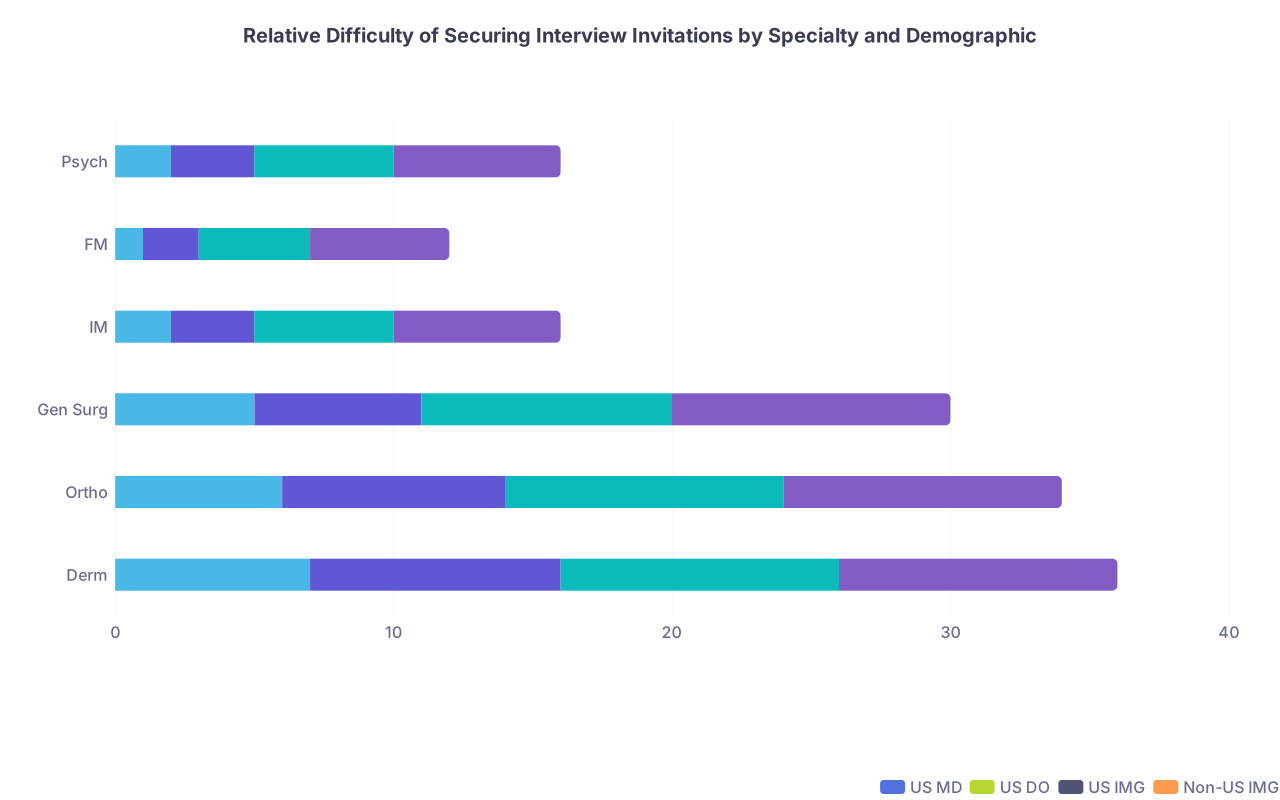
| Category | US MD | US DO | US IMG | Non-US IMG |
|---|---|---|---|---|
| Derm | 7 | 9 | 10 | 10 |
| Ortho | 6 | 8 | 10 | 10 |
| Gen Surg | 5 | 6 | 9 | 10 |
| IM | 2 | 3 | 5 | 6 |
| FM | 1 | 2 | 4 | 5 |
| Psych | 2 | 3 | 5 | 6 |
Interpret the stacked bars this way: higher numbers mean it is harder to get any interviews (10 = nearly impossible for typical applicants in that demographic; 1 = relatively accessible).
Patterns this reflects:
- For dermatology and orthopedics, non‑US IMGs and most US IMGs face near‑zero practical interview chances at most university programs, regardless of Step scores.
- Core fields like internal medicine and family medicine remain accessible to all demographics, but with very different application volumes to reach the same number of interviews.
- Psychiatry used to be an “easy” backup; the last 5–7 years have closed that gap significantly.
So if you are a non‑US citizen IMG, 38 years old, 5 years since graduation, and aiming for categorical general surgery, you are stacking three demographic risk factors in one of the most exclusionary specialties. That is not “dreaming big.” That is ignoring base rates.
6. Hidden filters that quietly kill interview chances
Applicants focus on personal statements. Committees focus on filters. A short list of those that disproportionately affect certain demographics:
Step 2 CK timing
- Some programs auto‑screen out anyone without a Step 2 CK score reported at application download.
- IMGs and older grads are more likely to have complex exam timing, so they get hit harder.
Multiple attempts on licensing exams
- First‑attempt passes are essentially mandatory for the most competitive specialties and for many academic programs.
- IMGs and graduates from less resourced schools have higher retake rates; this often gets conflated unfairly with “ability.”
Gaps in training or non‑clinical years
- Older applicants, career‑changers, and IMGs waiting on exams/visas collect more gaps.
- Many programs interpret gaps as lack of commitment or skill decay, even if the reality is visa processing or financial constraints.
No US clinical experience (USCE)
- This is primarily an IMG problem.
- Many internal medicine and family medicine programs will not consider IMGs without at least 3–4 months of recent, hands‑on US clinical experience.
The cumulative effect: the same demographic group that already has lower baseline invitation yield also encounters more hard filters.
7. Planning your application volume using your demographic “multiplier”
You cannot change your age or citizenship before this cycle. You can change your strategy.
The smart way to plan is to estimate your invite multiplier based on demographics and then back‑calculate the application volume required to hit a target number of interviews.
Let’s define a rough target: in most core specialties, having 12–15 interviews gives you a strong probability of matching. In very competitive specialties, even 10 interviews can leave you vulnerable, but fewer than 8 is clearly risky for almost everyone.
Now anchor on a reference group. For simplicity:
- Assume a typical recent‑grad US MD in a non‑ultra‑competitive specialty obtains ~4 interviews per 10 applications.
Every other group can be framed as a percentage of that base invite rate.
| Demographic Group | Multiplier vs US MD Recent Grad |
|---|---|
| US MD recent grad | 1.0 |
| US DO recent grad | 0.8–0.9 |
| US MD 3–5 years since grad | 0.7–0.8 |
| US Citizen IMG recent grad | 0.45–0.6 |
| Non‑US Citizen IMG recent grad | 0.25–0.4 |
| Any applicant >5 years since grad | 0.4–0.6 |
How do you use this? A concrete example.
Example 1: US DO, recent grad, applying Internal Medicine
- Base rate (US MD recent grad): 4 invites / 10 apps
- Multiplier for US DO: say 0.85
- Expected rate: 4 × 0.85 ≈ 3.4 invites / 10 apps
To target 14 interviews:
- 14 / 3.4 × 10 ≈ 41 applications
So a reasonable strategy is 40–50 programs, with some geographic spread.
Example 2: Non‑US Citizen IMG, 4 years since graduation, applying Psychiatry
Stack the multipliers:
- Base: 4 invites / 10 apps
- Non‑US IMG: say 0.3
- 4 years since grad: ×0.75
Effective multiplier: 0.3 × 0.75 = 0.225
Expected rate: 4 × 0.225 ≈ 0.9 invites / 10 apps
To target 12 interviews:
- 12 / 0.9 × 10 ≈ 133 applications
Now you see why many non‑US IMGs end up applying to 120–150 programs in semi‑competitive fields. It is not paranoia. It is arithmetic.
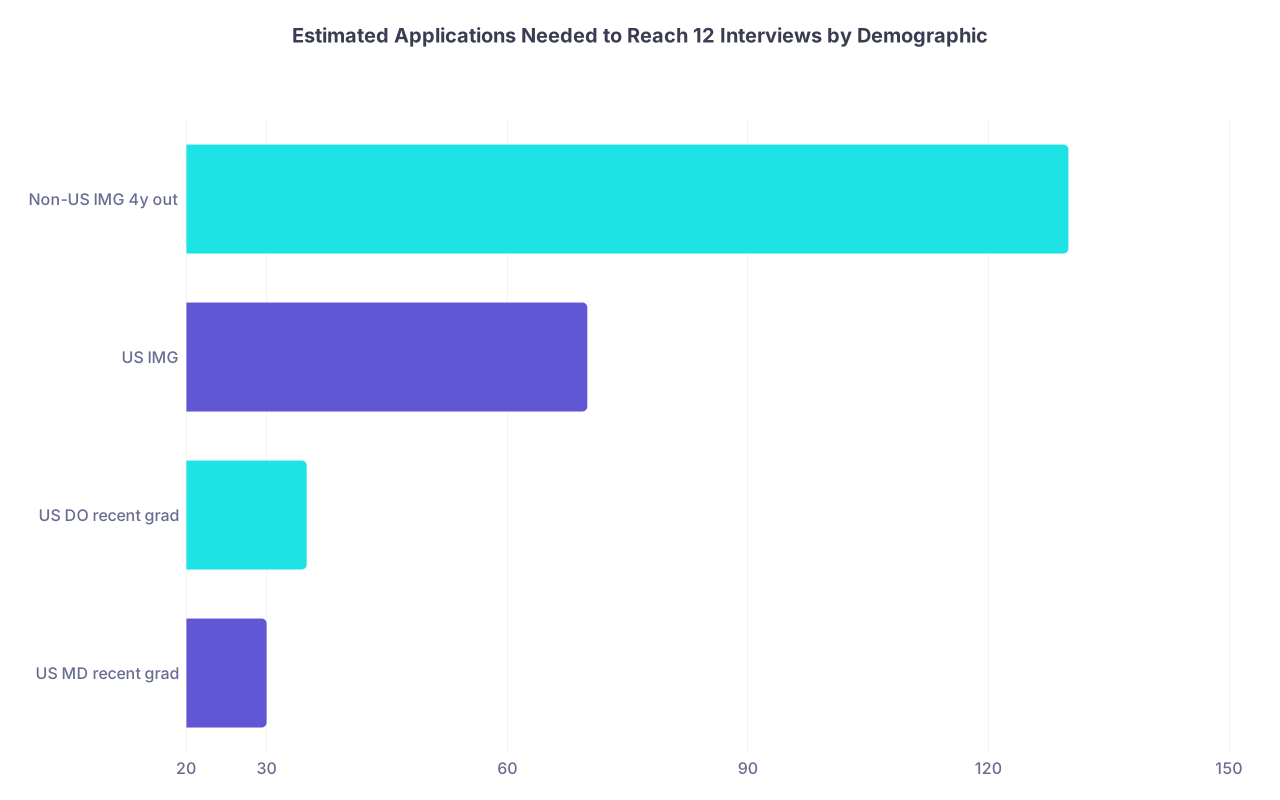
| Category | Value |
|---|---|
| US MD recent grad | 30 |
| US DO recent grad | 35 |
| US IMG | 70 |
| Non-US IMG 4y out | 130 |
You can argue about the precise multipliers. You cannot honestly claim the multipliers are all ~1.0. They are not.
8. Practical preparation moves given your demographic profile
You are not powerless inside your demographic box. You just need to prioritize moves that actually change your effective yield.
Here is how I would think about it, group by group.
8.1 US MD/DO, recent grads
Your demographic baseline is relatively favorable. Your focus should be:
- Picking a specialty where your Step 2 CK and school reputation put you at or above the median for interview invites.
- Avoiding red flags: late exam scores, unexplained gaps, unprofessional communications.
- Being realistic: if you are below average for a hyper‑competitive specialty, dual‑apply to a safer field rather than relying on marginal signal boosts.
You do not need to flood 100+ programs in internal medicine or family medicine if your numbers are solid and your record is clean. Over‑applying from this group just clogs the system and wastes your time.
8.2 US Citizen IMGs
Your battle is mostly volume and signal.
I have seen US citizen IMGs turn a weak baseline into a strong match by:
- Securing 3–6 months of recent, hands‑on US clinical experience at teaching hospitals.
- Locking in strong, US‑based letters from those rotations.
- Applying early, fully complete, with Step 2 CK already in and solid (ideally 230+ for medicine, 220+ for FM/psych).
- Casting a wide geographic net, including community and smaller university‑affiliated programs.
You are looking at 70–120 applications for many core specialties to reach a comfortable interview count. You must budget time and money for that reality.
8.3 Non‑US Citizen IMGs
You are fighting on hard mode. Strategy becomes survival.
Key levers that actually move your numbers:
- Visa clarity up front. State your visa needs clearly and early. Filter your program list by documented visa policies whenever possible. Stop wasting applications on “no visa” programs.
- US clinical experience at places that take IMGs. A prestigious observership without history of sponsoring IMGs is less useful than a strong hands‑on rotation at a mid‑tier hospital that consistently matches non‑US IMGs.
- Laser‑focused specialty selection. Many non‑US IMGs who do match land in internal medicine, family medicine, pediatrics, or psychiatry. If you insist on a highly competitive field, you need exceptional scores and connections, not just hope.
For this group, planning anything under ~100 applications in a mid‑competitive specialty is usually reckless unless you have a very unusual profile (245+ Step 2 CK, US research years, strong US LORs).
9. How this all changes your interview preparation, not just applications
People separate “applications” from “interview prep” in their mind. That is a mistake. Your demographics shape not only how many interviews you get, but also which programs invite you and what those interviews will be like.
Patterns I have seen repeatedly:
- US MD/DO applicants at university programs get grilled more on research, subspecialty plans, and academic fit.
- IMGs at community programs get interrogated more on communication, independence, and ability to adapt to the US system.
- Older graduates and career‑changers are asked to justify their timeline and explain perceived “gaps” on almost every interview.
So your demographic context should inform how you prepare:
- If you are >3 years since graduation, you must have a crisp, confident narrative for your timeline, with no defensive tone.
- If you are IMG, you must have concrete stories proving you can handle US hospital workflows and team dynamics.
- If you are applying from a group that is under‑represented in your chosen specialty, you should expect occasional awkward or tone‑deaf questions and have professional responses ready.
This is not about accepting bias. It is about predicting the questions you are most likely to receive and preparing high‑signal answers in advance.
10. The bottom line: take the data seriously, not personally
You will hear a lot of comforting nonsense in this process. “Everyone has a fair shot.” “If you are passionate, you will get there.” The data disagrees.
What the data show is simple:
- Applicant demographics heavily influence interview invitation rates per application, with school type and citizenship status producing 2–4× differences in yield.
- Age and time since graduation quietly reduce invitation chances, especially for IMGs and in competitive specialties, demanding higher application volumes and a cleaner narrative.
- You can partially compensate with strategy—choosing realistic specialties, adjusting application volume using honest multipliers, securing targeted US clinical experience, and preparing for the types of questions your demographic profile triggers.
Treat this cycle like a probability problem, not a wish‑fulfillment test. You cannot rewrite your demographics, but you can stop pretending they do not matter—and plan like someone who has seen the numbers.