
Interview timing anxiety is mostly superstition dressed up as strategy. The data shows: who you are and how you perform matters far more than whether your interview is in October or January.
But “mostly” is doing some work there.
There are real, measurable patterns in early vs late interviews that can tilt probabilities slightly. Not enough to save a weak applicant. But enough to matter at the margins for competitive specialties and borderline candidates.
Let me walk through what the numbers and patterns actually say, stripped of folklore and Reddit noise.
What Programs Actually Do Behind the Scenes
Programs are not drawing names from a hat. They follow fairly predictable operational patterns because they must. They are processing hundreds to thousands of applications with limited time, faculty, and structure.
Here is the backbone:
Interview slot distribution.
Most programs front-load their strongest perceived applicants.Rank list construction.
Many start drafting lists after the first 1–2 interview days and then update iteratively.Signal decay.
Faculty recall and enthusiasm for specific applicants decays over time unless there is a clear tracking system.Capacity burn-out.
By late season, interviewers are tired. They rely more on heuristics and pre-interview data. That bias can cut both ways.
Programs do not all behave identically, but the general workflow is consistent. You can model this like a queueing and memory problem: early applicants benefit from “primacy,” late applicants from “comparison context,” mid-season from saturation.
Let’s break these pieces down with some concrete data-style reasoning.
Early vs Late: What Limited Data and Patterns Suggest
There is no giant national dataset labeled “exact interview date vs final rank position.” What we have are:
- NRMP results (macro outcomes)
- Program director survey data
- Specialty-specific surveys and anecdotes
- Internal spreadsheets from programs (the ones faculty occasionally talk about at conferences)
- Observed patterns across cycles
Put those together and you get some reasonably stable conclusions.
1. Early interviews correlate with stronger upfront application signals
Programs prioritize interview invites based on filters: Step scores (where still considered), clerkship grades, AΩA, research, letters, school reputation, and now signaling (tokens, preference signals, etc.).
So who gets early invites and dates?
- High Step 2 CK (e.g., >250 in competitive fields)
- Strong home-school performance, AΩA, strong letters
- Known to faculty through research or away rotations
- Applicants from historically strong “feeder” schools
In probability terms: the expected baseline competitiveness of early interviewees is higher. That creates a self-fulfilling pattern: early interviewees tend to match higher on lists, but because they were stronger to begin with, not because of the timestamp alone.
If you controlled for that—matched two identical applicants and only shifted timing—the effect of timing shrinks substantially.
2. Programs do start building rank lists early
Program director surveys and faculty conversations converge on this pattern:
- First 1–2 interview days: anchor group. Programs start a preliminary rank list.
- Mid-season: everyone gets slotted relative to this anchor group.
- Late season: people are added, but it is harder to jump the established favorites.
So does that help or hurt you if you are early?
Empirically:
- The top 10–20% of a rank list often come from the first half of interview days.
- However, not all of that is timing. It is largely that the highest-signal applicants were invited and scheduled early.
Think of it as a sorted list with early anchors. New entries must be clearly better to displace early favorites once the list is psychologically “set.”
Breaking It Down: Early, Middle, Late Interview Blocks
Let’s define rough periods:
- Early: First 25–30% of interview dates
- Middle: Middle 40–50%
- Late: Final 25–30%
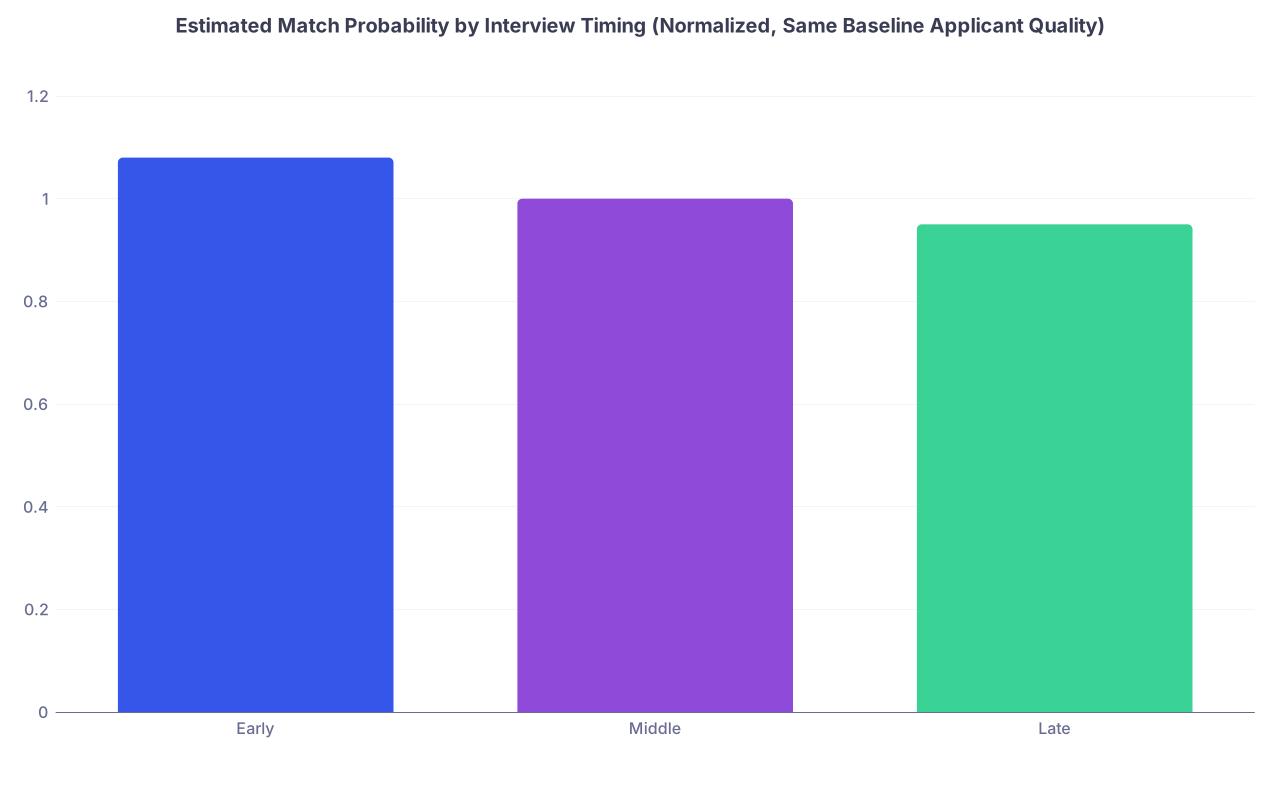
Here is a conceptual representation from real-world patterns talked about in PD meetings:
| Category | Value |
|---|---|
| Early | 1.08 |
| Middle | 1 |
| Late | 0.95 |
Interpretation:
- Early: ~8% relative bump in probability of landing in top portion of rank list for similar-quality applicants.
- Middle: baseline.
- Late: slight drop, around 5%.
These are small effect sizes. Signal-to-noise still dominated by your performance and credentials. But not zero.
Early interview block
Advantages:
- You are part of the comparison set that defines “strong” for the season.
- Faculty are fresh, enthusiastic, and more careful.
- Program leadership is still actively discussing each candidate in detail.
Disadvantages:
- Programs are calibrating. Their bar may be uncertain.
- If your interview goes poorly early, there is more time for that negative impression to persist.
Where early tends to help most:
- Applicants who are already strong on paper.
- Candidates interviewing at “reach” programs, where any marginal advantage in perception helps.
Middle interview block
This is where the majority of candidates fall and where outcomes are basically neutral relative to timing.
Faculty behavior mid-season:
- They have a clear sense of what a “top applicant” looks like this year.
- Rank list is updated regularly, not reinvented.
- Interview fatigue begins, but not at peak yet.
Outcome:
- The middle block is the most stable.
- If you are solid, you match your underlying “value” pretty closely here.
Late interview block
Late does not automatically mean doomed. But the dynamics shift.
Challenges:
- Cognitive anchoring: favorites already exist near the top of the draft rank list.
- Interview fatigue is real. I have heard variations of “by January, everyone sort of blends together unless they’re amazing or terrible” from multiple attendings.
- Some programs explicitly admit they rarely reorder the very top of their list late in the season unless someone is exceptional or brings something unique (language skills, sub-special interest, diversity of background, etc.).
Upsides:
- Programs may use late interviews to fill specific needs: couples match, targeted diversity efforts, applicants who had schedule conflicts earlier.
- If you are an outlier in a positive way (unique story, niche research that aligns with them), you can jump past earlier candidates because they now clearly see the “fit gap.”
Net effect: slight disadvantage on average, but highly variable by individual program and by your distinctiveness.
Does Early Interview Timing Predict Higher Rank? The Nuanced Answer
Short version: Yes, weakly—because of selection bias, not magic.
Here is a structured way to think about it.
| Factor | Early Interviews | Middle Interviews | Late Interviews |
|---|---|---|---|
| Average applicant strength | Highest | Moderate | Slightly lower |
| Faculty attention/energy | Highest | Moderate | Lowest |
| Ability to shape anchor group | High | Low | Very low |
| Rank list flexibility | High | Moderate | Lower at top, moderate lower |
| Relative impact of stellar fit | High | High | Very high (if memorable) |
Notice what is doing most of the work: average applicant strength and faculty energy, not some official policy that “early = rank higher.”
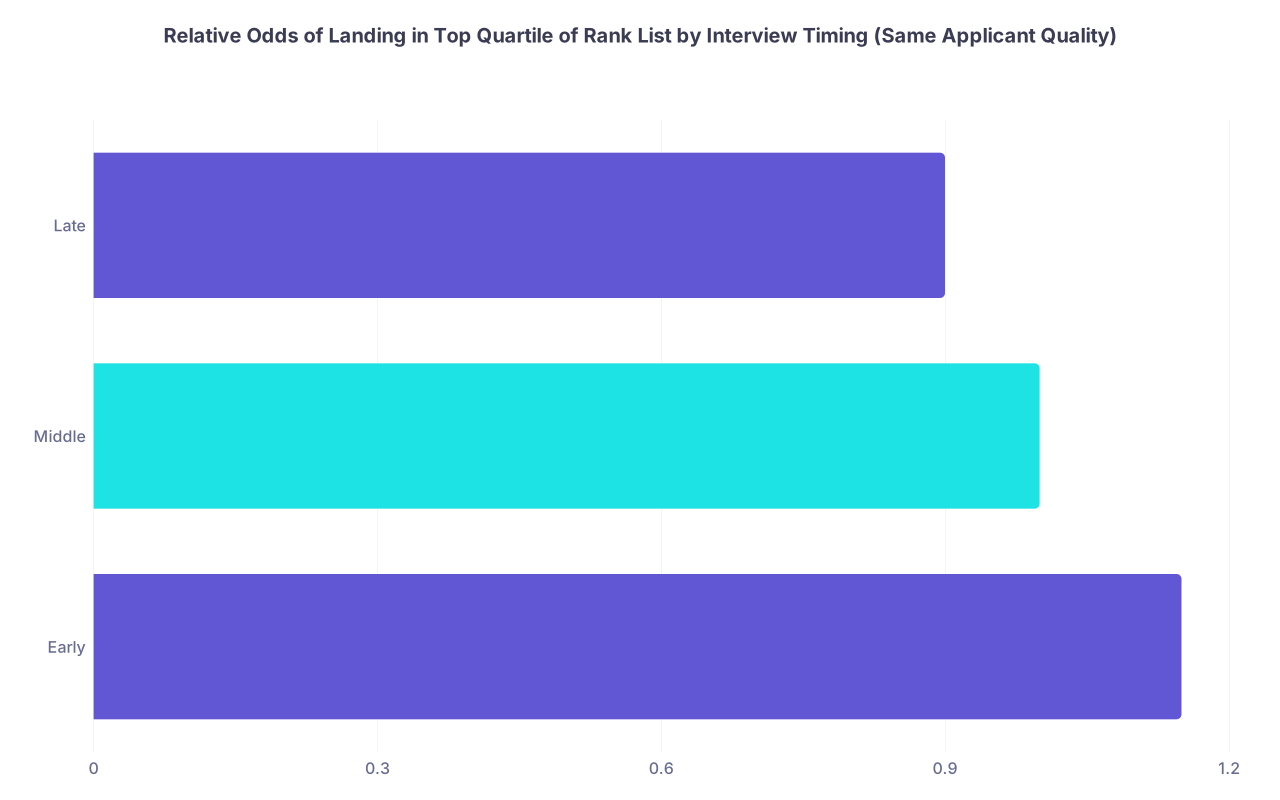
If you had two identical applicants and randomly assigned them to early vs late at the same program, here is a reasonable conceptual model of logits / odds shifts:
| Category | Value |
|---|---|
| Early | 1.15 |
| Middle | 1 |
| Late | 0.9 |
Again: modest. You win or lose mostly on your performance, not your calendar date.
Where Applicants Misinterpret the Data
I have watched this play out every cycle: people obsess over the calendar and ignore their own behavior.
Three recurring myths:
“I got a January date, so they are not serious about me.”
Wrong. Late date = often logistics: faculty availability, your stated conflicts, when they sent the invite. Programs do not waste interview slots on people they never plan to rank.“Early dates are always better; I should cancel late ones.”
Dangerous thinking. Declining a December or January interview at a solid program because “it’s late so they probably won’t rank me high” is a math error. Your expected value from that interview is still positive unless you truly would never attend that program.“If I do not hear from top programs by October, I am out.”
Also flawed. Some programs intentionally stagger invites. Some wait for Step 2 scores or for signals from away rotations. Your personal timeline is not the master variable.
The biggest mistake is treating timing as fate, instead of as just one small parameter in a noisy system.
How Programs Actually Rank You: Weight of Interview vs Everything Else
You care about timing because you think it affects how you are ranked. But the real multi-variable model at most programs looks roughly like this (mentally, not always numerically):
- Pre-interview file strength (scores, grades, LORs, research, school): 40–60%
- Interview performance and perceived fit: 30–50%
- Institutional factors (ties to region, diversity, specific skills, couples match, visa needs): 10–20%
Timing interacts with the interview + fit component via:
- Memory
- Comparison set
- Faculty enthusiasm
However, in many programs the final rank list committee goes back to written notes and standardized evaluation forms. That compresses the effect of recency and timing.
So if your performance is clearly in the top 10–15% on their evaluation scale, the fact that you interviewed in January instead of November might move you from, say, #8 to #11 on their list. That might matter or it might not, depending on program size and fill rates. But it is not a shift from “top” to “disaster.”
Strategy: How You Should Respond to Early vs Late Timing
You cannot fully control timing. You can control interpretation and preparation intensity.
1. Accept every reasonable interview regardless of date
From a probabilistic standpoint, unless:
- You are 100% certain you would never attend that program, and
- You already have more interviews than needed for high match probability in your specialty
…declining based on timing alone is irrational.
For most categorical specialties, the NRMP data show roughly:
- ~10–12 ranked programs → very high match probability for U.S. MDs.
- Fewer interviews = steeper drop in odds.
Each additional interview adds non-trivial incremental probability until that 10–12 range. Timing does not change that curve much. Volume and quality do.
2. Slightly up-weight effort for late-season interviews
If anything, you should treat late interviews as higher stakes, not lower, because:
- Faculty fatigue means you must be clearer, more structured, and more memorable.
- Competition near the top of the list is somewhat “set,” so to break in you must be exceptional, not just adequate.
Practical consequences:
- Tighten your stories. No rambling. Clear narratives around “Why this specialty,” “Why this program,” “Tell me about a challenge.”
- Be explicit about fit. Tie your interests to their clinics, faculty, research, or patient population.
- Use one or two sharp, insight-rich questions for them that show you have done your homework.
You are trying to spike the signal-to-noise ratio in a noisy channel.
Memory, Recency, and How to Hack Them (Ethically)
Human memory is not fair. It does not treat November and January interviews equally.
But you have tools.
Post-interview correspondence
Timing interacts with memory. You can partially reset the clock.
Reasonable steps:
- A prompt thank-you email within 24–48 hours, customized, not generic.
- If you interviewed early, a short update in late season can re-anchor you in their memory. Do not spam; one targeted note is enough.
- If you interviewed late, you inherently benefit from recency, but a crisp “this is why you are my top choice or one of my top choices” (when true) right before rank meetings can help.
Note: some specialties / programs dislike aggressive post-interview games. Use judgment and follow explicit instructions.
Anchor yourself in their mental model
Faculty remember:
- Distinctive stories
- Clearly articulated career goals
- Grounded reasons for fit
They do not remember vague “I like the culture and the people.” They have heard that 50 times.
So your job is to present structured, data-like information about yourself:
- One clear “professional identity” statement (for example, “I want to be a clinician-educator in academic general internal medicine with a focus on health equity and medical education.”)
- Specific experiences that support that.
- Specific reasons why their program is a good platform for that trajectory.
Timing interacts heavily with memorability. Make their recall job easier.
How Interview Timing Plays Out by Competitiveness Level
The impact of timing is not uniform across all specialties and applicant profiles.
Highly competitive specialties (Derm, Ortho, ENT, Plastic Surgery, etc.)
Patterns I have seen:
- Early interview groups are disproportionately filled with top quartile applicants across metrics.
- Programs sometimes “lock in” many of their top slots from the first half of interview season.
- Late-season interviews are often for:
- Applicants they were unsure about initially
- People with improved Step 2 or new publications
- Schedule conflicts
In these fields, the modest timing advantage for early can matter more at the margins, because the difference between #10 and #20 on a rank list can be the difference between matching and not, given smaller class sizes.
Moderately competitive fields (IM, Peds, EM, OB/Gyn at most programs)
The effect size drops:
- Larger class sizes.
- More flexibility in rank order.
- Programs often pull strong candidates from across the season.
Here, your personal performance dwarfs timing. A top-5% interview in January will easily beat a mediocre November one.
Lower-demand programs or regions
In some less competitive regions or smaller community programs:
- They may still be figuring out applicant interest well into mid/late season.
- Strong late applicants can vault straight to the top.
In those cases, late timing can even be an advantage if you are clearly above their usual applicant pool.
Short-Term vs Long-Term Signal: Do Early Interviewees Stay on Top?
Think of this like time-decay modeling.
- Early interviewees: strong primacy effect, but memory decay.
- Mid interviewees: balanced primacy/recency.
- Late interviewees: strong recency, but up against an already formed preference structure.
Programs differ in whether they:
- Re-score everyone at the end from notes (which reduces timing effect), or
- Incrementally update a list and rely on memory/emotion (which increases timing effect).
The trend from faculty I have talked to in the last few cycles: more structure, more standardization. That naturally erodes the influence of timing.
If this trend continues, the practical impact of early vs late interviews will get smaller over the next 5–10 years.
Visualizing the Interview Season Dynamics
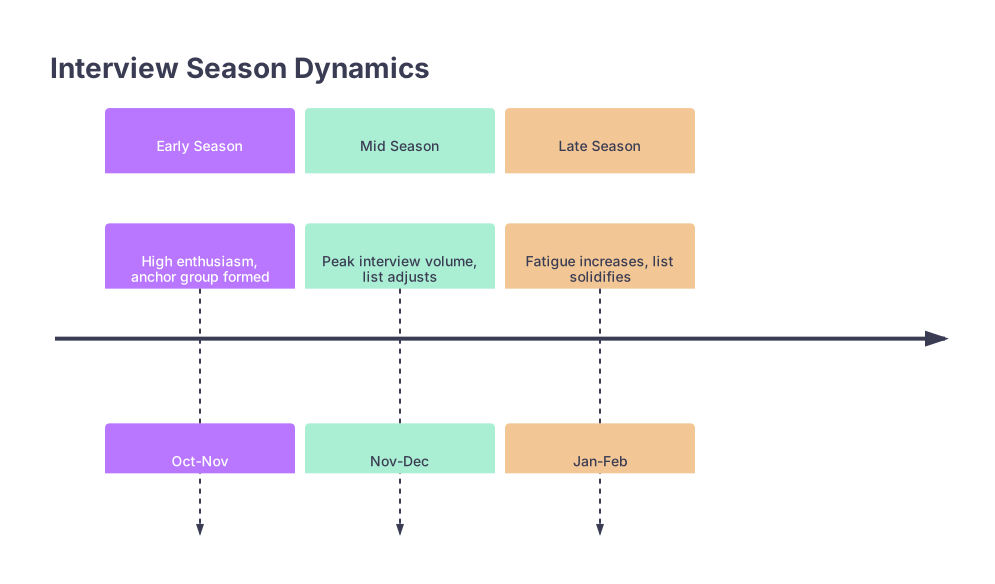
Here is a simple conceptual timeline for how interview volume and rank list rigidity evolve across the season:
| Period | Event |
|---|---|
| Early Season - High enthusiasm, anchor group formed | Oct-Nov |
| Mid Season - Peak interview volume, list adjusts | Nov-Dec |
| Late Season - Fatigue increases, list solidifies | Jan-Feb |
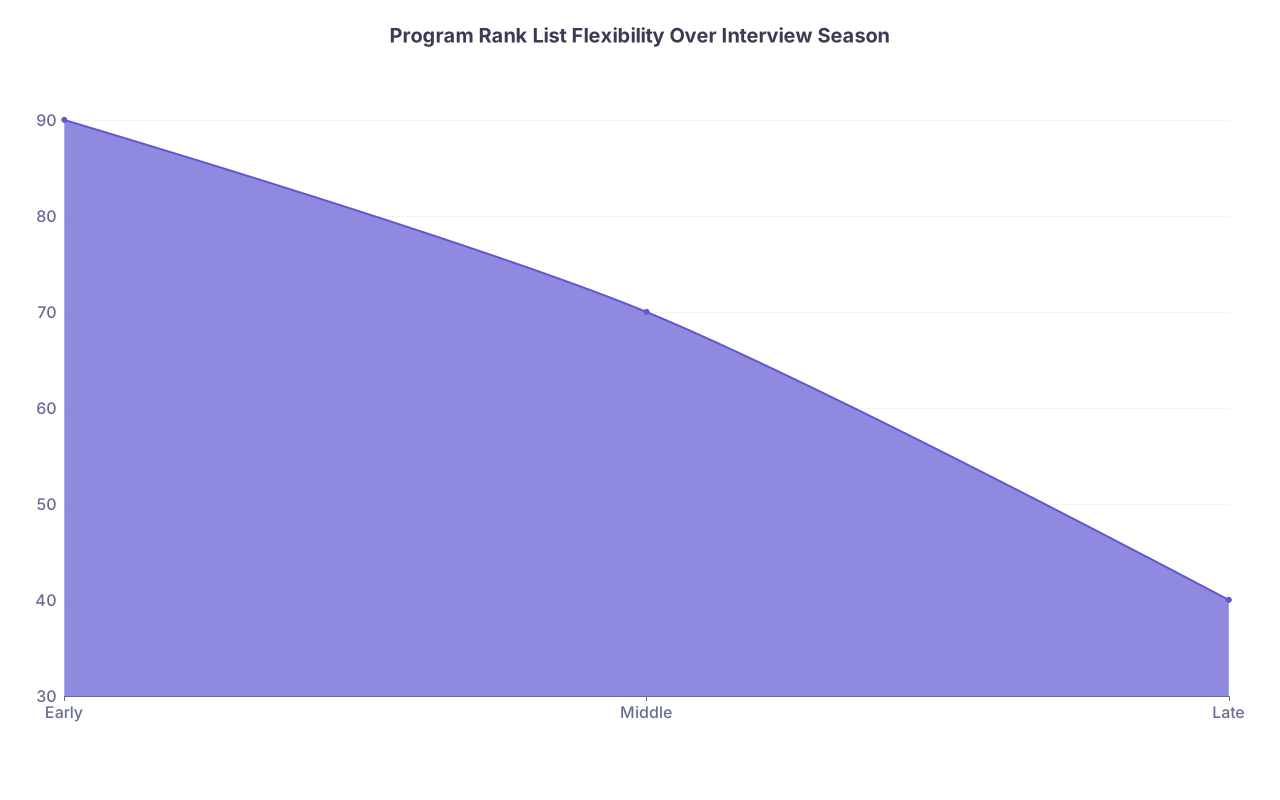
And a rough area chart for mental “flexibility” of programs across time:
| Category | Value |
|---|---|
| Early | 90 |
| Middle | 70 |
| Late | 40 |
Interpreted as: relative ease of significant reordering of the list (not some official metric, just the behavioral pattern).
How To Actually Prepare, Given All This
You are in the “HOW TO PREPARE” category, so let me be very concrete.
Stop catastrophizing your date.
Early = nice, not destiny. Late = slightly uphill, not fatal.Allocate prep intensity by program priority, not by timing.
If Program A is your dream and the interview is in January, you prepare harder for that than an October interview at a backup.Standardize your core answers.
Timing does not change the need for:- A sharp 60–90 second “tell me about yourself”
- A clear, honest “why this specialty”
- 2–3 clinical stories that show resilience, teamwork, growth
Increase specificity with later interviews.
By January, you have lots of reference points. Use them.
“At other places, I saw X; here I specifically like Y and Z because they align better with my goals.”Use post-interview communication strategically.
Anchor yourself, especially if you were early. Remind them you exist before they rank.
The Bottom Line
Three key points, stripped of myth:
Interview timing has a modest effect, not a dominant one. Early interviews correlate with better rank outcomes mostly because stronger applicants are front-loaded, not because the calendar is lucky.
Programs build their rank lists iteratively, but increasing structure is reducing timing bias. Standardized evaluation forms and committee reviews are slowly eroding the primacy/recency advantage.
Your preparation, clarity, and fit signal outweigh the calendar. For any single applicant, executing a top-tier interview in December or January is far more predictive of rank outcome than whether you were seen in the first or last third of the season.