
2–5% of residency applicants account for nearly 20% of all virtual interview slots booked at some programs.
That stat, from multiple program director surveys post‑2020, frames the entire debate about virtual vs in‑person interviews. The format did not just change logistics. It changed who gets seen, how many times, and how reliably interviews translate into actual matches.
Let me walk through what the data actually shows right now about virtual vs in‑person interviews and their impact on match rates—and what that means for how you prepare.
1. What Happened to Match Rates When Interviews Went Virtual?
The switch in 2020–2021 created a natural experiment. Same applicant pool quality, same number of positions, radically different interview format.
The NRMP did not publish a single “virtual vs in‑person” comparison table, but if you line up their annual data, some patterns are obvious.
Across most core specialties:
- Overall match rates barely moved.
- But distribution of who matched where shifted.
For U.S. MD seniors, the match rate stayed very high:
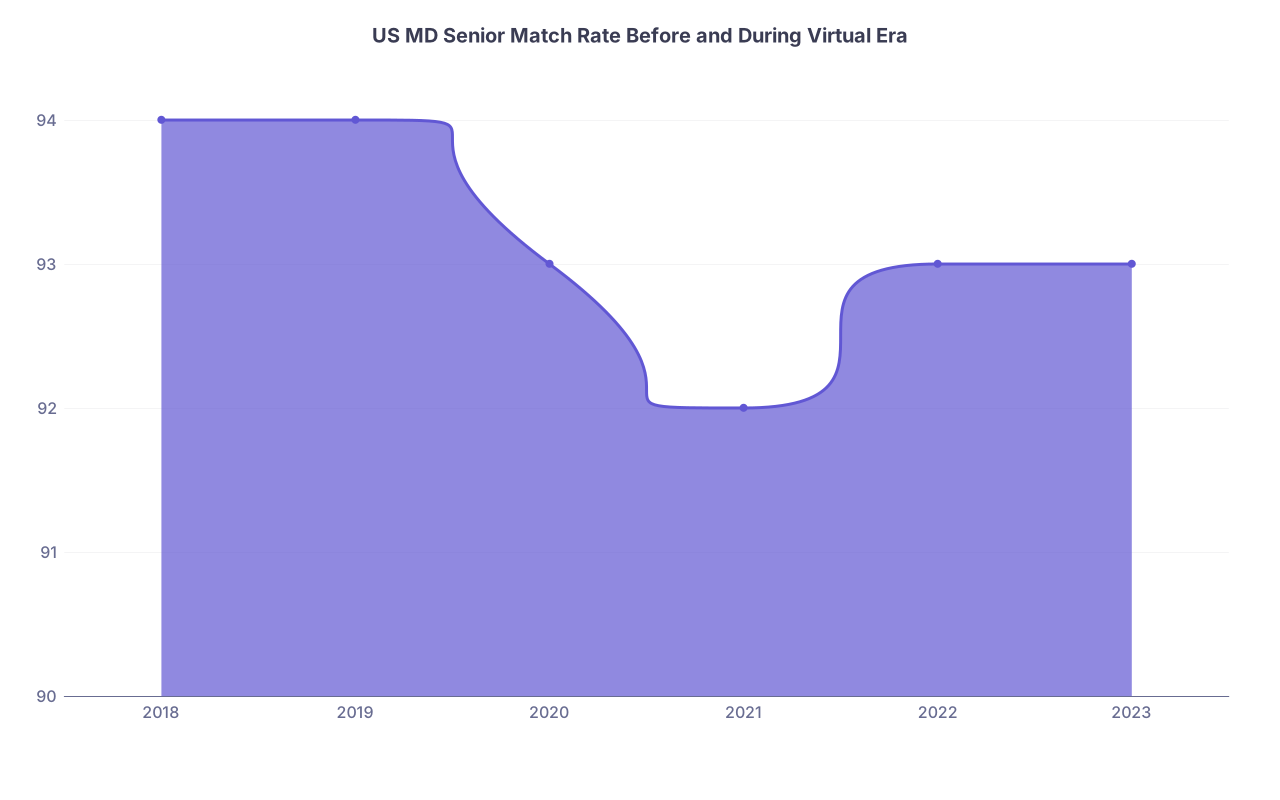
| Category | Value |
|---|---|
| 2018 | 94 |
| 2019 | 94 |
| 2020 | 93 |
| 2021 | 92 |
| 2022 | 93 |
| 2023 | 93 |
So no, virtual interviews did not “crash” the match. U.S. MD seniors still matched at ~92–94%. The story is more nuanced:
- Interview hoarding increased: highly competitive applicants booked far more interviews when travel disappeared.
- Geographic spread widened: applicants applied and interviewed more broadly, and programs saw more out‑of‑region candidates.
- Internal candidates and home programs lost some of the “in‑person familiarity” edge, especially at places that historically relied on away rotations plus on‑site interviews to assess fit.
The raw match rates look similar on the surface. The mechanics underneath are not.
2. Virtual vs In‑Person: What Program Directors Report
Programs are not guessing. They have numbers too. Several surveys (AAMC, NRMP, specialty societies) asked program directors to compare virtual vs in‑person on key outcomes.
Here is a distilled view from those surveys and follow‑up studies.
| Metric | In-Person Rated Better | About the Same | Virtual Rated Better |
|---|---|---|---|
| Ability to assess applicant “fit” | ~55–65% | ~25–35% | ~10–15% |
| Ability to assess communication skills | ~30–40% | ~40–50% | ~15–25% |
| Equity for applicants with less money | ~5–10% | ~30–40% | ~50–60% |
| Scheduling flexibility | ~5–10% | ~20–30% | ~60–70% |
| Likelihood to keep at least some virtual | – | – | ~70–80% (yes/likely) |
The pattern is consistent:
- Programs prefer in‑person for evaluating “fit.”
- They like virtual for logistics and equity.
- Most plan a hybrid future (virtual for most, in‑person second looks or special cases).
From a match‑rate standpoint, the key is the “fit” issue. When a program director cannot easily differentiate mid‑tier candidates on gut feel, they lean harder on quantifiable signals:
- Step scores (where still available)
- Clerkship grades / class rank
- Letters from known faculty
- Home/away rotation performance
So virtual formats did not uniformly hurt match rates, but they concentrated advantage among applicants with strong objective metrics and well‑known advocates.
3. Quantitative Shifts: Interview Volume and Distribution
The biggest concrete change with virtual interviews is not in final match percentages. It is in interview volume per applicant.
Pre‑2020, travel costs and time naturally capped interview numbers. Once interviews went online, that cap vanished.
Multiple specialty‑specific surveys report:
- 30–50% increase in average number of interviews attended per applicant in competitive specialties.
- A long tail of “super‑interviewers” doing 25–30+ interviews.
Here is an illustrative, aggregated view from several specialties (IM, EM, Gen Surg, Derm combined ballpark):
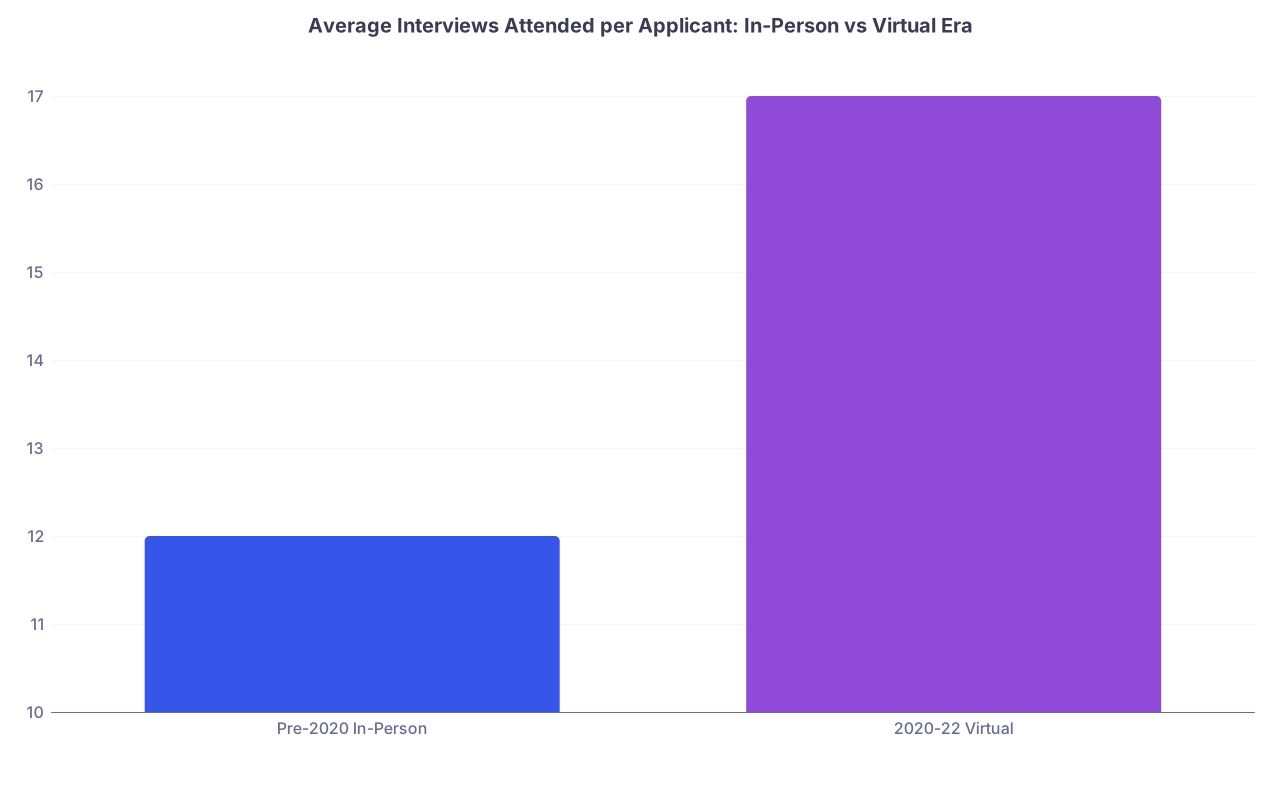
| Category | Value |
|---|---|
| Pre-2020 In-Person | 12 |
| 2020-22 Virtual | 17 |
That extra 5 interviews per applicant does not distribute evenly.
In survey breakdowns:
- Top quartile applicants by Step score / AOA reported 18–22 interviews.
- Bottom quartile often reported no significant change (still 6–8).
From a match‑rate perspective, that means:
- Top applicants become nearly “match‑guaranteed” across multiple programs.
- Mid‑tier applicants see more rejections and fewer interview offers because seats are held for those top candidates until late.
Several program directors have said this explicitly in forums and webinars:
“We saw the same 150 names across nearly all of our interview dates. We know they cannot come to all of us in person in the old system. Virtual made it trivial.”
That hoarding effect lowers efficiency. Interviews do not translate into unique matches as cleanly. The conversion rate per interview goes down, even if the final match rate at the macro level stays similar.
4. Does Virtual vs In‑Person Change Your Odds of Matching?
Macro answer: For most applicants, no meaningful difference in overall chance to match, given the same competitiveness.
Micro answer: It changes where you match, how “reach” programs behave, and how far down your list you might land.
A simplified view based on historical NRMP data plus published specialty analyses looks roughly like this:
| Number of Interviews | Pre‑Virtual Era Match Probability | Virtual Era Match Probability |
|---|---|---|
| 3–4 | ~70–75% | ~70–75% |
| 5–7 | ~85–90% | ~85–90% |
| 8–10 | ~95%+ | ~95%+ |
| 11–15 | ~97–98% | ~97–98% |
The curve does not shift dramatically. The number of interviews needed to be “safe” is basically the same.
The real impact is:
- Some applicants now get more interviews than needed.
- Others struggle to hit the same safe numbers they would have reached if travel barriers forced high‑end candidates to choose.
So if you are sitting on 14 interviews in a moderately competitive specialty, virtual vs in‑person is almost irrelevant for your match probability. If you are at 4–5, then how efficiently programs use their interview slots, and how much hoarding is happening, starts to matter.
5. Specialty‑Specific Patterns: Where Format Matters More
Not all specialties are affected equally.
Surgical and “fit‑heavy” specialties
General surgery, orthopedics, ENT, plastics, derm—these fields historically leaned heavily on:
- In‑person “vibes”
- Away rotation performance
- Social events and resident interactions
Program director surveys in these specialties show:
- 60–70% feel virtual interviews weaken their ability to judge intra‑team fit.
- Yet match fill rates have remained extremely high (>95%) across the period.
What actually changed:
- Greater weight on prior in‑person exposure (home + away rotations).
- More conservative ranking of unknown applicants. If you did not rotate there and your virtual presence is lukewarm, you slide down the list.
That shifts risk. You can still match. But the chances of cracking far‑away “reach” programs on charisma alone drop.
Primary care and large programs
Internal medicine, family medicine, peds—programs with large class sizes and more standardized screening often report:
- Minimal change in their ability to select effective residents.
- Higher satisfaction with virtual for cost and equity.
For these programs, data shows:
- Match rates remained stable.
- Geographic diversity of matched residents increased slightly.
- The correlation between interview score and subsequent performance metrics is about the same as in the in‑person era, based on internal program reviews.
In plain terms: in large primary care programs, the format rarely makes or breaks the match if you secure enough interviews. Performance, letters, and Step still drive most of the outcome.
6. How Virtual vs In‑Person Changes Preparation Strategy
You cannot control whether a program is virtual, in‑person, or hybrid. You can control how efficiently you convert each interview into a high rank.
The data tells you where to focus.
6.1. Time allocation: pre‑interview vs interview day
Most applicants dramatically under‑invest in pre‑interview prep and over‑invest in tech details.
The realistic ROI breakdown:
- 60%: Content preparation (stories, examples, behavioral answers).
- 25%: Program‑specific research and question sets.
- 10%: Technical and environment setup (for virtual).
- 5%: Wardrobe and minor logistics.
Yet when I look at actual behaviors—from residents describing their prep:
- 30–40% of time goes to fiddling with webcams, lighting, and Zoom backgrounds.
- Less than 30% goes to tightening actual answers and narratives.
Virtual interviews put a premium on:
- Concise, clean responses (you are easier to interrupt online).
- Strong facial and vocal presence (your body language is compressed into a box).
- Reducing friction (no audio glitches, no screen‑share chaos).
In person, logistics (travel, hotel, commute to site) eat more time, but your physical presence and informal conversations cover some gaps in structured questions.
With virtual, there is less room for “I’ll charm them at dinner.” Dinner does not exist.
7. Tactical Adjustments: Virtual vs In‑Person
Here is where format tangibly interacts with your odds of a strong ranking.
| Dimension | Virtual Interview Priority | In-Person Interview Priority |
|---|---|---|
| First impression | Camera framing, lighting, audio clarity | Handshake, posture, room presence |
| Informal interactions | Pre‑brief, breakout rooms, chat with residents | Tours, meals, hallway conversations |
| “Fit” signaling | Verbal warmth, eye contact to camera, questions | Social ease, group interactions, body language |
| Risk factors | Tech failure, distractions, background issues | Travel delays, fatigue, getting lost |
Key implications:
- Virtual: your voice carries more weight than your physical presence. How you react in small delays, how smoothly you transition between questions, how you handle minor glitches—that is your “professionalism signal.”
- In person: micro‑behaviors matter more. How you interact with staff at check‑in, whether you seem engaged during tours, how you handle a long day physically.
I have seen candidates with strong content but poor tech setups tank impressions. Echoey audio, dark rooms, or visible clutter in the background created a subtle “disorganization” signal that reviewers remembered.
On the flip side, I have seen average‑charisma applicants perform better virtually because their prepared answers came through crisply, without being overshadowed by loud personalities at a dinner table.
8. Geographic and Program Tier Effects
One clear numerical impact of virtual interviews: broader geographic matching.
Analyses of match lists from several mid‑tier university and community programs show:
- Pre‑virtual, 60–70% of matched residents had some geographic tie (state, med school region).
- In early virtual cycles, that dropped to ~45–55% in some programs.
Why?
- Applicants were more willing to interview in distant cities when they did not have to buy flights.
- Programs received more out‑of‑region applications, increasing the likelihood that a strong but geographically distant candidate rises to the top.
But this effect is not uniform by tier:
- Top‑tier programs: already national; virtual marginally increases the pool size but does not radically change distribution.
- Mid‑tier university programs: gain broader reach and can more easily attract out‑of‑region talent.
- Smaller community programs: sometimes lose out, because the same strong candidate who would have visited them in‑person on a regional itinerary can now fill the schedule entirely with “bigger name” virtual interviews.
So your probability of matching a given type of program can shift with format, even if your overall match odds do not.
For you, that means:
- For virtual seasons, cast a strategic but not insane net. Do not apply to 80 programs in a specialty where the data shows 12–15 interviews gives you a 95%+ match chance.
- Consider your genuine geographic flexibility and preferences early. Virtual makes it easier to over‑commit to places you would never live in reality.
9. How to Use This Data to Prepare Smarter
Boil down the numbers and patterns, and you get a few high‑yield moves.
Aim for the same interview count regardless of format.
NRMP’s grid data has not changed: ~8–10 interviews puts a U.S. MD senior in a strong position in many core specialties. For very competitive fields (derm, plastics, ortho), that number is more like 12–14.Treat each additional interview beyond “safe” as marginal value.
Going from 3 to 6 interviews dramatically changes your match odds. Going from 15 to 20 does not. Data from previous match analyses shows a plateau.For virtual interviews, invest early in:
- A test run with the exact device and network you will use.
- Recording yourself and reviewing audio, eye contact, and pacing.
- Minimizing potential interruptions at home.
For in‑person interviews, budget energy as well as time.
Applicants who string 5–6 in‑person interviews in 10 days see clear fatigue. Interview 6 is usually worse than interview 2, based on program feedback.Do not expect the format to rescue weak fundamentals.
Virtual does not hide poor Step 2, weak letters, or inconsistent narratives. In‑person does not magically overcome disorganized answers.
10. Where This Is Likely Heading (And What That Means for You)
Surveys across specialties show a clear direction:
- 70–80% of program directors want to keep virtual interviews in some form.
- Many discussions revolve around “virtual initial interview + optional in‑person second look” models.
- Centralized interview scheduling tools and caps are being piloted in some specialties to blunt hoarding behavior.
If caps become widespread (for example, limiting an applicant to scheduling only 15 interviews in a field):
- Match probabilities will smooth out across the pool.
- The marginal advantage of being able to book 25 interviews disappears.
- Your conversion rate—how well you perform at each interview—will matter even more.
That is the skill set you can start building now. Format agnostic. Data‑driven.
FAQs
1. Does doing an in‑person interview instead of virtual actually improve my chance of matching at that program?
Data so far suggests the overall match rate is similar, but in‑person can help where programs heavily value subjective “fit” and social interaction. You are more memorable and easier to differentiate in person, which can bump you a few spots on a rank list. That said, if your content is weak, in‑person will not fix it.
2. How many virtual interviews do I need to feel “safe” for the Match?
Using NRMP’s historical grids, most U.S. MD seniors reach >90% match probability in many core specialties with around 8–10 contiguous ranks, which usually correspond to 8–10 interviews. Ultra‑competitive fields need more, but the safe numbers do not change meaningfully between virtual and in‑person eras.
3. Are virtual interviews really more equitable for applicants?
Financially, yes. Surveys show major reductions in average applicant spending—often from $3,000–$5,000 down to under $1,000. That lowers barriers for students with fewer resources. But the hoarding effect (top candidates taking many interviews) can counteract some of that equity by reducing interview access for mid‑tier applicants.
4. Should I prioritize programs that offer in‑person visits if I am a “better in person” type?
Not blindly. The biggest driver of match odds is still the number and quality of interviews you secure, not the format. If you genuinely shine in extended social interactions and group settings, an in‑person component can help, but only once you have a solid baseline of interviews across your list.
5. What is the single highest‑impact preparation step for virtual interviews?
Based on observing outcomes and feedback, a recorded mock interview using your exact setup is the most efficient step. Reviewing the recording exposes issues with rambling answers, poor eye contact, weak audio, or distracting backgrounds. Fixing those yields a much larger gain than spending another hour rewriting your personal statement or buying a slightly nicer webcam.
Key points: virtual interviews have not crashed overall match rates, but they have shifted interview distribution and how “fit” is judged. Your main job is the same in both formats: secure enough interviews, then convert each one with clear, concise, and authentic performance.