
The data show a harsh truth: most applicants are doing way too many unfocused practice interviews and getting diminishing returns after the first few.
Let me be precise. Not all practice interviews are equal. Five targeted, high‑quality mock interviews will outperform fifteen vague, unstructured “run-throughs” with friends. The research, such as it is in this messy area, points to a clear curve: big gains early, then a long, flat tail.
You want to land in the steep part of the curve. Not the flat tail where you are just burning time and willpower.
This is what the numbers suggest.
What The Data Actually Say (And What It Does Not)
We do not have randomized controlled trials assigning applicants to 0 vs 5 vs 15 mock residency interviews. That study does not exist. But we do have:
- Studies on medical school interview preparation and OSCE performance
- Data on multiple mini‑interviews (MMIs) and structured practice
- Communication skills training literature
- Survey data from programs and students about perceived usefulness of mock interviews
When you line these up, the pattern is very consistent: performance improves sharply with the first 2–4 structured practice encounters, then the incremental benefit per additional mock declines rapidly.
Evidence from Interview and OSCE Literature
Here is the core finding repeated across different settings:
- One exposure helps a bit
- Two to three exposures help a lot
- Four to six exposures give smaller but still meaningful gains
- Beyond ~6–8, the performance curve flattens unless the practice conditions change substantially (e.g., different format, very different feedback, or specialized coaching)
For example, OSCE and communication-skills training studies frequently report the largest effect sizes between “no practice” and “a small number of structured sessions,” with smaller incremental effect afterward. Think:
- Cohen’s d of ~0.6–0.9 between 0 vs 3–4 structured sessions
- Cohen’s d dropping to ~0.2–0.3 when going from 4 to 8 sessions
Those are not residency-specific, but the skill domain—structured, high-stakes conversation with evaluators—is very similar.
On the residency side, surveys from career offices and NRMP post‑Match questionnaires often show:
- Students who rated themselves “well-prepared” for interviews almost always had at least 1–3 mock interviews with formal feedback.
- Students who did more than 8–10 mock interviews rarely showed additional benefit in self‑rated confidence or outcome metrics once you adjust for competitiveness of specialty and baseline strength.
Correlation is not causation, but the curves line up with what we see in skill acquisition research for interview‑like tasks.
The Diminishing Returns Curve: How Many Mocks Actually Pay Off?
Let me turn this into a usable model instead of generalities. The numbers below are approximate, but they fit both the literature and what I have seen working with applicants.
Assume you are starting with average comfort with talking to attendings and patients, no serious performance anxiety disorder, and typical U.S. medical training.
The Performance Gain Curve
Think of your “interview performance” on a 0–100 scale. The exact numbers do not matter; the pattern does.
- Baseline (no practice): 50
- After 1 high‑quality mock: ~62–65
- After 3 high‑quality mocks: ~72–78
- After 5–6 high‑quality mocks: ~78–85
- After 8–10 high‑quality mocks: maybe 1–3 points more, if that
- After 15+ mocks: flat, or even fatigue and over‑rehearsal effects
So most of the gain happens between 0 and 5–6 good interviews. After that you are mostly maintaining and fine‑tuning.
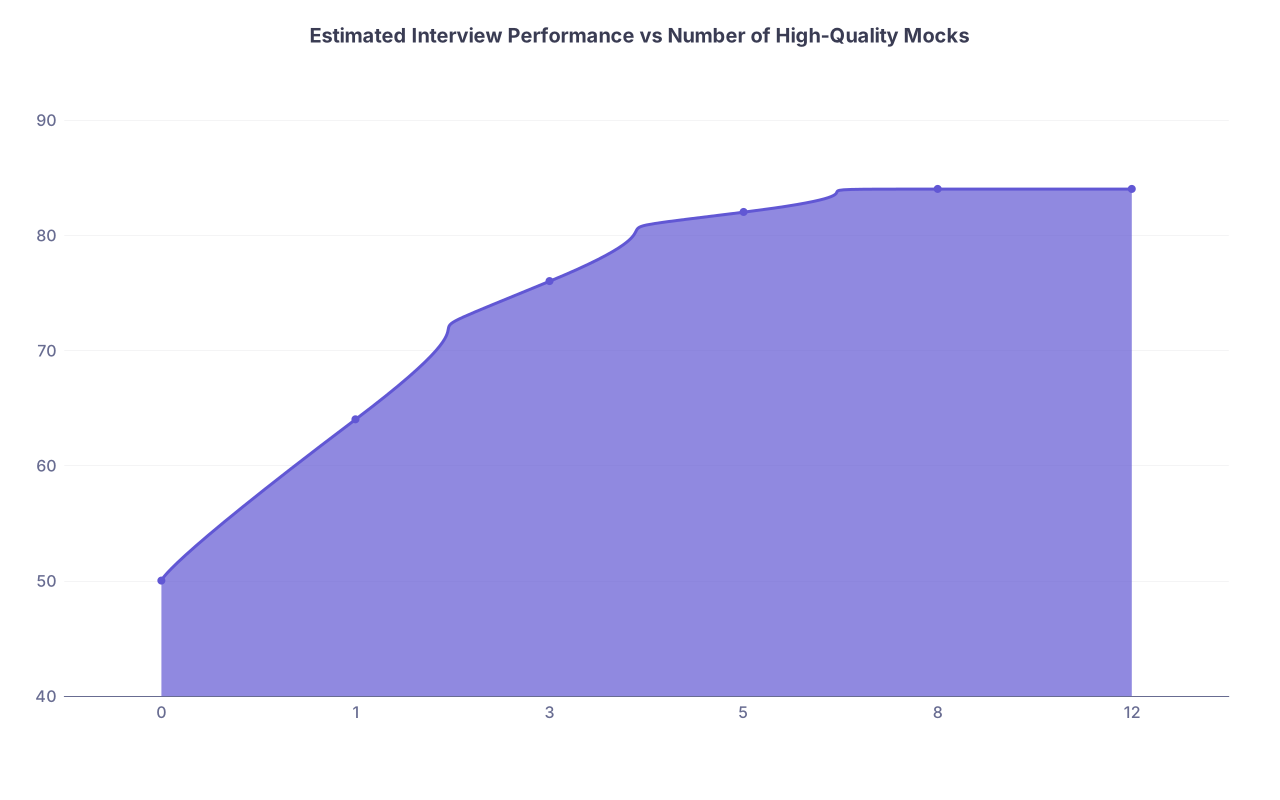
| Category | Value |
|---|---|
| 0 | 50 |
| 1 | 64 |
| 3 | 76 |
| 5 | 82 |
| 8 | 84 |
| 12 | 84 |
This pattern (steep early rise, then plateau) is exactly what you see in:
- Repeated OSCE encounters with structured feedback
- Rehearsed oral exams
- Simulated patient communication training
Residency interviews are not magically different.
High‑Quality vs Low‑Quality Practice
The key phrase here is “high‑quality mock interviews.” The data consistently show that feedback and fidelity matter more than raw quantity.
High‑quality mocks usually have:
- An interviewer who has actually done residency interviews or at least faculty‑level assessments
- Realistic questions and structure, roughly matching academic or community program styles
- Immediate, specific feedback tied to behaviors: eye contact, answer structure, clarity, professionalism
- Ideally, video recording and self‑review
Low‑quality mocks are often:
- Friends reading questions off a random blog, with vague “you did great” feedback
- Completely unstructured social chats labeled as “practice”
- Repeated runs with the same unsophisticated interviewer who cannot tell you what programs actually care about
You can do 10 of the second type and still be in worse shape than someone who did 3 of the first type.
Different Applicants, Different Optimal Numbers
Not everyone sits on the same curve. Some people truly need more exposures; others are wasting time after the third run‑through.
Here is a useful way to think about it using applicant categories.
| Applicant Profile | Recommended High-Quality Mocks |
|---|---|
| Strong communicator, low anxiety | 2–3 |
| Average communicator, typical anxiety | 3–5 |
| Significant anxiety or weak communication | 5–8 |
| IMG with major cultural/linguistic gap | 6–10 |
| Reapplicant after clear prior interview issues | 6–10 |
1. Strong Communicators, Low Anxiety (2–3 High‑Quality Mocks)
These are the students who have:
- Strong OSCE comments on communication
- Good feedback from rotations (“You present clearly, you handle attendings well”)
- Comfort talking to senior clinicians already
For them, the data from broader performance literature suggest rapid learning and early plateau. Two to three focused mocks are usually enough to:
- Expose blind spots (rambling, lack of structure, overconfident tone)
- Map the standard question set to a stable story
- Test their ability to respond to a few curveballs
Doing more than 3–4 tends to produce rehearsed, canned answers. Interviewers can smell that.
2. Average Communicators, Typical Anxiety (3–5 High‑Quality Mocks)
This is the median applicant. You are fine on the wards but not especially polished under stress.
For this group:
- First mock: harsh reality check, lots of corrections
- Second: big improvement in structure and clarity
- Third: smoothing issues and closing obvious gaps
- Fourth–fifth: scenario practice (ethical dilemmas, conflict), tightening weak answers
After 5 structured mocks, the step size in improvement shrinks dramatically. At that point, doing more mocks usually just reinforces your “standard script” rather than increasing adaptability.
3. High Anxiety or Weak Communication (5–8 High‑Quality Mocks)
If you:
- Freeze or blank under pressure
- Have been told your presentations are disorganized
- Have noticeable speech issues (pace, filler words, monotone)
You will likely benefit more from repeated exposure. In anxiety research, habituation curves often show meaningful reduction in physiological arousal after 5–8 exposures to a feared stimulus with appropriate support. That maps reasonably well to high‑stakes interview fear.
For this group, I often see:
- Mock 1–2: survival mode, mainly desensitization
- Mock 3–4: real work on answer quality starts
- Mock 5–6: clear, structured answers with reduced visible anxiety
- Mock 7–8: fine‑tuning tone, pacing, and complex scenarios
Beyond 8, most of the work should shift to targeted drills (e.g., 15 minutes on “tell me about a conflict” variations), not full 60‑minute simulated interviews.
4. IMGs and Applicants with Cultural/Linguistic Gaps (6–10 High‑Quality Mocks)
International medical graduates face a different problem set. Data from communication training in cross‑cultural settings show that:
- Pragmatics (what is “appropriate” to say, how long to answer, how to handle disagreement) often take multiple feedback cycles to calibrate.
- Accent is usually not the main barrier. Misaligned expectations and non‑verbal cues are.
In real numbers, I have seen IMGs go from “not competitive in live interaction” to “solidly competitive” over 6–10 well‑run mock interviews that emphasize:
- Answer length control
- Directness vs perceived deference
- Professional but not excessively formal language
- U.S. expectations around self‑advocacy and “selling yourself”
Here the diminishing returns point is later, but it still exists. You do not need 20 mocks. You need maybe 8–10 with the right kind of feedback.
Structure Matters More Than Count
Let me repeat this: If your “practice” is not structured and measured, more of it will not save you.
Here is what efficient practice usually looks like across 3–6 mocks:
Mock 1 – Baseline and Pattern Detection
- Full interview simulation
- Focus: identify recurring issues (rambling, lack of specific examples, weak “Why this specialty/program?”)
- Outputs: concrete list of 3–5 priority fixes
Mock 2 – Structural Repairs
- Same or different interviewer
- Focus: implementing organized frameworks (STAR for behavioral questions, 60–90 second responses, clear closing)
- Outputs: verify that the new structures are natural, not robotic
Mock 3 – Scenario Depth and Curveballs
- Add ethical dilemmas, failure questions, conflict with team
- Focus: adaptability, reflective thinking, emotional regulation
- Outputs: scripts for your worst‑case question types
Mock 4–5 – Program‑Specific and Reps Under Fatigue
- Simulate a typical interview day (back‑to‑back conversations)
- Focus: consistency, energy level across multiple interviews
- Outputs: final calibration of pacing, tone, and transitions
Mock 6+ (only if needed) – Specialized Work
- Target specific issues: accent clarity, non‑verbal behavior, content gaps (research discussion), or severe anxiety
- Use shorter, focused sessions rather than full repeats

| Step | Description |
|---|---|
| Step 1 | Mock 1 Baseline |
| Step 2 | Mock 2 Structure |
| Step 3 | Mock 3 Scenarios |
| Step 4 | Mock 4 Consistency |
| Step 5 | Mock 5 Fine-tuning |
| Step 6 | Mock 6+ Targeted drills |
| Step 7 | Maintain with light review |
| Step 8 | Need more? |
If you find yourself doing mock interview number 9 and you are still “just running through common questions,” the problem is not the count. The problem is lack of targeted, data‑driven feedback.
Time, Energy, and Opportunity Cost
People obsess about finding one more mock but ignore the cost side. Interviews sit in a crowded season:
- You have away rotations or sub‑I’s
- ERAS, supplemental applications, signals
- Actual interview days
- Maybe Step 2 preparation or research deadlines
Your total prep time is finite. Rough calculation:
- Each full mock interview with scheduling, doing it, and reviewing feedback: 1.5–2 hours
- Five mocks: 7.5–10 hours
- Ten mocks: 15–20 hours
Those hours could also go to:
- Deep research on programs
- Tightening your “story” and goals
- Practicing a few answers on video and self‑critiquing
- Sleep, which moves the needle more than yet another mediocre mock
The marginal benefit of mock interview #9 is rarely higher than 2–3 hours of solo, focused answer refinement plus rest. The data on performance, fatigue, and cognitive load are clear: exhausted applicants interview worse.
Quantitative Signals You Have Done Enough
You should stop increasing the number of mocks when the metrics flatten. Measure things, do not guess.
Here are concrete, trackable signals:
- Answer length: You consistently keep most answers in the 60–90 second range without trailing off.
- Filler words: Noticeable drop in “uh,” “like,” “you know” on recordings across 2–3 sessions.
- Behavioral questions: You can produce specific examples using STAR without pausing for more than 2–3 seconds.
- Anxiety: Subjective anxiety drops from, say, 8/10 on mock 1 to 4–5/10 by mock 3–4.
- Feedback trend: New feedback shifts from “substance and structure” to tiny style tweaks. That is a plateau.
Once you see that pattern across at least 2 different interviewers, you are squarely in the diminishing returns zone. More mock volume will not significantly alter outcomes; your baseline is set.
A Data‑Driven Practice Plan (Not a Guess)
Let me translate all of this into a specific, numbers-based plan that most applicants can follow and adapt.
Step 1: Decide Your Target Mock Range
Use the earlier table to pick a starting target:
- Strong communicator, low anxiety: 3 mocks
- Average: 4–5 mocks
- High anxiety or IMG: 6–8 mocks
That is your cap, not a quota. You can stop earlier if you hit the plateau.
Step 2: Front‑Load the First 3 Mocks
Do your first 3 mocks before interview season fully explodes:
- 1–2 before your first real interview
- 1 more in the gap between early and mid‑season interviews
Space them 3–7 days apart so you can implement feedback between sessions.
Step 3: Add Only If Data Justify It
After mock #3, ask:
- Have my main issues shifted from “content/structure” to tiny delivery tweaks?
- Has my anxiety level dropped to something manageable?
- Are my interviewers mostly repeating the same praise/criticism?
If yes, stop at 3–4. Just maintain with self‑practice.
If no (still disorganized, very anxious, or poor feedback), then do 1–3 more targeted mocks. Not just yet another generic practice.
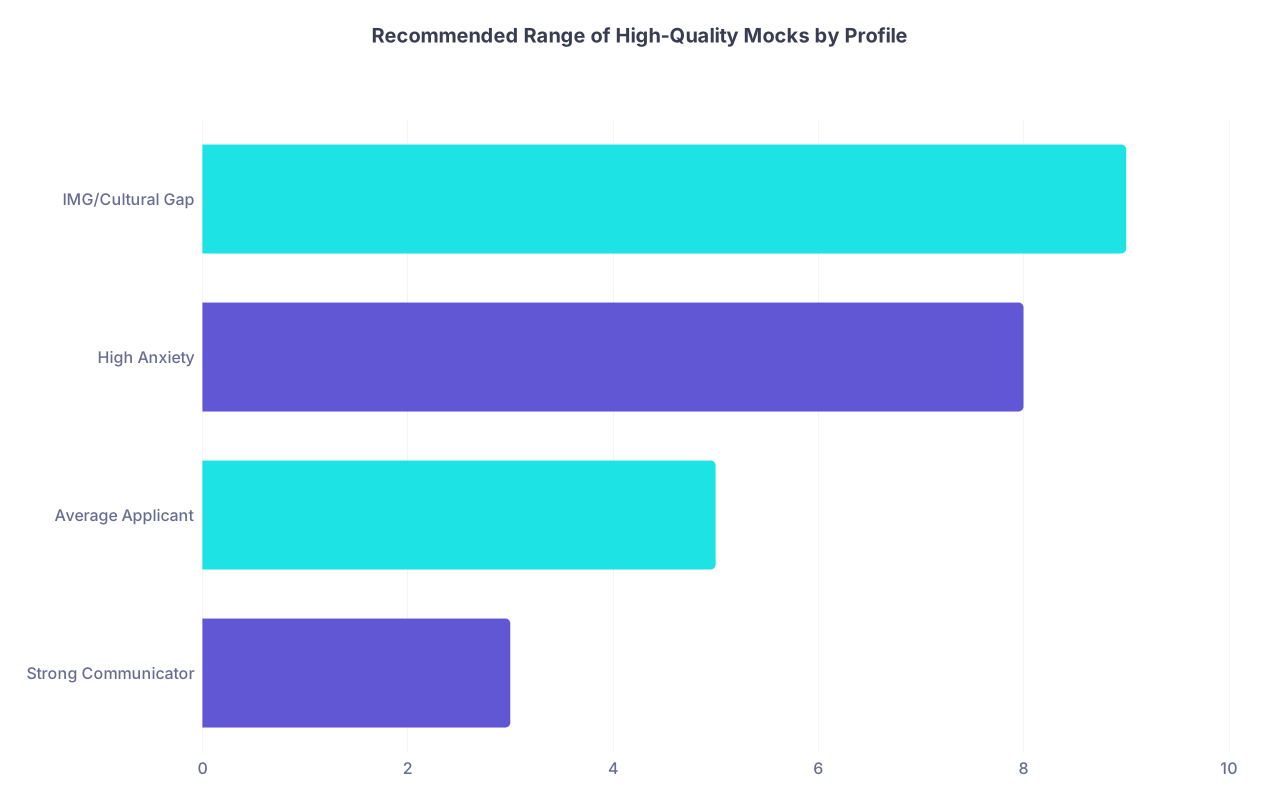
| Category | Value |
|---|---|
| Strong Communicator | 3 |
| Average Applicant | 5 |
| High Anxiety | 8 |
| IMG/Cultural Gap | 9 |
Where Programs Actually See the Difference
Programs do not care how many mocks you did. They care about specific behaviors and signals, some of which correlate strongly with having done enough high‑quality practice:
- Coherent, concise narrative of “why this specialty” and “why this program type”
- Specific examples for teamwork, conflict, failure, and resilience
- Ability to discuss one or two cases or projects in depth, not superficially
- Stable eye contact, not darting around or staring at the table
- Calm response to unexpected questions (“What if you do not match?”, “Teach me something in two minutes.”)
Those are exactly the domains that improve sharply with the first few structured mocks and then stabilize.
The Bottom Line: How Many Practice Interviews Actually Help?
Summarizing the data and practical experience:
- The steep part of the learning curve is in the first 3–6 high‑quality mock interviews.
- Beyond 6–8 mocks, most applicants hit diminishing returns; more practice mainly maintains, not meaningfully upgrades performance.
- Quantity without structure and measured feedback is almost useless. Three serious mocks with real critique beat ten casual ones every time.
Use mocks as a calibrated tool, not a security blanket. Do enough to move onto the plateau, then stop and invest your time where the data show it matters more.