
How to Explain a Downward Trend in Grades or Scores During Interviews
What do you actually say when the program director looks at your transcript, pauses, and says: “Walk me through what happened here”?
If you have a semester of tanked grades, a Step 1 or Step 2 drop, a rough clerkship block, or a bad year that stands out, you already know this: they will notice. The only question is whether you’re ready to handle it like an adult…or you let it derail the conversation.
Let’s go straight at this.
First: Know Exactly What They See (and What They Worry About)
Before you craft any explanation, you need to look at your record the way a PD or faculty interviewer will.
Pull up your transcript, exam score report, and MSPE and ask yourself:
- Where does the downward trend start and stop?
- Is it one exam? One semester? A whole year?
- Is the damage in pre-clinical, clinical, or both?
- Does it overlap with a known life event (illness, family issue, work, etc.)?
- Did things stabilize or improve afterward?
Most interviewers are silently trying to answer 3 questions:
- Is this a pattern or a one-time hit?
- Does this predict future problems with boards or residency performance?
- Has this person taken responsibility and changed anything?
They’re not looking for perfection. They’re looking for risk. If you talk like someone who denies problems, blames everyone else, or has learned nothing, you look risky.
Your goal: show them three things, clearly and quickly:
- You understand what went wrong.
- You’ve already fixed the underlying issue.
- It will not repeat when you’re in their program.
If you do that, the “downward trend” becomes a data point, not a red flag.
Step 1: Categorize Your Situation (Be Specific, Not Vague)
You need to know what type of “downward trend” story you’re telling. These are not all handled the same.
| Scenario Type | What Interviewers Look For |
|---|---|
| One bad semester/year | Clear cause + solid recovery |
| Step/COMLEX score drop | Test-taking fix + board readiness |
| Clinical grades down after strong pre-clinical | Adaptation to wards, feedback use |
| Ongoing slow decline | Insight, interventions, current stability |
| Personal/medical crisis period | Maturity, boundaries, support systems |
Most people fall into one of these:
- One bad pre-clinical semester or year
- Step 1 or Step 2 CK drop or underperformance
- Strong didactics, weaker clinical grades (or vice versa)
- Chronic slow slide over time
- Crisis period (illness, family death, depression, burnout, pregnancy, etc.)
Pick your main category. That dictates your emphasis.
If you’re not sure which one you are, you haven’t looked at your file hard enough. PDs already have.
Step 2: Build a 3-Part Answer (and Stop There)
You do not need a TED Talk. You need a tight, controlled answer that hits three beats:
- Brief context
- What you learned / what you changed
- Evidence that it worked
Think: 60–90 seconds, max.
Here’s the bare-bones structure:
Context (concise, not dramatic)
“During my second-year spring, my grades dropped compared to prior semesters. This coincided with [X].”Ownership + specific changes
“I realized [problem]. I changed [study habits / schedule / support / time management / mental health care].”Outcome + reassurance
“Since then, you can see [upward or stable trend, Step score, later clerkship evaluations]. I’m confident those changes will carry into residency because [short reason].”
Notice what’s missing:
- No 5-minute backstory.
- No blaming faculty, the school, “the system,” or your group members.
- No “I’ve always struggled with tests” with nothing after it.
You’re not on trial. You’re showing professional insight.
Step 3: Script It for Your Exact Situation
Let’s get into actual wording and scenarios. This is where most people screw it up—too much detail or too much vagueness.
Scenario A: One Bad Semester or Year (Pre-Clinical)
What they’re thinking: “Was this immaturity or something serious? Does it get better?”
Wrong way to answer: “I just had a lot going on. The classes were harder, and some personal issues came up. But I got through it.”
That says nothing.
Better way:
“During the spring of MS2, my grades dropped compared to the rest of medical school. I took on too many responsibilities outside of school, including [briefly name 1–2 things: research, family obligations, leadership role], and I overestimated my ability to juggle everything.
That forced me to rethink my priorities and structure. I scaled back [X activity], started using a weekly study plan instead of cramming before exams, and met with our learning specialist to tighten up my approach.
You can see the impact in my clerkship year and Step 2 score, where my performance was back in line with my earlier work. I’m much more deliberate now about protecting time for core responsibilities, which will matter even more in residency.”
Short, clear, accountable. You show cause, intervention, result.
Scenario B: Board Score Drop or Weak Score
Very common. They care about this because it predicts in-training exams and board pass rates.
Let’s say you did fine on Step 1 (pass on first attempt) but had a mediocre or lower Step 2, or your COMLEX Level 2 dipped.
What not to say: “I’m just not a good standardized test taker.”
That makes PDs nervous. They hear: “I will fail your in-service exams.”
Instead:
“On Step 2 CK, my score was lower than I expected and not fully consistent with my clinical evaluations. In hindsight, my approach was too passive and spread out. I relied heavily on reading and not enough on timed, exam-style questions.
Since getting that score back, I’ve been more aggressive about timed practice and dedicated question blocks. For instance, on subsequent NBME practice exams and shelf exams after Step 2, I saw [X-point] improvement and more consistent performance.
Going into residency, I plan to maintain a weekly question schedule tied to our specialty in-training exam, building on the methods that helped me improve after that initial misstep.”
If your score dropped between Step 1 and Step 2 and you do not have later shelf/NBME data, you emphasize the change in process and ongoing plan more.
If you had a Step failure, your response must be even more specific: what changed day-to-day in your study process, how your second attempt score improved, and what feedback you incorporated. No hand-waving.
Scenario C: Grades Dropped When You Hit Clinical Rotations
You crushed pre-clinical, then your early clerkships are “Pass” with some lukewarm comments. Classic.
What they’re thinking: “Can this person function on a team? Are they slow to adapt to the wards?”
Your instinct might be to blame a toxic team, or “subjective grading.” Do not do that.
Try:
“In my early clerkships, my evaluations and grades were lower than what I’d been used to academically. I came in very task-focused and quiet, and I underestimated how much initiative and communication matter on the clinical side.
About midway through the year, I started asking each team explicitly for expectations on day one and checking in weekly about how I could contribute more. I also asked residents directly for feedback on presentations and notes and adjusted in real time.
You can see in my later rotations—especially [name one or two]—that my evaluations improved and comments mention better communication and reliability. That shift is something I’m carrying forward: clarifying expectations early and actively seeking feedback instead of waiting for final grades.”
You’re saying: Yes, I stumbled. Then I got coachable.
Scenario D: Slow, Continued Decline Over Time
This is the toughest one. A gentle slide semester after semester with no strong recovery. PDs see this and think: burnout, poor coping, possible depression, or lack of insight.
You absolutely need to show insight and current stability.
Let’s say your pre-clinical started strong, then each term slightly worse, then clerkships average, then Step 2 just okay.
You might say:
“My performance over the course of medical school shows a gradual decline rather than the consistency I’d hoped for. Looking back, I didn’t recognize early signs of burnout and fatigue. I tried to push through by simply studying more hours instead of studying differently and taking care of myself.
In my clinical years, I finally addressed that with more structure and support. I started working with a therapist, cut back on non-essential commitments, and adopted a more realistic weekly schedule. That stabilized my performance; my later clerkships and sub-internships are more consistent, and I’ve felt more focused and sustainable.
I’ve learned that ignoring early warning signs and just pushing harder doesn’t work. For residency, I’m much more proactive about using resources and guarding time for sleep and recovery so I can perform at a high level long-term.”
If mental health was a clear factor, you can mention it briefly and maturely:
“I was dealing with untreated depression/anxiety, which I’ve since addressed with counseling and, when appropriate, medication under supervision. I’m in a much more stable place now, and you can see that in my more recent performance.”
You don’t need your full psychiatric history. You do need to sound like someone who has insight and a plan.
Scenario E: Personal or Medical Crisis Period
Sometimes the trend lines sync perfectly with something big: a parent dies, you get seriously ill, your partner has cancer, you had a complicated pregnancy. Programs are not heartless. But again—you’re not asking for pity, you’re showing how you handled it.
Example:
“During my third-year fall, my grades and exam performance dipped compared to the rest of my record. That coincided with my father’s unexpected hospitalization and later passing. I tried to maintain my full clinical load while flying back and forth to help my family, and my focus suffered.
I did eventually take some time away, then returned with a clearer plan and better support from my school. Since then, my performance has been more consistent—particularly on my later clerkships and Step 2.
Going forward, I’m more realistic about my limits and about asking for help early rather than trying to manage everything in crisis mode. If something major came up during residency, I would communicate sooner and use institutional support instead of letting performance quietly deteriorate.”
You show humanity, but the center of gravity is on your professional response and current stability, not the tragedy itself.
Step 4: Watch Your Traps – Things That Sink Your Credibility
I’ve seen solid applicants talk themselves into the “no” pile with a bad explanation. The content is less important than the tone.
Avoid these:
Blame-shifting
“That rotation was known to be unfair.”
“Our school had terrible support for Step 1.”
Use sparingly. You can mention structural issues, but if everyone else from your school didn’t crash, this sounds weak.Victim tone without agency
If your story ends with “and then my grades dropped,” and not “so I changed X, Y, Z,” you look passive.Over-sharing or trauma dumping
You’re not in therapy. You’re in an interview. Mention what’s relevant, skip graphic details.Over-defensiveness
If you sound angry at the question—eye roll, long sigh, “Yeah, that’s a long story”—you signal lack of professionalism.“I’ve always…” narratives with no correction
“I’ve always been bad at tests.” → Not acceptable without “so I did ___ and now I’ve improved by ___.”
If you catch yourself justifying instead of explaining, reset. They’re not accusing you. They’re asking: “Can we trust you with patients, exams, and a stressful schedule for three years?”
Show them yes.
Step 5: Practice Out Loud Until It’s Boring
You cannot wing this answer. If you try, you’ll either ramble or sound defensive.
Here’s a simple practice drill that works:
- Write out your answer in full.
- Read it out loud. Time it. Cut anything that sounds whiny, blame-heavy, or too detailed.
- Reduce it to bullet points:
- Context (1–2 lines)
- What changed (2–3 concrete actions)
- Evidence it worked (1–2 data points)
- Practice saying it from bullets with a friend or mentor acting as the interviewer.
- Ask them: “Did I sound defensive? Did I answer the question? Did I talk too long?”
Do this until your delivery feels steady and unemotional. Not robotic—just calm.
You want to be able to answer and then smoothly pivot back to your strengths:
“…so that’s what happened during that semester. Since then my performance has been consistent, and those changes have really helped me on the wards.
Happy to talk more about my sub-I experience in [specialty], which is where I think you see the best reflection of how I’d function as a resident.”
You acknowledge the weak point, then pull them back to the version of you they’re actually hiring.
Step 6: Make Your Application Back Up Your Story
Your words only work if your file doesn’t contradict them.
If you say you “fixed your test-taking,” but your later shelves are the same or worse, that’s a problem. If you say you “prioritized your mental health,” but you’ve stacked 7 leadership roles on your CV last year, that raises questions.
You can’t rewrite your past, but you can:
- Highlight your improvement areas in your personal statement or secondary essays (briefly, not the whole essay).
- Ask letter writers (who know that rough period) to explicitly mention your growth and current reliability.
- Make sure your ERAS experiences section reflects the new you: someone with more focused commitments rather than scattered overcommitment.
Programs notice trends more than single data points. If the curve is now flat or going up, you’re in better shape than you think.
A Few Real Phrases You Can Steal
These snippets work across situations; adapt to your own story:
- “At that time, I didn’t yet have the systems in place to handle [increased workload / clinical responsibilities / personal stress].”
- “Looking back, I waited too long to ask for help and tried to just push through, which was a mistake.”
- “The main change I made was [specific], which you can see reflected in [later exam/rotation].”
- “That experience forced me to confront how I handle stress and led me to build healthier, more sustainable habits.”
- “I’m not proud of that dip, but it was a turning point in how I approach my work.”
Use them as scaffolding. Swap in your details.
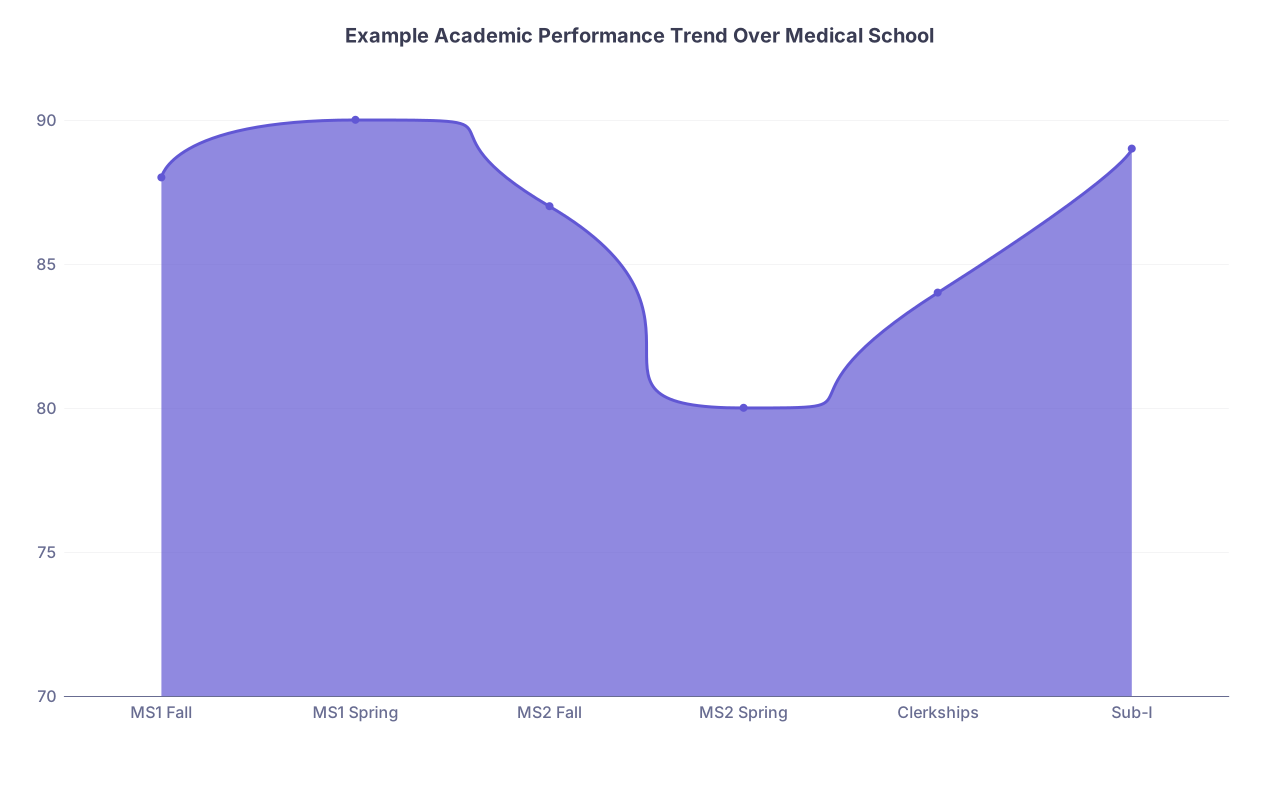
| Category | Value |
|---|---|
| MS1 Fall | 88 |
| MS1 Spring | 90 |
| MS2 Fall | 87 |
| MS2 Spring | 80 |
| Clerkships | 84 |
| Sub-I | 89 |
Step 7: Anticipate Variations of the Question
They won’t always say “Explain your downward trend.” It might sound like:
- “If I asked your dean about the biggest academic concern in your file, what would they say?”
- “Tell me about a time you underperformed academically.”
- “Is there anything in your transcript you wish you could change?”
Same answer. Same structure. Do not panic because the wording is different.
You can start with a bridging line:
“I think the biggest concern some people might have is [that second-year semester / my Step 2 score], which I’m happy to explain.”
Then go into your 3-part answer.
If they follow up with “Are you worried about handling boards/in-service exams?” you respond with a direct reassurance anchored in your new process:
“I’m aware of the importance of in-service exams, especially in this specialty. I’ve already adjusted my approach with [weekly questions, timed blocks, regular review], and I plan to continue that in residency. My recent [shelf/NBME/other] performance reflects those changes, and I’m confident in my ability to meet your program’s expectations.”
Calm. Specific. Confident, not cocky.

| Step | Description |
|---|---|
| Step 1 | Interviewer mentions grades/scores |
| Step 2 | Use 3-part answer |
| Step 3 | Risk rambling/defensiveness |
| Step 4 | Context: brief |
| Step 5 | Changes made |
| Step 6 | Evidence of improvement |
| Step 7 | Pivot to strengths |
| Step 8 | Prepared? |
What This Really Signals About You
Underneath all the logistics, this is what programs are actually testing when they ask about your rough patch:
- Can you look at your own performance honestly?
- Can you adjust when things are not going well?
- Do you wait until the wheels come off, or do you course-correct early?
- Are you going to be one of the residents they’re constantly worried about?
A downward trend, by itself, does not kill your chances. A downward trend plus denial, blame, or zero growth? That does.
Treat this part of your interview prep as seriously as any clinical question. Script it. Practice it. Own it. Then move on.
Because once you’ve shown that you understand your past and have a handle on your future, the conversation can shift back to where it should be: who you are on the wards, how you work on a team, and whether you fit the culture of their program.
Get this piece solid, and you’ve cleared one more obstacle between you and the Match. The next step is making sure the rest of your interview answers show the resident you are now—not the student you were when those grades dipped. And that’s the part you get to work on next.