
The way most people try to prep for residency interviews during a hard sub‑I is unrealistic — and it’s why they feel constantly behind and guilty.
You’re not failing because you “aren’t organized enough.” You’re failing because you’re trying to live two full-time jobs at once: excellent acting intern and full-time applicant. That doesn’t work unless you change the rules of the game.
Here’s how to handle residency interview prep while you’re on a demanding sub‑I, without tanking your rotation or your sanity.
Step 1: Get Extremely Honest About Your Actual Constraints
Forget the fantasy plan where you “just study interview questions at night.”
You’re on a busy sub‑I. So your real life probably looks like this:
- Pre-rounding at 5–6 AM
- Long days, notes, admits, discharges, cross-cover
- Pager going off exactly when you sit down
- Random evening sign-outs, late family meetings
- Brain fried by 8–9 PM
You will not consistently do 2 hours of solid interview prep every night. Stop pretending you will. That lie is what keeps you in permanent low-grade panic.
First, quantify your week.
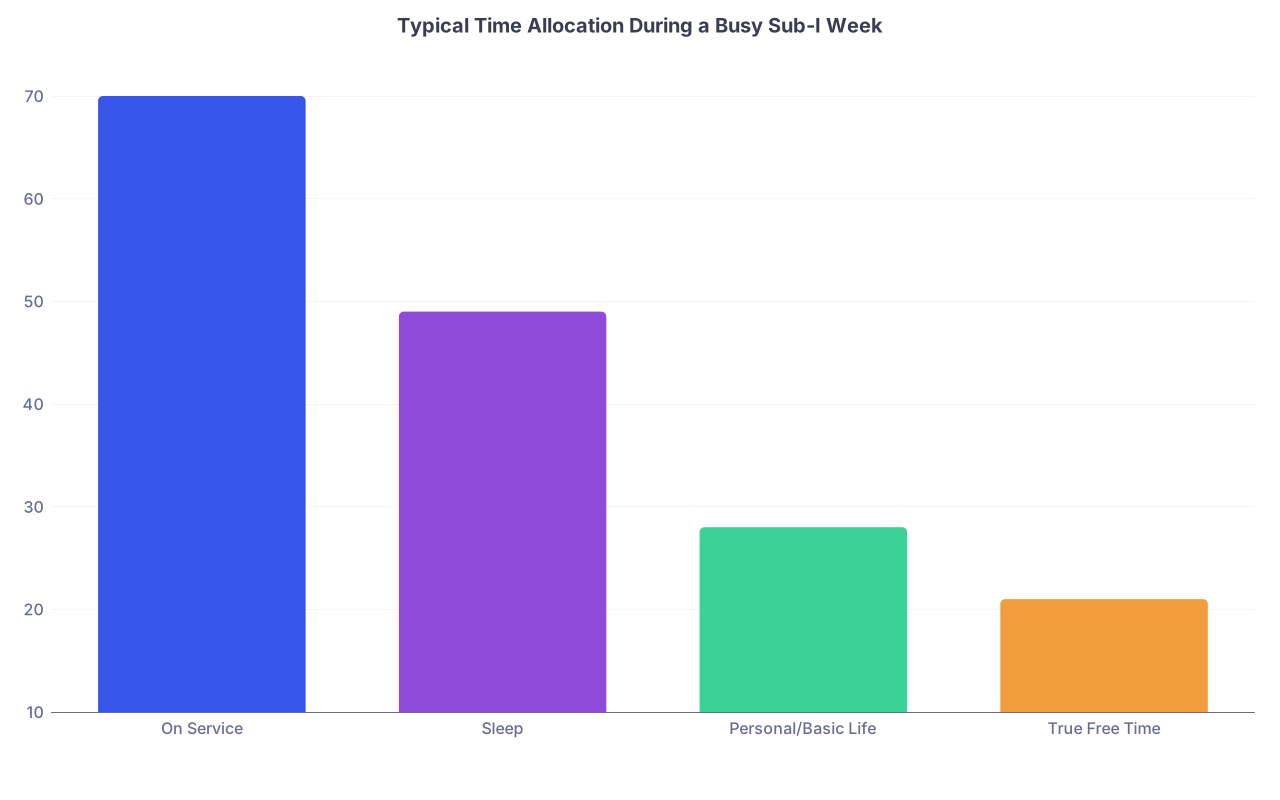
| Category | Value |
|---|---|
| On Service | 70 |
| Sleep | 49 |
| Personal/Basic Life | 28 |
| True Free Time | 21 |
On a 168‑hour week, you realistically have maybe 15–25 hours of truly flexible time. That includes everything: laundry, groceries, staring at the wall.
Your job is to carve out small, protected, non-negotiable chunks for interviews inside that mess.
Here’s the mindset shift:
- Stop thinking “How do I add interview prep?”
- Start thinking “What 20–30 minutes can I protect daily, and what 2–3 slightly larger blocks per week can I defend like a code stroke?”
Write this down as a real schedule. Not vibes. Actual clock times.
Step 2: Build a “Minimum Viable” Interview Prep System
You do not need a 50‑page question bank and a color-coded binder.
You need a lean system that hits the three things programs actually care about:
- Who are you? (story, values, trajectory)
- Why this specialty/field? (and why you’ll be good at it)
- Can you talk like a normal, functional human under pressure?
That’s it.
Your Core Prep Packet (1–2 hours on a day off)
On your next lighter day (post-call, golden weekend, whatever’s least awful), sit down somewhere quiet and build a bare-bones packet. One time investment.
Create a doc with:
A tight 60–90 second personal pitch
- Past: Brief background and how you got here
- Present: What you’re doing now/your current interests
- Future: What you’re aiming for and what you want from residency
Example skeleton:
“I’m a fourth-year at [School] who originally came into med school interested in [X], but during [clinical experience] I found myself increasingly drawn to [specialty] because [specific reason]. On my [rotation/sub‑I], I’ve especially enjoyed [type of patient/workflow]. Long term, I see myself in [academic/community/hybrid] practice with a focus on [interest], and I’m looking for a program that offers [2–3 specific program features].”4–6 “anchor stories” from your clinical life
Each one should hit at least one competency: teamwork, conflict, failure, leadership, ethics, resilience, communication, improvement. Bullet only:- Situation: 1–2 bullets
- Your actions: 2–3 bullets
- Outcome & reflection: 1–2 bullets
A one-page “specialty & program fit” sheet
- Why this specialty (3–4 specific reasons, not clichés)
- Your specific interests in the field
- What kind of training environment you want
- 3–4 strengths you bring to a program
This packet is your source code. During the rotation, you’ll just be pulling from it, not reinventing from scratch.
Step 3: Use Micro-Slots, Not “Study Sessions”
On a demanding sub‑I, your key weapon is micro-prep: 5–15 minute chunks, repeatedly.
Here’s how to break it up:
Daily 15-Minute Drill (Non-Negotiable)
Pick one specific time you can usually protect. Example: 15 minutes after you get home before you sit on the bed. Or 15 minutes after lunch while everyone’s doom-scrolling.
Daily rotation:
- Day 1: Personal pitch out loud 3–4 times, slightly different versions
- Day 2: One anchor story — say it aloud in STAR format (Situation, Task, Action, Result), then sharpen it
- Day 3: “Why this specialty?” + “What are your strengths?” out loud
- Day 4: Quick practice for “weakness/failure/conflict” questions
- Day 5: Review and refine notes from the week
- Day 6–7: Rest or catch up as needed
You’re not writing novels. You’re training your mouth and brain to not freeze.
Do this out loud. Not in your head. The first 3–4 times will feel clumsy. Good. That’s the point.
Step 4: Protect Two Bigger Blocks per Week (30–60 Minutes)
You also need a couple of “heavier lift” periods to simulate actual interviews and refine.
Target: 2 sessions per week, 30–60 minutes each. That’s it.
Use them for:
One full mock interview (20–30 minutes) with:
- Friend, partner, co‑student, resident who likes you, or
- Just your phone’s video camera + list of common questions
Reviewing video or feedback and tightening:
- Rambling answers
- Overly negative self-talk
- Weak “why our program” answers
If you absolutely cannot find two blocks, you have to take them from somewhere:
- One less social event this week
- 30 fewer minutes scrolling in bed
- Ask co‑student to swap a pre-round day so you get one morning that’s slightly less brutal
Is that fun? No. But this is a 2–3 month crunch period, not your new permanent lifestyle.
Step 5: Learn to Say “I Have an Interview” Like an Adult Professional
Stop whispering about interviews like they’re a crime. Residents and attendings know you’re applying. Many of them like helping.
But timing and tone matter.
When & How to Tell Your Team
Tell your senior/resident early in the rotation, once you’ve shown you’re competent.
Something like:
“I wanted to give you a heads up — I’m applying in [specialty] this year. I’ll likely have a few residency interviews during this rotation. I’ll do my best to cluster them and minimize disruptions. What’s your preference on how I handle scheduling and letting you know?”
This does three things:
- Signals professionalism
- Shows you care about the team
- Invites them to collaborate instead of react
Then:
- As soon as you get an interview invite with a fixed date, tell your senior. Not the day before.
- If it’s virtual and you might be able to do part of the day, ask:
“Would you rather I take the whole day as off-service, or is there value in me coming for pre-rounds/rounds then leaving?”
Most teams respond well if you’re early, clear, and not constantly asking for last-minute “emergencies.”
Step 6: Handling Interview Days Without Burning Bridges
Here’s the messy part: You’re on service, but you need to disappear for a day. Or half-day.
Your priorities, in order:
- Patient safety / coverage
- Not screwing your co‑student or intern
- Protecting your professional reputation
- Maximizing interview performance
Notice “being at every minute of the rotation” isn’t actually number 1–3.
Before the Interview Day
The day before:
- Finish all your notes. Do not leave half-done charts for someone else.
- Pre-communicate any anticipated issues:
“Mr. X is borderline for discharge; I’ve prepped everything, but can someone confirm once PT sees him?” - Confirm with your senior how they want it documented:
- Epic schedule changed to “off-ward”
- Email to clerkship coordinator / chief
- Ask if there are ways to help async:
- “I’m happy to call families before or after the day if that’s helpful.”
During a Virtual Interview Day
Common mistake: Trying to pre-round, then rushing into a full interview day already fried. You come off flat and exhausted.
If you must come in briefly:
- Do pre-rounds only if it doesn’t wreck you
- Hard stop and leave in time to commute, eat, and mentally reset
- No “I’ll just stay for noon conference” — you won’t leave on time
If you can be entirely off:
- Treat the interview like your sole job that day
- No charting, no pagers, no “I’ll log in quickly between sessions”
Step 7: Do Smart, Minimal Program Research
You don’t have weekends to deep-dive every single faculty member’s PubMed page. You also don’t need to.
For each program, spend 15–20 minutes max on:
- Program website:
- Size, structure, obvious strengths (community vs quaternary referral, patient population, call structure)
- Location basics:
- Something non-generic about the city/region that actually matters to you
- 2–3 reasons this program might fit you:
- “Strong exposure to X population”
- “Track/ pathway in Y”
- “Heavy autonomy vs more structured supervision” based on what you’ve seen online
Put this in a simple one-page template you can quickly scan the morning of:
| Field | Example Entry |
|---|---|
| Program Name | University Hospital IM |
| Program Type | Large academic, county + VA |
| 2–3 Strengths | Strong ICU, underserved, teaching focus |
| Why It Fits Me | I like high acuity & med-ed |
| Questions to Ask | Resident autonomy, fellowship support |
You’re not trying to become a program historian. You’re trying to sound like you cared enough to learn the basics and can connect your goals to what they actually offer.
Step 8: Practice Under “Sub‑I Brain” Conditions
You won’t be bright-eyed and fresh for most real interviews. You’ll be post-call, or pre-call, or mid-rotation fried.
So occasionally, practice tired.
Once a week, do this:
- After a long day, set a 20-minute timer
- Stand up or sit at a desk (no bed)
- Rapid-fire answer:
- “Tell me about yourself”
- “Why this specialty?”
- “Tell me about a difficult patient interaction”
- “What’s a weakness you’re working on?”
You’ll sound worse than your “ideal.” Perfect. That’s closer to reality.
Then ask yourself:
- Where did I ramble?
- Where did I sound defensive or apologetic?
- Where did I feel like I was just reciting a script?
Adjust your anchor stories and phrasing so they’re simple enough that even Tired-You can pull them off.
Step 9: Don’t Let the Sub‑I Eat Your Narrative
One of the ugly things that happens: you get so lost in surviving the rotation that you forget to collect the best material from it.
Your sub‑I is actually gold for interview stories — if you capture it.
Once or twice a week, take 5 minutes and jot down:
- A patient you learned a lot from
- A moment you advocated for someone
- A time you messed up (small but real) and what you changed
- A system problem you noticed and tried to fix, even in a tiny way
These become:
- “Tell me about a time you disagreed with your senior”
- “Describe a challenging patient or family interaction”
- “When did you feel overwhelmed and how did you handle it?”
Do not leave this to memory. You will forget half of it by next week.
Step 10: Protect Your Evaluation Without Being a Martyr
Here’s the tension: you’re on a high-stakes sub‑I that may produce letters and grades, and you keep stepping away for interviews.
The way you thread that needle:
When you’re on service, be fully on.
- Show up early
- Volunteer for unsexy tasks
- Own your patients
- Close the loop with the team, nurses, consults
When you’re off for interviews, be cleanly off.
- Don’t try to “half be there” by texting for updates
- Do not chart or place orders from an interview day
- Instead, come back the next day and follow up: “I know I was gone yesterday — how did Mr. X do after we changed his regimen? Anything you’d want me to do differently next time I hand off before a day away?”
That last question signals maturity, not absence of commitment.
If you’re worried about how interview time will affect your eval, say this directly about halfway through the rotation to your senior or attending:
“I really value this rotation, and I know I’ve been away for some interviews. I’d appreciate any feedback on how I’m doing when I am here, and anything I can focus on in the time remaining.”
You’re reminding them to judge you on performance, not attendance alone.
Sample One-Week “Sub‑I + Interview Prep” Plan
Let’s make this concrete.
Assume:
- 70–80 hour week
- One interview Thursday (full day, virtual)
- One golden half-day Sunday

| Step | Description |
|---|---|
| Step 1 | Sunday |
| Step 2 | Build/Review Core Packet 60 min |
| Step 3 | Light Program Research 20 min |
| Step 4 | Mon-Wed Daily 15-min Drills |
| Step 5 | Wed Evening 30-min Mock Interview |
| Step 6 | Thu Interview Day - No Clinical Work |
| Step 7 | Fri-Sat Daily 15-min Drills |
Add in 5–10 minute “story capture” twice during the week. That’s it. That’s enough.
Manage the Psychological Garbage
The worst part of this phase isn’t time. It’s guilt.
- Guilt when you’re on the ward and not prepping
- Guilt when you’re prepping and not reading on your patients
- Guilt when you’re off for an interview and your co‑student is slammed
You can’t eliminate that. But you can contain it.
Three rules:
When you’re at the hospital, be at the hospital. No scrolling programs or Reddit during downtime “because it’s residency stuff.” If you’re free, help with discharges, notes, or reading about your patients.
When you’re in your daily 15-minute prep window, be in that window. No email, no texts. Short, intense, focused.
When you’re off for an interview, be in the interview. Not checking your EMR. Not feeling the need to prove you’re charting between breaks.
You’re not going to feel completely balanced. But you can decide which voice you’re listening to in each context.
Quick Reality Check: This Is Temporary
The combo of a brutal sub‑I and residency interviews feels endless when you’re inside it. It’s not.
You have a finite number of weeks where this overlap is insane. Then it eases.
So don’t build a system for a year. Build a system to survive 8–12 weeks well enough that:
- You don’t burn bridges
- You show up decently prepared to interviews
- You don’t completely wreck your health
After that, you can exhale.
FAQs
1. What if my sub‑I is malignant and not supportive of interviews?
You have to be more strategic and more documented.
- Notify the clerkship director and coordinator early that you’re in interview season. Get their guidance in writing about time away.
- Loop them in if a team is being unreasonable (“no days off for interviews”) — most schools have explicit policies.
- On the ground, minimize disruption by clustering interviews and giving maximal notice.
- Do your absolute best when present; malignant places often still respect obvious hustle.
If it becomes truly hostile, document specific incidents and talk to your dean’s office. You are allowed to apply to residency. Full stop.
2. How many mock interviews do I really need if I’m on a killer rotation?
If you’ve done:
- 1–2 full mocks with a human
- 2–3 self-recorded sessions with video
- Consistent 15-minute daily drills for a couple weeks
You’re fine. More than that is nice but not essential. Depth of practice beats volume — repeatedly working your pitch and stories until they’re natural is better than doing 10 mediocre mock sessions.
3. Should I ever decline interview invites to protect my sub‑I performance?
Sometimes, yes. If:
- The program is a clear bottom-tier backup you’d never actually attend, and
- You’re already overloaded with interviews and a critical sub‑I
Then declining can be rational. But be honest with yourself — “I don’t feel like going” is not the same as “this does not fit my goals and I have adequate options already.”
4. How do I handle back-to-back interview days during a heavy week?
Simplify aggressively:
- Batch program research: 15–20 minutes per program the weekend before
- Use one evening earlier in the week for a single longer mock, then just short daily drills
- Protect your sleep more than your reading — a tired, sloppy interview can hurt you more than not knowing a niche program detail
- Coordinate early with your team so those 2–3 days are fully off-service rather than constantly negotiating day by day
Now, do one concrete thing: open your calendar for the next 7 days and block a single 15-minute daily window for interview prep, plus two 30–60 minute blocks. Treat them like real obligations — as hard a commitment as pre-rounds or sign-out. Then build the rest around that.